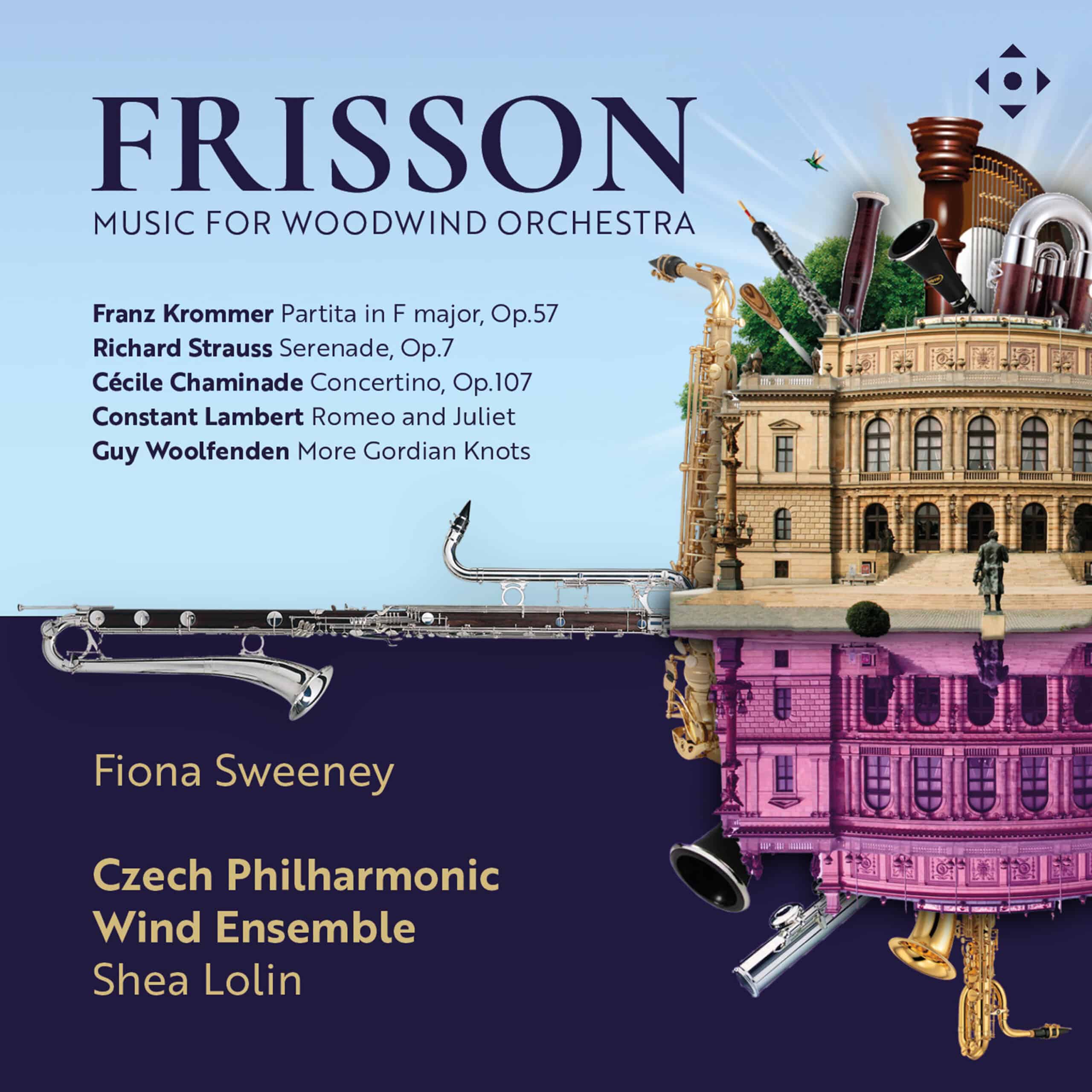
Frisson is the creation of conductor and arranger Shea Lolin. In his introductory comments to the new Divine Art CD release, Lolin discusses the history of Harmoniemusik, ensemble works popular in the late 18th and early 19th centuries that feature horns, bassoons, and various treble-clef instruments. The Franz Krommer Octet-Partita, op. 57 (1807) (two oboes, two clarinets, two bassoons, contrabassoon, two horns) and the Strauss Serenade (1881) (two flutes, two oboes, two clarinets, two bassoons, contrabassoon, four horns) are works in the Harmoniemusik tradition. Lolin continues: “My aim is to showcase the woodwind orchestra as a contemporary evolution of Harmoniemusik, challenging the misconception that it is merely a scaled-down version of a full wind orchestra.” The Krommer and Strauss (and indeed all the works on Frisson) are heard with a full complement of wind orchestra instruments (including saxophones), ranging from piccolo to contrabassoon. To be sure, the Krommer Octet-Partita and Strauss Serenade as arranged by Lolin emerge with greater richness and variety of sound, not to mention increased dynamic range. One may certainly argue that what we hear on Frisson is not what Krommer and Strauss intended. But as someone who has no objection, and indeed enjoys, Stokowski’s Bach orchestrations, and Mahler’s retouchings of Beethoven and Schumann Symphonies (to name a few examples), I’m in no position to complain. That is especially the case given Lolin’s keen ear for woodwind sonorities. Lolin’s tasteful arrangements, as realized by the Czech Philharmonic Wind Ensemble’s (CPWE) crisp execution and flawless blending of the various instruments, produce an immensely pleasurable experience.
The remainder of Lolin’s arrangements are of orchestral works. Cécile Chaminade’s Concertino (1902) for flute and orchestra receives a masterful performance by soloist Fiona Sweeney. The flutist’s beautiful tone and virtuoso realization of Chaminade’s challenging score are a delight. Constant Lambert’s Romeo and Juliet (1926) was one of only two works by British composers to be performed by Sergei Diaghilev’s Ballets Russes (Lord Berners authored the other ballet). On this recording, Lolin and the Czech Philharmonic Wind Ensemble perform a sequence of excerpts recommended by the composer: “Sinfonia: Romeo and Juliet meet at the ball”; “Siciliana: The professor teaches a pas de deux”; “Sonatina: The lovers are separated”; “Adagietto: The death of Juliet”; “Finale: The curtain falls.” Lambert’s sprightly Neoclassical orchestral score prominently features the winds. It fares well in Lolin’s arrangement that displays a light touch throughout. In 1995, Guy Woolfenden composed a work inspired by Henry Purcell’s incidental music for the play The Gordion Knot Unty’d. Gordian Knots (1995) began as a piece for clarinet choir. In 2010, Woolfenden created the woodwind orchestra arrangement, retitled More Gordion Knots. The three brief movements—Air, Chaconne, and Jig—feature, like Lambert’s Romeo and Juliet, a Neoclassical take on music with a foundation in English melody and dance. Woolfenden’s colorful scoring complements the music to perfection.
The winds of the Czech Philharmonic have long been one of the cornerstones of the ensemble’s greatness and distinctive sonic profile. The CPWE plays with distinction throughout the recording, which boasts superb, detailed sound. Colin Clarke gave this recording a warm recommendation in the Mar/Apr 2026 Fanfare (49:4). I second his opinion with enthusiasm.