Catalogue Connection: 20211

  • Violetta Fialko prizewinner recital DBU 20221 – review from Audiophile Audition

    Ukrainian pianist Violetta Fialko (b. 1997) makes her recording debut with this recital, taped in January 2022. A student of Alfonso Soldano, Fialko took First Prize at the Ciccolini Competition, 2021. Despite the open hostilities between her native land and Russia, she selects here a colorful array of solo keyboard works that illuminate her capacity for realizing distinct, musical personalities within a defined idiom.

    Fialko opens with Anatoly Liadov’s 1876 set of miniatures he labels Biryul’ki, the equivalent of pick-up-sticks, the children’s game that involves releasing a handful of thin sticks into a pile, from which one uses a colored stick to remove individual sticks from the pile without disturbing any of the other pieces. The assortment may pre-figure Prokofiev’s notion of Fugitive Visions in their spiky brevity, their delicate, songful character that demands a light touch and a sense of contrived naivete. Fialko then adds a touching Prelude in B Minor whose rainy-day sentiment seems a cross between Brahms and Rachmaninoff. 

    The music of Nikolai Medtner (1880-1951) received more attention in that generation of pianists like Benno Moiseiwitsch and Sviatoslav Richter, who relished the wry, romantic contours and self-indulgent modalities of the composer, himself a fine advocate of his keyboard works. Medtner’s idiosyncratic oeuvre has enjoyed a renaissance of late. The 1918-1920 Sonata Reminiscenza in A Minor unfolds as one movement, a tearful farewell to his beloved homeland, then in the throes of the Revolution and its immediate aftermath. The piece has breadth and various shades of mood, alternately delicate and impulsive, though its introspective moments hold us in thrall. A bravura piece in its own way, the knotty task of holding its disparate sentiments together has had good results from Evgeny Kissin and Boris Berezovsky, and now, Violetta Fialko, who obviously cherishes its color possibilities. 

    The animated spirit of Sergei Prokofiev shifts the recital away from nostalgia to a brisk fervor of grand ballet, with the composer’s arrangement of his music for Shakespeare’s Romeo and Juliet, Op. 64, whose production in the mid-1930s by the Bolshoi had been cancelled for political reasons. Prokofiev’s keyboard arrangement of ten pieces preserves much of the relevant action in the form of a series of toccatas, virtuoso showpieces for the performer. The dances capture the folk elements – often in staccato figures – that pervade the city of Verona and its warring clans. The fatal passion that emerges has some of the most ardent, lyrically compelling tropes in music. The various character sketches, of Juliet, Mercutio, Friar Laurence, and Romeo, in his parting scene, emanate wit, youthful energy, and the inevitable tragedy that besets the eponymous lovers. Fialko’s rendition of “Juliet as a young girl” has graceful exuberance and that mysterious touch of mature passion that will prove her undoing. Fialko’s pungent reading of “Romeo and Mercutio Masked” revived my earliest recollection of this music, as rendered by the New York Philharmonic under Dimitri Mitropoulos. The gravitas in “The Montagues and the Capulets” has the dire power of Mussorgsky in its bell tones and shattering, passing dissonances. The most extended scene, of “Romeo and Juliet before Parting,” had to compete with my personal favorite recording, from Evgeny Mogilevsky, which Fialko accomplishes with her own sympathy for the uncanny, tragic poetry of this classic score.

    Filako concludes with music by the Russian mystic and extreme solipsist, Alexander Scriabin (1872-1915), whose 1903 Fourth Sonata throbs with the composer’s yearning for divine light. In two movements, Andante and Prestissimo volando, the music means to capture a text of aspirations to seize a distant star, embodied in a pattern of falling sixth and rising scale. The key center in F# remains tangible, but the chromatic motion sets the piece, especially in the deliciously delirious second movement, in its own universe. The three-hand effects, traceable to Thalberg, emerge with resilient force, especially as Scriabin borrows layered effects from the third of Chopin’s ballades. The result from Fialko compounds passion, exoticism, and that touch of erotic madness that defines the Scriabin experience. A most auspicious debut recital, this.
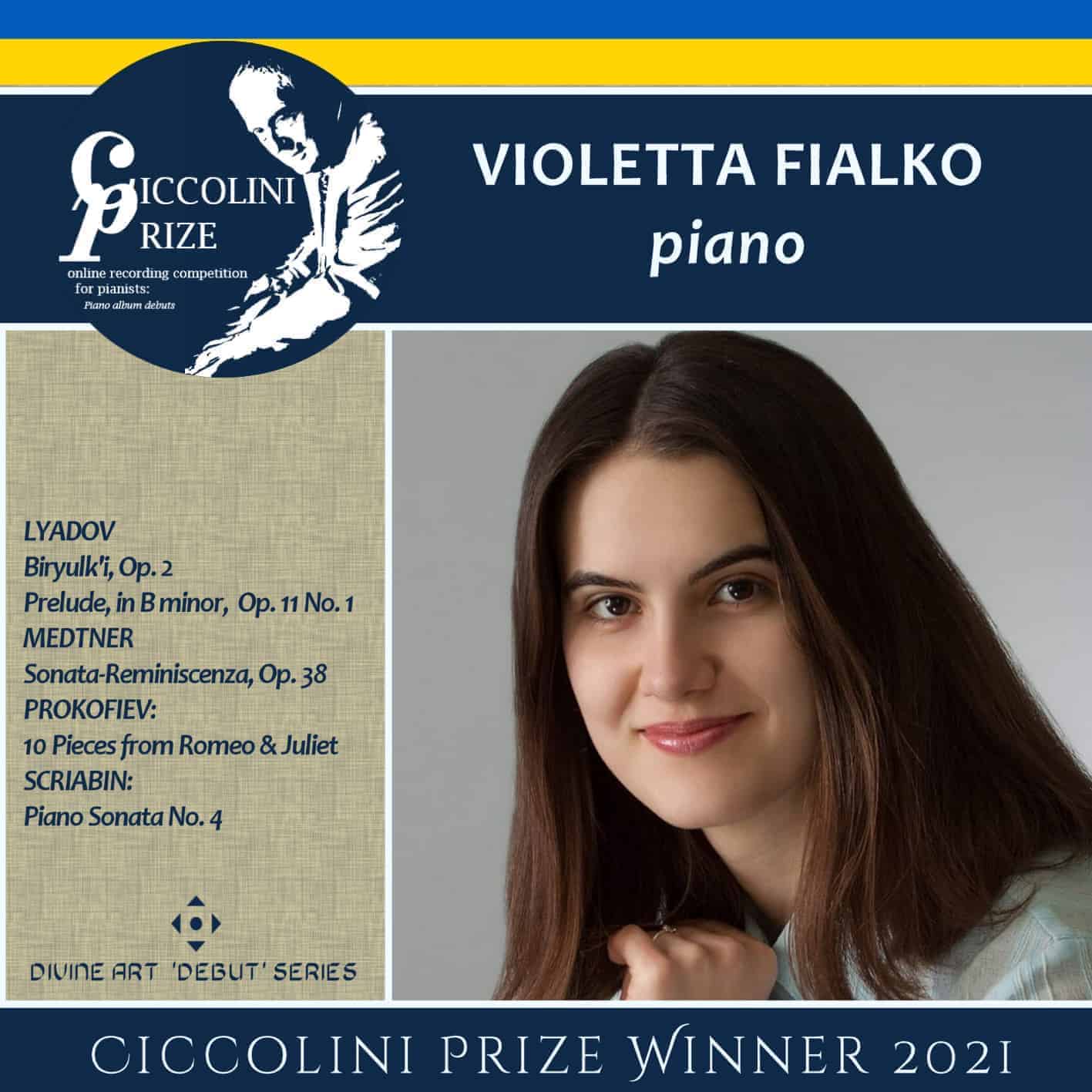
  • Violetta Fialko – prizewinner recital DBU 20211 Textura review

    As its title indicates, Violetta Fialko’s commercial recording debut directly resulted from her winning the 2021 Ciccolini Prize for Pianists, a new international competition that attracted entrants from many countries. Among the prizes the Ukrainian virtuoso received for winning the competition was a recording with Divine Art, hence the recital album. Born in 1997, Fialko has won multiple awards and since 2018 has worked as an accompanist at the Lysenko Kyiv Specialized Music Scholl and as a teacher of piano performance and music theory at the Ukrainian Evangelical Theological Seminary and at the Music Art Academy. Her circumstances, however, have changed since the war in Ukraine erupted and she was evacuated from her home town to a safe house. While her seventy-minute release focuses on Russian Romantic classics, Prokofiev was, in fact, born in Ukraine. Nothing in the album content explicitly addresses war, though its very existence might be seen as a symbol of support for Fialko’s country and for peace and freedom in general.

    The collection commences with the fourteen miniatures of Biryul’ki (1876), one of two Lyadov pieces performed and the composer’s first work for piano. If a spirit of child-like playfulness colours the material, it’s intentional: in playing biryul’ki, one plays with small toys that are hooked back one by one without one touching the rest. All fourteen settings are executed with authority by the pianist, who never lets their considerable technical challenges dampen their carefree spirit. Complementing Biryul’ki is Lyadov’s also-compact Prelude in B minor, Op. 11-No. 1 (1886), a lyrical setting based on an old folk song, “Why the love is so cruel in this too cruel world,” having to do with a girl suffering abandonment by her beloved. In contrast to the breezy tone of Biryul’ki, the prelude effectively captures Lyadov’s capacity for heartfelt solemnity.

    At thirteen minutes, Medtner’s Piano Sonata ‘Reminscenza,’ Op. 38 No. 1 towers over the rest. Part of the composer’s “Forgotten Motives” series (1918-20), ‘Reminscenza’ is understandably marked by melancholy and wistfulness; it also shows Fialko playing with an emotional maturity befitting someone looking back upon an entire lifetime of memories as opposed to a person whose adult years have just begun. Her realization of the work dazzles, though the same could as easily be said about her handling of the other pieces too.

    As mentioned, the album’s highlighted by ten Romeo and Juliet pieces, which give the pianist a wealth of melodic material with which to work. Amazingly, when Prokofiev played the score in a “pre-premiere” concert after finishing it in 1935, the reception was less than enthusiastic and the work was rejected thereafter by both the Kirov and Bolshoi ballet companies. However, when he presented some fragments from it a few years later at a concert in Paris, the response was far more positive, which led to a successful staging of the ballet in Brno in 1938 and one in Prokofiev’s homeland two years later. Composed of sparkling dance numbers and evocative character portraits, the work captivates from the moment “Folk Dance” appears until “Romeo and Juliet before Parting” caps it thirty-three minutes later. Bringing his brilliant melodic command to the project, the composer vividly conjures the images of an awakening village, guests arriving at a stately ball, the innocent joy of a young Juliet, and the yearning the warring families’ lovers experience as their story nears its tragic conclusion. Closing out the album is Scriabin’s two-part Piano Sonata No. 4 in F sharp minor, Op. 30, which sees the composer’s belief about the triumphant power of art distilled into eight-minute musical form. In this case, a languorous “Andante” advances gracefully through impressionistic passages towards an energized “Prestissimo volando” that takes flight immediately and wings its way to an ecstatic climax. After listening to Fialko’s accomplished execution of the album material, it’s easy to visualize the release as the first of many in a potentially distinguished career. As she’s only in her mid-twenties, a future of immense promise lies ahead of her.

  • Violetta Fialko recital – MusicWeb review

    Anatoly Liadov was particularly known for his miniatures. It has always been recognised that writing a short story often demands greater skills than writing a full-length novel. The same goes for successful musical miniatures. Lyadov’s output shows how fond he was of the genre where one finds mazurkas, arabesques, impromptus, intermezzi, preludes, ballades, bagatelles, polonaises, folksongs, and so on. His well-known work A Musical Snuff Box implies taking a pinch at a time, in a manner similar in concept to his first piano pieces from 1876, with the opus number 2.

    The set’s title, Biryul’ki (бирюльки), refers to the children’s game of spillikins. One holds a clutch of sticks vertically and then releases them. The sticks fall randomly across each other. Players then have to remove one stick at a time from the higgledy-piggledy pile without disturbing any other sticks. These fourteen tiny pieces, between half a minute and a minute and a half, are delightfully charming. There is a definite feeling of a toylike nature as if the player is required to pick the notes out from a pile of notes lying there. Each piece is a perfect entity, and could easily be expanded to become a longer piece. The final one reprises the melody from the first to make for a neat rounding off of the set. It is followed by a prelude from Lyadov’s Trois Morceaux.

    Nikolai Medtner was another genius of compact writing but on a somewhat larger scale. It was another of those wonderful revelatory moments when I discovered his music, which abounds in the wistful as well as the melancholy laced with nostalgia. It demonstrates a supreme grip on how to construct the most fabulously delicate melodies which stay in the mind for long, and become perfect ‘earworm’ territory. The Sonata ‘Reminiscenza’ is among the most brilliant of Medtner’s many sonatas, though each and every one is truly glorious.

    I have a feeling that this is my first hearing of Prokofiev’s Ten pieces from Romeo and Juliet. They came into being as the composer fought to salvage what he could from the ballet, which at the time of the great purge of 1936-1938 he had been forced to cancel: it was associated with a by then purged theatre director. In this suite for piano, Prokofiev was simply coming back full circle to the ballet’s origins – it had been originally plotted out on the piano. The cycle certainly works well in this form (much as Mussorgsky’s Pictures from an Exhibition, originally for solo piano, do in Ravel’s orchestration). Prokofiev’s predilection for spiky and unusual rhythms, which marked him out as sounding modern, is in a way all the more apparent in this version. It can certainly be enjoyed as much as the more familiar score for full orchestra.

    Alexander Scriabin was a one-off without a doubt: not many people proclaim “I am God”. When translated into music, his mystical ideas make for a unique experience. His piano works are particularly rewarding examples of this strange musical personality. The Fourth Sonata is a good example of his general philosophy distilled in music. The idea of struggle against adversity leads to the apex of existence which he had planned to demonstrate through a work called Mysterium, a multi-media performance held in the Himalayas and leading to the end of the world in a state of bliss. Scriabin was a synesthete: he saw notes as colours, and that added to the mysterious aspect of his music. This sonata’s first section describes a languid state in which the composer views a distant (bluish) star. The second has the music racing frantically and energetically towards it. As the poem he wrote to explain the sonata ends:

    “Approaching thee by my desire for thee
    I lave myself in thy changing waves
    O joyous god.

    I swallow thee
    Sea of light.

    My self-of-light
    I engulf thee!”

    Motivation for writing music comes in many forms. Scriabin’s was certainly unique, and that is why his music is especially interesting and rewarding to study.

    This well-chosen programme must have meant a great deal to Violetta Fialko. The debut disc suggests a very promising future for the young Ciccolini prize winner. The way she plays Liadov’s pieces shows a real love for these tiny gems, and so does her rendition of Medtner’s Sonata. The latter is as fine a performance as I have heard: she is in good company with heavyweights Evgeni Svetlanov, Geoffrey Tozer and Marc-André Hamelin! I was also impressed by Fialko’s playing of Scriabin’s piece; I felt she injected the required dose of mystery into this ethereal piece. In the Prokofiev suite, she makes a good case for these stand-alone piano pieces, away from the ballet.

    Violetta Fialko is Ukrainian. It is to be hoped that the current situation in her country will not impede her progress too much. She is a considerable talent, and I hope to hear more from her soon.

  • Violetta Fialko recital DBU 20211 – Chronicle review

    Ms Fialko is a talented Ukrainian pianist who was signed by Divine Art for her commercial recording debut as winner of the 2021 Ciccolini Prize for pianists, a new international competition that had to be held virtually due to the pandemic. The audio masters arrived from a studio in Kyiv only days before the Russian attack.

    Given that she won the prize, she’s clearly a talented pianist, and she has chosen a varied programme of Russian Romantic classics (though Prokofiev was born in Ukraine).

    Her playing is confident and possesses the feel of someone who could play even harder pieces if she chose – she’s got the air of someone who is really on top of the instrument and the music, and can devote some mental energy to enjoying playing, rather than just getting it played.

    There are two long pieces: Anatoly Lyadov’s Biryul’ki, Op. 2 (he is “rightly considered a master of the miniature” say the sleeve notes) and Sergei Prokofiev’s 10 Pieces from Romeo and Juliet, Op. 75, the latter being half the CD’s 70 minutes. Shorter pieces by Nikolai Medtner and Alexander Scriabin complete the programme.

    In the opening section, “biryul’k“ means playing with small toys that need to be hooked back one by one, and the pieces have the feel of playfulness (and Fialko’s skill means she can be playful). “This work is a great challenge for the pianist, as the composer also plays with the performer from whom is required true virtuosity and the ability to play complex things very simply and with a smile,” Say the sleeve notes.

    Romeo and Juliet is obviously well-known so some sections of this will be familiar to many listeners.

    An excellent CD; some of the pieces may be works in miniature and playful but Fialko’s skill means this is a serious pieces of piano playing. One for lovers of the piano and for those who want something jolly, to entertain.

  • Violetta Fialko DBU 20211 review from Atlanta

    Violetta Fialko, born into a family of musicians, is a remarkably talented young Ukrainian pianist who shows a decided penchant for looking inside a given work of music and not taking it for granted. Educated at the Lysenko Specialized Music School in Kiev and the Kiev Conservatory, she has continued to reside in a section of her country that has not yet been ravaged by Putin’s war of aggression. And she has not allowed the tragedy occasioned by that conflict to erode her love and admiration for the music of the great Russian masters, four of whom are represented here in very illuminating performances.

    First up is the whimsically entitled Spillikins (Biryul’ki) by Anatol Liadov (1855-1914), a composer who has not yet received his due as an innovative voice in Russian music. The curious name refers to a game, also known as “jackstraws,” in which the players attempt to extract individual straws from a pile without moving any of the others. The premium on patience and dexterity required by said game may serve as a metaphor for the skill needed by the keyboard artist who attempts these fourteen pieces.

    They begin with a Presto that seems like a tribute to the Russian National School (Borodin, perhaps?), followed by an energetic Allegro, and then a slow, gracious Allegretto in waltz time that reveals Liadov’s skill in crafting a perfectly formed miniature. No. 4, Allegro con fuoco, is aggressive and probing, as befits its description (“with fire”), while No. 5 is a majestic Vivace and No. 7 a Moderato in lively accents.

    No. 8, a discretely formed Allegro moderato, is succeeded by No. 9, Allegretto tranquillo, that manages to incorporate traits of both descriptions. No. 10, an Allegro is followed by No. 11, a handsome Tempo di valse. No. 12 is a Prestissimo of athletic virtuosity. No. 13, Vivace, is quieter than we might have expected from fts title. No.14, a Presto in perpetual motion, concludes the set admirably. A Prelude in B minor from 3 Pieces, Op. 11, is noble and restrained, packing a lot of musical substance in a timing of just 2:59.

    Nicolai Medtner’s Sonata reminiscenza (Sonata remembered), all in a single movement, is taken by Fialko with consummate skill that emphasizes its natural fluidity between sections. Both lugubrious and lively, this is a difficult work to analyze and perform, but Fialko manages to accomplish both while bringing out the work’s delicate lyrical beauty.

    Fialko goes on to capture all the vivacity, sadness and sheer lyrical beauty in Sergei Prokofiev’s Ten Pieces from Romeo and Juliet. This performance captures it all, from the tricky-fingered whimsicality of “Folk Dance” and “The Street Awakens” to the final poignancy of “Romeo and Juliet before Parting,” with its distilled sadness and its richly conveyed light-and-shadow substrate of emotions, ending in the ominous rattling of dry, untuned keys near the very end, a foreshadowing of the final tragedy.

    Amid all these elements, “Friar Lawrence” comes across as a peaceful, sunlight-dappled interlude before we plunge on to the catharsis. Most memorable of the Ten Pieces is No. 4, “Juliet as a Young Girl,” with its deft portrait of the heroine: playful skittish, slightly poignant, poised on the verge of a life that, as we are forewarned, will end all too soon. Fialko brings out all these facets, and more, in Prokofiev’s music in a breathless performance that is beautifully detailed without being fussy.

    Lastly, we are given Alexander Scriabin’s Sonata No. 4 in F-sharp Major, Op. 30. Fialko’s performance encompasses all the bold color elements in a work written in a rarely-used but unusually rich key signature (six sharps). Conceived at a time when the composer had become increasingly disenchanted with tonality itself, this work trades heavily on mystical sonorities, eccentric key resolutions, and the evocation of light as streaming from the vastness of the universe. Fialko reconciles all of these diverse elements unflappably in the course of a very satisfying performance.

  • Violetta Fialko: DBU 20211 Pizzicato review

    When this program was recorded in Kiev in January 2022, the criminal Vladimir Putin had not yet begun his murderous war of aggression on Ukraine. Ukrainian pianist Violetta Fialko, born in 1997, is the winner of the 2021 Ciccolini Prize. She certainly makes no secret in her playing that she is a woman and approaches music with a feminine sensibility. Prokofiev’s 10 pieces from Romeo and Juliet benefit from this, and while they are rhythmically very fine, they emphasize the melodic throughout and never become motoric or hammering.


    Anatoly Liadov (1855-1914) was a fine pianist and composed mostly short pieces in which he could show his mastery of form and expression with little effort, as in the 14-part cycle Biryul’ki (Mikado Playing), which he composed in 1876 when he was a student at the St. Petersburg Conservatory. Violetta Fialko plays the music with great freshness and genuine charm.

    The Russian late romantic composer Nikolai Medtner (1880-1951) is no longer a forgotten composer, but he is not very popular either. According to Marc-André Hamelin, one of the best interpreters of Nikolai Medtner’s music, Medtner composed « very genteel, aristocratic music » that « doesn’t have such an immediate drawl as Rachmaninov. Rachmaninov goes directly to the listener. The listener, however, must approach Medtner. For this, his pieces gain ceaselessly with repeated listening. »

    Violetta Fialko’s playing of the Sonata reminiscenza is varied and sensitive, controlling the architecture of the work as well as the musical flow. The tonal quality of her playing, the dynamics, the art of lighting and shading allow her a wide range of expression.

    Scriabin’s Fourth Piano Sonata, written in 1903, the year he moved from Russia to Western Europe and left his wife and four children for another woman, is the work with which the composer began to break away from the Romantic style and develop his own language. Fialko makes her way with gripping musicianship through the rapidly shifting emotions to the ecstatic conclusion, which Scriabin called ‘focosamente, giubiloso’ fiery and jubilant. (4 stars)

  • Violetta Fialko recital – Infodad review

    A new (++++) Divine Art recording featuring Violetta Fialko offers personalized pianism of a very different sort [from the Bach disc just reviewed] – devoted to music that, although far less significant and meaningful than Bach’s, nevertheless has many pleasures of its own to offer. Nearly half of the 70-minute disc is devoted to Prokofiev’s Romeo and Juliet—Ten Pieces for Piano, a work that proves just about perfect to highlight the variegated sounds and expressions that Fialko elicits from the piano. She manages, for example, to maintain the old-style underlying rhythm of Minuet: Arrival of the Guests, while overlaying the material with 20th-century expressiveness; there is naïve enjoyment aplenty in Juliet as a Young Girl; the inherent drama of the well-known Montagues and Capulets comes through strongly and contrasts interestingly with Friar Laurence; and so on.

    Fialko is quite comfortable with this music’s essentially down-to-earth elements – but she is also well-attuned to the far more evanescent, near-mystical beauties of Scriabin’s Piano Sonata No. 4, and handles the almost-jazzy rhythmic elements of the second movement to fine effect. The other works on this CD, which are less familiar than the Prokofiev and Scriabin, receive equally fine readings. The Piano Sonata “Reminiscenza” by Nikolai Medtner (1880-1951) has delicacy and an inwardness of expression quite different from those of Scriabin’s No. 4. And the Op. 2 miniatures by Anatoly Liadov (1855-1914), collected as Biryul’ki and sounding like a series of 14 études, are snippets of enjoyment from start to finish – less elaborate and portentous than the Prokofiev movements, but filled with little touches of delight of a salon-music sort. Fialko does especially well with the somewhat-more-intense movements, including the fourth (Allegro con fuoco), the fifth (Vivace), and the sixth (Allegro), but without giving short shrift to the delicate ninth (Allegretto tranquillo) and sweet 11th (Tempo di valse). Fialko also offers Liadov’s Prelude in B Minor, the first of his Trois Morceaux, Op. 11, with warmth and sensitivity. Indeed, everything on this disc has a feeling of being warm and sensitively interpreted, displaying Fialko’s considerable talents to very good effect in music that may be of no great consequence but that produces very considerable feelings of pleasurable enjoyment.

  • Violetta Fialko – Ciccolini Prizewinner Recital

    Violetta Fialko – Ciccolini Prizewinner Recital

    Violetta Fialko is an exceptionally talented Ukrainian pianist, who has been signed by Divine Art for her commercial recording debut, as winner of the 2021 Ciccolini Prize for Pianists, a new international competition which had to be held ‘virtually’ due to the Covid pandemic. At the time of writing this, Violetta is living in a part of Ukraine which has so far not been desecrated, having been evacuated from her home town. The audio masters arrived from the studio in Kyiv only days before the Russian attack, for which we are thankful, and we do not yet know if the studio still exists. Leaving the war aside, we have a brilliantly talented pianist who has chosen a varied and highly virtuosic program of Russian Romantic classics (though Prokofiev, to give him his due, was born in Ukraine).

    Violetta was born in 1997 into a family of musicians. She began to attend music school at the age of 5, and at 9 entered the Lysenko Specialized Music School in Kyiv, graduating with top honors in 2016 and entering the Kyiv Conservatory. She won many prizes, culminating in the 2021 Ciccolini Prize which has led to this album being made. She worked (until the current war began) as a teacher of piano performance and music theory, and is also a volunteer and program host on the Evangelical Radio station ‘Emmanuel’.

    We commend this album as the debut of a fantastic pianist and also in support of her home country and peace and freedom everywhere.