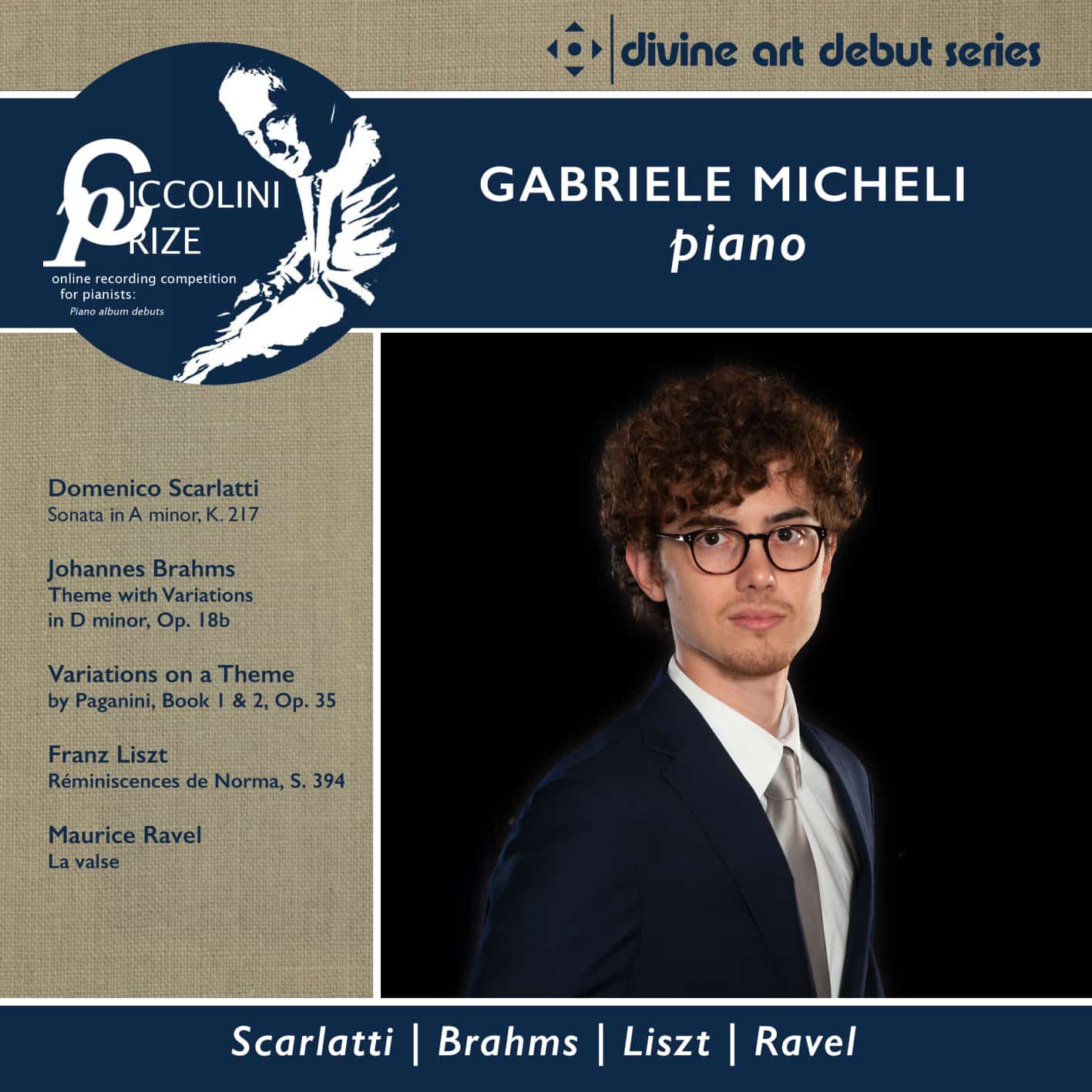
Italian pianist Gabriele Micheli received the second-place Ciccolini Prize in 2021, resulting in this recording for Divine Art made in Trani, Italy in October of that year. Among his mentors since his graduation from the Santa Cecilia Conservatoire are the important pedagogues Benedetto Lupo, Pietro De Maria, Roberto Cappello, and Boris Berman.
Micheli begins with music by Domenico Scarlatti, the Sonata in A Minor conceived during the composer’s stay in Spain. An expansive Andante in binary form, the piece exploits the use of ornamentation, trills, and small arioso kernels that sing in occasional passing counterpoints. The mood shifts into a more martial character with a darker color, but guided by the fascinating balance of staccato and legato gestures. The music soon assumes the character of a ceremonial pavane or richly ornamental sarabande, solemnly introspective. Micheli’s assortment of textural hues and sustained delicacy of filigree may, for some auditors, remind them of the palette of Arturo Benedetto Michelangeli, which says something quite notable in this young man’s playing.
In terms of keyboard effects, Micheli’s rendering of the Brahms Theme and Variations in D Minor, arranged by Brahms from the second movement of his own 1860 String Sextet No. 1 in B♭, proves quite remarkable, with Micheli quite literally strumming the opening theme, Andante ma moderato. We must rightly consider the independent piano work an homage to Clara Schumann, to whom it is dedicated. With the addition of rich bass chords, the music becomes a nobly austere march with tragic overtones. The six variants conform to classical procedures, rhythmically diverse, with added moments of ornamental punctuation and active scalar patterns. The latter variants diverge from the initial 2/4 impulse and wander into the major mode. Variations 5 and 6 convey a deep sense of consolation or valediction, imbued with bittersweet melancholy.
Whatever temperamental and artistic differences separated Johannes Brahms and Franz Liszt, their mutual admiration for the virtuosity of Italian violinist Niccolò Paganini led each composer to write variations on the Caprice No. 24 in A Minor from Paganini’s op. 1 set. Brahms conceived his 1863 set of two books on the theme plus the 28 total variations and tripartite coda that follow to serve as studies on the level of Schumann’s Symphonic Etudes, op. 13. Brahms, like Liszt, venerated the Polish piano virtuoso Carl Tausig (1841–1871), whom Liszt described as “the infallible, with fingers of steel.” Both technically demanding and emotionally and coloristically expressive, the Brahms studies preserve the nature of the original theme while demanding brilliance and articulation in double notes, wide arpeggios, competing metrics, and the full exploitation of the keyboard’s registers. Besides demonstrating a striking, resonant sonority, Micheli impresses with his variety in touches and accents, as in the Brahms equivalent of violin bariolage technique. Even in the midst of hands alternating octave patterns and registers, Micheli projects a music-box transparency—as for example in Variation 11 from Book I in A—and then delivers a thunderous cavalcade of effects in the best style of his great predecessors Backhaus and Bachauer. The rendering of part two of Variation 13 enjoys a glittering faux Hungarian style, a moment well reminiscent of the best from Evgeny Kissin. The passion of the Book I coda ripples with excitement. Book II feels more academic in its approach to technique, rife with syncopated complexities and an occasional concession to popular styles, as in the waltz variation, No. 4. The rendering of the chromatic octaves of No. 7 should drop a few jaws in astonishment. A consistent resolve informed by sensitive attention to the Brahms capacity for sweetness in the midst of bravura complexity marks this performance as a banner moment, in what may well become the Micheli canon of immortal sound documents.
The music of Liszt appears in this recital, seeming inevitable in terms of keyboard evolution. Micheli chooses Liszt’s 1841 Reminscences de Norma by Vincenzo Bellini, a clear opportunity for Liszt to emulate the bel canto piano style patented by Chopin. In the general structure of a one-movement fantasia, Liszt utilizes the overture, the cavatina “Casta diva,” and the cabaletta “Ah! Bello a me ritorna.” In his audacious application of chromatic harmonies Liszt wishes to retain the two central themes of love and death embodied in the opera, even superimposing the two arias, originally sung respectively by the Druid priestess and the Roman centurion Pollione. Micheli applies a symphonic sonority to the opera overture, setting the tragic tone for the dramatic action. Micheli’s traveling trill offers a minor marvel, leading directly to the bel canto writing that soon assumes martial, opulent power. It soon becomes apparent that Micheli bears a torch for the Liszt tradition that owes debts to the pianists Cziffra, Bolet, and Lewenthal. Some canny pedal-work softens Liszt’s hammer blows in the bass, still thunderous in their driven, ominous suggestion of implacable fate.
Micheli turns last to the music of Maurice Ravel, the 1920 evocation of the lost world of the Vienna waltz, La valse, in the solo piano version first introduced to this reviewer by Leonard Pennario. From the swirling phantasmagoria of the opening pages to the evolving influx of light in the music’s development, Micheli maintains the nervously tragic pulse of the work, which, like all of Ravel’s dance forms, explodes in a paroxysm of its own momentum. The kaleidoscope of color and nuance achieves a fluent, kinetic energy that swells and retreats with erotic suggestiveness, a tour de force to end what has already proven itself a potent demonstration of keyboard proficiency.
The accompanying booklet fails to credit Micheli’s chosen instrument, but the recorded sound proves compelling and explosive, courtesy of engineer Massimo Mazzone and executive producer Alfonso Soldano.