In a marketplace crowded with sets of Beethoven’s piano sonatas, many are good and some superb, but it is rare to find one that is unique. The more I listen to Tamami Honma’s traversal of all 35 sonatas, including the three so-called Bonn sonatas, the more Blake’s doors of perception open to their Protean narratives. Now, I hear Honma’s as a confluence of micro and macrocosmic layers. Take the opening of the “Pastoral” sonata as a relatively simplistic manifestation of Honma’s pianistic virtues by homing in on the left hand. Is that a drone or a pulse? Of course, it’s both, but the subtleties of articulation underpinning the chorale-like harmonies confound and delight. The cycle resonates with similar moments as difficult to describe as to categorize as she conflates eras and national styles in a project as thoroughly researched as it is expertly performed. Yes, Honma is an excellent pianist, virtuosity aplenty evident where needed, but it is her scrupulous interpretation that makes each listening experience as unique as her approach to pieces suddenly unfamiliar.
Catalogue Connection: 21001
-
Beethoven Complete Piano Sonatas Fanfare Review
Japanese-American pianist Tamami Honma hails from the San Francisco Bay area and teaches at university music departments at Stanford and Santa Clara. This is her first entry in Fanfare, and she gets introduced not with a whimper but a big bang: the complete 35 piano sonatas of Beethoven. Yes, that’s right, 35 sonatas, not just 32, because she has included some juvenilia: the three so-called “Bonn Sonatas,” likely composed when Beethoven was 12 or 13 years old, aka the “Kurfürst” sonatas, WoO 47, because they were dedicated to the Prince-Elector (German: Kurfürst) of the Holy Roman Empire, Maximilian Friedrich, Archbishop of Cologne.
This handsome 10 CD set includes an equally handsome rarity (nowadays, at least): a reasonably thick booklet with detailed and informative annotations by Julian Brown. (Brown is a British-born violinist who in recent years has performed all 10 Beethoven violin sonatas with Honma, with whom he cofounded a chamber group known as the Cal Arte Ensemble, so in addition to excellent notes on the music, his information about the pianist is presumptively reliable.) He explains that Honma has used, as her playing edition, the one edited by British musicologist and Beethoven scholar Barry Cooper and published by Associated Board of the Royal Schools of Music. That edition incorporates numerous revisions, even of notes themselves from time to time, but more often of phrasing, dynamics, pedaling, and accent marks. I have not studied that edition, but it may well account for her predilection, throughout the cycle, for staccato textures even at junctures where—according to the Lieber/von Bülow, Schenker, Casella, and Arrau editions, among others—there are no staccato indications in the score.
While I may not always agree with Honma’s interpretive choices, all of them are clearly delineated and stylishly played, in a manner that makes her Steinway concert grand sound at times a little bit like a fortepiano. If I had to choose two adjectives to describe Honma’s Beethoven set, it would be “elegant” but, at the same time, “quirky.” I mean “quirky” in a good way, one in which she underscores many of Beethoven’s (often equally quirky) humorous touches. Honma does not overpedal anything in her Beethoven. Her legato lines are well delineated, even though she seems frequently to prefer a staccato texture, what one might call détaché if she were playing a violin.
Let’s get the “Bonn Sonatas” out of the way, before moving to the canonical 32. These three are well played, but Honma’s artfulness reveals their compositional immaturity. They are nice to hear at least once in your life, but they are eminently forgettable. On, now, to the remaining nine discs.
Let’s start with some highlights of the early sonatas. Her set of the three op. 2 sonatas is sprightly. Although I would prefer stronger sforzandos at the conclusion of the first movement of op. 2/1, her finale is tremendously exciting, and her right-hand figurations in the finale of op. 2/2 are even and pearlescent. All the scherzos in that set are witty and satisfying. The huge op. 7 could be more exciting, but apart from that gets a superb performance. The finale of op. 10/1 likewise could be more exciting, but Honma certainly captures throughout that set the humor of Beethoven’s rhythmic gestures. She plays the middle movement of op. 10/2 slower than I have ever heard it, reminiscent of some of Richter’s idiosyncratic choices in Beethoven and Schubert. She abandons all caution in the Presto finale, however, and the performance—perhaps a tad faster than she can comfortably manage—is one that Annie Fischer and Walter Gieseking would envy and is a full minute faster than other pianists, including Arrau.
The “Funeral March” and the two op. 27 sonatas (each quasi una fantasia, the second being the famous “Moonlight”) are very deftly performed, with elegantly contrasted passages. My only complaint in the “Moonlight” is that, despite her typically scrupulous adherence to the printed page, she falls into the trap that ensnares many a pianist of rhythmic inaccuracy in the three vs. four pattern of the first movement theme. In the measures expounding that famous theme, there is just a dotted eighth note, followed by a 16th note, in the soprano line on the fourth beat of the measure in the right hand, offset against a triplet. Mathematically, the 16th note should come almost immediately after the third note of the triplet is played. Instead, many pianists treat is as though it were a double-dotted, not a single-dotted, eighth note. Honma is even at the extreme end of this rhythmic displacement. The slow movement of the “Pastoral” is faster than expected, but all told that particular sonata is played with great serenity and lyricism until the closing romp in the finale.
Moving to the middle period, the three op. 31 sonatas are a treat. Honma adroitly captures the playful rhythmic displacement of op. 31/1 and delivers a passionate and powerful first movement of the “Tempest.” I think she takes some undue risks in the breakneck acceleration she employs in the scherzo and finale of the “Hunt” sonata. One does not expect perfection across so gargantuan an undertaking as the complete Beethoven cycle. Thus some disappointments are inevitable. For me, the “Appassionata” and the op. 79 fell into that category.
In the late sonatas, Honma takes some chances in the “Les Adieux” and gets away with them. This contrasts with the op. 90, which is a little dull and metronomic, but the op. 101, particularly the hair-raising finale, is excellent, if a bit circumspect in the risk-taking department. Also quite circumspect, even disappointingly so, is her playing of much of the “Hammerklavier.” After a fierce beginning to the first movement, the performance devolves into one that is generally uninflected and unexciting, just seeming to be going through the motions and happy to survive the many demands of the piece without calamity. On the other hand, I found the final three sonatas to be very poised, by turns elegant where appropriate and passionate where required.
At the end of the day, however, these quibbles are insignificant in the face of Honma’s achievement in this Beethoven cycle. Make no mistake: This is very distinguished musicianship and very beautiful Beethoven playing. I am delighted to become acquainted, via this release, with this talented artist. Honma has evidently given these performances a great deal of thought and preparation, and the result is an emotionally and intellectually satisfying Beethoven cycle. Urgently recommended.
-
Beethoven Complete Sonatas Fanfare Review
This box set is titled Complete 35 Piano Sonatas, which immediately attracts attention because we all learned that Beethoven wrote 32 piano sonatas. Most pianists have multiple scores and probably one or more complete recordings of arguably the greatest piano music ever written. The three early, fully developed sonatas also included here were published in 1783 and seem a quite logical addition to a complete set. They actually were included in the 35 piano sonatas published in the first anthology of Beethoven’s compositions (supervised by the composer himself). They were written when he was 12 to 13 years old and were dedicated to Prince-Elector (Kurfürst) Maximilian Friedrich, and so have been referred to as the Kurfürstensonaten. The story behind the Andante favori is well known. It was the original middle movement to the “Waldstein” Sonata, but Beethoven dropped it and composed a short transitional movement that works perfectly. At nearly nine minutes, the Andante favori is a beautiful piece on its own and certainly appropriate to include in a full set of the sonatas.
After many hours of listening to this set, I must say that it is one to savor. The playing is crisp and the voices well delineated. Each time, even in the best-known sonatas, I hear a new detail. Beethoven writes so many quick dynamic changes and accents that Honma’s exceptional abilities here are one of the high points. Not only is her “Appassionata” a prime example of this, it is also one of the most exciting I’ve heard in a long time. There is outstanding piano playing all through this collection, from the simple but always well-shaped Alberti bass lines in the earlier sonatas to the monumental fugue that ends the “Hammerklavier” and the variations in the final movement of Op. 111. Even the best-known first movement of the “Moonlight” is special, mainly in the beauty of the exceptionally quiet triplets and perfectly voiced melody.
Discovering the sonatas that are not as well known make this an essential set. Honma has significant teaching credentials, and virtually every undergraduate piano student learns a Beethoven sonata (or two or more). I wish I had been fortunate enough to have had a teacher with her insight into all of them. My sonata was the “Tempest,” and after years of playing it, I found Honma’s performance just about perfect. I would have been off to a much better start some 50 years ago had she been my teacher. She handles the recitatives in the recapitulation of the first movement with Beethoven’s pedal markings exactly followed, and a touch that allows for the dissonances created, but she never loses the melodic content. The opening rolled chord of the second movement perfectly ties back to the first. Even though the third movement is continuous 16th notes, the variety of textures and attention to both the little short phrases and the long ones makes this an exceptional musical treat.
Credit here must also be accorded to Julian Brown. He is listed as the recording engineer, co-producer with Honma, and author of the notes in the detailed 76-page booklet. The recordings were made at Cal Arte Studios in Saratoga, CA from 2019 to 2023. Unlike the variety of recorded piano sound we hear on Pollini’s complete set of sonatas (recorded 1975–2014), the consistency here is quite good. This box set will take a place in my CD library right next to Pollini as a more complete reference with insightful, solid interpretations.
-
Beethoven Complete Sonatas Fanfare Review
In my personal experience, Tamami Honma’s recorded traversal of Beethoven’s complete piano sonatas is unique in at least a couple of ways. Whether another pianist before her has trumped Honma in this feat, I cannot say, for I’m not familiar with, nor do I have access to, every Beethoven piano sonata collection out there that stakes claim to being the oeuvres complètes, but of those I know and have covered in these pages, none is as complete as is Honma’s; for in her accounting of the sonatas, there are 35, three more than the standard 32 we commonly take to be the official canon.
Actually, the three additional works are neither recent discoveries nor new to disc. They are, in fact, the three sonatas Beethoven composed as he entered his early teenhood in 1782–83. The scores bear a dedication to Maximilian Friedrich, the Prince-elector (Kurfürst in German) and are thus nicknamed Kurfürstensonaten. No evidence remains, if ever there was any, that the Prince commissioned the sonatas, or that he did the princely thing and rewarded the precocious young composer with a gift.
Surprisingly, however, the sonatas found their way to the Bössler publishing house in Speyer, Germany, virtually within days of their completion. So, they were known works and known to be by Beethoven from the start. But Bössler went bust in 1828, the year after Beethoven’s death, and the Kurfürstensonaten languished for a long time in the shadows of the composer’s mature piano sonatas, and, as indicated above, have rarely to my knowledge been included in recorded collections of Beethoven’s complete piano sonatas. But that’s not to say they’ve been completely neglected on record. Most notably, perhaps, they were recorded by Emil Gilels, who, ironically, never quite completed his “complete” survey of the sonatas. Jenő Jando also took them up, as did period instrument specialist Ronald Brautigam. But admittedly, the choices are slim.
If I belabor the point, it’s because the music history books need revising. Beethoven wrote 35 piano sonatas, not 32. While it’s true that the Kurfürstensonaten are juvenilia, English musicologist and Beethoven scholar Barry Cooper has argued that “A complete edition has to be complete, and if you ignore early works, you don’t show the longer trajectory of the composer’s development.”
The Andante in F, WoO 57, which Tamami Honma also includes in her set, is not, by itself, a sonata, but rather the rejected slow movement originally intended for the “Waldstein” Sonata. Familiarly known as the Andante favori, unlike the Kurfürstensonaten, the ejected Andantemovement is very well known and well represented on disc. While a less galactic traveler than Beethoven would likely have retained the original slow movement, the new movement Beethoven composed to replace it is arresting in its originality. Harmonically vague, ambivalent, and unsettled, its equivocation is disquieting. Even the new movement’s title, “Introduzione,” is enigmatic. An introduction to what? The answer to the question, spoken in a soft voice, comes as the theme of the Rondo finale steals in. Hushed, as if in a state of reverential awe, it hovers mysteriously between the major and minor modes of the key, humble and meek at first, and then, gaining confidence and strength, it erupts in a blaze of blinding glory. Imagine what a lesser work the “Waldstein” Sonata would have been had Beethoven not replaced that middle movement.
The other possibly unique aspect of Honma’s cycle is the order of succession she has chosen to follow, which is based strictly on composition date as opposed to cardinal number, opus number, or publication date. The effect this has on the distribution of the sonatas across the 10 discs that make up the set is seen as early as disc three, on which not only are the two so-called “easy” (leichte) sonatas, Nos. 19 and 20, opp. 49/1 and 49/2, placed ahead of the Sonata No. 4, op. 7, because the two op. 49 sonatas predate op. 7 by 10 years; but even the op. 49 sonatas themselves are given in reverse order—op. 49/2 first, followed by op. 49/1—because No. 20 (op. 49/2) was composed between 1795 and 1796, whereas No. 19 (op. 49/1) was composed in 1797. In this matter of ordering, Honma appears to be scrupulous and consistent, although truth be told, there don’t seem to be any such similar numbering discrepancies in the later sonatas; their cardinal numbers, opus numbers, and composition dates are reasonably in line with their publication dates.
Three issues prior, in 48:3, colleague Marc Medwin submitted a beautifully written review of this very set, which introduced Tamami Honma to Fanfare and the magazine’s readers. I concur with every last word of Marc’s review and seriously doubt there is anything I could add to improve upon his stated opinions and conclusions. All I can do is to touch upon one or two things about the set that Marc didn’t cover.
Honma performs the sonatas in the meticulously prepared, critical ABRSM (Associated Board of Royal Schools of Music) edition, published in 2007 by the earlier mentioned Beethoven scholar, Barry Cooper. His research was based on comparing original manuscripts, early editions, and historical sources, and his published edition includes detailed notes on performance practice, history, and source assessment for each sonata.
The included 88-page English-only booklet, authored by Julian Brown, who is also the set’s recording engineer and co-producer along with Honma, is, itself, a work of art, as meticulously executed and beautifully presented as is Honma’s playing. Printed musical examples are included along with the description and brief analyses of each sonata.
Well-known music critic and author Alex Ross is quoted in the second paragraph of the opening essay, summing up Beethoven’s special stature and place in the course of music history. It’s a paragraph worth requoting in full because it lends insight into the determinative impact that the originality, strength of character, and the moral and ethical persuasive power of Beethoven’s music has had on our humanity, culture, and civilization.
In a New Yorker article, Ross observed that “Beethoven is a singularity in the history of art—a phenomenon of dazzling and disconcerting force— a composer who not only influenced all subsequent composers but also molded entire institutions including professional orchestras, the art of conducting, and the evolution of the modern piano. Even 20th century recording technology,” Ross noted, “was shaped by considerations of Beethoven’s music, with the first commercial 33⅓ rpm LP in 1931 stamped with the Fifth Symphony, and the duration of first-generation compact discs fixed at seventy-five minutes, long enough to play the Ninth Symphony without interruption.”
In his review, colleague Medwin settles on Alfred Brendel’s three Beethoven cycles as reasonable comparisons to Honma’s approach. Among later 20th-century modern pianists, Brendel, of course, and also Rudolf Serkin, Vladimir Ashkenazy, Wilhelm Kempff, and Maurizio Pollini, have long been regarded as near-definitive interpreters of Beethoven’s keyboard works. One wouldn’t go wrong with any of them, although Serkin is the only one of this group who did not record a complete cycle.
What I would say of Honma’s playing is that it is characterized by the best of all of them. Of Brendel, she gives us his rhythmic control and intellectual rigor. Of Kempff, she brings us his animated style, sometimes puckish and playful, other times noble and filled with a sense of occasion, and still other times dark and probing. Of Ashkenazy’s Beethoven, Honma gives us its clarity of voicing, tempos that find the mean of the music and always feel right, and the comfort of knowing there’s a steady, knowing hand steering the ship. From Serkin’s style, Honma inherits a balance between opposing instincts for muscularity on the one hand, and subtlety in harmonic voice-leading and nuance in dynamics on the other hand. And from Pollini, Honma gives us his rigor and technical precision, but without the sense of compulsive virtuosity for its own sake that can impress but not always move us.
To all of this, Honma adds her own set of ethics that guide and condition her personal voice and style. Most listeners familiar with Beethoven’s 32 (now 35) piano sonatas, I would venture, have a favorite one or two among them, or perhaps a single movement or two that carries some special emotional weight. There are, of course, the name-brand shoppers—those on the lookout for an illuminating new “Moonlight” or an impassioned new “Appassionata”—while others may wish to explore the less advertised offerings—like the “Moonlight’s” Cinderella companion, the E♭-Major Sonata (No. 13), op. 27/1. Whichever type of shopper you are, it doesn’t matter, for Honma’s Beethoven cycle, from beginning to end, gives equal justice to all.
Are there performances of individual sonatas I would not want to part with? Of course: an evocative “Moonlight” by Cliburn that lingers in the memory, an electrifying “Appassionata” by Horowitz, and a “Pathétique” and “Tempest” of frightening tension and dramatic urgency by Fazil Say, who, more often than not, plays with hair-on-fire intensity. His Beethoven might not be to everyone’s taste, but it can’t be said that it’s not special.
Japanese-American pianist Tamami Honma is a onetime student of Byron Janis, who in turn was a student of Horowitz and both the Lhévinnes, Josef and Rosina, thus grounding Honma firmly in the great Romantic tradition. Currently on the music faculty at Stanford University and at Santa Clara University as both collaborative pianist and piano instructor, Honma adjudicates for international competitions and is regularly invited as a guest artist, performing and giving masterclasses at universities and conservatories in the U.S. and beyond.
If there is one word to sum up Tamami Honma’s Beethoven piano sonata cycle, it would be “transcendental.”
-
Beethoven Complete Sonatas Fanfare Review
Japanese-American pianist Tamami Honma has recorded one of the most challenging Beethoven piano sonatas surveys I’ve ever heard. I mean that neither as a value judgment nor as the proverbial damning with faint praise. Her set stands apart from many others for several reasons, the first of which is quite practical in that she includes the three 1783 sonatas, as should occur given their merits. That said, there’s much more to the case she makes for all 35 sonatas, and it may be simplest to suggest, by way of citing outstanding qualities, that Honma is an explorer of place, of region. It seems fair to ask: Who isn’t? That granted, I suggest that as I’ve come to terms with her series of recordings, I am repeatedly aware that, unlike so many more traditionally-minded artists, she exposes often neglected details in areas large and small in a way that doesn’t so much isolate as highlight them, completely revitalizing their contexts.
As op. 110’s third movement begins, Alfred Brendel’s 1970s Phillips version exudes a meditative calm, slowly arching its way through long-breathed phrases while maintaining a tranquil mood until the ascending arpeggio paves the way for Beethoven’s vocal melody. Twenty years later, while the arpeggio is more completely separated from preceding events and Brendel’s tempos are more relaxed, his overall conception has not changed. I use his recordings as a point of comparison because Brendel shares with Honma a penchant for exposing minute changes in articulation in all three of his cycles, but like the context in which he does so, there’s a gentle unity to his playing. Extremes are often avoided in favor of mildly unfolding narrative. Honma tells an entirely different story. Hers is a narrative of meditation and disruption. When that arpeggio occurs at 0:28, it sweeps the board, with that top note, the first of the exquisite melody, a complete statement, becoming a declaration and a salvo. When the repeated G-Major chords (8:18) lead to the fugue subject’s inversion, each is a similar statement, each voiced slightly differently as it provides the next with energy. The more power they accrue, the more overtones emerge, and the sequence becomes a shattering experience that is then countered by the fugue’s reemergence.
I dwell on this moment at length as it’s indicative of Honma’s Beethoven, her vision of the stylistic and epochal interstices these sonatas inhabit. This is where the importance of those three very early sonatas becomes crystal clear. There is the rather astonishing way she renders the call-and-response dialog opening the third, but it is the second where Beethoven the young visionary is revealed. Honma’s playing of it and of the Pathétique is of a piece, certainly a fitting approach, since, as annotator Julian Brown observes, Beethoven revamps the slow introduction in the F-Minor Sonata as he would in its later and much more famous C-Minor counterpart. Beethoven’s intuitions for era-bridging began even before his cantatas of 1790, where I had previously imagined the point of transition, and Honma makes this argument with interpretive cogence. Along similarly boundary-blurring lines, the final movement of her Tempest is Classicist in itssymmetry, uninterrupted even by the occasional use of slight rubato, but its sudden changes in mood point the way backward and forward, evoking shades of the fantasia tradition which itself prefigures the Romanticism then still nascent.
Production values play an integral role in the qualities that make this set unique. I have seldom heard a piano recorded with so huge a dynamic range. This has advantages, as with the overtones I outline above, but beware of listening at too high a volume. The Steinway’s brightness can become overwhelming if listening levels are too high. Honma’s recording is no replica of a concert hall experience, with its distant perspective coated in a blanket of reverberation. We are up-close and personal, the combination of atmosphere and detail working splendidly given the kinds of phrasing with which Honma imbues each sonata. Indeed, there’s a level of subsection interrogation that is always refreshing, and in this, Frederich Gulda’s Amadeo series might be the closest point of comparison in terms of a kind of studied spontaneity. Honma is frugal with the pedal, but this only serves to promote textural clarity. Her counterpoint is second to none, so that the fugal sections of Beethoven’s final set of sonatas come off as convincingly as I’ve ever heard them.
Is Honma a Classical Romantic, or is it the other way around? It hardly matters when Beethoven playing of this stature and invention graces my speakers. While I have focused on a few examples to make the overall point, suffice it here to say that hers is a set not only rife with the kinds of detail that brings the listener back for more but brimming with the vitality that brings each sonata to life. The final movement of her Appassionata exemplifies perfectly her approach in toto, bristling and buzzing its way forward with each harmony and intertwining harmonic strand perfectly executed. She never misses a sudden harmonic trick, and again, the recording’s dynamic range places every nuance front and center. Putting the two op. 49 sonatas in their proper chronological position was also an inspired choice. Yes, Honma’s is a challenging vision, but it’s remarkably complete and endlessly rewarding.
-
Beethoven: Complete 35 Piano Sonatas Classics Today Review
The Bay Area-based Japanese-American pianist Tamami Honma serves on the music faculties of Stanford University and Santa Clara University, while maintaining an international itinerary of performing and master class engagements. She’s also found time in her busy schedule to record Beethoven’s “Complete 35 Piano Sonatas”. These include the three youthful “Kurfürst” sonatas WoO 47, hence 35 instead of the canonical 32.
At first I was struck by the lean and astringent sonority of her piano, where louder moments in the higher registers convey an aural “buzz” akin to certain period instruments. I’ve since learned from Dr. Honma that she recorded the sonatas on her very own 1990 Steinway concert grand, although she keeps a period Broadwood next to the Steinway for reference purposes.
The cycle’s extensive annotations by Julian Brown draw attention to Honma’s adherence to Barry Cooper’s edition published by Associated Board of the Royal Schools of Music, which incorporates numerous revisions of phrasing, dynamics, pedaling, accentuation, and, on occasion, the notes themselves. This may explain Honma’s proclivities for finely honed detaché articulation and discreet pedaling, along with her linear orientation and tendency to focus on details over the proverbial big picture.
In the A major Op. 2 No. 2 Rondo, for example, Honma’s delicately turned right-hand lines find more of an intriguing foil than warm support in the non-legato left-hand accompaniment. She informs the same opus number’s F minor and C major sonata Scherzos with a breezy and angular feeling of one beat to the bar. Op. 7’s Allegro molto may not be the most rollicking and joyous reading to be had, but the F major Op. 2 No. 2’s Presto Finale has all of the wild abandon that the C minor Op. 10 No. 1 Prestissimo Finale ever-so-slightly lacks.
By contrast, Honma’s conscientious cross-rhythmic phrasing in the D major Op. 10 No. 3 Menuetto justifies her measured tempo, whereas her brisk Op. 14 No. 2 Andante undermines the music’s mysterious undercurrents and the impact of the rests. Although the B-flat Op. 22 begins with an imaginatively characterized Allegro con brio, the remaining movements sound relatively prosaic and studio bound. However, the “Funeral March” Op. 26 and “Moonlight” Op. 27 No. 2 contain some of the most inspired and dramatically contrasted pianism in Honma’s cycle.
Listeners accustomed to a genial “walking” Andante in Op. 28 will be startled by Honma’s terse sprinting. I love the variety of touch and shifts in emphasis that Honma brings to the Op. 31 No. 1 Allegro vivace’s desynchronized chords, as well as the pianist’s fervency in the “Tempest” Op. 31 No. 2 first movement. Her fast tempos for the Scherzo and the Presto Finale of Op. 31 No. 3 occasionally border on breakneck, with more than a few dangerous accelerations. It’s one thing to play the “Waldstein” coda’s infamous octaves from the wrist rather than as glissandos, but quite another to slow down in order to accommodate that passage comfortably, and, as a consequence, stop the music’s momentum in its tracks.
Honma’s stern, dryly detailed “Appassionata” Andante con moto leaves lyrical respite at tradition’s door, but her driving yet flexible outer movements are right on the money. The pianist similarly trades surface elegance for edgy inflections throughout Op. 54’s opening Menuetto, although it took several hearings to convince me. She gives a surprisingly broad and even Romantically tinged interpretation of the little Op. 78 sonata’s first movement, yet proves a bit heavy in Op. 79’s outer movements, and rather foursquare in Op. 90.
“Les Adieux” Op. 81a stands out for Honma’s combination of brashness and rhetoric in the first movement, not unlike Artur Schnabel’s arresting conception. Do I hear traces of Schnabel in her emphasizing the right hand’s lower notes in the opening of Op. 109’s first movement? I would have expected this pianist to have taken more chances in the Op. 101 March and Allegro Finale, to have aimed for Beethoven’s controversial metronome marking for the “Hammerklavier” Op. 106 first movement, and to have let loose more in the fugal Finale; still, these clear, vital, and engaging renditions stand their ground in a crowded catalog.
Honma’s unorthodox yet carefully pondered tempo relationships in Op. 110’s fugue and Op. 111’s Arietta take some getting used to, and are worth a review in themselves. One can surmise that Honma put a great deal of thought, research and practice time into this project, and her most stimulating interpretations provide food for thought.
-
Beethoven: Complete 35 Piano Sonatas International Piano Review
I first encountered Tamami Honma’s playing in 2002 on a Métier CD accompanying the indefatigable Peter Sheppard Skærved in works by Rawsthorne and McCabe. Since then, her modest discography has traversed more McCabe (Second Concerto, solo pieces, and a duo programme with the composer), Rawsthorne’s complete piano output, Chopin’s concertos arranged as quintets, and Mozart violin-and-piano sonatas (with Howard Davis).
In February 2016 Honma embarked on the cycle of 32 piano sonatas as part of her ‘Beethoven Odyssey’, also taking in the 10 with violin, the five concertos, Choral Fantasy, and a staging of Fidelio with West Bay Opera. The present recordings, using her own Steinway B with its distinctive sonority, were made in Saratoga’s Cal Arte Studios between 2019 and 2023, and one can hear from the outset that this is music Honma has lived and breathed for many years. In her ‘Odyssey’ programmes, Honma played the two Op 49 sonatas from 1792 (pre-dating the official First Sonata of 1794) in numerical sequence between the Op 31 set and the Waldstein. Yet Op 49 provides a vital step in Beethoven’s early compositional evolution, especially when heard in the context of the three Kurfürst Sonatas (composed in his early teens for Maximilian Friedrich, the Prince-Elector of Cologne), which Honma, following the ABRSM critical edition of Barry Cooper, includes on her first disc, with Op 49 placed close to their proper chronological position, between Op 2 and Op 7. Hence she presents 35 sonatas (as with Brautigam on BIS), covering four decades of the composer’s life.
A bonus on the first disc is the Andante favori, originally written for the Waldstein but later replaced by the Introduzione that leads into the Waldstein’s glorious finale. Honma judges that finale (disc 7) just about perfectly, letting it sing as it should but with a keen eye for structure. Readers may know how much I esteem Paul Lewis’s Harmonia Mundi cycle (just the 32 numbered sonatas, not sequenced chronologically), but taken as a whole Honma’s accounts stand up well in comparison to his or Brautigam’s. Honma’s performances are often swift, especially in the outer movements, usually without sounding rushed (the pell-mell finale of Op 54 is an exception, the phrasing a touch awkward in places to my ear). The Tempest and Hunt sonatas (Op 31 Nos 2 and 3) are fine examples, Honma bringing out the drama as much as the lyricism of the keyboard-writing; the conclusion of the Hunt, for instance, is particularly satisfying.
So too is her way with, for instance, Op 7 in E flat major, Beethoven’s first big-boned sonata, or the over-familiar Appassionata (Op 53). Honma’s interpretative approach evolves as the cycle progresses, a measure of and reaction to the development in the composer’s piano-writing, from the Mozartian proportions of the early works to the more Romantic style that becomes more prominent from the Pathétique on. The Pathétiqueis rendered very well indeed, especially heard as part of the greater whole rather than as a stand-alone ‘pops’ number. So, too, the Moonlight and, initiating the magisterial sequence of the final 10 sonatas, the Appassionata: Honma, like Lewis, lets the music sing without any extraneous imposition of personality that has disfigured many an interpretation elsewhere.
For many, the acid test of any such Beethoven survey is the later sonatas, particularly the Hammerklavier and its three successors. Suffice it to say that the strengths of Honma’s interpretations of the earlier works persist to the end, whether in the lyrical warmth of Op 90’s finale or the stratospheric heights of the final three. Yes, there may be more sensational, spectacular or mesmerising renditions of individual works, but as a cycle this is rather good, and one I will return to often, as I have barely scratched its surface for this review. Divine Art’s sound is very natural, every note, chord and twang of Honma’s trusty instrument caught with unflinching clarity. If this set does yield to Harmonia Mundi’s warmly resonant recording for Lewis or BIS’s spotlit clarity for Brautigam, I rather like its unobtrusive intimacy, never detracting from the music itself and Honma’s consistently fine playing of it.
-
Complete 35 Beethoven Sonatas InfoDad Review
Deciding which set of Beethoven piano sonatas to own – or more likely which sets, plural, as new recordings becomes available – is a balancing act. In any performer’s cycle, it is unlikely that any music lover will find every single performance of every single Beethoven sonata “just right,” since performers themselves are constantly making choices as to how to handle specific sonatas and, indeed, how to handle the same pieces over time, since it is not unusual for a pianist to record the Beethoven cycle more than once. The producers of these sets of sonatas also have many choices to make in terms of packaging, presentation, pricing and more. So while a new recording of the Beethoven cycle is always welcome, any such release is bound to please some listeners, displease others, and have its own set of pluses and minuses.
Tamami Honma’s new 10-CD cycle on the Divine Art label positions itself firmly in the modern-piano-and-Romantic-temperament-approach camp. Honma takes full advantage of using a contemporary concert grand, with ample use of the sustaining pedal and very strong emphasis on the lower reaches of the keyboard being prominent features of her readings. She offers some distinctly personal presentations, in part on her own and in part because of the way the cycle is put together. The packaging insists that the correct number of Beethoven piano sonatas is 35, not 32 – that is, that the three early “Kurfürst” sonatas (“Elector,” for their dedication to Elector Maximilian Friedrich) should be counted as part of the sequence – and that, because some sonatas were published years after they were written, the traditional numbering (which is based on publication dates) should be omitted altogether. Accordingly, the sonatas are identified only by opus numbers, which is an unnecessary affectation: there is really no harm in referring to the “Pathétique,” for example, as No. 8, rather than insisting it be called Op. 13.
The cycle does make a good theoretical case for presenting these works in order of composition, although Julian Brown’s generally very fine sonata-by-sonata essay (which takes up most of the enclosed booklet’s 88 pages) overdoes matters a bit. The “Kurfürst” sonatas have been recorded before, after all, as Brown acknowledges. Honma takes the works’ repeats, which gives a better sense of their scope than does a recording such as that by Jenő Jandó for Naxos. Brown notes that these sonatas, written when Beethoven was 12, almost mark the start of Beethoven’s composing for piano solo – being preceded by variations in C minor on a march by Ernst Christoph Dressler (1734-1779), which are discussed in the essay but not recorded by Honma. There was room to put them on the first CD, and they have been recorded before (for example, by Sergio Gallo on modern piano and Alessandro Commellatto on fortepiano in their original 1782 version, and by Susan Kagan in Beethoven’s 1803 revision); so omitting them (and including the Andante favori – the original second movement of the Waldstein sonata – on the first disc) was certainly a choice by the pianist, producers or both. This sort of thing is, of course, fodder for the usual nitpicking of any release of a Beethoven cycle, when what really matters (or at least should matter) is the music on its own terms – or at least on the terms chosen by the performer!
Honma’s terms are at times polarizing, especially in the earlier sonatas. The inclusion of repeats in the “Kurfürst” sonatas is admirable, but Honma’s pedal use is often overdone and gives the sonatas a bigger sound than their musical material and time period warrant. The inauspicious beginning of the cycle continues through the Op. 2 sonatas (Nos. 1-3 in the usual numbering). The finale of Op. 2, No. 1 is actually pounded. In Op. 2, No. 2, Honma’s strong contrasts in power and volume in the first movement, with strongly accentuated bass notes, make the work sound more like something from Beethoven’s middle period. The second movement of the same sonata again features actual pounding in the louder sections, and this is obviously a deliberate choice, since Honma plays the delicate passages with care and a light touch. In Op. 2, No. 3, the first movement starts with pleasant lightness but quickly turns very intense indeed, leaving the impression that Honma is inordinately fond of sforzandi whether they are in the score or not.
Next in this sequence are the sonatas usually numbered 19 and 20 (the two of Op. 49), and in these Honma shows herself capable of admirable delicacy in chord-playing, reinforcing the notion that when a light touch is not used, that is deliberate. Thus, when she moves on to Op. 7 (Sonata No. 4), and again hammers the chords in the first movement, this is clearly a personal choice.
It is with the Op. 10 sonatas (Nos. 5-7) that Honma hits her stride and this cycle improves significantly. The finale of Op. 10, No. 2 is especially good, although Honma is somewhat reserved in the emotional depth of the second movement of Op. 10, No. 3. Nevertheless, performances are more effective from this point forward. The middle movement of Op. 13 (No. 8, the aforementioned “Pathétique”) is especially tender, and Honma finds very considerable differences between Op. 22 (No. 11) and Op. 26 (No. 12), playing up the structural and emotional contrasts interestingly and to good effect.
From here on, listeners’ reactions to Honma’s readings will be highly individualized, depending on how each person hears and feels the elements of Beethoven’s sonatas. Honma’s approach will surely resonate with many and just as surely misfire from others’ perspectives. In all cases, however, she showcases formidable technique and makes it clear that she has studied the sonatas’ scores and interpreted them through her own emotional lens, as all first-rate pianists do.
Among many further highlights and shortcomings of this set:
In Op. 27, No. 2 (No. 14, the famous “Moonlight”), the opening movement drags a bit and the whole is a little heavy-handed. The humorous Op. 31, No. 1 (No. 16) is a bit too straightforward, and Honma misses opportunities to “overdo” elements of the overblown, parodistic second movement. On the other hand, in the second movement of Op. 31, No. 3 (No. 18, “La Chasse”), she does find considerable amusement. As for Op. 31, No. 2 (No. 17, “Tempest”), her finale has almost Lisztian fervor in the chords – very high drama indeed, although somewhat ahead of its time.
In Op. 53 (No. 21, “Waldstein”), Honma offers exceptional delicacy through much of the finale, then breaks through very impressively, at a genuine breakneck pace, in the Prestissimo coda. Honma makes a particularly good case for the vastly under-appreciated Op.54 (No. 22), with the unending cascade of notes in the second movement handled especially well. Op. 57 (No. 23, “Appassionata”) is rather bland, except for an undeniably exciting coda to the finale. In Op. 79 (No. 25), the work’s delicacy is well-communicated, notably in the first part of the finale. In Op. 81a (No. 26, “Les Adieux”) there is also some effectively delicate playing – here, in the finale’s scurrying notes.
Musically, the last four sonatas are in a class by themselves, and every pianist measures himself or herself against them in a different way. Op. 106 (No. 29, “Hammerklavier”) is a work of extremes and is not immediately appealing: it is intellectually impressive but not always emotionally gripping, inspiring respect rather than love. Honma offers a tremendously intense opening, but the first movement as a whole is somewhat episodic: this is a sprawling sonata that is very difficult to make cohesive, and in that respect her performance falls short. The third movement, which can seem overwhelmingly sorrowful, does not have great emotional heft here: it is well-played but somewhat standoffish, massive and stolid rather than emotionally engaging. Honma is at her best in the last movement, attacking the fugue with relish, pacing it quickly, and emphasizing its architecture with strength – but without the pounding that she sometimes overdoes in other sonatas.
If Op. 106 represents a kind of climb to a pianistic mountain peak, Opp. 109-111 explore the view from the summit in three different directions. Honma’s reading of Op. 109 (No. 30) is matter-of-fact. Op. 110 (No. 31) is more successful: the first movement’s delicacy is impressive, and Honma provides good contrast between the two parts of the finale. In Op. 111 (No. 32), she really attacks the dramatic chords in the first movement, providing a sort of litmus test for listeners: her way of handling this material more or less sums up her overall approach to analogous music throughout the cycle. Honma then does a good job of differentiating the qualities of the second movement’s variations, especially the one that contrasts very low notes with very high ones. The sense of transcendent beauty toward which the movement strives is somewhat compromised by Honma’s insistence on intense sforzandiand very strong emphasis of bass notes, but it is simply impossible not to make the very end of this movement sublime, and here she does not disappoint.
As a totality, Honma’s Beethoven cycle, despite some mischaracterizations (especially in the earlier sonatas), is a strong, meaningful and pianistically always impressive presentation of music that is subject to near-infinite interpretations that all shed new light on Beethoven’s Weltanschauung while challenging listeners to bring their own feelings and experiences to their responses to these variegated works. Honma’s approach will not please everyone – no pianist’s cycle can or should do that – but it certainly reflects thoughtfulness and a strong commitment to the music, in addition to very considerable technical skill.
-
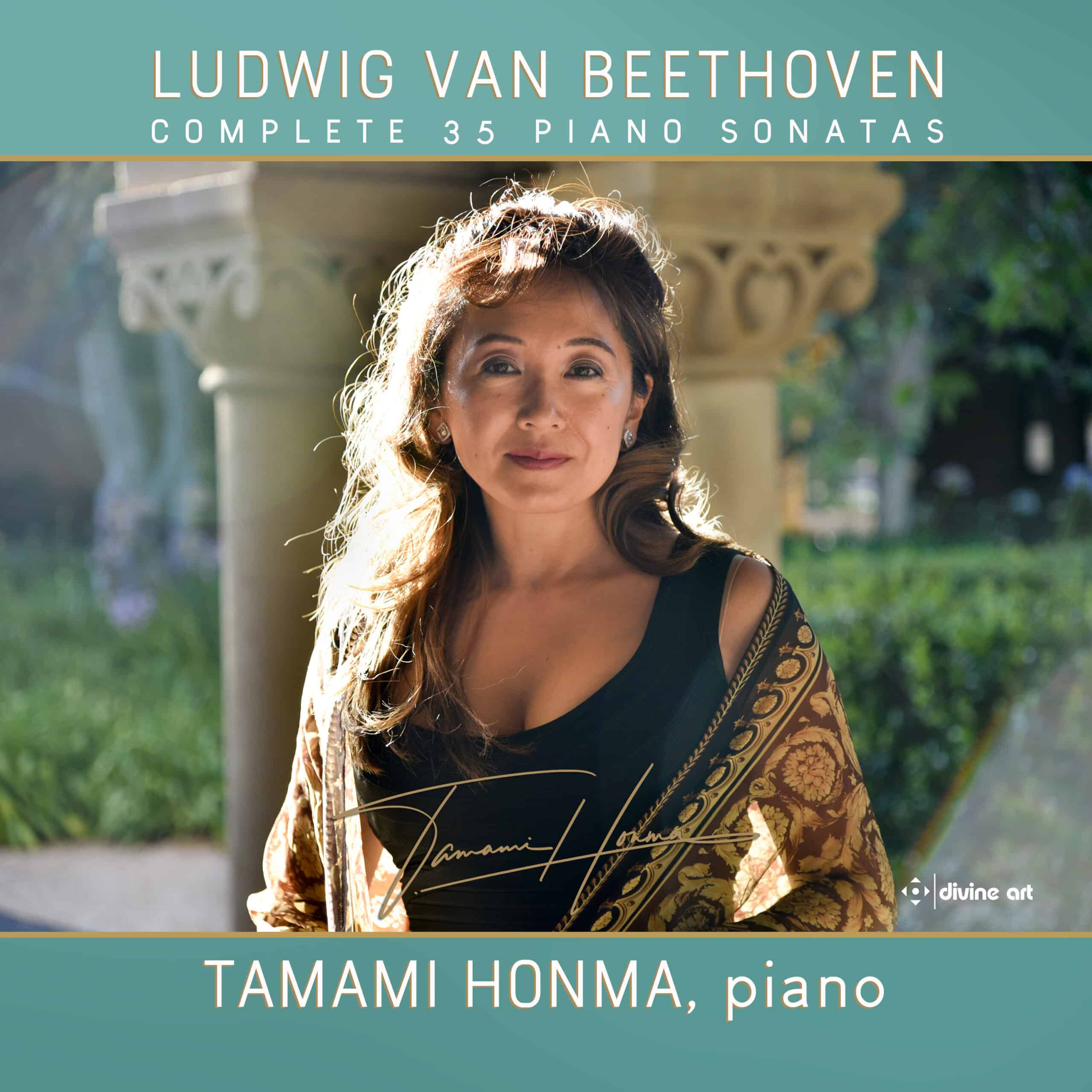
Ludwig van Beethoven: Complete 35 Piano Sonatas
Experience the full scope of Beethoven’s musical evolution with this comprehensive collection of his 35 piano sonatas, meticulously organized in chronological order to offer a panoramic view of his artistic journey, tracing Beethoven’s transformative progression as a composer.
While opus numbers traditionally guide the dating of Beethoven’s works, exceptions abound, notably in the case of the Opus 49 Sonatas. This collection challenges the conventional exclusion of the early “Kurfürst” Sonatas, shedding light on Beethoven’s formative years as a composer. Musicologist Professor Barry Cooper’s advocacy for their inclusion, based on their publication by Beethoven himself and their intrinsic merit, finds resonance in this comprehensive set.
Pianist Tamami Honma brings these sonatas to life with precision, adhering closely to Cooper’s editorial corrections in the ABRSM edition. Cooper’s meticulous research, comparing original manuscripts, early editions, and historical sources, ensures an authentic interpretation of Beethoven’s intentions, from note values to nuanced articulation. This collection is not merely a recording; it is a vibrant testament to Beethoven’s brilliance, offering a fresh perspective on his extraordinary works.
Renowned Japanese-American pianist Tamami Honma is celebrated for her expressive and captivating performances, earning acclaim in prestigious venues such as Wigmore Hall, St John’s Smith Square, and Carnegie Hall. Her recordings, including the Chopin concertos with the Vilnius String Quartet, have garnered five-star reviews in Gramophone and the BBC Music Magazine. As a distinguished piano performance educator, Honma serves on the music faculty at Stanford University and Santa Clara University