Catalogue Connection: 21101

  • Rachmaninoff American Record Guide Review

    The most common CD program of Rachmaninoff’s two-piano pieces is the two suites along with the Symphonic Dances. Here the first Trio and two short pieces arranged for piano trio are offered along with the suites. For me, they are the best thing here. The Suites are quite adequately done, a little on the slow side, but that allows for some details to emerge that are not often heard. There is plenty of world- renowned competition in the suites: Argerich-Friere and Ashkenazy-Previn are two that sit at the top of my favorites. If we go back in time, Vronsky-Babin are superb and played them for Rachmaninoff, who also played at least Suite 2 with Horowitz (wish that had been recorded). In recent years, they have been played at Carnegie Hall by Trifonov and Babayan, who also played the Symphonic Dances. I assume they recorded (or will record) these for DG. The suites here are individual enough to create interest in their many-faceted details. 

    Polish pianist Barbara Karaskiewicz plays on every track and also translated the booklet essay by Mlynarczyk from Polish to English. She teaches at two colleges in Poland, and this is her ninth CD. The Huberman Piano Trio appears to have been founded in 2014 and has recorded at least one other CD. Cellist Rysanov has been a member since the beginning, but it was unclear as to when pianist Karaskiewicz joined. Violinist Swystun joined in 2022. Their Rachmaninoff Trio is top notch. It is a big single-movement piece that is usually a filler on CDs of the much longer Trio 2. This first trio was written in four days as a tribute to Nikolai Rubinstein in 1892. It was not published until after Rachmaninoff died. The Huberman Trio plays this rarely heard piece with all the passion and attention to detail one could ever want. The additional trio pieces are an uncredited, but very effec- tively arranged Elegie Op. 3:1 and the well- known Vocalise arranged by Julius Conus for piano trio. With all of the available recordings of the 2-piano suites, it is the trio pieces that set this release apart and make it worth getting. 
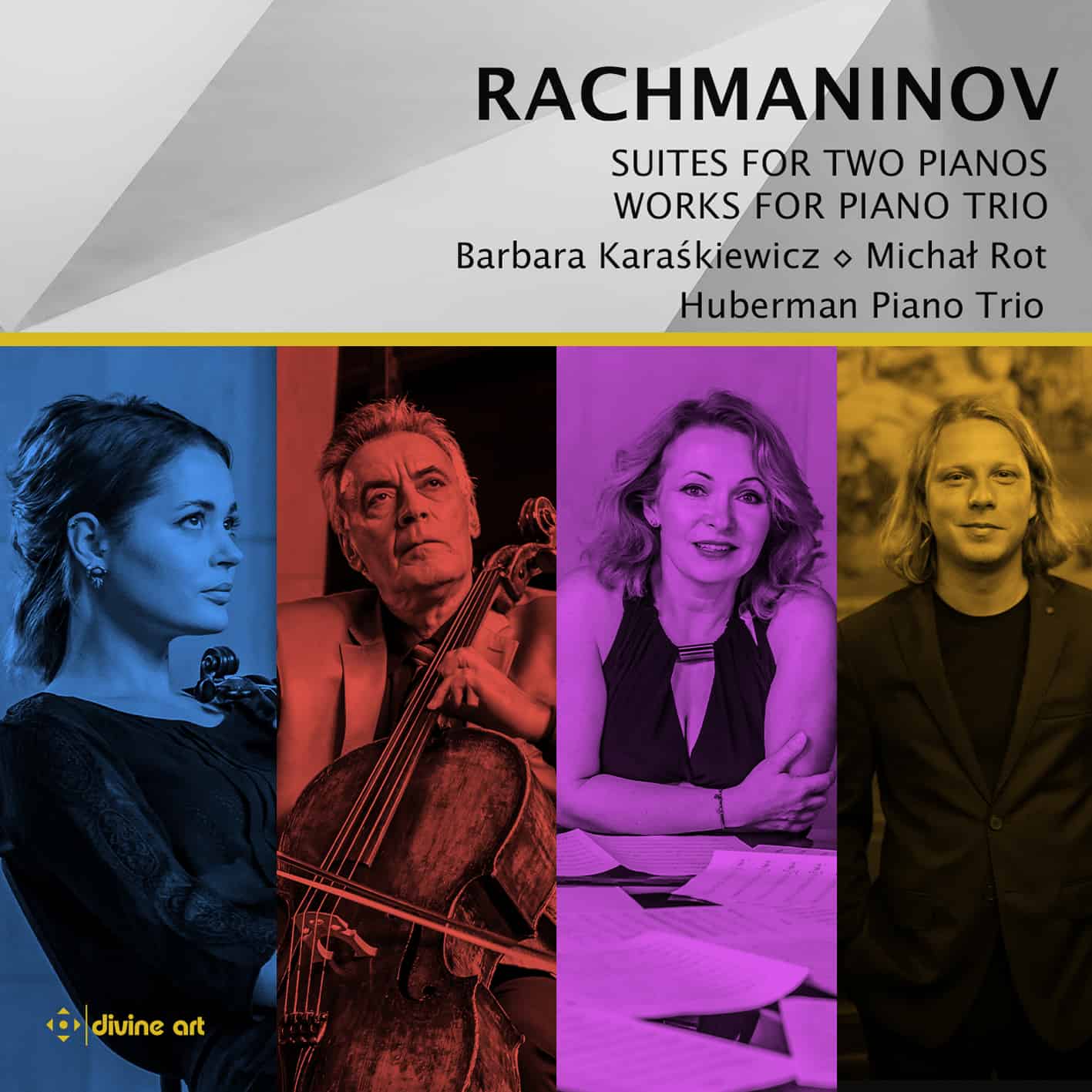
  • Rachmaninov: Suites for Two Pianos / Music for Piano Trio DDX 21101: online review

    This Divine Art recording of chamber works by Sergei Rachmaninov was made in Poland. The insightfully written liner notes by Beata Młynarczyk are accompanied by comments by Rachmaninoff himself.

    Sergei Rachmaninov did not write much chamber music. Most of his chamber works were composed between 1890 and 1896, only three after 1900. A record of the youthfully passionate writing of the Russian composer reads: A composer’s music should express his country of birth, his religion, his romances… It should be the sum of his experiences… Music is the sister of poetry and the mother of sorrow…

    Recording engineer Wojciech Marzec used to great advantage the acoustics of the Łódź Academy of Music, and the Czestochowa Philharmonic, where the recording was made.

    Barbara Karaśkiewicz and Michał Rot play sublimely in Suite No. 1 for two pianos and the Suite No. 2 for two pianos, Op. 17 with a command of the grand Romantic style seldom heard these days of soulless playing of some of today’s superstar pianists.   In the same manner, the superbly accomplished members of the Huberman Piano Trio bring to life the Trio Elegiac No. 1 in G minor, and both the Elegy from the 1882 Five Fantasy Pieces, Op. 3, and the familiar 1915 Vocalise. The two miniatures are separated by 33 years, yet imprinted by the composer’s gift for memorable melody, which in the enormously gifted hands of pianist Barbara Karaśkiewicz, violinist Dagmara Swystun, and cellist Sergei Rysanov are heard again in impeccably delivered readings.

  • Rachmaninov: Suites for Two Pianos & Music for Piano Trio

    Rachmaninov: Suites for Two Pianos & Music for Piano Trio

    A new album of chamber works by Sergei Rachmaninov. This outstanding recording was made at two venues in Poland: the Łódź Academy of Music, and the Czestochowa Philharmony. The principal performer is pianist Barbara Karaśkiewicz who has made several highly praised recordings for Divine Art (and before that the esteemed Polish label Acte Preable). She performs two piano duos with her musical partner Michał Rot. The chamber works are played by the Huberman Piano Trio whose Divine Art recording of 20th Century Chamber music was also acclaimed by critics.

    Both the performances and the perfectly engineered recording offer a sumptuous program of Rachmaninov that will delight listeners.

    The Huberman Trio was formed at the initiative of Barbara Karaśkiewicz, named in honour of the great Polish artist Bronislav Huberman, famed for his performances and transcriptions of works by Chopin and others.