Catalogue Connection: 21102

  • Bach Tranquillity Performing Arts Review

    Individually, each selection on the Tranquillity album is a moonstone of clairvoyance and spirituality in Phillips’ interpretations. As a whole, the set transports the listener beyond consciousness.

    Jonathan Phillips’ cleanly articulated, well balanced, and perfectly voiced performances confirm beyond doubt he is a pianist’s pianist. Technique is a given at this level, but Phillips takes full advantage of the modern piano’s capacity for delicacy and nuanced color.

    The keyboard pieces he has selected are risky, because so well known. It is Phillips’ intimacy of messaging that elevates this album. Breaching sensitively the still pond of the composer’s already private soundscape with wonderful hesitations, lovely and relaxed executions, and discreetly meditative embellishments, Phillips transports the listener to sound imagery intractable by ordinary soul compass.

    Revelatory performances on this album include Ich ruf du zir, Herr Jesu Christ (I call to you, Lord Jesus Christ), BWV 639 (track 2) – each individual note and every superb chord are somehow momentous in Phillips’ interpretation. The pianist utilizes the modern piano beautifully, with subtle dynamic shadings, wonderful interpretive hesitations, and cadential rubati that add meaning to each fraction of melodic narrative.

    Prelude and Fugue in C sharp minor, BWV 849 (tracks 6 and 7) – Phillips’ magnificent understanding of sostenuto makes each note weighty with meaning. Yet there is also a finesse to this controlled energy that sets Phillips’ performance apart. Clarity, concentrated power, and control of the instrument pay off, abetted by utterly satisfying forward movement.

    Organ Sonata No. 4 in E minor, BWV 528 – Adagio (track 12) – so simple, its essence stroked delicately by Phillips’ subtle comprehension of where and how the melodic line is being developed and varied by the composer. Phillips makes the piano soar with expression; his voicing is glorious. The pianist’s intuitive understanding of Bach’s harmonic movement gives the listener opportunity to enjoy fresh interpretive surprises, all nuanced in style and elegance.
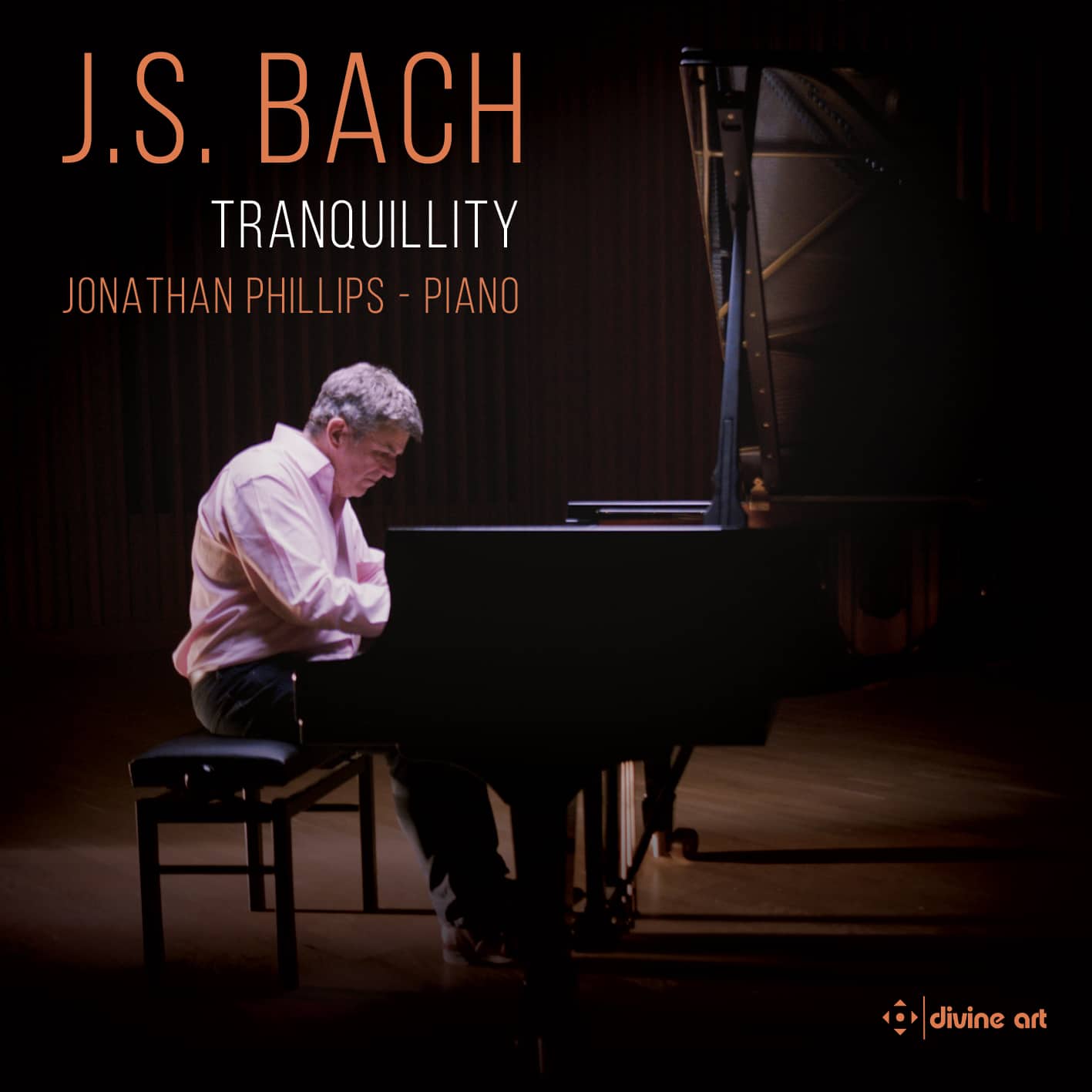
  • Bach: Tranquillity Fanfare Review

    This CD is titled Tranquillity, and the title should give you a good idea of what to expect from the program. The pianist writes, “Bach’s music has radiance, luminosity, divinity, serenity, and timeless beauty. There is tenderness and sometimes melancholy, but it is always suffused with optimism, and as Bach indicates at the end of many if not all of his scores, his music is always written in the service of God.” Amen, I suppose.

    Phillips’s biography paints him as perhaps a reluctant virtuoso—a pianist who has enjoyed considerable success but who has shunned the limelight. On his website, the only other album listed is a Chopin disc (the four ballades plus a selection of nocturnes) and that hasn’t been released yet, although it should be by the time you read this.

    I suspect that his Chopin disc will be more successful, at least for me, than the one I am reviewing here. Tranquillity is hardly a failure, but not everyone will want to hear 76 minutes of slow music by Bach (first a movement of this, then a section of that, etc.) played in a manner more consistent with the 19th century and the Steinway than with the 18th century and a harpsichord. There is no denying that beautiful music is played and recorded beautifully on this CD, but Bach is not what sometimes is called “classical chill” and his music is not Romantic. You can’t fully appreciate Bach’s contemplative music without putting it in context, or at least juxtaposing it against his less inward, less contemplative music. It is said that less is more, but the opposite is also true.

    Still, this is gorgeous, sensitive playing, as long as you are willing to accept Bach’s music being treated and played this way. Still more impressive is Phillips’s statement that this recording was assembled from two “performances” (not live, apparently, but simulating live conditions) in a church in Oxford, “and that was pretty much that.” In other words, this recording was not put together in a studio from numerous takes and retakes, and I respect that integrity very much.

    Several of these works are played in arrangements by Busoni, Siloti, or August Stradl. Phillips acknowledges this in his booklet note, but we are not given specifics. Piano mavens should be able to figure it out on their own … but they should not have to. Let’s give credit where credit is due. This is the second CD that I have reviewed in this issue which has taken a casual approach to attributions. Maybe it seems musty or old-fashioned to mention this. This lack of detail, too, smacks of “classical chill.”

    Enough complaining. Phillips can play Bach’s music for me whenever he likes, but not necessarily for as long as he likes.

  • Bach: Tranquillity (DDX 21102): CD Hotlist Review

    The title of this recent Bach recording might lead you to expect some kind of minimalist – or perhaps even New Age – approach to the music.  But that’s not what’s happening. Jonathan Phillips’ solo piano recording is straightforward: it’s a warmly produced and intimate-sounding collection of selections from Bach’s keyboard compositions including assorted preludes and fugues, sections and movements from the Goldberg Variations and various concertos, arrangements of cantata extracts, etc.

    All are selected with the purpose of helping “anyone hoping to gain an overriding sense of stillness, calm, contemplation and reverence.” Phillips makes no sacrifices of rigor in his interpretations, which are both emotionally rich and stylistically thoughtful — but he has successfully selected a program that gently feeds the soul.

  • Bach: Tranquillity (DDX 21102) – MusicWeb review

    This is a programme of Bach’s keyboard music which is ‘for anyone hoping to gain an overriding sense of stillness, calm, contemplation and reverence’, to quote the note by the performer. Jonathan Phillips casts his net widely; apart from original works intended for the clavier, there are transcriptions by Bach himself, Busoni, August Stradl and Alexander Siloti. The sources include the Well-tempered Clavier, chorale preludes for organ, a slow movement of an organ concerto (arranged from Vivaldi by Bach), a movement from one of the Organ Trio Sonatas, the slow movement of the Italian Concerto and two Sarabandes from the French and English Suites. All the items are very well played in a way which makes you forget that you are listening to modern grand piano; one is simply conscious of Bach’s music, which is as it should be.

    It is not intended a criticism to state that, taken as a whole, the contents of this disc do not constitute a satisfying programme because they are not meant to. Listened to at one sitting, there is, inevitably, a lack of contrast, but I doubt whether that was the intention. Divided into groups of 6 or 7 tracks, the effect is very pleasing and in the best possible way, tranquillising. It did make me want to hear more of Jonathan Phillips’ Bach-playing and I hope that he may be encouraged to commit more of the composer’s music to disc, perhaps to explore other facets of Bach’s musical personality.

  • Tranquillity DDX 21102 – review from Atlanta Audio Club

    British pianist Jonathan Philips, a graduate of the Royal Northern College of Music with over a hundred performances of concertos by such major figures as Rachmaninoff, Tchaikovsky, Chopin, and Schumann under his belt, shows that he can distinguish himself in the quiet, solo repertoire for piano as well. This album of keyboard pieces by J. S. Bach is called “Tranquillity,” and the title is well chosen.

    Pieces such as these must have meant a great deal to Bach who is known to have played them frequently in his own moments of quiet-hour pleasure and refreshment. Such moments must have meant a great deal to someone whose life was often quite turbulent. (Bach, as a matter of fact, was once reprimanded by the authorities for getting into an altercation with a fellow musician, whom he taunted by calling a “nanny-goat bassoonist,” to the point where swords were drawn. Happily, friends intervened and no one was injured in the fracas!)

    In the present program, Jonathan Philips has carefully selected music that affords pleasure to listener and performer alike, ultimately giving rise to feelings of centeredness and well-being. They include various preludes and fugues, conceived as such, as well as extracts from such larger works as the Largo from the Organ Concerto in D Minor, BWV 596; the Lutheran chorale Nun komm der Heiden Heiland (Come Now, Saviour of the Nations), BWV 659a, which Bach was to use in his Cantata No. 61 and which is heard here in the famous arrangement by Ferruccio Busoni. Also, the Aria from the Goldberg Variations, BWV 988; the Andante from his Italian Concerto, BWV 971; and the Largo from Organ Concerto No. 4 in D Minor, BWV 596, to cite only some of the more familiar pieces.

    We are also given excerpts, finely conceived, and executed by Philips, from the English Suites nos. 1 and 2, the Adagio from the Toccata in C major, BWV 564, in another memorable Busoni arrangement; plus, Bach’s own setting, BWV 974, of the hauntingly beautiful Adagio from the Oboe Concerto in E Minor by Alessandro Marcello.

    There are 21 pieces in all in this album “Tranquillity,” all calculated to appeal to the inner man or woman in us all. And the performances are as treasurable as the music itself.

  • Bach: Tranquillity – Chronicle review

    This is for anyone who wanders round garden centres thinking a nice New Age CD based on whale noises captured at a holistic cetacean sanctuary by Terry Oldfield and turned into bland and unsatisfying music would be good, were it not for the fact that he’s made 800 other CDs that all sound the same, and your friends will laugh at you. This is Bach, so this is classy music for people wanting to achieve a sense of calm (or sense of clam maybe, if you’re a whale). The sleeve notes even cite Immanuel Kant.

    Bach produced several gentle and peaceful works and many of these are here, collected by pianist Jonathan Phillips. “This CD contains music for anyone hoping to gain an overriding sense of stillness, calm, contemplation and reverence. Bach’s music has radiance, luminosity, divinity, serenity, and timeless beauty,” say the sleeve notes, and that about does the review for us. Thank you and goodbye.

    The programme contains a selection of original Bach compositions and transcriptions, including one transcription by Bach himself on a melody by Marcello. There are two organ pieces, and the opening movement of one of Bach’s Cantatas.

    Notes the pianist: “In my view, they all work extremely well on the modern piano. I am convinced JS Bach would have approved of the modern Steinway concert grand piano on which this CD was recorded.”

    It is indeed calming and relaxing, and in places there’s a sense of proportion, probably introduced by the fact that Bach wrote music in praise of God and there’s a certain religious immensity in places.

    It’s also got a nice organic feel: the sleeve notes say that two complete performances were recorded at St John the Evangelist Church in Oxford, “and that was pretty much that”.

  • J S Bach: Tranquillity

    J S Bach: Tranquillity

    Like all great composers, Bach wrote lively dynamic pieces for keyboard as well as in his cantatas etc. But he also produced many wonderful gentle and peaceful works and many of these are collected by pianist Jonathan Phillips in his new album ‘Tranquillity’. This recording contains music for anyone hoping to gain an overriding sense of stillness, calm, contemplation and reverence. Bach’s music has radiance, luminosity, divinity, serenity, and timeless beauty.

    Jonathan Phillips (“a musician of real quality and finesse” – The Times) has broadcast for the BBC, Russian and Italian and Swedish TV and radio, and has given recitals all over the UK, Europe and former Soviet Union.