The distinguished Australian (long UK resident) composer John Carmichael was born in 1930, and has enjoyed a significant reputation for the sheer musicality of his work – steeped in the tonal tradition, and formally never seeking to shock or shout – ‘Look, everyone! It’s me!’ – creativity unfailingly notable for its
inherently aesthetic qualities, which, in musical terms of course mean its melodic distinction and natural harmonic under-pinning and intelligence of structrualisation.
This new disc is most welcome and is comprehensively recommended, ranging from relatively short chamber-music pieces to the Second Piano Concerto and the wind Nonet ‘On the Green’ – and, al-in-all, forming a splendid portrait of an excellent and admirable composer whose music is eminently worthwhile getting to know.
The admirable standard of the artists willing to perform and record Carmichael’s work is itself proof positive of the quality of his inspiration, and the practicality to which the results of that inspiration are
put. The result is an outstanding CD: one can only recommend to performers (and their audiences) such fine music as Contrasts (for viola and piano), the Second Concerto and the notably impressive Piano Trio ‘Toward the Light, as well as the frequently humorous (in the musically best sense) wind nonet On the Green.
Make no mistake, this is an eminently worthwhile issue of some quite outstanding music, which in today’s teeming world is in serious danger of becoming unnecessarily overlooked. Strongly recommended.
Catalogue Connection: 21103
-
John Carmichael Toward the Light Musical Opinion Review
-
John Carmichael Toward the Light Fanfare Review
John Carmichael (b. 1930) is an Australian composer who describes himself as “a Romantic.” His music is tonal and conservative, strongly influenced by the French Impressionists, with touches of Rachmaninoff as well. In his introductory notes, Carmichael says, “Because it is quite accessible, my music is sometimes labelled ‘light music’; I would simply like to quote Stravinsky – ‘There is no such thing as light music – only good or bad music.’” Actually, I know of no such quote by Stravinsky, and could not find one through an internet search. The closest approximation is a quote often attributed to Duke Ellington: “There are two kinds of music. Good music, and the other kind.”
This disc was my introduction to Carmichael’s music. Paul Snook gave an enthusiastic review to his Trumpet Concerto (Fanfare 29:6), writing “this is simply one of the most coherent and effective works in its genre.” I share Snook’s enthusiasm for some but not all of the works on this disc. The most effective pieces are the two for viola and piano, Ariaand Contrasts, particularly the latter. Morgan Goff and Antony Gray dive into the music, playing with tonal beauty and flair. The last movement of Contrasts, titled “Flamenco,” is lively but also tinged with a bittersweet mood.
Short Cuts, which is subtitled “Divertimento for flute, oboe, clarinet, and piano,” is a suite of eight short pieces. All four instruments come together only in the finale; in the first seven movements we hear the piano and one or two of the other instruments. Short Cuts was written to be performed by faculty members of the Camden School for Girls in London. The music is charming and witty. On the Green was composed for a wind ensemble called Octanphonie, and its three movements recall the enjoyment of parks and green spaces. The influence of jazz is present in the enjoyable first movement, “Summer’s Day on the Green.” Inspiration flags in “Nocturne,” which is the longest and the most aimless movement, but the final “Funfair on the Green” is a delightful romp.
The 17-minute Piano Concerto that opens the disc is the biggest disappointment. Its gestures don’t add up to a persuasive whole; the thematic material isthreadbare, and the composer resorts to a good deal of repetition. The following Piano Trio, “Toward the Light,” has the strongest French influence, but it too seems to have no real direction.
The performances are all committed and skillful, and the recorded sound is natural. In the end, I find it hard to give an enthusiastic recommendation to this release except to those with an insatiable curiosity.
-
Toward the Light InfoDad Review
The focused nature of a new Divine Art recording featuring the music of John Carmichael is clearly on the composer: the Faliks disc omits composers’ names, while this one’s outer packaging makes no reference to any performers. Carmichael (born 1930) has amassed a notable although not particularly large catalogue of works, most often focused on the piano – he himself is a concert pianist. He is also a music therapist – one of the first – and it can be interesting to listen to his own works with that in mind. However, the six variegated pieces on this CD are not especially therapeutic or, for that matter, especially closely related to each other – the disc is really an exploration of multiple aspects of Carmichael’s musical interests. Piano Concerto No. 2 features three well-balanced movements for piano and strings; echoes of Rachmaninoff are notable, but the overall impression is more intimate and altogether gentler, especially in the nicely flowing central Andante. The Piano Trio “Toward the Light” is also a three-movement work with a fine sense of balance among its elements, and here the neo-Romanticism is if anything a bit more pronounced, the passionate elements somewhat more heart-on-sleeve than in the concerto. Interestingly, the second and third movements of both works have the same tempo indications: Andante and Moderato ma molto ritmico. The trio’s third-movement pizzicato elements are especially engaging.Aria for viola and piano is a warmly expressive single movement, while Contrasts is a three-movement work that, true to its title, offers listeners significantly contrasting experiences that conclude with a bouncy Flamenco. The eight-movement divertimento Short Cuts is neatly titled – its components range in length from one minute to three – and is pleasant and lightweight. It neatly showcases Carmichael’s ability to write idiomatically for individual and paired woodwinds as well as piano and then, in the final movement, brings everyone together for an exuberant finale. The CD concludes with the mildly Impressionistic On the Green, its three movements first swaying gently, then emoting expressively, and finally tripping along jauntily and ebulliently. This Carmichael disc shows him, in a sense, as a miniaturist: there are 22 tracks on the CD, and most are short, as the composer makes his points with clarity and directness and then moves on to something else. The disc’s Carmichael-only focus makes it immediately appealing only to audiences that already know and enjoy this composer’s music, but the music itself, expertly crafted, tonal and accessible, has the potential to engage listeners who do not know the composer yet but are willing to open themselves up to a welcome set of new musical experiences.
-
Toward the Light MusicWeb Revie
Australian composer John Carmichael, who will be 94 this year, found his style early in his career and its neo-Romanticism has not changed in seventy years. There is no reason why it should, as he has a phenomenal musical technique, writes wonderful melodies, and his music provides much needed calm in these difficult times.
He was born in Melbourne, Australia. He studied piano and composition at the University Conservatorium there, followed by two years of piano studies with Marcel Ciampi at the Conservatoire National in Paris. Further composition studies followed with Arthur Benjamin and Anthony Milner in London. He was one of the first group of musicians working for the Council for Music Therapy, for whom he introduced groundbreaking music therapy programmes at Stoke Mandeville Hospital and Netherden Mental Hospital, Surrey. In 1960, he became musical director of the Spanish dance group Eduardo y Navarra, with whom he toured extensively. Much of his music seems imbued with the spirit and rhythms of the dance. His most well known work is the first piano concerto, the Concierto Folklorico, inspired by his work in flamenco.
This Piano Concerto No 2 is a short work and seems most indebted to his teacher Arthur Benjamin, also an Australian, long resident in the UK. It is full of memorable tunes and is gloriously orchestrated. Like the first concerto, it has a flamenco influence, with a figure growing out of the cadenza in the first movement being a close relation to works by Albeniz and Falla. It would be a perfect work for the new-look BBC Radio 3’s ‘Friday Night is Music Night’. Australian pianist Antony Gray plays magnificently, his cascading arpeggios giving Leonard Pennario in Midnight on the Cliffs mode a run for his money. The St Paul’s Sinfonia, under the extremely gifted conductor Andrew Morely, give no clue as to their ad hoc status and play as though they work together every day.
Towards The Light for piano trio is a companion piece to Carmichael’s Piano Quartet Sea Changes and really is a substantial addition to the repertoire. The first movement is by turns elegiac and turbulent, before ending mysteriously and enigmatically. The elegiac feel is continued in the slow movement, which is beautifully structured. There seems to be some anger or bitterness in the central section, where the violin and cello get to demonstrate their emotive best. The finale does its best to clear the air and provide some sort of positive resolution, though it is not all plain sailing. Ultimately, though, the dynamic wins over the lyrical and the work ends triumphantly in the light. The playing from all three artists is superb, there being a wonderful balance of tone and colour which is magnificent captured by the engineers.
The viola is a difficult instrument to write for and it takes a good composer to make it work. Mr. Carmichael is just such a composer and the twenty-two minutes of music for viola and piano recorded here show the instrument to its advantage. The original work Aria and Finale was written in 1990 for saxophone and piano; the composer later arranged the work for viola and piano. Only the Aria is recorded here. He has done a sterling job in arranging the work, as hearing it now on viola I cannot imagine it on saxophone. The viola lends a particular character to the work, highlighting the darker side in the score. It sings long melodic lines, intertwining with the piano’s substantial contribution. A wide range of moods from sombre to joyous, even playful, provides opportunities for both players to highlight both their technical and expressive skills and the players here revel in it.
The second work, the three movement entitled Contrasts, aims to show the wide range of expressive and technical possibilities of the viola. To emphasise this, each movement is emphatically contrasted. Zephyr conjures a lilting, gentle breeze. Remembering brings sadness of remembered joy and shows just how emotive the viola can be in its lower register. The finale Flamenco is coloured by that extravagant dance style without being mere pastiche. The contrast between bowed and plucked sounds is particularly effective and there is a vital rhythmic interplay between the duo.
Short Cuts, a divertimento for flute, oboe, clarinet, and piano, does exactly what it says and is diverting. The sound world is reminiscent of the jolly, yet masterful works of Jean Françaix. Each instrument has a solo; then at the ending they all play together. Various Latin American or Caribbean dance forms are alluded to in very successful pastiches. The piano has a delightful nightclub tango. Despite all the humour, there are also some genuinely touching moments, notably in the extended clarinet and piano number and the duet for oboe and clarinet. The final chase brings the work to a rousing close.
On the Green, for the unusual combination of wind nonet, rounds the disc off nicely. The inclusion of contrabassoon in the ensemble gives a wonderful richness to the work. After the calm of the nocturnal middle movement, the last movement, which imagines the green as a funfair, brings the work to an exciting and emphatic close.
The liner notes are patchy. They give no dates for composition nor for first performances. This may be down to the composer, as his website has very few dates on it either. Antony Gray appears as Antony Grey under his photograph. Niggles aside, in these troubled times, it is wonderful to have on disc such life affirming music. It gives me pleasure and it sounds as though it gave pleasure to the players, too. Although recorded over a number of years in different venues, the recorded sound is excellent in all tracks. Life would be better if such music made its way onto the concert platform.
-
Toward the Light Charlottesville Classical
I admit I wasn’t at all familiar with John Carmichael’s work before this release crossed my desk. I’m glad it did. “Toward the Light” has a healthy sampling of Carmichael’s catalog. Enough to encourage me to explore further.
John Carmichael is an Australian pianist and composer, who worked mainly in the UK. A good deal of his works involve the piano. This release includes his second piano concerto. Four of the five chamber works on the release include piano.
Carmichael writes in an accessible post-Romantic style. The tonal structure of his music is easy to follow — but never cliche. The Piano Concerto No. 2 features Antony Gray, soloist, with the St. Paul’s Sinfonia and Andrew Morely.
The way Gray performs the work suggests it’s a joy to play. The gestures are big, but not overblown. The technique is challenging, but not impossible. And the music itself is engaging and well-crafted. And this is a very good performance.
Also included is the Piano Trio “Toward the Light.” Here the piano performs in partnership with the violin and cello. And yet it’s a very full part with lots going on.
The balance is a little better in the Aria for viola and piano. Carmichael writes effectively for the viola. He uses the instrument’s dark tone to write some wonderfully resonant melodies.
“On the Green” is a work for wind ensemble — no piano. It includes pairs of oboes, clarinets, horns, and bassoons. Plus a contrabassoon. I think it’s a real charmer. Carmichael uses his instruments to create a variety of interesting timbres. The music’s straightforward, almost bordering on light classical.
And there’s nothing wrong with that. “On the Green” has an immediate appeal. It should be a staple with community bands everywhere. I know it hasn’t, but perhaps this recording will help.
What I found most appealing about Carmichael’s music was its honesty. Carmichael is straightforward in his intent. And the clarity of that intention makes his music appealing (at least to me).
-
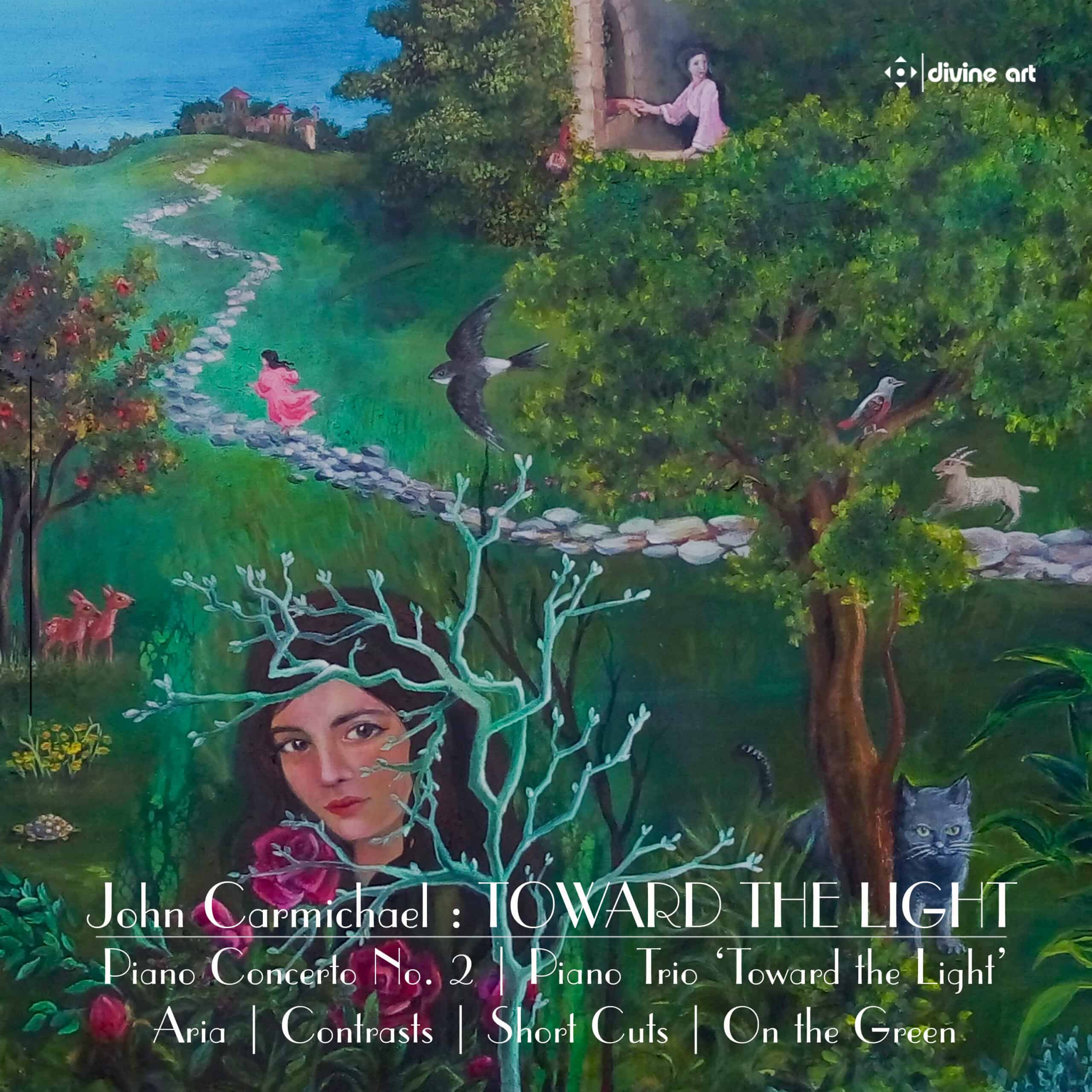
John Carmichael: Toward the Light
Divine Art presents the enchanting compositions of Australian maestro John Carmichael in this extraordinary collection. Carmichael’s distinctive neo-Romantic style, an exquisite fusion of originality with echoes of Rachmaninov, offers a lush musical journey that will resonate with a broad audience, particularly those less inclined towards avant-garde new music.
This album boasts a diverse selection of duos, solos, and a Piano Concerto characterised by exuberant pianism harmoniously paired with a string orchestra, culminating in a Caribbean-flavoured final movement. Carmichael’s compositions extend to a Piano Trio, Towards the Light, spotlighting the viola in works designed to elevate this often-overlooked instrument. The collection is further enriched by a Divertimento for flute, oboe, clarinet, and piano, giving the listener a varied repertoire where melodic elements take centre stage.
Collaborating with Carmichael are some of highly talented artists, including acclaimed pianist Antony Gray, whose recent Divine Art recordings of Saint-Saëns piano music have earned glowing praise, making them the label’s top sellers of 2022. Join us in this celebration of the potential in new orchestral and chamber music, where Carmichael’s melodic brilliance and the artistry of our distinguished performers converge to create a truly remarkable album.
John Carmichael was born 1930 in Melbourne, Australia. He studied piano and composition at the University Conservatorium there, followed by two years piano studies with Marcel Ciampi at the Conservatoire National in Paris. Further composition studies followed with Arthur Benjamin and Anthony Milner in London while Carmichael joined the first group of musicians working for the newly established Council for Music Therapy, for whom he introduced music therapy programs at Stoke Mandeville Hospital and Netherden Mental Hospital, Surrey. In 1960 he became musical director of the Spanish Dance group Eduardo Y Navarra touring extensively with them both abroad and in Britain; foreign languages are one of his passions – the latest challenge being Chinese.