Catalogue Connection: 21104

  • Clarinet and Saxophone Magazine Diary of the Bee Review

    Helen Leach’s career as a composer (which draws on her background as a clarinetist, has developed significantly around her experience of chamber music and her penchant for nature and landscape. She is partial to the exquisite countryside of her birth in the Scottish borders and this interest has been enriched by her present position as Composer in Residence at Marchmont House Berwickshire, an inspiringly scenic location “far from the madding crowd’. Indeed, one might describe the luxuriant surroundings of the estate, once overseen by another passionate advocate for music, Robert Finnie McEwen (a friend of Stanford, Vaughan Williams, Somervell and Boutt), as part of an artistic symbiosis since much of the music on this CD derives its creation from Marchmonts natural beauty.

    Leach’s love of the pastoral, which reveals an affinity for an earlier 20th-century British ‘school’ of composers (such as Vaughan Williams, E. J. Moeran, Gerald Finzi, Herbert Howells, Patrick Hadley and others) is evident in much of the repertoire with its fondness for lyricism, rhapsody and an unobtrusive injection of Scottish colour. This is especially evident in Prelude for a Royal Swan, the Melrose RhapsodyAn Edinburgh Farewell (a tribute to Prince Philip) and the solo quasi-baroque suite for cello, Letters from the Owl House.

    Where Hope Was Sown, dedicated to Oliver Burge, is a set of evocative miniature movements scored for oboe and string quartet, and the bucolic atmosphere of these evocative, illustrative pictures is echoed with even greater nostalgia in the works for clarinet and string quartet. The autumnal, occasionally melancholy ambiance of this instrumental combination finds an earlier romantic locus in Brahms’s famous quintet and Howells’s glorious Rhapsodic Quintet, but it was also very effectively exploited in the music Derek Bourgeois produced for the masterly BBC series of Anthony Trollope’s Barchester Chronicles made in the early 1980s.

    Leach seems in her element working with the tinctures of this sensitive amalgam, and her understanding of the clarinet’s athleticism, generous tessitura and dynamic range serves to give Tenera Caritate (Tender Charity), the longest work on this recording, and the affectionate, gossamer sounds of Diary of the Bee (a work which touchingly conjures up mental images of those naive drawings for the poems of William Allingham), a soothing, numinous poignancy. The performances on this CD by Richard Simoson (oboe), John Bradbury (clarinet) and members of the Victoria String Quartet are also executed with stylistic and diaphanous sympathy.

  • Diary of a Bee Textura Review

    The sheer delight composer Helen Leach experiences in creating is evident in every moment of this collection, which at eighty-two minutes provides an in-depth account of her music’s general character and her stylistic approach. The project exudes an appealing coziness in featuring her husband, pianist Simon Leach, as one of the musicians and in its having been recorded in the oak-paneled Music Room at Marchmont House in Berwickshire, Scotland, where the Hawick-born artist made the most of her tenure as Composer-in-Residence. Adding to the impact of Diary of the Bee is the fact that all of its chamber settings are world premiere recordings.

    Leach established herself first as a clarinetist (she was Principal Clarinet with the National Youth Orchestra of Scotland), and the instrument is prominently featured on the release. But its expansive sound world extends to oboe, piano, and string quartet too, the result a luscious chamber presentation. Splendidly rendering Leach’s pieces into physical form are the Victoria String Quartet (violinists Benedict Holland and David Greed, violist Catherine Yeats, cellist Jennifer Langridge), clarinetist John Bradbury, oboist Richard Simpson, and Simon at the piano.

    The sumptuous music Leach crafts is lyrical, rhapsodic, and richly melodic and more evokes composers like J. S. Bach, Ravel, and Handel than, say, Scriabin and Schoenberg. It is, consistent with that characterization, music of immediate appeal that shows no lack of sophistication for being so accessible. That these oft-pastoral pieces are grounded in storytelling, landscapes, and natural phenomena only makes them all the easier to embrace.

    Written to commemorate the seventieth anniversary of Queen Elizabeth II’s accession to the throne, Prelude for a Royal Swan instantly draws the listener into Leach’s harmonious world when Simon’s lilting patterns accompany Holland’s romantic outpourings in memory of the late Queen. Poignant and dignified, Helen’s homage provides a magnificent portal into the recording. The album’s longest standalone setting follows, at ten minutes Tenera Caritate an intensely rhapsodic expression scored for clarinet and string quartet and a fantastic showcase for Bradbury. That the Latin title translates as ‘Tender Love’ is apt when the tone of the piece, inspired by a visit to the Holy Island of Lindesfarne and dedicated to Helen’s husband, is so rapturous and lyrical. The free-flowing design of the music speaks to the authority with which she shapes material into satisfying wholes.

    Structured in six parts that individually relate to different aspects of the Lapwing (known in Scottish circles as the ‘peewit’), Where Hope Was Sown partners the string quartet with Simpson, whose oboe is ideally suited to convey the physical agility of the bird and the forlorn quality of its plaintive cry. Sometimes tinged with baroque elegance, Leach’s outdoorsy music is riveting throughout, its impact enhanced immensely by the musicians’ performances. If Simpson’s oboe is perfect as the lead instrument for Where Hope Was Sown, Bradbury’s clarinet is the same for the five-part title work in suggesting the insect’s movements from one wildflower to another. Leach’s focus in the work isn’t on the bee, however, but more on different wildflowers. Be it the stirring “Bluebell (Prelude),” tender “Thistle (Air),” or delightful “Forget-me-not (Scherzo),” these miniatures fully capture the innocent joy of being in a garden and experiencing its intoxicating sights and smells.

    Simon and Holland reconvene for the fittingly titled A Melrose Rhapsody, which vividly conjures the countryside of the Borderlands and the ruins of Melrose Abbey. Floating serenely in its upper register, the violin evokes the heights the hills reach, and the instruments together capture the spiritual peacefulness of the setting. An affectingly lyrical and lamenting tone is also expressed by the duo in An Edinburgh Farewell, Leach’s heartfelt tribute to Prince Philip, Duke of Edinburgh. Strings alone appear in the four nocturnally set excerpts from the six-part Letters from the Owl House, the instruments, cello and viola in particular, fitting choices to suggest the wisdom associated with the enigmatic creature. Leach affectionately dedicated the work to Hugo Burge, the owner and restorer of Marchmont House who built several owl houses across its grounds, and used historic Baroque dance types (allemande, sarabande, air, gigue) as springboards for her imagination in rendering the antics of owls into musical form. Scored for violin and piano, Song Without Wordswas also created with Burge in mind as a gentle expression of gratitude for his life and generous spirit.

    In its quiet reserve and sincere expression, Leach’s music on this release is uplifting in the best way and transporting in its evocativeness. While it certainly wasn’t created with it as its primary goal, Diary of the Bee makes one long to visit Marchmont House and walk amongst its grounds with her replenishing music as the soundtrack. This encompassing collection presents a most flattering portrait of her considerable gifts.

  • Diary of the Bee MusicWeb International Review

    Helen Leach lives in the Scottish Borders. She is composer in residence at Marchmont House, a Palladian mansion in Berwickshire. It was recently restored by its owners, Oliver and Hugo Burge, who have played a considerable role in supporting the arts in the region. Leach’s booklet notes show that she is very much enlivened by the natural world about her; many of the short works have a wildlife or plant-life inspiration. The booklet includes several colour photographs of the mansion inside and outside.

    Leach’s music on this disc may be best classified as Scottish Lowland pastoral. It is almost wholly quietish, never rising to a frenetic or sustained climax, melodically pleasant, and well distributed across instruments or groups of instruments. If one listens from one end to the other, a sense of melodic or stylistic sameness might accrue. It is far nicer to dip in and out to enjoy the composer’s inspiration. I think it is best to listen to each work whilst being aware of her own words set down thoughtfully in the notes.

    Leach composed the 3½-minute Prelude for a Royal Swan to commemorate the 70th anniversary of the accession of Queen Elizabeth II. Originally written for organ, it is played here in an arrangement for piano and violin. The long gently undulating melody is intended to be a musical portrait of the Queen.

    In the ten-minute Tenera caritate (tender love)for string quartet and clarinet, Leach’s inspiration were her many visits to Lindisfarne also called Holy Island. The work begins with the clarinet musing for a few bars, then joined by the quartet, in a journey through a whole spectrum of harmonic shades. The composer says that the music, marked Adagio teneramente (tender adagio), “speaks simply and directly from and to the human heart”.

    Leach devotes Where Hope was Sown, a set of six movements of 2½-3 minutes, to the lapwing also known as peewit. She says that the oboe – accompanied by the string quartet – struck her as particularly suited to portray the character and agility of the bird and its pastoral habitat. The booklet notes comment on the decline in lapwing numbers and the associated environmental issues. The composer grew to increasingly appreciate the distinctive beauty of the bird’s appearance.

    The first movement, The Day of the Peewit’s Return, is gently beautiful. The violin arabesques just about manage to avoid sounding like The Lark Ascending, and the oboe’s dancing tones help. (RVW has so much captured this type of pastoral feeling that anyone who ventures into that field has their work cut out to avoid comparisons.) In all movements, the string quartet is more than background accompaniment; there also are individualistic parts. For each movement, Leach wrote a poem, reproduced in full in the booklet.

    The 3½-minute Melrose Rhapsody from 2022 speaks of the powerful spirituality of the ancient Melrose Abbey and the surrounding countryside. The gently flowing 9-8 meter reflects the waters of the River Tweed. It is my favourite here, with a haunting principal theme. It begins with a couple of chords of bell-like piano tone. The violin enters quietly, introducing the theme.

    The Diary of the Bee is a nineteen-minute suite of five short pieces, each named after a flower that the bee would visit: bluebell (Prelude), thistle (Air), forget-me-not (Scherzo), wild rose (Romanza) and buttercup (Inroduction and Capriccioso). It would have been an option to make the instruments sound vaguely onomatopoeic. For the first seconds of the Prelude this does happen, but it is not overdone. The cello occasionally plays in its lowest register – in the Air and the Scherzo. There is a brief shimmer in the strings and, at the very end, a neatly done downward passage on the cello as the bee swoops downwards into the flower.

    Any British composer who styles a movement ‘Romanza’ has to be careful of comparisons with RVW. I am very familiar with his music, and I can say that at no point was I reminded of it. The Romanza is delicate and tuneful, as befits its title. The Introduction and Capriccio, suitably flighty, fully exploits woodwind acrobatics.

    The Letters from the Owl House, four pieces for solo cello, have traits of Baroque dances in their improvisatory character. They are intended to capture the beauty of the night sky in the unspoilt area of the world near the Marchmont Estate, where the local owls fly. The four-minute Sarabande represents a fallen oak, which the owls visit and revisit. I am not usually taken by music for solo cello, but this sarabande is melodically very attractive indeed.

    The Edinburgh Farewell, a commemorative piece in memory of the late Prince Philip, tries to catch some aspects of his character. This is very attractive melody.

    The Black Rood of Scotland, composed in the isolation of lockdown in March 2020, is a personal devotion for Holy Week. The composer’s her husband, Simon Leach, gave the first performance on the organ of Canongate Kirk in Edinburgh, later that year when the churches reopened.

    The melody of a Song Without Words came to Leach when she was improvising at the piano and thinking about the late Hugo Burge of Marchmont House. It is a melody of gentle sadness and reflection.

    A Cup of Kindness, inspired by the words of Auld Lang Syne, is written for the string quartet and oboe. Nostalgic, lyrical, tender and thoughtful, it makes a fitting conclusion for this unusual programme.

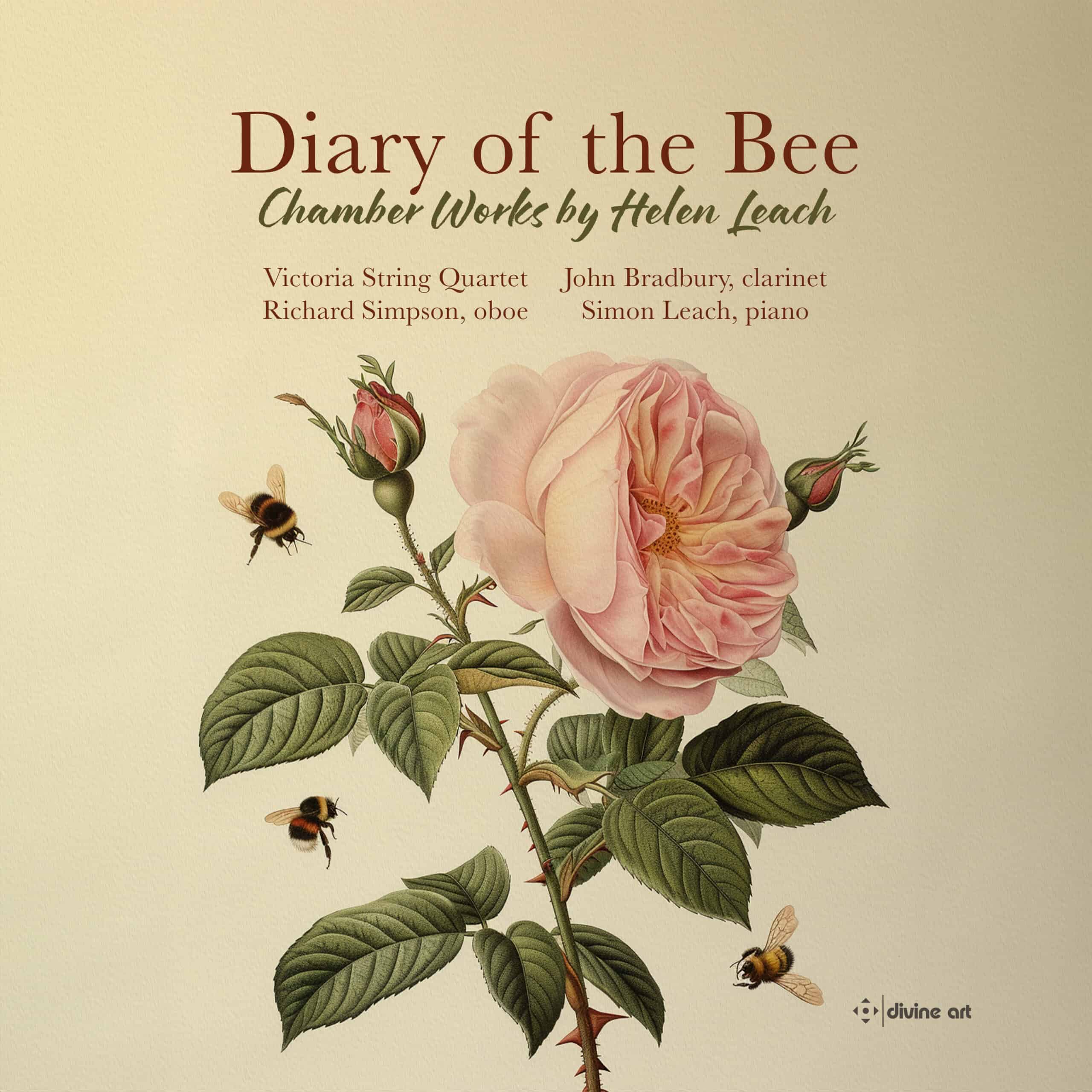
    I must single out the booklet. It has the most beautiful and thoughtful design and illustrations. Images of flowers, bees and birds appear throughout, especially alongside Helen Leach’s verses. Judging by the photographs, Marchmont House is an idyllic sort of place.
  • Diary of the Bee British Music Society

    Helen Leach lives with her family, she tells us in the colourful booklet, ‘in the beautiful Scottish borders’. Thus, it is not surprising that it is Scotland and Scottish connections which have informed and powered her own compositions.

    The CD consists of 10 works. I cannot go into all of them so I will point you in the direction of four which I feel represent what this CD is all about. Two of these pieces represent Royal events and are connected with Canongate church on Edinburgh’s Royal Mile, where her husband Simon, featured here as a pianist, is organist. 

    Prelude for a Royal Occasion opens the disc, and was played in the presence of HRH Prince Edward, Duke of Edinburgh in August 2023, and it is dignified and immediate in appeal. Similar in scope is Edinburgh Farewell, composed in 2021 for a memorial service in homage to HRH Prince Philip, Duke of Edinburgh. The original version was for Simon to play on the organ, but it is here heard on violin and piano. 

    The beautifully mournful The Black Rood of Scotland is scored for string quartet and oboe. It was written at the start of Covid. Leach writes that she ‘wanted to connect with the Christian roots of the country, and with a stream of melody and rich harmony’. 

    With similar Christian and strongly historical connections is Tenera Caritate for clarinet and string quartet, inspired by a place of ‘personal pilgrimage’, Lindisfarne. It is gentle and, like much of the music on this disc, will not ‘scare the horses’ but lure the listener into a world outside the hustle and bustle of everyday existence.

    The title of the disc is the longest work recorded here. The Diary of the Bee is a five-movement composition lasting 20 minutes, scored again for clarinet and string quartet. Five wildflowers are portrayed with their ‘beautiful hues and intriguing fragrances’. A poem about each, by the composer, with illustrations, is provided in the booklet. These are BluebellThistle with a touch of modality and a ‘scotch snap’ or two, the elegant Forget-me-not, the Wild Rose, and finally the jocular Buttercup. In every work the language is diatonic and tuneful. 

    And, for a work first heard in a school by ‘wide-eyed’ Scottish children, I can think of no better description of this piece than the comment made a young girl who I teach, who concluded ‘you know that’s really nice’. 

  • Diary of the Bee

    Diary of the Bee (Divine Art) is a collection of very different nature-inspired chamber pieces by Helen Leach, a clarinettist, composer and church music director based in the Scottish borders. Among some delightful neoclassical whimsy, baroque regal tributes and nods to Robert Burns, the highlight is Letters from the Owl House, a solo for cellist Jennifer Langridge that taps into the pastoral yearning of Ralph Vaughan Williams’ The Lark Ascending.

  • Diary of the Bee: Chamber Music by Helen Leach

    Diary of the Bee: Chamber Music by Helen Leach

    A Masterpiece Recorded at Historic Marchmont House

    Composer Helen Leach, known for her enchanting compositions that evoke rich landscapes and deep emotions, releases her album titled “Diary of the Bee.” This new collection features a series of rich, tonally traditional compositions. With all tracks being world premiere recordings, the album showcases Leach’s remarkable ability to blend lyrical melodies with profound storytelling.
    “Diary of the Bee” marks a significant addition to the classical repertoire, offering listeners an absorbing journey through Leach’s musical landscapes. Each piece on the album unveils a unique narrative, beautifully performed by leading instrumental soloists alongside the esteemed Victoria String Quartet. Reflecting on the inspiration behind her compositions, Leach shares, “Every piece in this album holds a special place in my heart, drawing from personal experiences and the beauty of nature that surrounds me.” Indeed, each composition in “Diary of the Bee” tells a story, from the evocative tribute to Prince Philip in “An Edinburgh Farewell” to the introspective musings captured in “Letters from the Owl House.”

    Among the highlights of the album is “Cup of Kindness,” a poignant ode to the universal warmth and blessings symbolised by Robert Burns’ iconic line, “we’ll tak’ a cup o’ kindness yet.” With its tender melodies and thoughtful arrangements, the piece resonates with a sense of harmony and peace.

    Another standout track, “Tenera Caritate,” showcases Leach’s mastery in crafting expressive rhapsodies, as she explores themes of love, hope, and healing through the emotive interplay of clarinet and string quartet.

    Listeners will also be enchanted by “Where Hope Was Sown,” a commissioned piece dedicated to Mr. Oliver Burge, of Marchmont Farms, which beautifully captures the essence of the Lapwing bird and its pastoral habitat through delicate musical motifs.
    From the haunting melodies of “The Black Rood of Scotland” to the elegant conversations of “A Song Without Words,” “Diary of the Bee” offers a tapestry of sound that is instantly appealing.

    Recorded at the historic Marchmont House in Scotland, where Leach is Composer-in-Residence, “Diary of the Bee” not only captures the essence of Leach’s compositions but also the timeless beauty of its surroundings. With its richly layered compositions and superb performances, “Diary of the Bee” stands as a testament to Helen Leach’s extraordinary talent and her ability to weave intricate musical narratives.

    The digital edition includes 2 extra tracks:
    Letters from the Owl House: Syzygy (Prelude)
    Letters from the Owl House: Touch of Heaven (Courante)

    Customers purchasing the CD from this website will receive the extra tracks as downloads. Download link is provided via email upon completion of CD purchase.