Catalogue Connection: 21106

  • American Choral Classics Congleton Chronicle

    This is an approachable album of American choral works; it’s not a Christmas album but if your Christmas is made better by some nice singing, this is for you. Despite the title, the choir, Alban Voices, is a chamber choir formed for St Alban’s Abbey, and it has featured in both “EastEnders” (December 2003) and on the radio, its recording of a Christmas song, accompanied by the Royal Ballet Sinfonia, played on Scala Radio and Classic FM in the run-up to Christmas 2022.

    As the title suggests, these are choral classics, not choral songs of one style, so we go from the grand melancholy of Randall Thompson’s “Alleluia” and Samuel Barber’s “Agnus Dei” to George Gershwin’s

    “Summertime”, then “Shenandoah” and, for the closing piece, Aaron Copland’s “I Bought Me a Cat”, which we guess must make a comic highlight for many a choral concert.

    The arc of the programme is thus from high art to the closer (“I bought me a cat, my cat pleased me, I fed my cat under yonder tree, My cat says fiddle eye fee”), good contrast from Thompson’s opener, which is essentially a plea for peace written in 1940.

    First play through, the variety is perhaps a little surprising, but it makes for an enjoyable programme. The set includes Aaron Copland’s “Simple Gifts”, the main theme of his ballet “Appalachian Spring” and better known to us as “Lord of the Dance”.

    Alban Voices sing clearly so you can pick up the lyrics — none are given, and we Googled the cat song — and we’d guess that more than one amateur choir member will wonder if this programme is a doable live show.

    Out on Divine Art, DDX 21106.

  • American Choral Classics Fanfare Review

    This is a fine collection of American choral works. There is sufficient variety of style in the program to hold the listener’s interest, and the choral singing is beautifully balanced. Alban Voices is a British choir who convincingly capture the spirit of these American pieces. The choir’s diction is crystal clear, so the fact that Divine Art doesn’t provide texts is not a significant issue. I should also note that their pronunciation of the English texts falls rather comfortably on American ears.

    Randall Thompson’s Alleluia for a cappella choir was commissioned by Serge Koussevitzky for the opening of Tanglewood in 1940. Koussevitzky expected a celebratory work, but instead he got this pensive, reflective piece in keeping with the mood of the country during the war. It is Thompson’s most popular work, moving in its beauty. The excellent tuning and blending of Alban Voices and their sensitive shading make this a very successful opener for the disc.

    Agnus Dei is Samuel Barber’s own choral arrangement of his famed Adagio for Strings. “Sure on this Shining Night” was composed as a song in 1938, and in that form is one of Barber’s most performed works. In 1961 he arranged it for choir and piano, and that lovely version is attractively sung here.

    Eric Whitacre’s intimate style of composition, along with his gift for melody, has made him among the most performed of American choral composers. The attractive setting of the poem “Lux aurumque” (originally in English but translated into Latin for this a cappella setting­­—poet unknown) is notable for its hushed, peaceful atmosphere.

    Copland’s In the Beginning is the most extensive work on the program. It is a cantata for mezzo-soprano and choir, telling the biblical Creation story. Copland mixed a few influences into his score, including Jewish liturgical music and jazz. The problem here is the edge and unsteadiness in mezzo Barbara Naylor’s voice. Her role as the cantor is important enough that her vocal flaws detract from the performance.

    The Alban Singers’ account of Ives’s Psalm 67 is successful in large part because of the precise tuning of the choir in a work that demands it. “Summertime” from Porgy and Bess is given here in a version that has an easy swing appropriate to the piece, and conductor Robin White’s arrangement of the beloved traditional folk song “Shenandoah” is also quite lovely. The disc closes with a witty, crisp performance of Copland’s “I bought me a cat” from his settings of Old American Songs.

    I cannot give this disc an unqualified recommendation, but it offers lovely choral singing of some very fine music. According to the Alban Singers’ website, “Our singers are all members of leading London and St Albans choirs. They are hand-picked for each event according to requirements.” Robin White’s notes are helpful, if a bit sketchy, and the recorded sound is excellent.

  • American Choral Classics DDX 21106 – Music Web review

    This is an imaginative programme, made up of many of the most attractive shorter American choral masterpieces.  In fact the most extended and complex piece here is Aaron Copland’s motet In the Beginning, which comes in at just over fifteen minutes.  Many others of the works, e.g. the Randall Thompson Alleluia, Samuel Barber’s Agnus Dei –  arranged from his famous Adagio for Strings – and Eric Whitacre’s ubiquitous Lux Aurumque,  are well-known to lovers of this repertoire, and to be found on many recordings.

    As it turns out, the Copland is the most convincing track on this CD – maybe it simply took up the larger part of the rehearsal time available, because it stands out as a really good effort at this very challenging piece.  The alto soloist, Barbara Naylor, does an excellent job.  It’s a very demanding part, and many of her entries are difficult to pitch, coming in as they do in a totally different key from the preceding choral section.

    The Alban Singers sing expressively, though they can’t match the excellence of James Morrow’s Texas University Chamber Singers (Naxos 8.559299), or of my personal favourite for sheer stylistic authenticity, on the Gregg Smith Singers’ disc of 20th century American Choral Treasures.  This dates from 1976, but in its CD transfer (on Albany) still sounds completely convincing. (Incidentally, it’s for sale on Amazon at £60.88. Yes, I know.  Instead I recommend looking for it on various streaming services, e.g. Idagio.)  

    Few of the other tracks rise to the same level. Barber’s beautiful setting of James Agee’s ‘Sure on this Shining Night’ receives a very sensitive performance; but the same composer’s Agnus Dei proves a bridge just too far.  The cruel exposure of the individual vocal lines does no favours to the Albans, especially their sopranos, who have a torrid time.  There are many fine recorded versions of this, notably Stephen Layton’s beautiful one with his group Polyphony (who also turn in a very moving performance of the Thompson Alleluia on Hyperion CDA67929).

    The less said about Summertime and Shenandoah the better – sounds like most of their best singers had another gig that day.  But Copland’s delicious I bought me a cat is done neatly, and makes an entertaining final track.

  • American Choral Classics DDX 21106 – Choir & Organ review

    ‘Non-obvious classics’ might have been a more selling line, since even with the presence of Aaron Copland’s ‘Simple Gifts’ and Gershwin’s ‘Summertime’, this is hardly a routine pops set.

    Opening with Randall Thompson’s elegantly simple and evanescent ‘Alleluia’ and closing with the Old-MacDonald simplicity of Copland’s ‘I Bought me a Cat’ the set organises itself with great naturalness around three further key pieces: Copland’s extended ‘In the Beginning’, Samuel Barber’s ‘Sure On this Shining Night’ and Charles Ives’s peerless version of Psalm 67, all of it sung with perfectly balanced reverence and delight by Alban Voices, to whom there is no cliché more applicable than ‘national treasures’.

    A living tribute to conductor Robin White and his late wife Frieda; time the music-loving new king tapped him on the shoulder.

  • American Choral Classics DDX 21106 – review from Textura

    Many things recommend this collection of American choral works performed by the UK-based chamber choir Alban Voices under conductor Robin White’s direction. Diversity, for one, as the set ranges from stirring meditations by Samuel Barber, Randall Thompson, and Eric Whitacre to choral renditions of “Shenandoah,” Gershwin’s “Summertime,” and Copland’s irreverent “I bought me a cat.” And concision, secondly, as the wide-ranging recording weighs in at a smartly considered forty-six minutes. That it includes a treatment of Copland’s In the Beginning as its centrepiece also argues powerfully on the project’s behalf, as does the participation of mezzo-soprano Barbara Naylor, who’s sung in The Cunning Little Vixen, The Rake’s Progress, and others, and pianist Peter Jaekel.

    The choir itself was formed more than two decades ago by White and his late wife, Freda, and was originally created as a relief choir for services in St. Albans Abbey, hence the ensemble name. On this recording, Alban Voices, whose members regularly appear in some of London’s most esteemed symphonic choirs, comprises nine sopranos, ten altos, nine tenors, and eight basses, with soprano Julia Blinko featured as a soloist in Barber’s Agnus Dei and Whitacre’s Lux Aurumque.

    A solemn tone is established at the outset by Alleluia, which, written by Thompson (1899-1984) in 1940, has become the composer’s best-known and most performed work. Hushed voices cast an immediate spell as they intone the titular word repeatedly and weave it into a delicate, polyphonic statement of soaring majesty. Its elegiac character is perpetuated by the subsequent settings, Agnus Dei and Lux Aurumque by Barber (1910-81) and Whitacre (b. 1970), respectively. The former is the composer’s own transcription for voices of his beloved Adagio for Strings and is as riveting in Alban Voices’ treatment as in its instrumental form. A natural complement to it is Lux Aurumque, a haunting expression Whitacre first shared with listeners via a ‘Virtual choir’ internet presentation. Barber returns on the recording with “Sure on this Shining Night,” a breathtaking exercise in uplift that’s elevated all the more by Jaekel’s graceful presence.

    Whereas Barber’s represented by two pieces, Copland (1900-90) gets three, beginning with “Simple Gifts,” whose joyous Shaker tune was written by Joseph Brackett, one of the movement’s elders, and was later incorporated into Appalachian Spring. At a minute-and-a-half, it acts as something of a prelude to the much more elaborate In the Beginning, which, over the course of sixteen engrossing minutes, couples vivid solo expressions by Naylor with choir singing that ranges between declamatory and susurrant. Intricate in design and contrasting in mood, tempo, and style, Copland’s dignified setting of the Biblical Creation allegory is less well-known than Rodeo, Billy the Kid, and Fanfare for the Common Man but is no less deserving of attention. In contrast to the seriousness of In the Beginning is the cheeky crowd-pleaser “I bought me a cat,” a natural encore choice that’s sequenced fittingly at album’s end.

    Elsewhere, American Choral Classics includes a piece by Charles Ives (1874-1954), Psalm 67, which, while it does possess aspects characteristic of the iconoclast—polytonality and rousing chants, to cite two—is as orthodox as an Ives work gets. Gershwin (1898-1937) is represented by “Summertime” (from Porgy & Bess), which is given a haunting treatment by the vocal ensemble; it’s also, however, a bit stiff, or at least seems so when the song’s usually delivered with greater swing. Similarly, while the choir’s performance of “Shenandoah,” presented in an arrangement by White, isn’t ineffective, it feels muted and would benefit from a stronger emotional punch. Even so, American Choral Classics earns its recommendation and then some, not only for solid performances by the choir but for working In the Beginning into its varied programme.
  • American Choral Classics DDX 21106 – BBC Music review

    This is a very wholesome and mostly familiar selection of works, in largely a cappella performances. The choir is in fine voice, though the roomy acoustic suites some pieces more than others – the Whitacre sounds lovely. A pleasant enough listen, overall, with Copland’s In the Beginning a discoverable highlight.

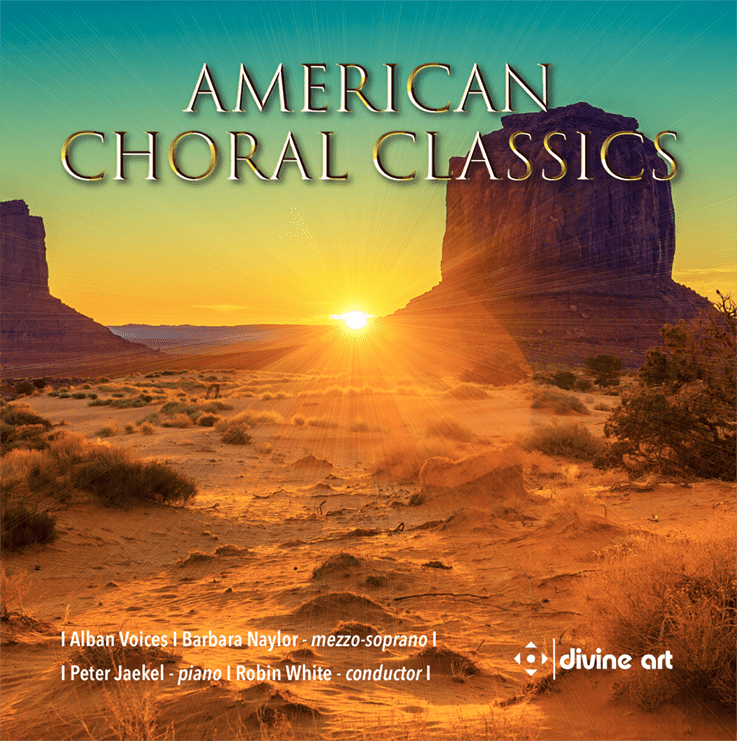
  • American Choral Classics

    American Choral Classics

    A fantastic collection of American choral classics ranging from Thompson’s sublime Alleluia to the terrific choral arrangement of Gershwin’s Summertime from Porgy and Bess.

    U.K. based conductor Robin White has put together this British interpretation of American Classics stemming from his own, excellent arrangement of the traditional Shenandoah. White’s arrangement balances the programme nicely along with Copeland’s I bought me a cat. This is a surprising and entertaining collection.

    Alban Voices is a chamber choir formed over 20 years ago by Robin White and his late wife, Freda, originally as a choir for St. Albans Abbey. Current members sing regularly in London’s top symphonic choirs. Among other appearances, it featured most notably in a pivotal episode of the BBC TV soap opera EastEnders in December 2003. More recently, the group’s recording of Robin’s original Christmas song, Light of the World, accompanied by the Royal Ballet
    Sinfonia, has been well received, and was played on Scala Radio and Classic FM in the run-up to Christmas 2022.

    Robin White trained at Imperial College, London and the Royal College of Music, studying conducting with Vernon Handley and orchestration with Bryan Kelly.

    He has conducted open-air, pop-classics concerts at National Trust and other venues across the south-west of England and the midlands. He has also worked with leading soloists such as John Lill, Christopher Warren-Green, Alexander Baillie and Emma Johnson. His 1992 recording of Edwardian light music for Chandos Records was played extensively on Classic FM. As an arranger, his work has been recorded and broadcast on Radio 2 and Classic FM, and played live in Melbourne by the Australian Pops Orchestra.