Catalogue Connection: 21111

  • Chopin: Ballades and Nocturnes The WholeNote Review

    What more can be said about Chopin – all too frequently referred to as the “poet of the piano?” More than 170 years after his death, his music continues to enthrall connoisseurs and amateurs alike and this disc presenting the four Ballades and a selection of Nocturnes played by British pianist Jonathan Phillips is bound to be a welcome addition. A graduate of the Royal Northern College of Music, Phillips was winner of the National Youth Orchestra of Wales Soloist award in 1986. He has performed throughout Europe, but in 1998, began studies for a degree in philosophy, after which he was less inclined to pursue a career as a performing artist. 

    Seldom is Chopin’s creativity so evident than in the four Ballades, written over a 17-year period between 1836 and 1843. Phillips’ approach is elegant and under- stated – his tempos are never rushed, nor does he resort to empty virtuosity, instead letting the music speak for itself. This is no more apparent than in the glorious fourth Ballade. From the calm and hesitant opening measures to the turbulent coda, Phillips is clearly in full command of this daunting repertoire, but never seeks to impress. 

    Of the five Nocturnes Phillps chose for this program, three – Op.9 No.2Op.15 No.1 and Op.32 No.1 are early works, while two – Op.55 No.1 and Op.62 No.1 – were written considerably later. Phillips treats this lyrical and introspective music with a sensitive poignancy concluding the disc with a mood of true serenity. 

    With his fine musicianship and impressive technique, it seems a pity that Phillips has too often forsaken the limelight, choosing instead to lead a more unassuming life with his family in the English Cotswolds. His talents most definitely deserve greater exposure.
  • Chopin: Ballades and Nocturnes Atlanta Audio Club

    Following up on the success of his all-Bach album “Tranquility,” which I was pleased to review in my column this past September, British pianist Jonathan Phillips returns to his pursuit of music giving rise to feelings of centeredness and well-being in “Chopin,” his latest release on the Divine Art label. His choice of this composer as the subject of the follow-up to his earlier success is not accidental, as Chopin is said to have been influenced by Bach in his own development, incorporating the earlier master’s harmony and counterpoint so subtly and to such good advantage that it doesn’t stick out. The natruralness and sheer poetic beauty of Chopin’s mature style reveals itself perhaps most clearly in his four Ballades which would have secured his place in the musical pantheon had he written nothing else. Ballade No. 1 in G minor, Op. 23 is given a solemn, slow opening, gradually becoming more robust as it develops in the thoughtful interpretation we are given here. The sinister ending that should never fail to given the impression of falling icicles comes across very well here. Ballade No. 2 in F major, Op. 38 follows up the very slow, introspective mood of its opening with some stirring passagework before returning to its previous mood. Phillips employs a judicious amount of legato in this ballade, just enough to be very effective.

    Ballade No. 3 in A-flat major, Op. 47 is possibly the best-known of the four because its theme provided the melody for a well- remembered American pop song of yesteryear, “I’m Always Chasing Rainbows.” Phillips is careful not to apply too much legato here, but just enough to give plausibility to the rippling measures at the very end. And Ballade No. 4 in F minor, Op. 52, opening in a bewitching “once upon a time” mood, gradually elvolves in tone and form in Phillips’ beautiful interpretation so that the ending, though quickened, does not seen excessively so. The pianist handles Chopin’s strong cadences so expertly that the quiet, poetic element is allowed to make its wonted effect, causing us to wonder which element will prevail in the end?

    The all-Chopin program concludes with five dreamy Nocturnes. This Chopin genre is treasured by many people as promoting peace, serenity, and centeredness in the listener, although not all of his nocturnes fit that description. Nocturne in E flat major Op.9 No.2, with its aura of breathless charm and enchantment, certainly does. On the other hand, the Nocturne in B major, Op. 62, No. 1 is more venturous, with a notable mood of urgency, before subsiding into a quiet ending. The Nocturne in B major, Op. 32, No. 1, enchants us with widely spaced bell-like sounds, while the F minor, Op. 55, No. 1 seems evocative of love, and the beautifully harmonized F Minor, Op. 55, No. 1 has the feeling of a promenade. Phillips’ sensitive artistry brings out the best in all five pieces.

  • Jonathan Phillips Chopin InfoDad review

    There are so many recent recordings devoted to unknown, little-known, should-be-better-known and who-knew? composers that it is a genuine pleasure, once in a while, to encounter familiar repertoire that is exceptionally well-performed and makes no apologies for its popularity. This is perhaps particularly true for piano music, so much of which has emerged from obscurity in recent years or has been written in our own time. Jonathan Philipps’ Chopin ballade cycle for Divine Art is a fine example of highly skilled, nuanced playing of music that is extremely well-known but still leaves plenty of room for personalization of response and interpretation. Phillips brings out the majesty and dynamism of Ballade No. 1 to fine effect, and pays particularly close attention to the work’s varying time signatures – it is the only one of the four ballades with a level of structural variability, the three others all being written in 6/8 time. The quiet opening of Ballade No. 2 is highly effective here, and it contrasts suitably sharply with the subsequent Presto con fuoco material. In Ballade No. 3, which is more tight-knit than the others, Phillips again excels with contrasts, here between the extended opening dolce material and the later chordal passage that in turn gives way to both right-hand and left-hand runs. Everything flows easily and naturally while upholding the underlying organizational elements, but without drawing overmuch attention to them. The quiet opening of Ballade No. 4 is noteworthy in Phillips’ reading, and the work’s contrapuntal nature comes through clearly while in no way diminishing its emotional expressiveness. And then, having taken the measure of these works, Phillips complements them with five selected Nocturnes, whose comparative structural simplicity and emotive directness stand them in good stead as comparable to, but very different from, the longer pieces. No. 2 flows gently, its familiar lines unfurling with care and consistency; it is followed by No. 9, which has a bit of a stop-and-start quality that comes across as an emotional balancing act; next is No. 4, nostalgic and sweet; then No. 15, the only minor-key nocturne chosen by Phillips and a work whose pervasive melancholy here seems tinged with world-weariness; and finally No. 17, longest of the five heard here, which spins itself into a kind of cradle song of gentility and warmth. Phillips’ impeccable musicality is everywhere apparent throughout the recording, and his love for Chopin comes through clearly as he manages all this music almost caressingly, allowing the feelings it evokes to flow freely from the piano to the listener.

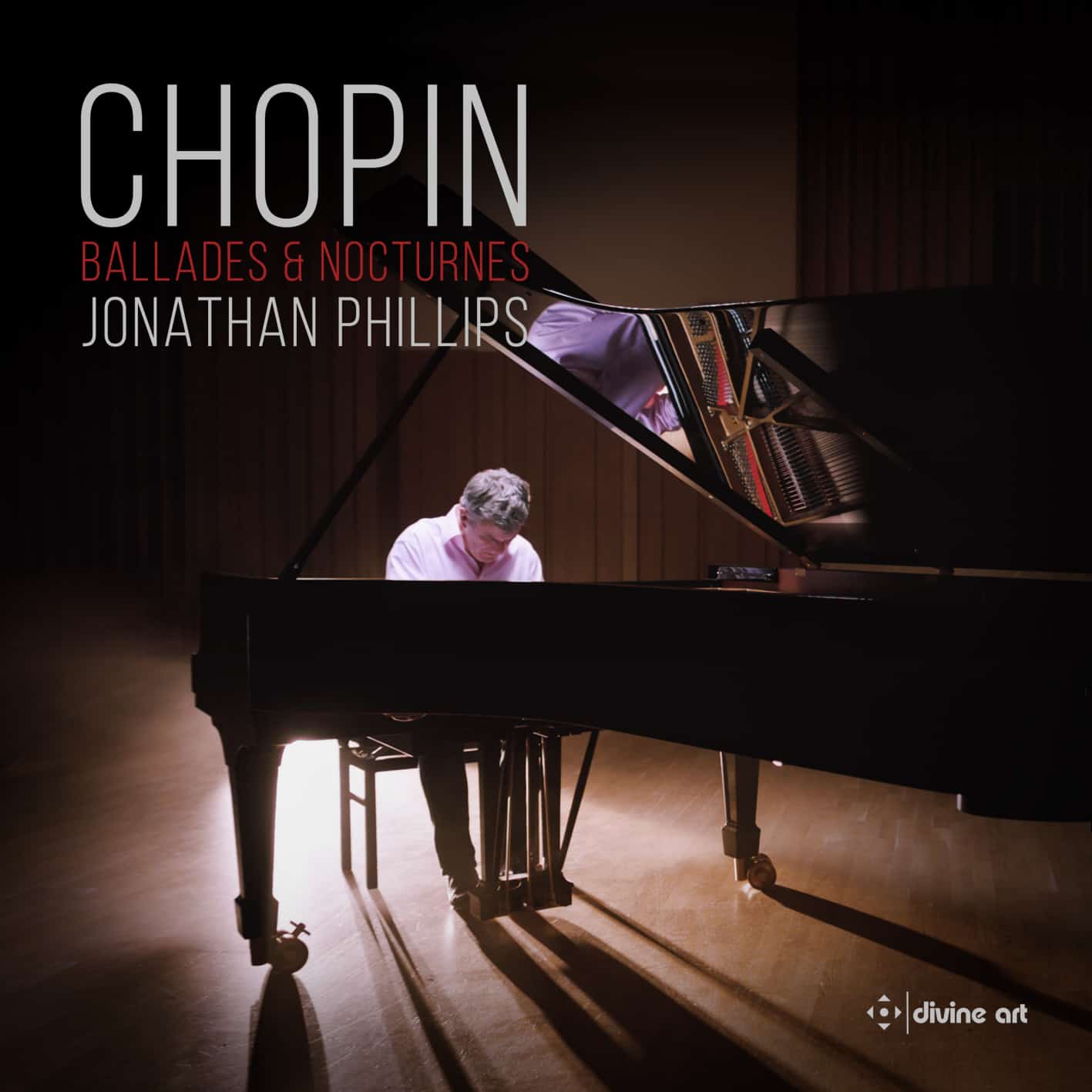
  • Chopin: Ballades & Nocturnes

    Chopin: Ballades & Nocturnes

    Following the success of Jonathan Phillips’ debut release, Bach: Tranquillity, Divine Art brings you his carefully curated selection of Chopin’s finest ballades and nocturnes. This selection naturally follows Phillips’ debut as Chopin himself was known to be strongly influenced by Bach.

    Recorded to replicate a “live” performance, Jonathan recorded two takes, deliberately avoiding all the usual editing, in an effort to communicate his love of these pieces as intimately as possible.

    A graduate of the Royal Northern College of Music, Jonathan’s Concerto experience is considerable, with over 100 performances including concertos by Rachmaninoff, Tchaikovsky, Chopin and Schumann. Jonathan worked with Tamás Vásáry who recommended him to take part in the 1990 Tchaikovsky competition in Moscow. Since then, Jonathan has broadcast for the BBC, Russian and Italian and Swedish TV and radio, and given recitals all over the UK, Europe and former Soviet Union. Jonathan was interviewed by John Humphries and played live on Radio Four’s Today programme following a full-page feature article in the Guardian Arts Section about the preparation and performance of the Rachmaninoff 3rd Piano Concerto he gave in London in 2003.

    Bach: Tranquillity, Jonathan’s debut album from Divine Art was released in May 2023 receiving much praise and described by Classic FM’s Katie Breathwick as “a little drop of heaven”.