Catalogue Connection: 21114

  • Dreams, Desires, Desolation in Congleton Review

    This is a rather lovely album that we have carried on playing, long after the review was written. Baritone Alexander and pianist Crockford have made an album celebrating English Song — art-songs by composers, well- and not-so- well-known say the sleeve notes, though we’d not heard any of it before (though the encore “How could I ever know” from “The Secret Garden” does sound familiar).

    “It is some of the best examples of what is often called the Parlour Ballad, beloved of audiences in the early years of the 20th century,” say the notes, which from the music on here must have been events that stilled the audience into silence, and had them leaving refreshed when the gig was done.

    It’s mostly relaxing and easy to listen to, though there’s a bit of dip for us in the middle for a section where it’s a little too harsh, but this is fine with the performers, who write: “We have not tried to be clever or intellectual in our choice of songs. We also realise that many wonderful songs have been missed out … it is unlikely that our audience will empathise with every song we have chosen. Some will find the desolation songs too distressing; others may find some songs are just too lightweight for them. However, we hope that you can all find enough herein to share our enjoyment of these songs” which is, as AE Housman (“Six Songs from A Shropshire Lad” opens) would say, bang on.

    “Is my team ploughing?” opens and is typical of many songs, offering a pastoral calm. Standout for us is “Love’s garden of roses,” written by Haydn Wood (1882-1959) — this one song is reported to have sold so many thousands of copies of sheet music that it earnt Wood a six-figure sum in royalties, and it was one of the biggest hits of 1918.

    “Kashmiri Song” by Amy Woodforde-Finden (1860-1919) is also peachy (again as AE Housman would say); very pleasantly romantic.

    There’s also the first commercial recording of “Autumn” (1938), by Peter Gellhorn (1912-2004), a German conductor, composer and pianist who fled Nazi Germany in 1935.

    Well worth a listen if you’re the human voice and / or peaceful music.

    Out on Divine Art, DDX 21114.

  • Dreams, Desires, Desolation MWI Review

    This is a disc of English song which re-creates an evening of Parlour Ballads, such as one might have heard in an Edwardian aristocratic home. Even the more contemporary songs fit quite comfortably into this category and in fact the most forward reaching and original song is by Frank Bridge: his last song, Journey’s End,written in 1925 to a text by Humbert Wolfe. Startlingly, the song almost sounds as if it might have been written by Bridge’s pupil, Benjamin Britten and in fact Pears did record the song with Britten at the piano in 1963. Some of the songs are old favourites that we don’t hear very often these days, though we might know them from older recordings, whilst others are brand new. Indeed, Peter Gelhorn’s Autumn and two songs by Clive Pollard (b. 1959) are here receiving their first commercial recordings. However, they are tuneful and tonal and do not sound out of place in a programme of songs mostly written in the early part of the last century.

    As you would expect with a title like Dreams. Desires, Desolation, the mood is mostly melancholy or dreamlike and I can’t help feeling one or two more lively songs would have created a little more variety in the programme. What would also have helped to enliven the recording is a bit more energy in the performances. Trevor Alexander has a pleasant, light, tenorish baritone and he has excellent diction. Though his is obviously not the voice of a man in the first flush of youth, it is mercifully free of excessive vibrato or wobble. Unfortunately, it is also a little lacking in colour and personality. The performances are somewhat diffident, rather lacking in substance and imagination. Take the opening song, Butterworth’s Is my team ploughing? Alexander commendably attempts to differentiate between the ghost and the young man, but whereas his ghost is convincingly eerie, the young man’s responses need to be more healthily robust. It is also true that many of the older songs tap into a vein of sentimentality that is perhaps not so fashionable today.  Even so, one wants a more open-hearted, outgoing emotional response to both words and music, such as we can hear in some of the old recordings of Jonn McCormack, Richard Tauber, Rosa Ponselle and Kathleen Ferrier. Where their voices and personalities fly out from even the crackliest old 78s, Alexander remains earthbound; nice but dull.

    Reading the notes that come with the disc, one appreciates that it was obviously a labour of love for the two artists involved and one doesn’t doubt their sincerity for a moment, but although there are some interesting discoveries (and re-discoveries) here, the performances need a little more personality and variety to sustain interest throughout a whole disc.

  • Dreams, Desires, Desolation British Music Society

    Let us start with the positives. This is a generous recital of 21 songs composed by English composers, largely in the first half of the 20th century, and includes some outstanding examples like Vaughan Williams Silent Noon and Butterworth’s Is my team Ploughing? which, curiously, begins the CD. It also includes songs and composers which may well be new to you, for example the two songs especially composed for these performers by Clive Pollard, or the emotionally gripping  Do not go my love by Richard Hageman (a new name to me) – a setting of Tagore.

    But there is more. Trevor Alexander’s voice is one I can listen to without hesitation, and with much pleasure, and he is aided and abetted by the very sensitive Peter Crockford, with whom he has worked for some time. The voice is a light, lyrical baritone which is rarely forced. The songs have been carefully chosen to suit this timbre. The booklet offers a brief ‘Artists’ Foreword’, and then detailed biographies of the composers and the poets; however, no texts are given. The print is small and may trouble older eyes, but you may not need the texts anyway as Alexander’s diction is almost perfect.

    As mentioned, there are some unusual and rare songs here. I like the juxtaposition, for example, of Haydn Wood’s Love’s garden of roses, one of his most popular songs from 1918, with Peter Gellhorn’s Autumn. This is a desolate and moving setting by a composer who should be so much better known. He had to leave Germany in the 1930s as a Jew and resided in Britain, despite being arrested in 1941.

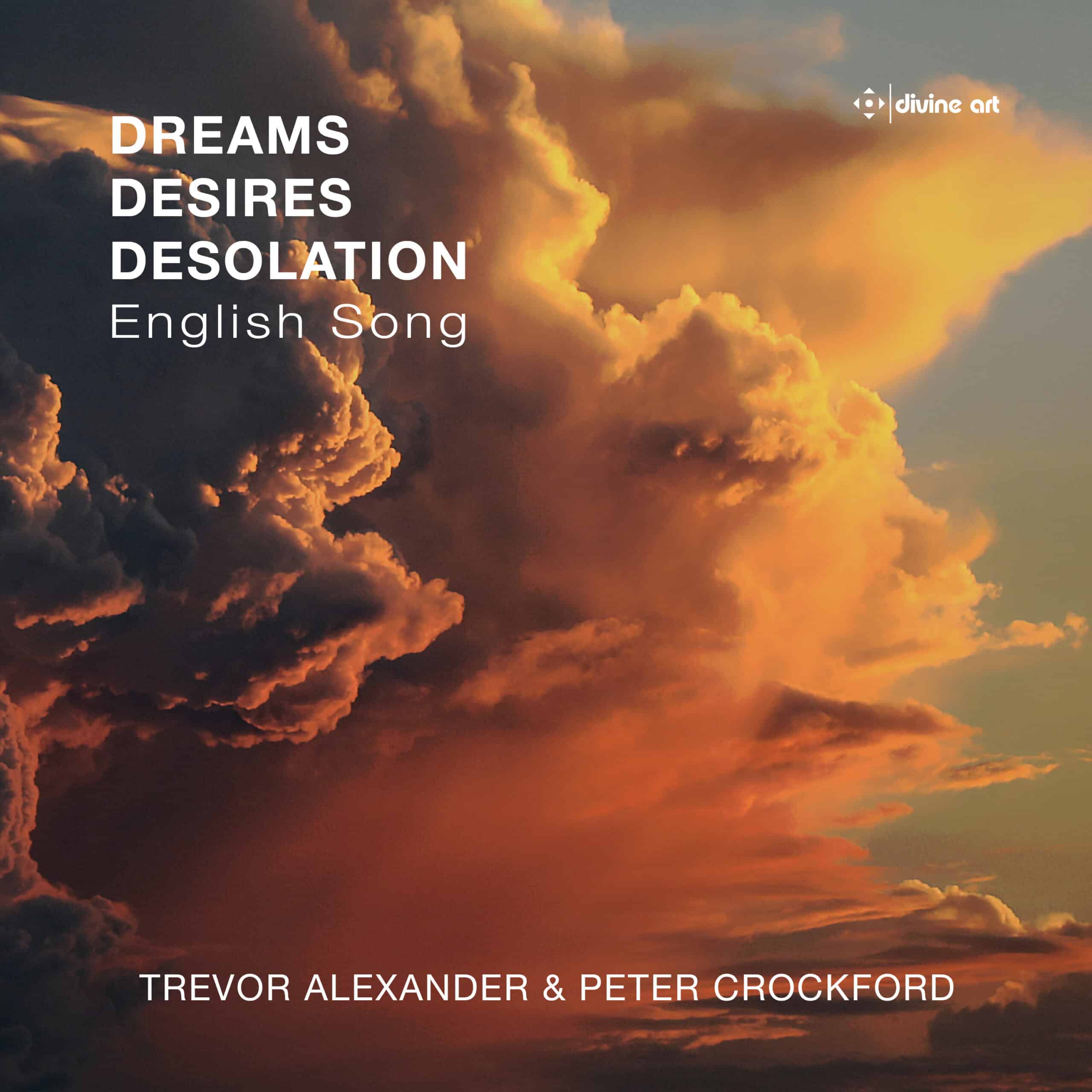
    Now, there is other side of the coin. Practically all of the songs are slow, and quite often I do not feel that Alexander has really dipped down deep enough into the inner meaning of the texts. There are exceptions though, such as Frank Bridge’s wonderful What shall I your true love tell? I also feel that breaths are occasionally taken in unnecessary places. The booklet cover has a dramatic brown sky on the cover and back which might reflect the generally slow songs chosen, but also it makes the titles, especially the names of the composers and poets, not particularly clear. The recording is a little dull and needed more spacing between the voice and piano, even though it was recorded in the vast space of the Henry Wood Hall.

    However, if you are coming to this repertoire for the first time, this could be a good disc to dip into. 

  • Dreams, Desires, Desolation Opera Today

    In Dreams, Desires, Desolation, baritone Trevor Alexander and pianist Peter Crockford present a miscellany of English song.  There are both art songs – some well-known, others less familiar – and what are commonly termed ‘parlour songs’, some of which were very popular in their day but are now less frequently sung or heard.  The poets are similarly diverse, representing the canonical – Shelley, Tennyson, Housman, Yeats, de la Mare, Arnold, the Rossettis (both Dante Gabriel and Christina) – and less commonly heard voices: Harold Harford, Katharine Hinkson, Ruth Rutherford, Thomas Beddoes, Mabel Dearmer.

    The duo offer three ‘first’ recordings, two of which are by Clive Pollard (b.1959), who has been a finalist in the competitions organised by the English Poetry and Songs Society and has worked extensively with Alexander and Crockford.  ‘The cloths of heaven’ sets a well-known poem by Yeats, in which he depicts the existence of the people of Ireland who, lacking material sustenance, have to rely on their inner, imaginative lives.  Pollard’s accompaniment unrolls in circling patterns suggesting restlessness, and there is an accumulation of intensity towards the central declaration, “I would spread the cloths under your feet”, followed by a retreat, “But I, being poor, have only my dreams”.  Alexander captures something of the pride and humility of the lyric, although Pollard’s setting ignores the implications of Yeats’ rhythm and metre, and the way that the strong dactylic pulse gives way in the single stanza to a more gentle anapaestic movement.  ‘Go, song of mine’ is a setting of Dante Gabriel Rossetti’s translation of a canzona by the thirteenth-century Italian poet and philosopher, Guido Cavalcanti, which was composed by Pollard especially for this disc (and has been set for a cappella chorus by Elgar and others).  I have to say that I don’t find Pollard’s anodyne oscillations and limited harmonic palette really capture the expressive weight in the protagonist’s heart who, “Dishevell’d and in tears”, sends out his song “[t]o break the hardness of the heart of man” but the performers present a poised reading.

    There’s also the first commercial recording of ‘Autumn’ (1938), by Peter Gellhorn (1912-2004), a German conductor, composer and pianist who fled Nazi Germany in 1935 and settled in London where he forged a successful and influential career, working for the Carl Rosa Opera Company, Covent Garden, Glyndebourne and becoming Director of the BBC Chorus (now the BBC Singers).  It’s one of several settings of Walter de la Mare included on the disc and in the murmuring dotted rhythm that pervades the piano accompaniment Crockford captures something of the ‘hope’ that lingers despite autumn’s erasure of the golden warmth of summer and of love.  Now, there are just “Sad winds where your voice was;/ Tears, tears where my heart was”; it a is desolate song and is delicately sung by Alexander, though (as I follow the RCM edition that was created as part of the AHRC-funded Cultural Engagement Project, Exile Estates – Music Restitution: The Musical Legacy of Conductor/Composer Peter Gellhorn, in collaboration with the International Centre for Suppressed Music (ICSM) and the Jewish Music Institute (JMI)) I’m not convinced the baritone is always entirely accurate, and the dynamics indicated in the score are sometimes ignored or overturned.  It’s a powerful song, and we need to hear more of Gellhorn’s music.  I’m not sure this reading does the composer justice.

    One half expects to hear the hiss and crackle of a gramophone when encountering the ‘parlour songs’, but they are presented sincerely and with earnestness by Alexander and Crockford.  Haydn Wood (1882-1959) was raised on the Isle of Man (where Gellhorn was interned during the Second World War) and was one of the most successful ballad composers of the earlier decades of the twentieth century, composing seven song cycles and in excess of 200 hundred songs.  One of his best, and best-known, ‘Love’s Garden of Roses’, may be designed to pull the heartstrings rather than exercise the intellect but it does the former superlatively.  Alexander’s baritone is focused and true, and he rises surely and engaging to the melodic peaks; the piano’s syncopations are flexible and natural.  Amy Woodforde-Finden’s ‘Kashmiri Love Song’ (1902) based on a poem by Violet Nicolson (under the pseudonym Laurence Hope) was a drawing-room standard in its day but has similarly succumbed to the whims of fashion.  Alexander poses the song’s questions and wonderings tenderly, and lets the underlying passion speak without pretention.  Charles Marshall (1857-1927) was an obscure composer of a handful of songs when he went knocking on the door of the Irish lyric tenor John McCormack and offered him ‘I hear you calling me’ (setting words by Harold Harford).  It became McCormack’s signature tune.  Crockford manages the sometimes dense piano textures (lots of octave doubling in the left-hand and plush right-hand syncopations) most expressively, and Alexander makes telling use of his head voice in the song’s culminating phrases, capturing the wistful distance between present and past, between life and death.

    It’s good to hear ‘Silver’ by Cecil Armstrong Gibbs (1889-1960).  A fortuitous family background enabled him to indulge his passion for composing, most compellingly in the world of song: he wrote 162 songs, 38 of which set poems by his friend Walter de la Mare.  One feels that Alexander might have made more of de la Mare’s alliteration, rhyme and diction – what a wonderful word is “shoon”! – to make the listener feel that they were a traveller through the poet’s dream world, but the duo’s straightforward approach works well in Victor Hely-Hutchinson’s de la Mare setting, ‘Dream Song’, which is both gentle and firmly outlined.  Cyril Scott (1879-1970) was known best for his piano music and songs and here we have his ‘Lullaby’ (which sets Christina Rossetti); it’s pleasant enough but feels a little four-square, though the rising phrase at the close is nicely shaped by Alexander.  The light textures and expressive melodic phrases of ‘Remembrance’ by Frederick Keel (1871-1954) are sensitively sculpted. 

    For those wanting some familiar favourites, the duo offer three songs by Frank Bridge.  In ‘Come to me in my dreams’ there is an alertness sometimes absent in other songs, and a welcome attentiveness to the nuances of Matthew’s Arnold’s text; and, in ‘Journey’s End’, in which we are forced to face the inevitability of death, the chromaticism and upswellings of emotion are made to tell.  Crockford’s postlude is beautifully reflective.  This was Bridge’s last song. 

    Roger Quilter’s ‘Now sleeps the crimson petal’ is simply lovely, as it is and should be, while the composer’s ‘I arise from dreams of thee’, which was originally written for voice and orchestra is more harmonically restless.  Alexander and Crockford capture its Romantic tanginess.  Quilter doesn’t have the monopoly of good tunes, though: John Ireland’s ‘If there were dreams to sell’ is sung with a directness which is both poised and haunting.  Alexander’s diction is superb throughout the disc, none more so than in this song.  From Ralph Vaughan Williams we have the oft-heard ‘Silent Noon’ but also ‘The Sky above the Roof’; the latter is wonderfully tender, Alexander finding the expressive weight of the downwards-tugging phrases.  The disc opens with George Butterworth’s ‘Is my Team Ploughing?’ which makes use of a rather odd juxtaposition of retreat and rhetoric in the presentation of the poem’s two voices.  Generally, the engineers have done a good job in balancing voice and piano, though the sound isn’t especially ‘present’.

    There are two songs on the disc that might be said to represent American art song and music theatre rather than English song.  The Dutch-born composer, conductor and pianist Richard Hageman (1881-1966) travelled from Holland to Hollywood, becoming an American citizen.  He worked at the Met and at Paramount Film Studios (he wrote twenty film scores including that for John Ford’s 1939 Western Stagecoach).  He also composed 69 songs, setting 51 different poets.  ‘Do not go, my love’ (1917) sets Tagore.  It would benefit from a bit more Romantic profundity and a much grander sweep – the spirit of Tchaikovsky looms large in this song but is overlooked in this reading.  ‘How could I ever know’ by Lucy Simon (1940-2022) is a rather saccharine ‘encore’, but earnestly sung.

    Alexander and Crockford’s selection of songs is eclectic.  Liner notes introduce composers and poets, and say a little about the musical settings, but there are no texts.  Perhaps there might have been more intensity at times, more engagement with the poetic texts?  But, I’ve been listening to this disc with a tear in my eye, and that’s a good thing.
  • Dreams, Desires, Desolation BBC Music Magazine

    The baritone Trevor Alexander has enjoyed a rich and varied career in opera and music theatre, and on the concert platform. This selection of English songs is his debut recording as a soloist, and is worth the wait. Butterworth’s ‘Is my team ploughing?’ immediately showcases Alexander’s mature interpretive temperament. Unlike many singers, he has convincingly unaffected ‘voices’ for the poet Housman’s two protagonists, and the technical control to give each the poise and stability needed.

    Subtle delineations of mood ensure Marshall’s ‘I hear you calling me’ (a John McCormack calling- card) avoids sentimentality, sitting comfortably alongside a mellifluous account of Quilter’s ‘Now sleeps the crimson petal. Though nominally a baritone, Alexander has a silky, tenor-like upper register which leads to a sense of elevation to Hely-Hutchinson’s ‘Dream Song’ and enables the softly floated top note concluding Cyril Scott’s ‘Lullaby.’

    Nor is Alexander found wanting when a more dramatic, declamatory style is needed. His impressive control of dynamics lends spine and structure to both Bridge’s ‘What shall I your true love tell?’, and to Quilter’s similarly self-reflective ‘I arise from dreams of thee.’ Peter Crockford provides empathetic accompaniments, consistently enhancing mood and atmosphere while never jockeying with his singer for attention.

    If there’s one draw back to Dreams, Desires, Desolation, it’s the preponderance of slow and mid-tempo songs, with little of an upbeat nature rhythmically. But that’s a niggle, not a major objection, and it’s more than offset by the consistent pleasure Alexander’s cultures singing brings. Song texts are absent from the otherwise informative booklet, but the crystal clarity of Alexander’s diction means they’re hardly necessary.

  • Dreams, Desires, Desolation MusicWeb

    The Artists’ Foreword in the booklet announces a potpourri of songs that are “very familiar”, with “some relatively unknown ones, and a few that were very popular in their day but have fallen out of fashion”. To construct this eclectic selection, they have chosen texts that reflect the emotions of “dreams, desires and desolation”. There are three world premiere recordings. The project was born out of the enforced isolation caused by Covid19, when Trevor Alexander and Peter Crockford learnt many songs “that we had always wanted to work on but had never had the time”.

    Nottingham-born composer Clive Pollard contributed two of the premieres. Go song of mine is set to a text by the Italian poet Guido Cavalcanti, The Cloths of Heaven to the well-known poem by W. B. Yeats. Both show that Pollard has synthesised the character of English lieder from the early to mid-twentieth century.

    I was excited to hear Autumn by the émigré German musician Peter Gellhorn, who fled from Nazi persecution to London in 1935. His setting of Walter de la Mare’s poemis atmospheric and bleak; I heard the influence of Britten. Sadly, this is one of only a handful of Gellhorn recordings. Surely other musicians could assume his cause.

    Drawing-room ballads include Love’s garden of roses by Haydn Wood, and Amy Woodforde-Finden’s Kashmiri Love Song. Both were immensely popular in their day but now singers tend to ignore them. Perhaps they are deemed as too saccharine? I have not heard anything by Charles Marshall before. The notes explain that he was not prolific, with only about fifteen songs to his credit. One that became famous was I hear you calling me: it was one of Count John McCormack signature tunes. But all three here are outstanding examples of this forgotten and often denigrated song category.

    There are two numbers by composers who are not English, by the Dutch-born conductor-composer Richard Hageman and the American Broadway composer Lucy Simon. Both are responsive to the character of the genre.

    It was good to hear representative works by Frank Bridge, Frederick Keel and Cecil Armstrong Gibbs. The latter’s Silver to words by Walter de la Mare is regarded as definitive amongst nearly two dozen competitors. Cyril Scott is best recalled for his idiosyncratic piano music but he was also a prolific song writer. One of his best known is his “lyrical and haunting” Christina Rossetti setting Lullaby.

    Big hitters include Butterworth’s Is my team ploughing, Ralph Vaughan Williams’s Silent Noon from his Rossetti cycle The House of Lifeand his The sky above the roof, John Ireland’s If there were dreams to sell, and Roger Quilter’s Now sleeps the crimson petal. Little need be said save that they are beautifully performed here.

    The performers have assembled the liner notes. They give details about the composers and authors of the poems, but typically only a short paragraph about the actual songs themselves. It is a pity that texts were not included in the booklet; many, if not all, are safely out of copyright. There are short resumés of both artists.

    The performances are well wrought. Both performers are clearly enamoured of their chosen repertoire. There is no condescension in the drawing-room ballads.

    I understand that, as part of the original Covid19 project, several other songs were rehearsed, including some French chansons. It would be instructive to hear Trevor Alexander and Peter Crockford turn their attention to Fauré, Duparc and Debussy. Meanwhile, I look forward to hearing this team in further performances of English song. There is certainly much to explore, both well-known and neglected.

  • Dreams Desires Desolation – English Song

    Dreams Desires Desolation – English Song

    Baritone Trevor Alexander and pianist Peter Crockford present an album celebrating English Song – art-songs by composers well and not-so-well known, and some of the best examples of what is often called the Parlour Ballad, so beloved of audiences in the early years of the 20th century.

    Dreams, Desires, Desolation was created out of our love for English Song. The album comprises a real mixture of very familiar songs, along with some relatively unknown ones, and a few which were very popular in their day but have fallen out of fashion. There are also three world premiere recordings. We believe, despite the mixture of styles, each song brings something valid to our concept.”