Catalogue Connection: 21117

  • Chromosphere Double Reed News Review

    I had not come across a ‘woodwind orchestra’ before. I knew of the eighteenth-century wind bands, best known for Mozart’s Serenade for 13 Winds K361, and I knew that Holst and Vaughan Williams had written works for large wind groups. This CD is a product of more recent activities – during the last 30 years or so – and conductor Shea Lolin plays a prominent role in the renaissance.

    The instrumentation of this orchestra is precise. Take a wind quintet, double it, remove the horns (valves not allowed), replace them with a saxophone quartet (made of brass admittedly, but with clarinet-like mouthpieces and oboe-like fingerings), add a cor anglais and contrabassoon, a couple more flutes, and three more clarinets including not only a bass but a contrabass clarinet, and what do you get? A splendid, integrated sound with a particularly rich bass to it, capable (as the album’s strapline says) of a huge array of orchestral colour.

    All five composers on the album (Keiron Anderson, Judith Bingham, Charlotte Harding, Kamran Ince and Christopher Hussey) use the band very effectively. Aware that I am writing for oboists and bassoonists, there are not many solos in the orchestral sense. But there are other places one can listen to individual virtuosity; here it is the colours that matter, and it’s rather pleasing when you can’t work out how they are being created, especially with the various combinations of bass instruments.

    I listened through the album on a CD player (remember them?) and the pieces work very well as a set; but knowing how people sample music these days I am going to pick out two songs for special mention. That term is surprisingly appropriate for the first one, the final movement of Mozart’s Pets by Judith Bingham. In A Canary Sings by Mozart’s Death Bed, the regret of his early death is palpable, a life unfinished, the canary taking his Spirit elsewhere. Credit goes to Judith Bingham, conductor Shea Lolin, piccolo player Jan Machat, and (especially) to Mozart, who showed us what a range of feeling can be conjured up with a bunch of wind instruments.

    The second track is Domes by Kamran Ince, a contemplation of the domed skylines of Rome and Istanbul. I approached the idea of 13 minutes of slow music with some trepidation: how can you express architecture in music? Maybe at the beginning you wonder how he has created these remarkable sounds, but after a while you become immersed in the sheer spaciousness of it: the movement where there is no movement.

    But I don’t want to give the wrong impression. This album is great fun, with expert playing and ensemble, well recorded in a good acoustic, especially the bass as I have mentioned twice before. Don’t listen to it on your phone’s speaker!
  • Chromosphere American Record Guide Review

    It has been only a few months since this marvelous woodwind orchestra was last heard from (March/April 2024: 150). That album took 10 years to move from recording sessions to release. This one has followed a more typical timeline. 5 new works are heard in their first recordings. All tell a story or are about something. My favorite is Turkish-American composer Kamran Ince’s haunting Domes (1993), inspired by the skyline of Rome. Harmonies are doleful, timbres hushed, phrases very brief, chord progressions enigmatic. 

  • Chromosphere Congleton Review

    For the first couple of tracks you might think this is “Now That’s What I Call Moderately Easy Listening Music from the Woodwind Section” but it’s not that at all, and gets more complex both as it plays through and with repeated plays. Conductor Shea Lolin and composer/producer Christopher Hussey have joined the Czech Philharmonic Wind Ensemble, “curating an album of premiere recordings spotlighting the woodwind orchestra” says the PR, “capturing its kaleidoscopic colours and symphonic potential in order to deepen and broaden appreciation of the medium’s power”.

    “Alice in Wonderland” (Keiron Anderson) opens and is very jolly, slightly whimsical and with varied changes as Alice meets the cat or falls down the rabbit hole. There are 12 movements but for the listener it is one cohesive piece. In parts it’s reminiscent of “New World Symphony” or Elgar, or some jaunty generic English piece drawing on folk. A nice tune.

    Judith Bingham’s “Mozart’s Pets” follows. Who knew Amadeus was a pet man? He had dogs, cats and a grasshopper according to this, and a canary by his deathbed. (We always think of Prince as the modern Mozart, and it would have been a so much better way to go with a canary at your bedside than keeling over in a service lift).

    After warming the listener up we get Charlotte Harding’s “Bright Lights” (the woodwind mix) which is a little more out there, trying to capture the mood as one moves to a new city (though being taken out by two friendly racists for a pub crawl, as happened to the Review Corner after moving to one big city, is not covered). It’s more haphazard in sound to reflect the cars, the lights and the people.

    Two long pieces close, “Domes”, which varies from a tranquil sound to something more raw, even strident — it’s about staring out over the rooftops of Rome and Constantine — and starts off slightly jaggedly. “Child of the Wandering Sea” — about marine life found at increasingly deep oceanic zones — is shimmery and descriptive of water.

    Standout track is perhaps “Domes”, whose range of sounds and feelings is absorbing.

    This is out now on Divine Art, DDX 21117

  • Chromosphere Clarinet & Saxophone Magazine

    I have been a big fan of both symphonic concert band and the woodwind orchestra since hearing East Coast Pictures by Nigel Hess in the early 1990s. Being a woodwind player, I probably have a bias towards this combination too, so I was really delighted when this CD landed on my desk. I had never before heard the Czech Philharmonic Wind Ensemble but I did smile to see the conductor was Shea Lolin. I have seen Lolin work with many woodwind ensembles and I know how meticulous he is in getting the smallest detail out of any player, so even before I pressed play, I knew I was in for a treat. I was not disappointed; the recorded sound is great and the ensemble playing is superb with lovely dynamic contrasts, great articulation and very clear key clicking picked up in the ‘Grasshopper’ movement of Judith Bingham’s Mozart’s Pets. 

    All five pieces on the album are world premiere recordings and all are deeply descriptive in nature. Without doubt all the composers featured here can write well for woodwind ensemble; there are no sudden, awkward turns of phrase and a well-defined timbral palette of sound. You won’t have time to get bored despite the sound world featuring only woodwind instruments, as a constant shift in colour keeps your ears transfixed to the ever­ changing textures. 

    I have heard the music of Kieron Anderson before and I attended the 2016 educational event where Alice in Wonderlandfirst appeared. While in one movement, the work has twelve episodes – The White Rabbit, The Chase, The Queen and The Lobster Quadrille to name just a few, and you can hear in each section what the music is depicting. It is in all but name a romantic symphonic poem in the style of Richard Strauss; a playful and lively piece that would be a great concert opener for any ensemble. 

    The playfulness is also evident in Judith Bingham’s Mozart’s Pets: five short, witty movements, each depicting a different pet. Mozart evidently liked animals and he was surrounded by them for his entire short life. The improvised coda of ‘Dawn Chorus in a Viennese Bird-Seller’s shop’ was ingenious. 

    Cityscapes are the inspiration for both Charlotte Harding’s Bright Lights and Kamran lnce’s Domes. You can clearly hear the hustle and bustle of city life in the second movement of Harding’s work; the driving rhythms and the stabbing accents made me think of Gershwin’s An American in Paris minus the car horns, but it is a fine and original work. In Domes, we are in Rome viewing the skyline and contrasting this against the city of Constantine. It was vividly portrayed and I enjoyed very much the contrasts of silence, and a harmonic language which moved from traditional to the more adventurously dissonant. 

    Finally Christopher Hussey’s Child of the Wandering Sea is a symphonic poem in three movements, depicting the ever­ increasing depths of the ocean. The piece works its way down from glittering textures and repeated fragments underpinning a soaring melodic line, reflecting the abundance of marine life, to the slow and deep resonant third movement Midnight which conjures up the ocean’s depths. Great use here is made of the bass clarinet, baritone saxophone and contrabassoon.

  • Chromosphere British Music Society

    As a follow up to a previous disc, Twisted Skyscape (DDX2118), the present CD offers five works for woodwind orchestra, all première recordings. The five composers are Keiron Anderson, Judith Bingham, Charlotte Harding, Kamran Ince and Christopher Hussey, who is also the producer along with conductor Shea Lolin, who are co-initiators of the project. 

    Each of the composers inhabits a different sound world, so there is a variety of contrasting musical idioms which makes for a satisfying listen, even all in one sitting. 

    Hussey’s Child of the wandering Sea, which ends the disc, is a symphonic poem in three movements, invoking the creatures who inhabit our oceans, from the colourful fish and corals of the upper regions (Sunlight) into the deep (Twilight) and then on to the very depths (Midnight). The music ranges from the sparkling to the sepulchral and Hussey shows an expert command of the instruments at his disposal. 

    In a completely different idiom is Keiron Anderson’s Alice in Wonderland which is overtly tuneful and sounds as you would expect from a score drawn from music for scenes such as the Mad Hatter’s Tea Party.

    Also great fun is Judith’s Bingham’s Mozart’s Pets, a set of five shorts movements portraying a fox terrier (yapping saxophones), a cat, a dawn chorus, a grasshopper (a movement which exploits the tapping of the woodwinds’ keys) and finally a canary singing at Mozart’s death. Who knew Mozart had a pet starling? 

    Charlotte Harding’s Bright Lights represents the excitement at visiting a new city. The two contrasting movements are Luminous and Energetic, colourful, and I can vouch that they sound as their titles suggest. The opening section gives a sense of space with sustained chords and juxtaposed roulades, while the second is much more rhythmic, dynamic and somewhat jazzy, conjuring up the bustle of the city. 

    Another city is recalled in Kamran Ince’s Domes, this time it is Rome. The music exploits the silence between musical phrases and ends with a haunting melody broken between moments of stasis.

    The large woodwind ensemble is a rare beast in Europe (there are more in the United States); the members of the Czech Philharmonic Wind Ensemble are wonderful advocates of this music with their dexterous and bravura playing. All of the works are receiving their world première recordings. This colourful collection is warmly recommended.

  • Chromosphere Classical Notes

    Conductor Shea Lolin and the Czech Philharmonic Wind Ensemble have recently recorded Chromosphere, a delightful selection of contemporary works (all first recordings) showcasing the ‘symphonic colours of the woodwind orchestra’, as the album’s subtitle describes them.

    They kick off with Keiron Anderson’s (b.1955) joyous Alice in Wonderland, which beautifully exploits the variety of textures and moods of the woodwinds. There is humour in the frenetic White Rabbit, and the craziness of A Tea Party and the Lobster Quadrille, yet the dreamy opening, Alice and Her Sister is full of pastoral tenderness. Meanwhile, The Trial brings dramatic tension, before the Return to the Garden brings things to a spirited conclusion. The episodic nature of the piece means that none of the ideas stick around for long, but that adds a sense of forward momentum and story-telling pace. And right from this opening piece, the clarity of articulation and precision of the players is in evidence.  

    With Judith Bingham’s (b.1952)Mozart’s Pets, we are still in the realms of fantasy to some extent, albeit based on some truth, in terms of Mozart’s fondness for his pets.Miss Bimperl, Fox Terrier has a slightly stuttering rhythm, with snappy saxes contrasting against the scurrying upper winds, whilst A London Cat uses the saxes again, this time in more sultry, feline mood. Dawn Chorus in a Viennese Bird-seller’s Shop is cleverly packed with quotes and hints at motifs, repeated like birdcall, and gradually building to a fabulous chattering chorus from the flutes, whilst The Grasshopper has fluttering keys against flighty, jumpy movement. A Canary Sings by Mozart’s Death Bed has thick, mournful textures from the bassoons and saxes, making the frantic crying song of the canary on the piccolo, left alone at the end, almost painfully moving. 

    Charlotte Harding (b.1989) contributes Bright Lights, a two movement work, originally written for smaller wind band forces, capturing the excitement of moving to a new city. The first movement, Luminous, is bright and atmospheric, but also full of mystery and a sense of discovery. The cor anglais makes a notable appearance, and there are flashes of colour from the flutes and piccolo amidst the glowing chordal texture, with everything building to a final flashing of lights, again led by the flutes and piccolo. Energetic, Colourful does what it says on the tin, with bright energy and sparkle throughout, and the players excel in bringing out all of the detail, with Lolin managing the rapidly shifting tempi and complex rhythms with evident command, building to an impressive climactic finish. 

    The programming on the disc comes into its own here too, with the frenetic energy of Bright Lights immediately subdued by the darkly atmospheric Domes from Kamran Ince (b.1960). Straight away, the falling, entwined flutes create a sense of awe and calm, occasionally disturbed by rapid interjections, the piece contrasting the ancient city skylines of Rome and Constantinople. As it develops, the ideas combine and clash more and more, with fiddling movement layered over the insistent falling lines and thick chordal textures. There is also frequent use of silence, the breaks accentuating the drama but also constantly reinforcing the calm, yet Lolin maintains the momentum, and the balance between the chordal textures and more energetic movement. The Pärt-like falling lines return at the end, picked up with tenderness by the clarinets, creating a rather beautiful, if somewhat poignant ending. 

    The disc concludes with Christopher Hussey’s (b.1974)Child of the Wandering Sea. Having recently been fortunate to be involved with Brighton16 in a recording of one of his choral pieces, Songs from the Temple, this work is a fascinating contrast to that work’s more transparent (but equally evocative) writing, a demonstration of Hussey’s compositional range. It is vivid and atmospheric, and in its three sections, Hussey explores marine life at increasing depths of the ocean. So Sunlight is busy and literally full of life, with trilling clarinets and a plethora of melodic material for mostly upper instruments competing for attention. The energy gradually builds, and Twilight quickens the pace, with more virtuosic demands on the players, and the precision and articulation here is as bright as ever, with Lolin clearly steering proceedings with confidence. After a wild climax, the tempo and mood subside into the darkness of Midnight, the deepest part ocean where there is no light. The weighty chords have a disturbing quality, and a final brief outburst notwithstanding, we are left in solitary darkness. 

    As an exceptional demonstration of the often neglected range that wind music can deliver, and with such commandingly expert performances from Lolin and the Czech Philharmonic Wind Ensemble, this has to be highly recommended.

  • Chromosphere Gramophone

    Subtitled ‘symphonic colors of the woodwind orchestra’, Divine Art’s ‘Chromosphere’ is an engaging collection of attractive new works – all receiving first recordings – in splendidly mellifluous performances by the Czech Philharmonic Wind Ensemble conducted by Shea Lolin. It forms a pair with their recent release ‘Twisted Skyscape’ (DDX21118, named from one of the two works by Christopher Hussey, who features again here).

    Keiron Anderson’s Alice in Wonderland (2016) originated in a didactic project for Shea Lolin at Leeds College of Music. Playing continuously, the music is divided into 11 sections inspired by key events in Alice’s adventures. Although including some of the darker episodes – ‘The Queen’, ‘The Trial’ – playfulness and jollity are the watchwords for this bright concert-opener, ideal for children of all ages. Things take a more mercurial turn in Judith Bingham’s glorious set of five miniatures, Mozart’s Pets (2021), each based on creatures that Mozart – an avid animal lover – encountered, whether the fox terrier ‘Miss Bimperl’, the anonymous ‘London Cat’ or the elegiac final ‘A Canary Sings by Mozart’s Death Bed’. The central ‘Dawn Chorus in a Viennese Bird-seller’s Shop’ is a riot of quotation and allusion, but even more fascinating is the tiny fourth movement, a brilliant evocation of a grasshopper, complete with orthopteran clicking from the wind instruments’ keys!

    The other peach on the programme is Charlotte Harding’s diptych Bright Lights (2010, for wind band; the expanded wind-orchestral version of 2023 is given here). Intended to convey ‘the excitement and apprehension felt when moving to a new city’, the titles of the two movements reveal the tone of each, ‘Luminous’ in the first span, ‘Energetic, colourful’ in the second. By contrast, Kamran Ince’s Domes (another wind-orchestral reworking, from 2022, of a 1993 orchestral original) is a vivid contemplation of the ancient skyscapes of Rome and Constantinople. Hussey’s tone poem Child of the Wandering Sea (2018) was ‘inspired by the marine life found at increasingly deep oceanic zones’, from the energetic ‘Sunlight’ to the inky abyss of the closing ‘Midnight’. This provides Lolin and the players the opportunity to show off their virtuosity, flawless intonations and ensemble. Recommended.

  • Chromosphere: Symphonic Colours of the Woodwind Orchestra

    Chromosphere: Symphonic Colours of the Woodwind Orchestra

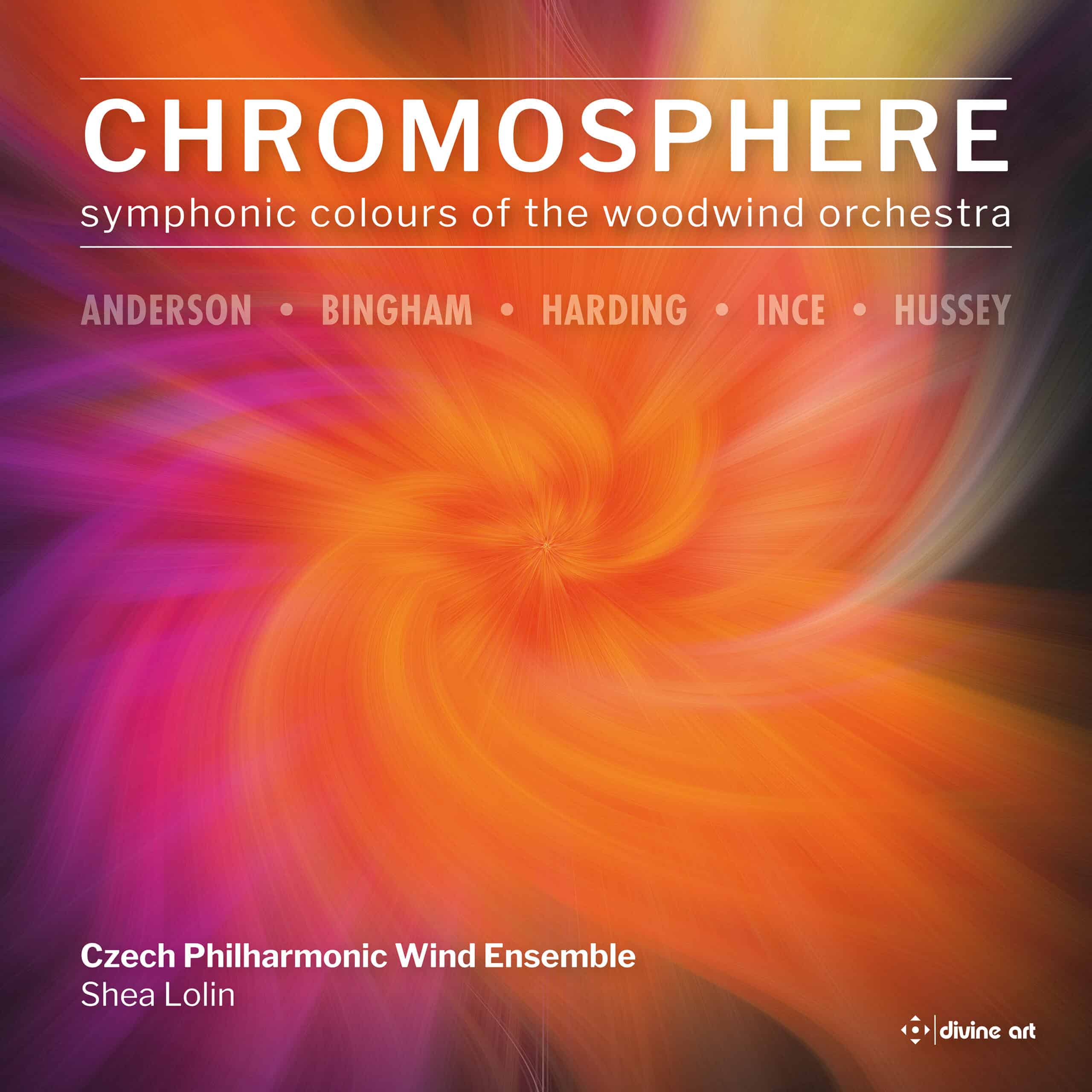
    Conductor Shea Lolin and composer/producer Christopher Hussey have returned to Prague to record with the Czech Philharmonic Wind Ensemble, carefully curating an album of premiere recordings spotlighting the woodwind orchestra, capturing its kaleidoscopic colours and symphonic potential in order to deepen and broaden appreciation of the medium’s power.

    A large chamber ensemble of flutes, oboes, clarinets, bassoons and saxophones in various sizes, the woodwind orchestra has a highly adaptable and magical tonal palette—it can be, in turn, boldly vibrant and delicately beautiful, thrillingly powerful and hauntingly tender, earnestly solemn and joyously comical.

    The recorded repertoire reflects a spectrum of musical styles that exist in 21st-century concert music, ranging from the familiar and instantly singable to the more avant-garde, but always possessing an accessible and inviting musical narrative. Chromosphere is a landmark album, comprising exciting new and re-imagined pieces by leading composers in the genre and demonstrating the unique soundworld of the woodwind orchestra.