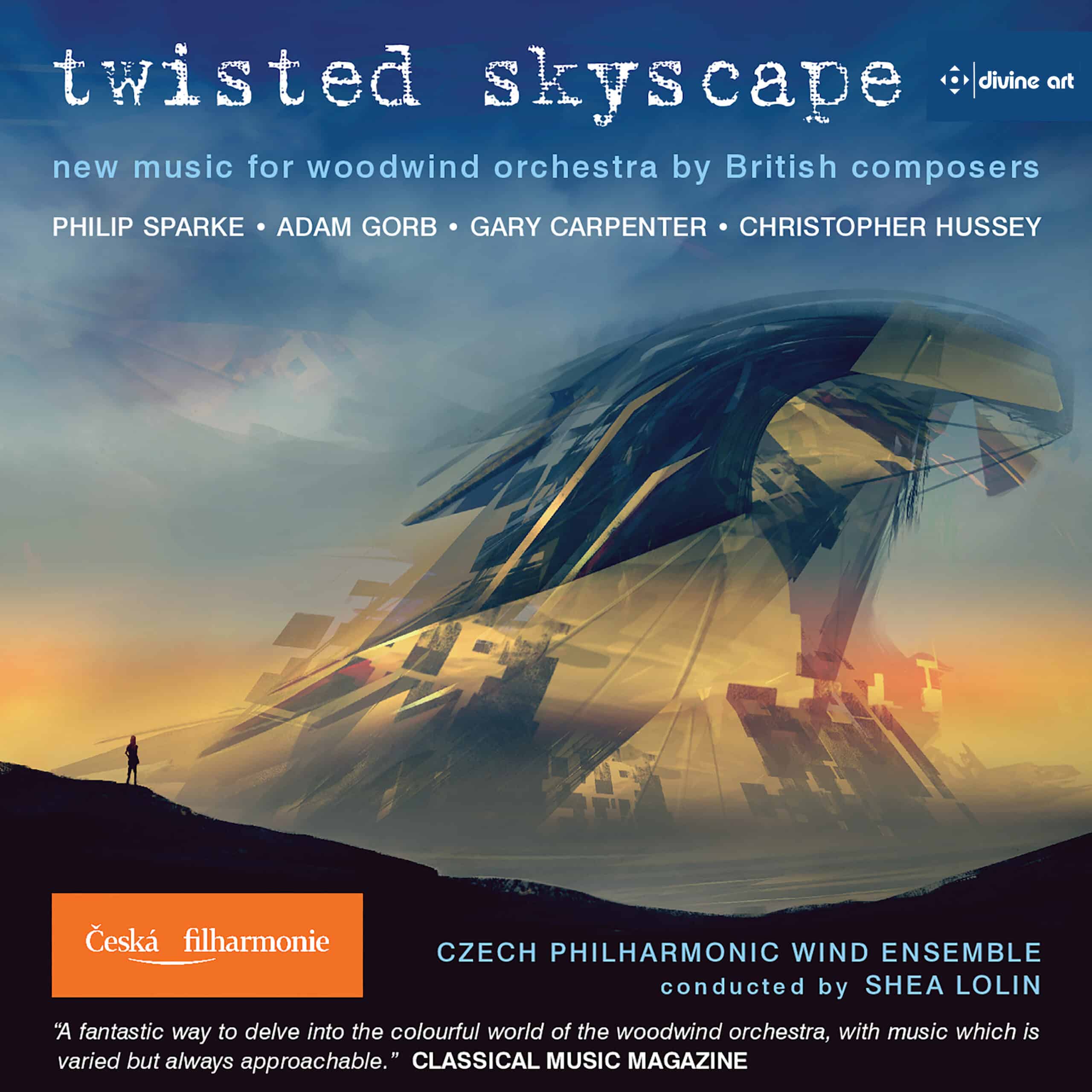
Here we have an album of new music for a woodwind orchestra, composed by British composers and conducted by a British conductor (Shea Lolin) but recorded in Prague with musicians from the Czech Philharmonic, including some of their principal players. The wind orchestra concerned is basically the wind section of a standard concert band: flutes, oboes, bassoons, and most of the clarinet and saxophone families. It is not a combination heard that often, although various amateur groups do exist in England, and if one hoped for some new and interesting sounds in listening to this, one gets them.
Because most of these pieces were written for such amateur groups, none of this music is avant garde in any way, it all comes under the ‘accessible’ umbrella, but that does not mean simplistic or ‘written down’. These are all experienced composers who know how to get results out of an ensemble within restrictions.
Philip Sparke is probably best known as a brass band composer but has written extensively for wind band as well. His Overture for Woodwinds is a good concert opener, starting with an ominous unison opening but settling into a more open texture based in fifths, then a skippy allegretto which has the higher winds jumping about but is also highly melodic. It’s all bright, playable, exploits all the instruments well and employs a wide palette of colour. In this it sets the tone for the whole album.
Gary Carpenter’s Pantomime is based on music written for a production of Aladdin, so we must expect some eastern colour, and indeed an evocative Prologue gives some quasi-eastern scene setting, but also introduces some comic elements evoking old theatre music, a definite 20s/30s feel to some of it, which Carpenter states in the notes is all part of the plan.
Various character pieces follow, including an oriental oboe solo for a lonely Aladdin, a Polka full of hi-jinks (quite a circusy feel here), a love duet for Aladdin and the Princess (lovely work by the oboe and alto sax soloists), A Grand March which takes the mickey out of the bureaucrats – somehow Mahler creeps into this! – and a Waltz-Finale which, although subtitled ‘Depravity’, does sound like a jolly fun ball that you could take your deb daughter to.
It’s all great fun and very theatrical of course, but one problem I have with it is that when the writing gets busy, the lines can get thick and various elements compete with each other, especially in the danger area for winds – the tenor-baritone register. This can obscure what’s going on and make it difficult to follow the argument.
Dreamtide by Christopher Hussey is the first of two of his pieces on the disc, originally written for choir on poems about dreams. Twilight Haze opens with suitably light airy textures (and some breath sounds) on close but pleasurable harmonies. All parts of the ensemble range are exploited in creating some arresting sonorities, in a very effective piece of atmospherics. Wild Reality uses a 5/4 motor rhythm (on a monotone for quite a while) often with shifting accent patterns, contrasted with long-note chords or melodic lines on top. It produces a kind of overall effect of stasis, and comes off as carefully controlled and constructed rather than wild. Dream Within a Dream is an exercise in various quartet combinations at first, all slow and contemplative chords and lines until a tenor sax solo weaves in and out, the piece rising to a climax before returning to the opening textures of the first movement.
Over all this is a very inventive piece in its scoring, showing the woodwind sounds off superbly and providing a good balance of consistency and variety.
Adam Gorb’s Battle Symphony is an admitted piece of pastiche, written in seventeenth century idioms but interpolating some modernistic touches, especially in the harmony. Gorb stays close to the styles and structures of the period: there are Flourishes, Courtly Dances, sections for before, during and after the battle. I didn’t always feel the content of the music matched the graphic titles of some of these sections, but there is plenty of variety and charm in here. Written for a youth wind ensemble, it doesn’t step outside certain boundaries in the writing, but there is no doubting its effectiveness.
Twisted Skyscape gives its title to the album, and was written to be performed synched with a silent film. Hussey again demonstrates his ability to come up with evocative textures, as Natural Worldstarts in the depths of the contrabassoon and contrabass clarinet, building interesting textures as it rises through the instruments, but overall remains an exploitation of instruments’ low registers rather than high – something still not often heard with woodwinds. Human Footprint is reminiscent of the second movement of Dreamtide – employing motor rhythms but in a lighter, more airy way. Jumpy upward lines and repeated chords give a flavour of some of the American minimalists. Nature’s Conquest brings us back to the atmospheric world of the first movement, the word ‘primeval’ coming to mind. Are we perhaps in a swamp on early Earth? Whether or not, Hussey’s clear ideas and ear-grabbing sonorities paint the sort of soundworlds that invite imaginative interpretation.
Notwithstanding the challenging moments of the Carpenter, the recording by Jonas Christian Persson and Vitek Kral is very vivid and displays the whole ensemble very well indeed. All tracks but the Sparke are world premiere recordings, and hopefully this disc will raise the profile of this kind of wind orchestra, as is the wish stated by Lolin in his notes.