Catalogue Connection: 21119

  • The Songs of Thomas Pitfield Planet Hugill Review

    Largely self-taught, based firmly in the North-West at the Royal Manchester College of Music, and writing music very much for friends and colleagues, Thomas Pitfield (1903-1999) is a composer who is often overlooked. But if you do so, then you are missing great delights and thankfully there seems to be a resurgence of interest in his music. The Divine Art label is currently having something of a Thomas Pitfield moment, with Thomas Pitfield: String Chamber MusicThomas Pitfield: His Friends & Contemporaries and The Songs of Thomas Pitfield. Time constraints mean that I have not been able to consider all three discs fully, but I have been listening to The Songs of Thomas Pitfield with great pleasure.

    For The Songs of Thomas Pitfield, that great exponent of English song, tenor James Gilchrist is partnered by pianist Nathan Williamson and they perform a selection of 28 of Pitfield’s songs, spanning the years 1934 to 1989. Many of the songs were published in an album in 1989 [still available from Forsyths], the songs chosen by Pitfield and with his own illustrations and calligraphy.

    I have always been somewhat aware of Thomas Pitfield, he stopped teaching at the Royal Manchester College of Music (RMCM) just before it morphed into the Royal Northern College of Music in 1973, the year I started studying in Manchester. His roots were always in the area, he was born in Bolton to a working-class family, and worked in a drawing-office of an engineering firm till he had enough money to study at the Royal Manchester College of Music for a year. Further study at the Bolton School of Art led to teaching posts across the Midlands, but music remained his main focus and from 1947 to 1973 combined teaching at the RMCM with composition, his pupils included John Ogden, John McCabe and Ronald Stevenson.

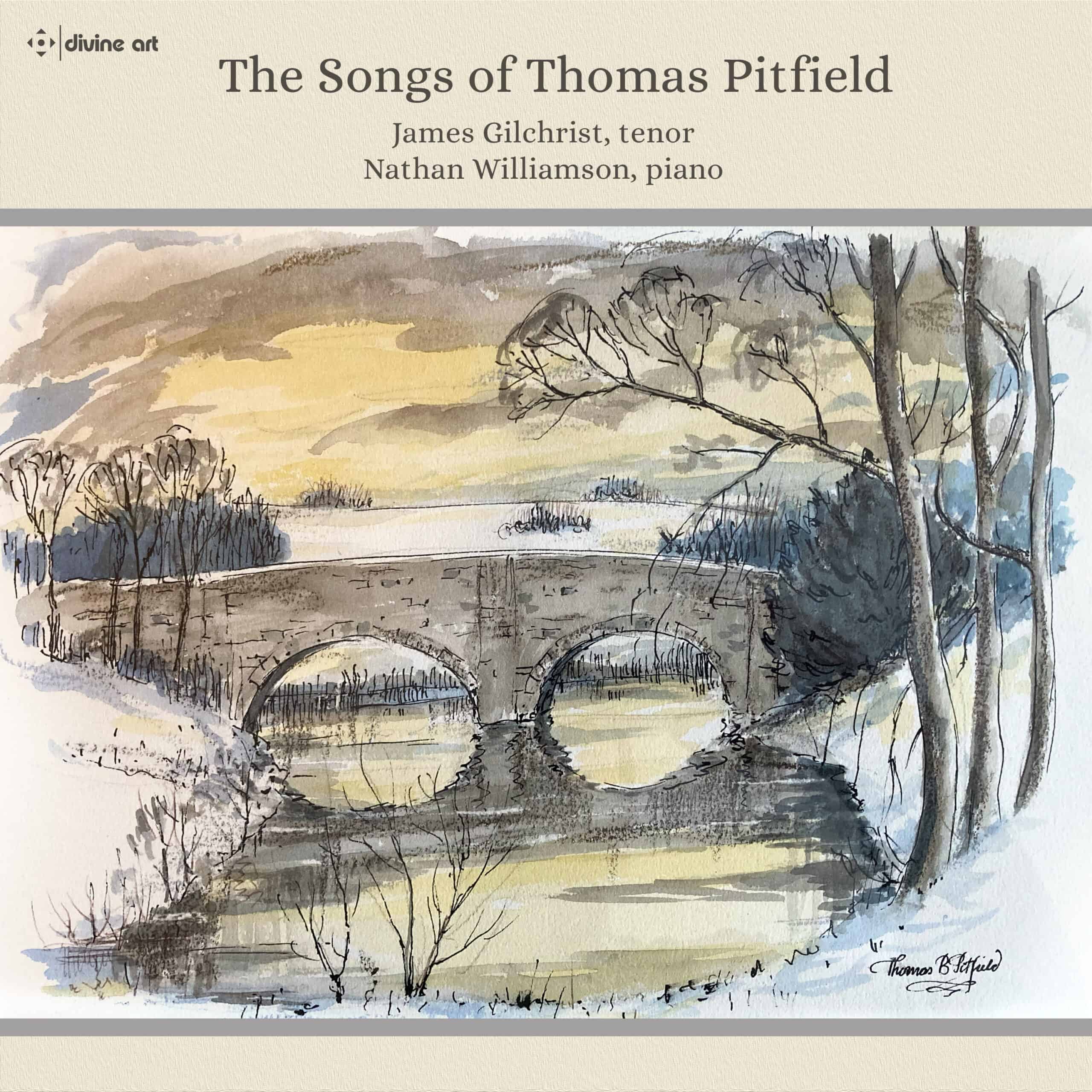
    He composed well over 150 songs, many for friends and musical colleagues, and performers of his songs include Owen Brannigan and Peter Pears. But though music was a focus, he had a wide range of interests, was an artist [the cover of the disc, see above, features one of his watercolours], craftsman and poet. His house in Bowden, he designed himself, and the furnishings he made for it.

    And early brush with the problems of copyright (involving James Joyce’s poetry) led him to concentrate mainly on setting his own poetry which perhaps has led his song output to be undervalued and he commented in later life that ‘I have perhaps patronised my own lyrics overmuch’. He wrote a great deal of verse, more than 260 poems, and was fond of lighter and nonsense verse. 

    The selection on this disc gives one the ability to explore the whole range of Pitfield’s songs. They are tonal, intelligently and imaginatively constructed. Harmonies tend to be imaginative, the piano parts complementing the voice and not negligible. In terms of sound world, the composer that comes most to mind is John Ireland for the way Pitfield combines a natural lyricism with a feeling flow of the words, though his English lyrical vein has hints of Warlock and in at least one song on the disc you feel Britten is around too.

    Though the recital flows naturally from beginning to end, Gilchrist and Williamson have assembled the songs into coherent groups. The opening group are serious and all variants on what one might terms a dramatic recitation, shading from recitative to arioso rather than strophic song. There is a seriousness of intent and a considered thoughtfulness here, there are several striking song including the powerful first song, The Sands of Dee. One curiosity is The Skeleton Bride a rather striking melodrama, for reciter and piano, that really needs to get out more.

    The classic English lyric songs comes next, these include Pitfield’s adaptations of folk song as well as one, In an Old Country Church that almost has pre-echoes of Britten’s Hardy settings. I have to admit that a little of this English-style goes a long way and it was a relief to get to the romantic complexities of his second setting of Lingering Music. Then the Robert Louis Stevenson setting, Shadow March, seems to partake of Scottish song but push the idea to more imaginative limits.

    Christmas Lullaby follows, but then three contrasting night songs. The child hears rain at night is, in a sense, purely descriptive with the darting rain in the piano but Pitfield makes it into something more intense. Song of Compassion returns us to the English lyric style, but In the moonlight is an engaging adaptation of a French nursery song. The recital concludes with Four Short Songs, all with texts by Pitfield. This tiny songs seem to manage to encompass a lot more than one might expect.

    Pitfield’s compositions are often described as light-hearted and small scale. Listening to this disc, you can clearly hear his influences from other English composers, but the selection of songs seems designed to demonstrate both the wideness of his taste but also his ability to be serious on a concentrated scale. In his Obituary of Pitfield in The Guardian (27 November 1999), John McCabe wrote that ‘There are, too, works in which Pitfield’s expression touches considerable emotional depths. The Sands Of Dee [the song that opens his recital], for voice and piano, has great dramatic power’.

    The performances from James Gilchrist and Nathan Williamson are far more than admirable. Gilchrist has a way with this music, a sympathy with the essential lyric English style along with an ability to spin a line whilst promoting the words. All the time he is sympathetically partnered by Nathan Williamson.

    For those interested in exploring the composer further, the book Endless Fascination: The Life and Work of Thomas Pitfield, Composer, Artist, Craftsman, Poet, issued by Forsyths, brings together most of Pitfield’s significant autobiographical writings, new critical essays reappraising his work, and the recollections of family, friends, pupils and colleagues.
  • Thomas Pitfield Songs Musical Opinion Review

    Twenty-eight individual songs with an overall playing time of less than fifty-five minutes tells its own story; among the wide-ranging gifts this unique figure possessed was that of brevity: not the brevity of minimalism (the word was unknown to him) but of making a relevant musical point without unnecessary padding – nor are these songs wholly epigrammatic; they say, musically, what needs to be said an no more.

    There are several compelling gems here: September Lovers, Christmas Lullaby and The Carrion Crow, especially, to which music be added Winter Evening: Dunham Park (at 4’43”, the longest song here); as an example of Pitfield’s brevity, the Four Little Songs last in total less than three-and-a-half minutes (!), but work as a set beautifully, especially in admirable performance and recordings as these.

  • Thomas Pitfield (1903–1999) lived a long and productive life as a composer, teacher, poet, and artist. He designed the house he lived in and the furniture in it as well. Most of these songs are setting of his own texts or poems of friends (he avoided copyright issues that way). Pitfield’s style was conservative, and his songs fall directly into the British tradition represented by Vaughan Williams, Britten, and Holst. They display sensitive word settings, and their moods range from sweet and gentle to witty and even macabre. The downside is the simplicity of Pitfield’s piano writing, which causes the listener’s attention to wander after a while. In smaller doses, however, this is attractive material, particularly in the present performances.

    Tenor James Gilchrist spent his early career as a physician, turning to a full-time singing career in 1996 at the age of 30. His voice is rather generic, attractive but lacking in individuality and limited in its range of colors. He uses his vocal resources with intelligence, though, which counts for a lot in these songs. Winter Evening: Dunham Park is a highlight in this collection. The spare melodic line fits Pitfield’s bleak verse perfectly: “Beech boughs are etched on the grey waste of sky as on a wide-arched canopy of glass.” In his singing Gilchrist employs a varying range of soft dynamics to capture the mood. In “You Frail Sad Leaves,” the music and text turn darker when referring to the tears of estranged lovers, for which Gilchrist poignantly finds the right vocal coloration.

    This program works because the music and the singer are so well suited to each other. The songs respond to the intimacy Gilchrist imparts. This is singing that invites you into its world instead of reaching out to seize your attention. At this stage in Gilchrist’s career, this is probably how things have to be—he was 57 when this recording was made, and the voice sounds at its best at mezzo-forte and softer. But the singer’s dramatic skills are still evident in “Skeleton Bride,” a weirdly macabre quasi-recitation that isn’t quite Sprechstimme or speaking. Clearly Gilchrist relishes the bizarre text. Some of these songs have a touching bittersweet quality, like “September Lovers” and its reminiscence about lost love. Others aresimple and tender, like “Christmas Lullaby,” and yet others exhibit Pitfield’s brand of dry British humor, such as “Four Short Songs.”

    In short, this is an enjoyable disc of attractive songs performed with sensitivity. The recorded sound is a bit distant; I wish Gilchrist’s voice had more presence. The balance with Nathan Williamson’s piano, however, is fine, and his tasteful accompaniments are a nice fit with the singer. The booklet provides helpful notes and full texts. I can recommend this release confidently to anyone interested in off-the-beaten-path British songs.

  • The Songs of Thomas Pitfield Chronicle Review Corner

    Pitfield composed more than 150 songs, many written for and dedicated to friends and musical colleagues, particularly singers, including several who hailed from the north of England or who taught at the Royal Manchester College of Music.

    The songs vary in mood, from the haunting and powerful to gentler and even humorous. A volume of his songs, chosen by himself, spanning the period from 1934 to 1989, was published in 1989, and most of the songs on this album were included in that.

    Pitfield worked as a craft and cabinet-work teacher but music was his main focus and as more of his works were performed and published, his reputation as a composer grew. From 1947 to 1973 he taught composition one day a week at the RMCM, where his pupils included David Ellis, Christopher Littlewood, John McCabe, John Ogdon, Max Paddison and Ronald Stevenson.

    Pitfield was largely self-taught and considered himself to be one working in and allied to the community. His music was often written for specific occasions or performers, much of it for friends, amateurs or children. So, while in places, this wanders towards the more operatic, on the whole it is more intimate and very listenable.

    “The Sands of Dee” (based on a poem by Charles Kingsley) opens and is not a good guide to the more tranquil work that follows, a dramatic (ish) piano giving way to singing that threatens to turn into operatic rather than more domestic, although as the main character drowns while rounding up cows, some drama can perhaps be forgiven.

    “By the Dee at Night”, based on a poem by the composer, follows, and is slower.

    “Winter Evening, Dunham Park” is where it gets gentler, the song evocative of an evening in a country park and there’s a run of more easeful songs.

    The CD ends with four brief songs, one about a slow tortoise and the closer “King Nebshazzerod”, who is so mean he doesn’t feed his dog: “The dog bit off his master’s leg / He ordered one of wood / And said, ‘Get out, you naughty dog / I’d kick you if I could!’”

    Out on Divine Art, DDX 21119.

  • The Songs of James Pitfield American Record Guide Review

    Thomas Baron Pitfield (1903-99) was a British composer, poet, artist, engraver, cal- ligrapher, craftsman, furniture builder, and teacher. He was essentially self-taught as a composer, but studied piano, cello, and harmony at the Royal Manchester College of Music. Pitfield was a life-long vegetarian, a man of modest means, a pacifist, and a man closely attuned to the natural world. 

    During his lifetime and into his 90s Pitfield composed more than 150 songs. Most of the songs of this album are settings of his own texts or texts of his friends. They cover a wide range of moods, but a somber reflection on life dominates the program from the start. Two songs tell of the awesome but deadly power of the sea and two by Pushkin in English translation by Alice Pitfield (his wife) reflect on the harshness and uncertainty of life. 

    All but 2 of these 28 songs composed from 1934 to 1989 are from his book The Poetry of Trees, which included his own illustrations. He considered the production of the book, bound by his own hands in wood and leather, to be one of his finest achievements. The album cover is adorned by one of those illustrations. 

    Two settings of `Lingering Music’ are included here. Dates of composition are not given, but it gives a chance to hear two different ways he approached his own text. Other songs are about separation from home and family. Many have a nostalgic tone. The songs are ordered thoughtfully. Three songs with nighttime settings come toward the end of the program. `The Child Hears Rain at Night’ presents a child fearful of the wind and rain beating on his window followed by `Song of Compassion’, a prayer for “all birds and beasts that seek shelter” in such conditions. That is followed by Pitfield’s arrangement of the French nursery rhyme `Au Clair de la Lune’ in his own translation. 

    The program ends with 4 brief and witty songs, one about a slow tortoise and another about a dog who bites off his master’s leg, to which the master replies, “I’d kick you if I could!” I found his songs tuneful and easy to like, even if they may not find their place in the pantheon of greatest songs. 

    James Gilchrist shows again why he is so widely admired as a singer, particularly of English song. His voice is warm and supple; his phrasing is keenly nuanced; his varied use of dynamics illuminates the texts knowingly. Nathan Williamson’s collaboration is on par. It would be hard for me to imagine a better rendering of these songs. `Winter Evening: Dunham Park’ beautifully evokes the silence as day turns to night and “All shapes dissolve into the gathering grey”. Gilchrist gently characterizes the mood per- fectly. 

    This seems to be the first recording of Pitfield’s songs, and it makes a very strong case for them. Very few recordings of his music are available, but several recordings of his chamber and orchestral works are. Gil French in a review of Pitfield concertos for Naxos characterized his music as “bright, rhythmically infections, and tonal” (M/A 2006). That description also applicable to his songs. 

    Notes by Rosemary Firman offer a tribute to this modest man for whom life was, as he called it, “endless fascination”. Texts are included.

  • The Songs of Thomas Pitfield British Music Society Review

    This disc has been a surprising delight. I say ‘surprising’ because although I knew Thomas Pitfield was a composer I had no idea that his songs (and there are over 150) were so interesting, distinctive and attractive. Some of his works have appeared on CD (chamber works on Heritage and piano concertos on Naxos) and this collection of 28 songs is a welcome addition.

    Most of the songs were written for friends and colleagues, and occasionally his songs were included in recitals by Peter Pears and Owen Brannigan. Tenor James Gilchrist brings them all to life with wonderful clarity of diction and a full range of dynamics and expression. The quiet hushed ending of By the Dee at night is a good example. He is well supported by the pianist Nathan Williamson. 

    Pitfield taught composition at the Royal Manchester College of Music from 1947 to 1973 and among his pupils was John Ogdon, and it seems that he was always composing. His output includes concertos for various instruments, sonatas and chamber music including smaller scale works for amateurs. Works for professionals include pieces for Leon Goossens and Osian Ellis. He was lucky to be taken up by Herbert Foss at OUP who published much of his music.

    To my ears the songs inhabit a musical world somewhere between Warlock and Britten, although Pitfield was also influenced by Vaughan Williams, Grainger and Delius. In an old country church begins with the line The belfry clock ticks quietly and the piano represents that ticking. This reminds me of Britten’s The little old table where the piano represents the creaking. Some songs are stark, such as Winter Evening Dunham Park (to his own text) and some flow with the emphasis on melody (Your frail sad leaves and Song of compassion). 

    There are three folk song arrangements including The Carrion Crow with a Warlock-like accompaniment and Faithful Johnnywith Brittenesque piano part. The recital also includes Skeleton Bride which is scored for reciter and piano. There are two settings of his own poem Lingering Music; I would like to know the dates of composition. The recital ends with Four Little Songs, each under a minute long and gently witty.

    The booklet includes all texts and short foreword by John Turner.

    Pitfield was an artist, engraver, calligrapher, furniture builder and teacher, and I now know he was a fine composer of songs. 

  • The Songs of Thomas Pitfield

    The Songs of Thomas Pitfield

    Divine Art presents the songs of Thomas Pitfield, a revered composer whose catalogue boasts over 150 songs crafted over a lifetime of creativity and dedication. From heartfelt dedications to friends and colleagues to whimsical folk-inspired tunes, Pitfield’s compositions offer a kaleidoscope of emotions and experiences, showcasing his versatility and depth as an artist.

    This meticulously curated selection of songs is elegantly presented in a volume adorned with his own captivating artwork. The collection stands as a testament to Pitfield’s legacy with evocative interpretations of his songs by acclaimed tenor James Gilchrist, accompanied by the virtuosic pianist Nathan Williamson. With Gilchrist’s emotive performances and Williamson’s consummate skill at the keys, listeners are invited on a sophisticated journey through the melodies and moods of Pitfield’s musical landscape. The album celebrates the remarkable legacy of Thomas Pitfield, whose enduring contributions to the world of music continue to resonate and inspire.

    James Gilchrist
    Renowned for his expressive interpretations and captivating stage presence, James Gilchrist embarked on a full-time music career in 1996 after beginning his professional life as a doctor. With a repertoire spanning from baroque to contemporary music, Gilchrist has performed in prestigious venues worldwide under the baton of renowned conductors such as Sir John Eliot Gardiner and Harry Christophers. His discography boasts a diverse range of recordings, including critically acclaimed interpretations of British song cycles and baroque masterpieces.

    Nathan Williamson
    Pianist and composer Nathan Williamson is celebrated for his innovative collaborations and dynamic performances. From recording projects with esteemed tenor James Gilchrist to premiering compositions by contemporary composers, Williamson’s artistry knows no bounds. His discography includes acclaimed recordings of American and British piano repertoire, earning praise for his thoughtful interpretations and passionate delivery. As both performer and composer, Williamson continues to push the boundaries of classical music, captivating audiences with his boundless creativity and virtuosity.