Catalogue Connection: 21120

  • Williamson Fanfare Review

    Since I am known—if I am known at all in reviewing circles—as one who sticks to Mussorgsky’s Pictures and first recordings of contemporary music, it may surprise the reader to see my name appended to the end of a review of the music of one of the best-known British (well, Australian, to be picky) composers of the century just past. The answer to this enigma is the fact that most of the works on this well-filled disc of this former Master of the Queen’s Music are first recordings, despite the dozens if not hundreds of LPs and CDs that contain other works by him. Being a decades-long fan of his music, the receipt of the disc from Fanfare Central was most welcome. These “unknown” works by the master span the gamut of his compositional style and career.

    I shall consider together one group of works, the eight Gallery works which are scattered about in this recital, and for a good reason: they are all very brief (all under 50 seconds, and most less than half that length) and bear significant resemblance to each other. These are products from 1966 and constitute music that Williamson wrote for an eponymous British television show. Thus, these vignettes were for opening or closing music or transitions between scenes. The majority of them provide the last word in “mechanical music” and are highly rhythmic and propulsive, the type of music that would have worked perfectly as underscoring for the machinery in Chaplin’s iconic film Modern Times. Each is scored for the unusual combination of six trumpets, two pianos, and percussion.

    The remaining longer works I’ll address more or less in program order. The first of these is Pas de quatre, written the following year after the Gallery pieces, for wind quartet and piano. The suite is cast in six contrasting movements, a very busy and exuberant Allegro vivace that is followed by two variations, a pas de trois, a pas de deux, and a coda. And, yes, this is music that could be danced to with considerable success, despite some occasional irregular meters. Some of the movements (such as Variation B, restricted to two woodwinds and seemingly the composer’s take on Ballet of the Unhatched Chicks) confine themselves to subsets of the entire ensemble with considerable success. Despite the composer’s sometimes prickly and curmudgeonly personality, this is music that is nothing short of delightful.

    The two Vocalises, both for clarinet and piano, are created with lovely lines in the solo instrument decorated with gentle figuration in the piano. Sandwiched in between these is another work for the same forces, the “December” movement from the composer’s cycle Year of Birds, thought by scholars to have been intended by him as a stand-alone piece. It indeed nestles comfortably between its two bookends and impresses the listener as essentially a third Vocalise. Willamson’s brief two-movement Trio adds a cello to the instrumentation of the preceding three works. The opening Poco Lento is a quiet movement in which the cello carries most of the tunes with the clarinet and piano often providing birdlike figuration as commentary. The second section speeds up the proceedings by several degrees, but continues the employment of long lines—again often in the cello—complemented by the other two instruments. It’s a most effective and ingratiating work that I wish had gone on a good bit longer, given my captivation by it.

    Williamson had a special affection for Scandinavia and even knew Swedish well enough to translate some texts in that language into English in order to set them to music. In Pietà, however, he foregoes the translation and sets Pär Lagerkvist’s text in its original Swedish. The 1973 song cycle was commissioned by the Athenaeum Ensemble and is a good bit more austere than most of the works gathered together on the present CD. The cycle, a meditation on the Virgin Mary, reflects its composer’s conversion to Catholicism some years prior. Its somber nature as she reflects upon her crucified Son may have been consciously applied by Williams to his musical setting here. The addition of oboe and bassoon to the usual piano accompaniment of song cycles lends a certain piquancy to the sound.

    Music for Solo Horn receives no discussion in the booklet, but may have been one of the numerous works the composer wrote for various musician friends. The work is quite lively as horn works go, and includes a fair number of quickly repeated notes. An interior panel slows down the pace, although I doubt it gives the soloist much time to catch his breath before the lively activity resumes. The following Concerto Fragment reverts to (and even exceeds) the austere sonorities of Pietà. Again there is no information given about this minute-and-a-half snippet of an unfinished work for three pianos.

    The program concludes with its longest work, the 24-minute Concerto for Wind Quintet and Two Pianos (Eight Hands), a combination possibly unique in the history of music despite its being confined to conventional instruments. After a slow wind intro, the eight hands on the two pianos burst into the heretofore serene lines with a fusillade of fortissimo tremolos guaranteed to instantly rouse any listener whose eyelids may have become heavy. The near-equal disposition of parts between wind players and pianists’ hands produces a sound unlike that of any other work I’ve ever encountered, and I suspect that few of Williamson’s many fans would recognize this work as his if they did not already know it. The Concerto was one of numerous commissions the composer received upon the successful premiere of his opera Our Man in Havana, and was intended to honor British composer Alan Rawsthorne on the occasion of his 60th birthday.

    The first three movements are more or less quite laid-back, with some long passages in which the piano ensemble is silent, but the final one, containing far more notes than those preceding it combined, is busy, dynamic, and loud throughout, making a stunning closer for the recital.

    Performances of this outstanding composer’s “chips from the workbench” are uniformly fine, and this unknown music should take its place proudly alongside the many masterpieces produced by Malcom Williamson. My usual high recommendation, as befits any composer whose music I admire.
  • Williamson Chamber Music La Folia Review

    Williamson’s a dissonant Poulenc with an attitude.

  • Williamson Chamber Music Limelight Review

    Prolific and often controversial composer Malcolm Williamson, the first Australian Master of the Queen’s Music (and the only appointee not to be knighted!), has dropped into near-oblivion since he died in 2003 – something that London-based Victorian pianist Antony Gray hopes to ameliorate with the release of this beautifully performed anthology.

    Gray plays on most of the tracks – alongside crack performers from St Paul’s Sinfonia the New London Chamber Ensemble – and has written liner notes on his friend’s complex personality.

    Impish and attention-getting sound grabs of music for a 1966 TV project punctuate the collection, lending a sense of cohesion, just as the recurring Promenade interludes do in Mussorgsky’s Pictures at an Exhibition. We get a terrific Pas de quatre for wind quartet and piano, worthy of Poulenc; a trio for clarinet, cello and piano; some solo pieces, and a substantial and strikingly good Concerto for Wind Quintet and Two Pianos.

    At its heart, and worth the price alone, is the moving Pieta, set to verses by Pär Lagerkvist and superbly sung by Swedish soprano Sally Lundgren, with Gray on piano and the atmospheric combination of oboe and bassoon.

    There are many lovely moments in this always interesting, chameleon-like collection. What comes across is the exceptional quality and musicality of Williamson’s diverse material. He defined it best himself. “Most of my music is Australian,” he said. “Not the bush or the deserts, but the brashness of the cities. The sort of brashness that makes Australians go through life pushing doors marked pull.”

  • Williamson: Chamber Music BBC Magazine Review

    Malcolm Williamson’s later life was often chaotic, which led to many of his works remaining unheard or disappearing from view, so it’s good that some of them are seeing the light of day. Most come from the 1960s and 70s, but Music for Solo Horn (1947) and the Clarinet Trio (1958) find the young composer stretching his wings, with brittenesque exuberance in the faster music, and the sound of birdsong and long melodic lines redolent of Messiaen in the slow movement of the Trio.

    The 1966 Concerto for Wind Quintet and Two Pianos shows Williamson’s tougher side, with its serial musical language colouring a sinister encroaching march in the opening Lento followed by a fuguee whose tricky cross rhythms sometimes catch the performers out. A second Lento is gentler for much of the time, and it’s only the finale that reveals a more outgoing mood – again there’s sometimes a lack of ensemble in the performance.

    A similar energy informs much of Pas de Quatre from the following year, more modestly scored for wind quartet and piano, but with the same thorny harmonic profile. An exception is the flowing Pas de deux where clarinettist Neyire Ashworth plays a beautifully long-breathed line over Antony Gray’s rippling piano accompaniment.

    The emotional core of the album is Pietà, a 1973 setting of five poems by Par Lagerkvist, relating to Mary and the Crucifixion. It’s a slow, austere processional for most of its 20 minutes, with oboe and bassoon sinuously winding round the mezzo-soprano, Sally Lundgren, who could have a greater tonal range. But there is a concentration to the performance, with a hard earned taste of resolution in the final poem.

  • Malcolm Williamson: Chamber Music MusicWeb Review

    I will start by quoting from the notes here: “Anyone trying to pin Malcolm Williamson down, either in his music or his personality, is in for a hard time. As a man he could be completely adorable one minute, and infuriatingly obdurate the next. And although he had close life-long friends, he as often as not left a trail of devastation and destruction in his wake. It could be said that at least in part, it’s for this reason that his music, which enjoyed great success particularly in the early stages of his career, has disappeared almost completely from the concert hall as well as the recording catalogues. This is an enormous shame, given the extraordinary quality of his music.” The works on the present release are chamber music for wind and piano spanning almost his whole compositional life; most  appear on disc for the first time, partly due to the Williamson archive becoming available in 2023, on the death of Simon Campion.

    An extensive MusicWeb International profile of Williamson written by Paul Conway can be found here. I must admit that, prior to this review, I knew little about Williamson apart from that when he was appointed Master of the Queen’s Music in 1975 the comment was made that “They’ve got the wrong Malcolm” – a reference to Malcolm Arnold, who was also very much in his prime in the 1970s but also always a controversial figure with well-documented mental health issues.

    All but one track on this release feature the pianist Antony Gray, who seems to be the guiding force behind the CD and wrote the very extensive notes. Wikipedia tells us that Williamson “was the Master of the Queen’s Music from 1975 until his death. According to Grove Music Online, although Williamson’s earlier compositions aligned with serialist techniques, he later modified his approach to composition in the search of a more inclusive musical language that was fundamentally tonal and, above all, lyrical”.

    Of the 17 pieces on the album, eight make reference to gallery; three to “gallery opening music”,  three to “gallery concluding music” and two to “gallery sandwich trailers” and the notes tell us that the music was written “for what appears to be incidental music for a television show, Gallery. Apart from a catalogue entry there is no other evidence of what the music was written for. The film and television music expert Ian Gardiner suggests that Gallery may have been a working title as it does not appear on any database.” The longest of these pieces is just 46 seconds. In most of the pieces the same opening music is used but with a different ending; the works are for a grouping of six trumpets and two pianos, which will give the reader a sense of the style of the pieces; it is often urgent but there are also some sweet lyrical motifs.

    There are three other works at less than two minutes each. Vocalise in G was written for a friend the soprano Hazel Reader. It is gentle and lyrical. December from Year of the Birds – again gentle and lyrical similar to Vocalise in G. Both these works are scored for clarinet and piano. The final short piece Concerto fragment is, however, scored for four pianos. It is dark and deep, very different to the lyrical nature of the two vocalises and December, and is another atmospheric work using counterpoint to create a mysterious, eerie effect. Another “vocalise” on the release, Vocalise in G minor, is longer at 3.51. It is scored for the same instruments as the shorter Vocalise and is very similar in style.

    Pas de Quatre isscored for four wind instruments – no horn – and a single pianist. It was commissioned by the Metropolitan Opera Ballet Workshop. It was subsequently choreographed by the Northern Dance Theatre in Manchester, and was performed there in 1970, rejoicing in the name BigfellaTootsSqoodgeandNora! It has six movements:

    I. Allegro vivace,featuring the whole ensemble, is fast and furious. The meandering motif heard on the wind instruments at the beginning of this movement serves as a link between the variations, in various guises.
    II. Variation A for piano and flute, is lively and playful.
    III. Pas de trois for flute and oboe, is peaceful and quiet.
    IV. Variation B is bright and lively.
    V. Pas de deux is lyrical and slow.
    VI. Coda 2 again features the whole ensemble, the motif heard in the first movement underpins the whole of this frantic finale.

    Benjamin Britten was impressed with the young Williamson’s talent and asked him to write the Trio for Clarinet, Cello & Piano for the Aldeburgh festival in 1958. On that occasion it was played by the clarinettist Harrison Birtwistle. It has two movements. 

    I. Poco Lento is slow and contemplative, the piano twinkling throughout as the cello plays softly, and the clarinet can be heard above both.
    II. Allegro – Presto is in a lighter mode; the cello is more in evidence as it alternates with the clarinet. It’s all much more animated and fun than the first movement.

    Listening to the work I can certainly relate to a comment in the notes: “a (unnamed) reviewer from Manchester Guardian, who described the Clarinet Trio as being ‘forthrightly tuneful, simple in form and texture, though making use, very loosely, of some sort of serial technique.’” on hearing the piece.

    By the 1960s, after ten years in London, Williamson was quite firmly established on the music scene. His first major opera, Our Man in Havana, written when Williamson was just over thirty, had been performed to great critical acclaim, and major commissions were coming in constantly. One of which, in 1966, was the Concerto for Wind Quintet and Two Pianos, Eight Hands. It was commissioned for the 60th birthday concert at the Wigmore Hall of the composer Alan Rawsthorne, the pianists on that occasion being no less than Richard Rodney Bennett, Peter Maxwell Davies, Thea Musgrave and Williamson himself, with the New London Wind Ensemble. It has four movements:

    I. Lento which begins as a slow lyrical melody played by the woodwind instruments before we hear energetic bursts from the pianos and then the horn takes the lead. Next, there are ominous piano notes repeated urgently, then a gentle woodwind section again; the urgent piano beat returns with the horn making its presence felt. The overall effect is both dramatic and melancholic, making it a memorable track.
    II. Allegro is a fugue and a great example of Williamson’s command of counterpoint; the movement is lively and full of energy.
    III. Lento. The second lento starts with a simple piano tune; the gentle mood is maintained as the woodwind joins in as they play an eerie melody, urgent notes are played loudly on the piano and the dynamics of the whole piece increase before we return once more to a gentle, peaceful and lyrical melody.
    IV. Allegro vivo. The final movement is frantic and boisterous, demanding much virtuosity from the players.

    The work was well received, but performances have been rare since, due partly to the unusual mix of instruments it requires. 

    Pieta is a work for mezzo-soprano, oboe, bassoon and piano. Throughout his life, Williamson was a fan of Scandinavian poets, in particular, Swedish ones. In 1973 he received a commission from the Athenaeum Ensemble for which he chose a work by the poet Pär Lagerqvist. It’s a setting of five poems the final one called Pieta after which he named the whole work. The texts are included in the CD brochure. Williamson, who had lived in Sweden with his family for a while, chose to set the poems in their original Swedish but the CD notes include translations by Sally Lundgren. On reading English texts, I am struck by how bleak they are. The work reflects this; it is austere and yet holds your attention to the very end. I find it a really fine work.

    Finally, we have Music for solo horn. The manuscript is contained in an exercise book containing a number of other early works or sketches. Williamson was sixteen at the time and although he was a horn player himself, it was beyond his skills; however, Barry Tuckwell played it at first sight. It’s a simple, entertaining piece.

    This is a thoroughly entertaining release, including a really excellent mix of Willaimson’s chamber music. I thoroughly enjoyed exploring the music and reading the excellent notes in the CD brochure.

  • BBC Record Review Williamson Chamber Music for Wind and Strings

    “a joyful outburst of invention in a brilliantly scored piece of chamber music… You can’t pin him down in this album. Like his personality, his music was often unpredictable. But also, delightfully imaginative, quirky and uncompromising. Excellent performances from pianist Antony Gray and friends.”

  • Classical Music Sentinel Williamson Chamber Music for Wind & Strings Review

    The music of Australian/British composer Malcolm Williamson (1931-2003) is nothing if not brash and assertive, with rare but deeply lyrical moments thrown in for good measure. And according to the booklet notes, his personality mirrored his music. “As a man he could be completely adorable one minute, and infuriatingly obturate the next. It could be said that at least in part, it’s for this reason that his music, which enjoyed great success particularly in the early stages of his career, has disappeared almost completely from the concert hall as well as the recording catalogues. This is an enormous shame, given the extraordinary quality of his music.”

    Spontaneous, impulsive yet calculated, jaunty and spirited yet deeply reflective. These are but some of the initial impressions that come to mind when listening to his music. As I had noted in a previous review of a recording of his Piano Concertos, “his music is constantly diverse, imaginative, bold, conservative, lyrical and adventurous, all rolled into one.” There’s even a slight jazz element at times lurking just under the surface (the composer himself played the piano in night clubs during the 1950s).

    The pieces gathered together in this collection are for mixed instrumental combinations including flute, clarinet, trumpet(s), bass trumpet, percussion, cello, oboe, bassoon, horn, piano(s), and even a mezzo-soprano. Some of them premiere recordings, and mostly incidental music ranging from Music for Solo Horn composed when Williamson was only 16, to music for the television show Gallery, to the greatly impressive Concerto for Wind Quintet & Two Pianos, Eight Hands, a prime example of Williamson’s volatile temperament in which the composer’s mastery of counterpoint is on full display.

    A 20th century composer well worth discovering or at least reacquainting yourself with if he’s already part of your musical vernacular.

  • Williamson: Music for Wind & Piano Gramophone Review

    Being appointed Master of the Queen’s Music after the death of Arthur Bliss in 1975 was probably the worst thing that ever happened to Malcolm Williamson. It is telling that almost all the music in this wide-ranging selection was written before this unfortunate milestone – and a look at his complete catalogue reveals a devastating falling-off in productivity after he assumed the royal role. The spotlight of scrutiny tragically led to an immediate inability to complete over-ambitious high-profile projects, which in turn exacerbated certain unfortunate personality traits in the composer. From being one of the most gifted and versatile musicians of his generation he effectively became persona non grata for the rest of his career – a consequence of which is that his large output has been virtually ignored since his death in 2003.

    This recording is a significant attempt to make amends for such neglect and is masterminded by Australian pianist Antony Gray, who knew the composer well. He takes a leading role as pianist on the disc together with a considerable gathering of friends and colleagues who generally do Williamson proud. But a look at some of the performers associated with him in his heyday now makes poignant reading. The earliest work here is the engaging Music for Solo Horn, written in 1947 in Australia when Williamson (a budding horn player himself) was just 16. Too hard for him, it was immediately read at sight by fellow Aussie student and exact contemporary Barry Tuckwell! Never heard since, it is brought back to life with brilliance by Roger Montgomery.

    The quirky Trio for clarinet, cello and piano was premiered at the 1958 Aldeburgh Festival (Britten was an early supporter) with Harrison Birtwistle rather piquantly on wind and Cornelius Cardew on piano, another work forgotten until now. The line-up for the extraordinary Concerto for wind quintet and four pianists at the Wigmore Hall in 1966 included Richard Rodney Bennett, Peter Maxwell Davies, Thea Musgrave and Williamson himself on the two pianos. The most sustained and serious piece here is the Pieta of 1973, setting five poems by Pär Lagerkvist in the original Swedish as a continuous 20-minute span for soprano, oboe, bassoon and piano. Sally Lundgren has a monochrome voice which oddly seems to suit the austere expression – adding an entirely unexpected dimension to Williamson’s chameleon-like character. The recording quality is somewhat variable throughout but this needn’t deter anyone eager to explore a forgotten master.

  • MusicWeb International Malcolm Williamson Review

    Sir Arthur Bliss Master of the Queen’s Musick – he liked the old spelling – died on March 27th, 1975, and two Malcolm’s, Arnold and Williamson were suggested as replacements. Both sadly had emotional and alcohol problems which got worse in the coming years. For Williamson, who was appointed in 1976, this proved challenging as from the start he had difficulty in meeting some deadlines for high profile works and the British press got their knives out for him. From the early 80s it seemed he could do no right although he did write a number of significant works until a Parkinson’s diagnosis and a major stroke in the mid-90s limited his ability communicate verbally and put notes on paper. For whatever reason, by the late 90s he could not fulfil the role, but he did not resign as Master of the Queen’s Musick and when he died in 2003 the obituaries were not charitable about his considerable achievements. Most chose to dwell on his idiosyncratic personality or pointing out he was the only Master of the Queens Musick in 100 years not to be knighted. After his death the post was limited to ten-year terms and the name reverted back to Master of the Queen’s Music.

    Live performances of Williamson’s has music all but disappeared. Of new recordings on CD there were few. Hyperion did record all of the works for piano and orchestra. For ABC Classic Antony Gray recorded the complete piano music. A Chandos series of orchestral music only got to two volumes before stopping. This was tragic as he was a very fine composer and there is much in his large catalogue well worth exploring. This disc covering chamber music from over fifty years is therefore more than welcome as it shows just how wrong has Williamson’s neglect been.

    While showing the undoubted quality of the music it does highlight a problem. Williamson’s music is wide ranging stylistically. At times it seems to be leaning towards Broadway and the downright popular, the next mixing plain chant with Messiaen and cerebral serialism. His friend Richard Rodney Bennett who, for most of his life, kept his more ‘difficult’ works separate from his popular ones likened his music to being from different rooms in his house. The fundamental design is the same, but each have a different ambience. In Bennett’s case it was a very tidy house, with Williamson it is more an open plan affair with the contents spilling over. So here, for the unsuspecting, some of the track changes will come as a shock but keep going. A number of works are appearing for the first time since following the death of his partner Simon Campion a previously hidden archive has become available.

    The disc opens with and intersperses through the ensuing tracks, music cues from what seems to have been intended incidental music for a television show. The score calls it Gallery, but no such programme has been traced, and no further details are available. Whatever the programme was it must have been of ‘serious’ intent as the style is spikily Stravinskian. The eight tiny, punchy pieces, scored for six trumpets (including D and Bass) as well as two pianos and percussion and here perhaps receiving their first performance are a welcome amuse-gueule.

    The Pas de Quatre for flute oboe, clarinet, bassoon and piano was commissioned by the Metropolitan Opera Ballet Workshop for the 1967 Newport, Rhode Island Festival. Taking its cue from the commissioners the structure is inspired by the pattern of a classical balletic pas de quatre. The whole ensemble are involved in the first and last movements, and the middle four movements being variations in the ballet sense, feature individual wind instruments with piano, and in the third Variation, flute and oboe alone. For all its fun and wit, it is a tightly worked out suite with the sinuous motive heard on the wind at the beginning of the first movement serving as a link between the variations. The solos for the instruments are perfectly suited to them with the flute having a florid spiky jazz influenced dance which here could perhaps be a little quicker. The clarinet comes of best with a wide-ranging lyrical barcarolle which Neyire Ashworth shapes beautifully.

    The Clarinet Trio, dedicated to Imogen Holst, was premiered at the Aldeburgh Festival in 1958 where the performers were Harrison Birtwistle on clarinet and Cornelius Cardew on piano, before they became well known as composers, John Dow was the cellist. It is a short work that covers quite a few stylistic references in its six-minute duration. The opening clarinet solo is reminiscent of Messiaen who leaves very soon and a Poulenc like cello arrives with a seductive melody. Other members of Les Six or maybe Shostakovich appear in the second movement a joking scherzo in which the clarinet seems to try to reference other composers. It was long thought lost but it is a fun work that I hope players will take up.
    Throughout his life Williamson was attracted to Scandinavian poets and in 1973 when he was asked for a work by the Athenaeum Ensemble, he chose texts by Pär Lagerkvist, calling the work Pieta after the title of the final poem. It is a twenty-minute Adagio in a single span scored for mezzo soprano, oboe, bassoon and piano which sets five poems from different collections in the original Swedish,. The poems are separated by interludes for the three instruments in different combinations. The poems all relate to Mary and the crucifixion and drew from Williamson, at the time a devout Roman Catholic, some of his most personal music. It is highly chromatic and tautly controlled but the vocal writing is strangely seductive and in Sally Lundgren with her unerring sense of pitch has a perfect interpreter. The wide-ranging oboe and bassoon lines are likewise impeccably shaped.

    Williamson’s fiftieth birthday occurred when I was a student. To celebrate the event I organised a performance of the final work on the disc and one of his finest works his Concerto for Wind Quintet and Two Pianos, Eight Hands. It was a beast to get together, though tremendously rewarding to play, and I have waited over forty years to hear a ‘proper’ performance. At last here it is! The concerto was commissioned by the Macnaghten (spelled Macnaughton in the booklet) Concerts for a 60th birthday concert at the Wigmore Hall for the composer Alan Rawsthorne on 9th April 1965 (the booklet gives 1966). The distinguished pianists on that occasion were Richard Rodney Bennett, Peter Maxwell Davies, Thea Musgrave and the composer, with the New London Wind Ensemble. For a celebratory occasion it is not all high jinks with the composer taking the opportunity to pay tribute to a distinguished musical figure with care.

    The work opens quietly yet dramatically with a powerful movement full of dissonant counterpoint. A fanfare like tune introduced by the horn is often accompanied by unsettling, dense, cluster chords in the pianos. It is a tremendously impressive piece of writing which must have made the first audience sit up. The difficult balance between the instruments is beautifully captured by the engineers. The drama is blown away in the second movement a skittishly entertaining fugue. It is tough to bring off, with many awkward entries and timings but these expert performers are perfectly on cue. The third movement is based around an Italian sounding cantilena. The melody is subject to ever dissonant accompaniment culminating in some violently dense, dissonant, chords on the pianos before ending serenely. It is a powerful piece but needs a careful hand to shape the disparate events. Matt Scott Rodgers proves himself a more than capable director. If everything has been quite sober so far the party gets underway in the finale. This is basically a madcap ostinato chase with the pianos seeming to imitate some of Conlan Nancarrow’s studies for player piano. The wind try to bring in some tuneful melodic material but get caught up in the hijinks and the work ends with everyone enjoying themselves. It is enormous fun of the type that was so frowned upon in musical circles in the sixties.

    In the archive Antony Gray found what appears to have been another possible opening to the Concerto, which was abandoned. Scored for the two pianos alone, it has the same dramatic feeling as the published first movement. It is interesting to hear but the published movement is far superior.
    Other works on the disc include a study for solo horn taken from a notebook written when Williamson was sixteen and a student horn player. It is skilfully written but nothing earth shattering. There are also arrangements of three works originally for voice but here played on clarinet and piano. The two vocalises were written as gifts for friends while December is an arrangement by him of a movement from his 1995 song cycle A Year of Birds. The cycle a setting of verses by Iris Murdoch premiered at the 1995 Proms was his last success. All three work very well and make welcome additions to the clarinet and piano repertoire.

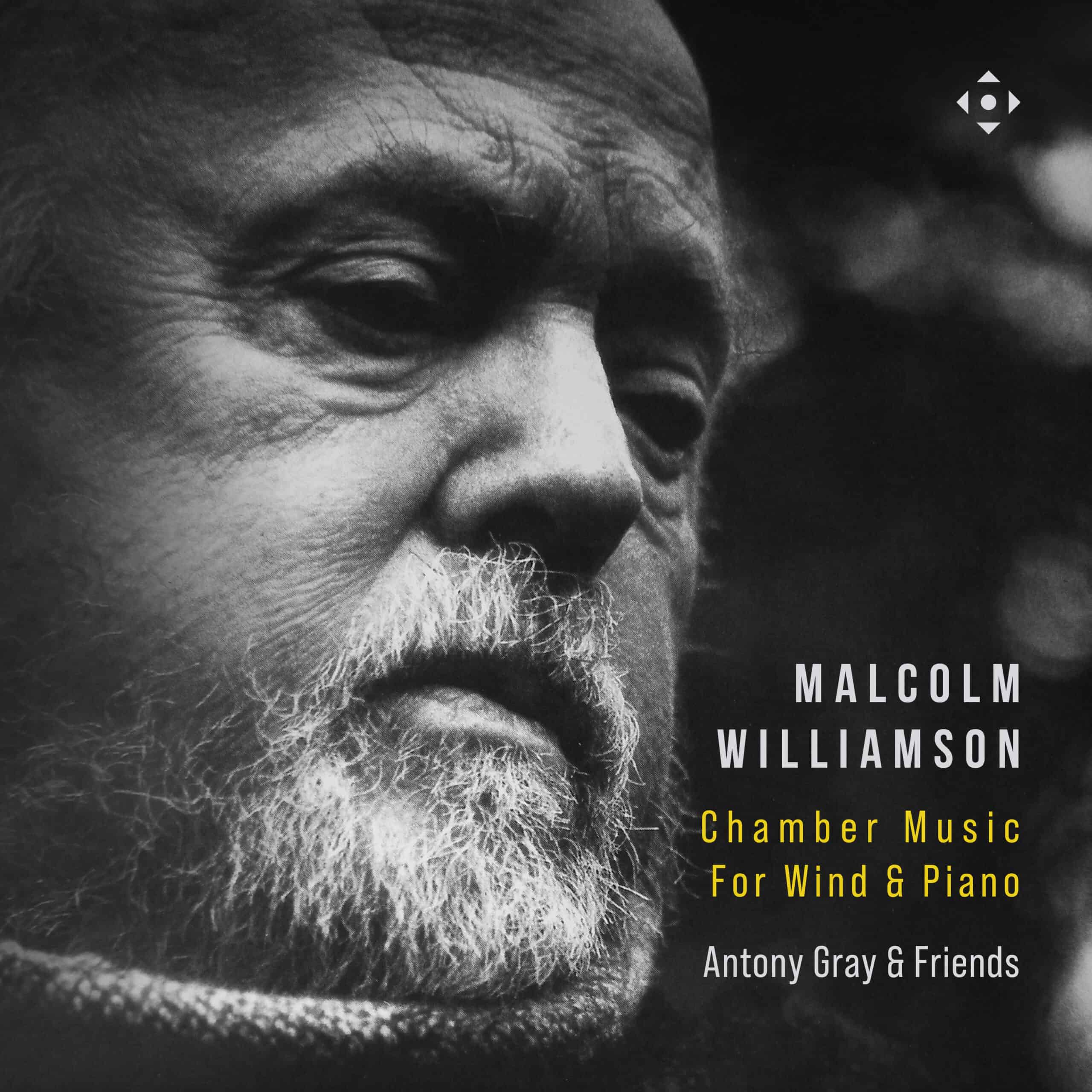
    Overall the recording is a superb achievement. The technically difficult music receives wholehearted, idiomatic playing from all involved. Special thanks must go to Antony Gray who has been tireless in his support of Williamson’s music over the years. The booklet has some poignant black and white photographs of the composer in old age, his eyes still radiating energy. I hope that the release will prompt other, labels, or even this one, to explore Williamson’s chamber music further. The world is long overdue recordings of the many song settings with piano or the dark Piano Quintet or Piano Trio written in memory of Sir Arthur Bliss

  • Malcolm Williamson Chamber Music British Music Society Review

    Pianist Antony Gray has assembled a fascinating and enticing issue, generously filled with rarities spanning Williamson’s career. All are impeccably delivered and well worth exploring. 

    The light-hearted Music for Solo Horn, written when the composer was 16, is basically an extended series of warm-up exercises, cheerful and highly approachable. 

    Of three Vocalises, played exquisitely by clarinettist Neyire Ashworth, with Antony Gray, two were originally for voice and piano. The third is Williamson’s own adaptation of December from his 1995 Prom commission A Year of Birds. The challenging Trio for clarinet, cello and piano, was first heard at Aldeburgh in 1957 (not 1958, as erroneously stated in the booklet), by clarinettist Harrison Birtwistle, with John Dow and Cornelius Cardew. Despite encouraging notices, it sank immediately and remained unpublished until the Williamson archive became accessible on the death of his partner, Simon Campion, in 2023. 

    The Concerto for wind quintet and two pianos (eight hands) was commissioned in 1966 for Alan Rawsthorne’s 60th birthday concert at Wigmore Hall, for a stellar line-up of Richard Rodney Bennett, Peter Maxwell Davies, Thea Musgrave and Williamson himself. This is a spiky, virtuosic score, not immediately celebratory at all, although the listener is eventually granted a riotous and hysterical finale, dispatched here with breathtaking panache. 

    An alternative opening is included as a separate piece. Pas de Quatre (1969) for four wind instruments and piano is also serially influenced, with arching melodies and moments of transcendence. Central to the disc is the extended Pieta (1973), comprising fivehushed meditations by Pär Lagerkvist on the Crucifixion, filtered through memories of World War II (not unlike Edith Sitwell’s Still falls the rain). Set in Swedish, for mezzo, oboe, bassoon and piano, this is a measured and powerful score of unremitting Mahlerian intensity, finely sung by Sally Lundgren.  

    The real curiosities are eight bombastic miniatures from c.1966, all including the tag Gallery, and designated variously as Opening, Concluding, Trailer, and so forth. Each is well under a minute in length – some last mere seconds – for the exotic combination of six trumpets (including D, and bass trumpet), two pianos and percussion. They were probably designed as incidental music for TV, although no show entitled Gallery has been traced. 

    My own theory is that they were intended for the Gallery section, or other segments, of the iconic BBC1 feature, Vision On (1964–76). This was initially designed for deaf children who responded well to vibrations, which would explain Williamson’s scoring. Some readers will have fond memories of the restful sequence showcasing children’s work, backed by Wayne Hill’s haunting theme, Left Bank Two. Were the producers perhaps considering alternatives?

  • Malcolm Williamson: Chamber Music for Wind & Piano

    Malcolm Williamson: Chamber Music for Wind & Piano

    MALCOLM WILLIAMSON: The uncompromising and divisive Master of the Queen’s Music

    Once one of the most widely performed composers of his generation, Malcolm Williamson’s music has since fallen into obscurity. This new recording – featuring 16 world premieres — seeks to redress that balance, offering a fresh perspective on a composer whose work defied easy categorization.

    Williamson’s output ranged from bold serial explorations to tuneful lyricism, often within the same piece. His music was lauded for its ingenuity yet suffered from the composer’s refusal to conform to prevailing academic tastes. As Master of the Queen’s Music, he occupied a prestigious position but remained a divisive figure—uncompromising in his artistic voice and unpredictable in both temperament and style.

    Drawn from recently uncovered archives, this collection spans nearly five decades of Williamson’s career, from early student works to some of his final compositions. The album includes the Clarinet Trio (1958), a strikingly assured work praised for its “forthright tunefulness” and loose application of serial technique, and the Concerto for Wind Quintet and Two Pianos, Eight Hands (1966), an intricate, often densely chromatic score performed by an extraordinary ensemble of composer-pianists. Other highlights include the ballet-inspired Pas de Quatre (1967), the haunting Pietà (1973) for mezzo-soprano and ensemble—setting texts by Swedish poet Pär Lagerkvist—and the enigmatic Gallery (1966), a set of miniature pieces likely composed for an unknown television project.

    These performances, led by pianist and producer Antony Gray, bring Williamson’s music vividly to life, illuminating its rhythmic dynamism, harmonic inventiveness, and sheer expressive range. With the discovery of the Williamson archive in 2023, this recording marks an important step in reintroducing a composer whose legacy deserves reappraisal.