Catalogue Connection: 21121

  • Robin Stevens Fanfare Review

    I took great pleasure from a disc of Robin Stevens’s chamber music in Fanfare 46:6. The present release (a twofer that extends just over a single disc’s playing time), entitled A Questing Soul, concentrates on Stevens’s music for violin and/or piano. The performers, Christine Townsend and Stephen Robbings, have been in a duo for decades, and it shows; this is a true chamber music partnership.

    Something of a musical chameleon, Stevens’s music is richly expressive. It certainly is in the one-movement Fantasy-Sonata, along with the Sonata Tempesta both the longest and earliest music here. The Fantasy-Sonata is multicolored, often octatonically-based, and often beautiful. Christine Townsend plays beautifully, flexible when required and staunchly determined elsewhere; Stephen Robbings is the perfect partner, and both are caught in a fine recording.

    The Toccata (for solo piano) is exactly that, a study in touch comprising a fast-moving line brilliantly, sparklingly delivered by Robbings. Stevens’s harmonic language is individual and clear; this would make a fantastic encore. The short Cri de coeur demands huge control from the violinist in the highest register, and Townsend is superb. The music floats, as if in suspended grief, with piano flurries indicating spikes of emotional pain; tonal, or quasi-tonal, passages seem to offer a potential way through. In this context, the solo violin scamperings of Stratospheric! seem to act as a prolongation to Cri de coeur, which includes another toccata, balancing the piano offering, that is flawlessly performed by Townsend.

    Balancing all that angst is the rather more relaxed Scherzo in Blue for violin and piano, a blues progression meeting Stevens’s own mode of utterance, with passages of some dissonance vying with more consonant areas. The piano piece Reconciliation? that concludes the first disc is, as the booklet notes suggest, a mini-tone poem. Clusters (especially clusters that echo on) make a powerful effect, while Stevens plays with his various forms of material (lyric and consonant; angular and dissonant; a march) with some mastery. Robbings’ performance is clearly one of much preparation; it exudes understanding, so that consonant arrivals feel structurally right.

    As was the case with the first disc, the second opens with an extended work: Sonata Tempesta. It does live up to its name, its stormy passages heard against moments of great lyricism; one particular melody for violin in the first movement is positively inspired. The feeble intensity of the Scherzo is perfectly captured here. This is a multi-hued scherzo, fiery and fleeing, its final enigma sustained in the lovely Andante tranquillo (ma non tanto). Here, harmonic consonance has a poignant part to play, so that this movement’s “cri de coeur” moment cuts deep. The finale is a nicely edgy rondo. It does require split-second responses between the players, and the razor-sharp playing here is very much integral to the performance’s success. Only a musical partnership of the caliber of Townsend and Robbings could negotiate the tricky metrical play of this movement with such aplomb and bring them to success. A fine performance of a work that buzzes with energy.

    The solo piano piece from which the disc takes its name, A Questing Soul, is only about four minutes long. A sequence of abrupt juxtapositions, it makes maximal effect under Robbings’ fingers; spiky staccato chords perhaps indicate a sinister aspect. Balancing that solo piano piece is one for solo violin, Tom and Jerry. The piece is a tribute to Scott Bradley, the composer of music to the Hanna-Barbera cartoons, and a finely judged one at that.

    It is a nice idea to present two sets of three pieces separated by a lovely piece called An Interrupted Waltz, especially as the central waltz changes scoring (from flanking solo piano to duo). There are other connections: “Beethoven through the Looking Glass” and “Master of the Rocking Horse,” the first and third of the Vignettes respectively, inhabit something of the same world as Tom and Jerry. The Bagatelles are earlier music, typical of the composer’s dissonant early pieces; Robbings finds the right sense of background dance to Tempo di Valse.

    Written for a friend in the midst of a difficult pregnancy, Say Yes to Life combines play (and children’s phrases) with some real compositional grit. Finally, we have the solo-piano Soliloquy, which acts as a sort of partner piece to A Questing Soul.

    Divine Art continues its valuable documentation of the music of Robin Stevens in style. Townsend and Robbings are a brilliant duo. Recommended.
  • A Questing Soul American Record Guide Review

    Here are 14 wonderful works by Welsh composer Robin Stevens (b 1958), whose musical language is quite tonal but free. 6 are for violin and piano, including the big pieces: the 4-movement, 33-minute Sonata Tempesta; and the 16-minute Fantasy Sonata. Both are serious works that would be strong entries in a recital. The rest of the program consists of 2 works for solo violin, 6 for piano. All are given vibrant, thoughtful performances by these first-rate artists.

  • Stevens: A Questing Soul BMS Review

    This is a generously filled double CD of music for violin and piano by Robin Stevens. There are works for violin and piano duo, and well as solo violin and solo piano. The musical language might broadly be described as expressionistic. The formal design of most of the pieces is not immediately apparent to the listener at a first hearing. 

    One interesting comparison is between the Toccata for solo piano and Stratospheric! for solo violin. The keyboard piece features a staccato single line contrasted with slower smoother writing. Both works use a form of declamatory recitative. The solo violin work has a wider variety of tempi and, as the name suggests, some of the writing is very high. 

    Perhaps the most immediately appealing work is the Scherzo in Blue for violin and piano. The composer states in his notes that ‘jazz influences often feature in my vocal music, but rarely in my instrumental output.’ Here the idiom is skilfully captured without the slightest hint of pastiche. The only fault one might find is that it leaves the listener wanting more. 

    The solo piano piece which follows it, Reconciliation?, is described by the composer as ‘a compact contemporary tone-poem’. A number of ideas are presented to the listener, a lyrical opening and two rather more dissonant passages. These are juxtaposed (the composer’s word is ‘intertwined’) culminating in a cadenza. 

    New contrasting material is presented which is dense and chordal, but with a sense of optimism. Towards the end of the piece, some of the earlier figuration returns undermining this mood, and while the turbulence subsides there is an ambiguity as to whether the opposing forces have found reconciliation. Hence, presumably, the question mark in the title.

    As a conspectus of Stevens’ achievement as a composer of chamber music and solo instrumental music, this album represents a wide variety of musical material. It is not particularly easy listening and the two most substantial works, the Fantasy Sonata (in one movement) and Sonata Tempesta are densely wrought pieces which make very little concession to the first-time listener. Yet there is a variety of expression and Stevens has spread his net widely in terms of stylistic influences.

    This is an interesting release which provides much food for thought, although I would suggest that the first disc would make a satisfying beginning, followed by the second, perhaps divided into two, tracks one to six followed later, by tracks seven to 15.

  • Robin Stevens: A Questing Soul

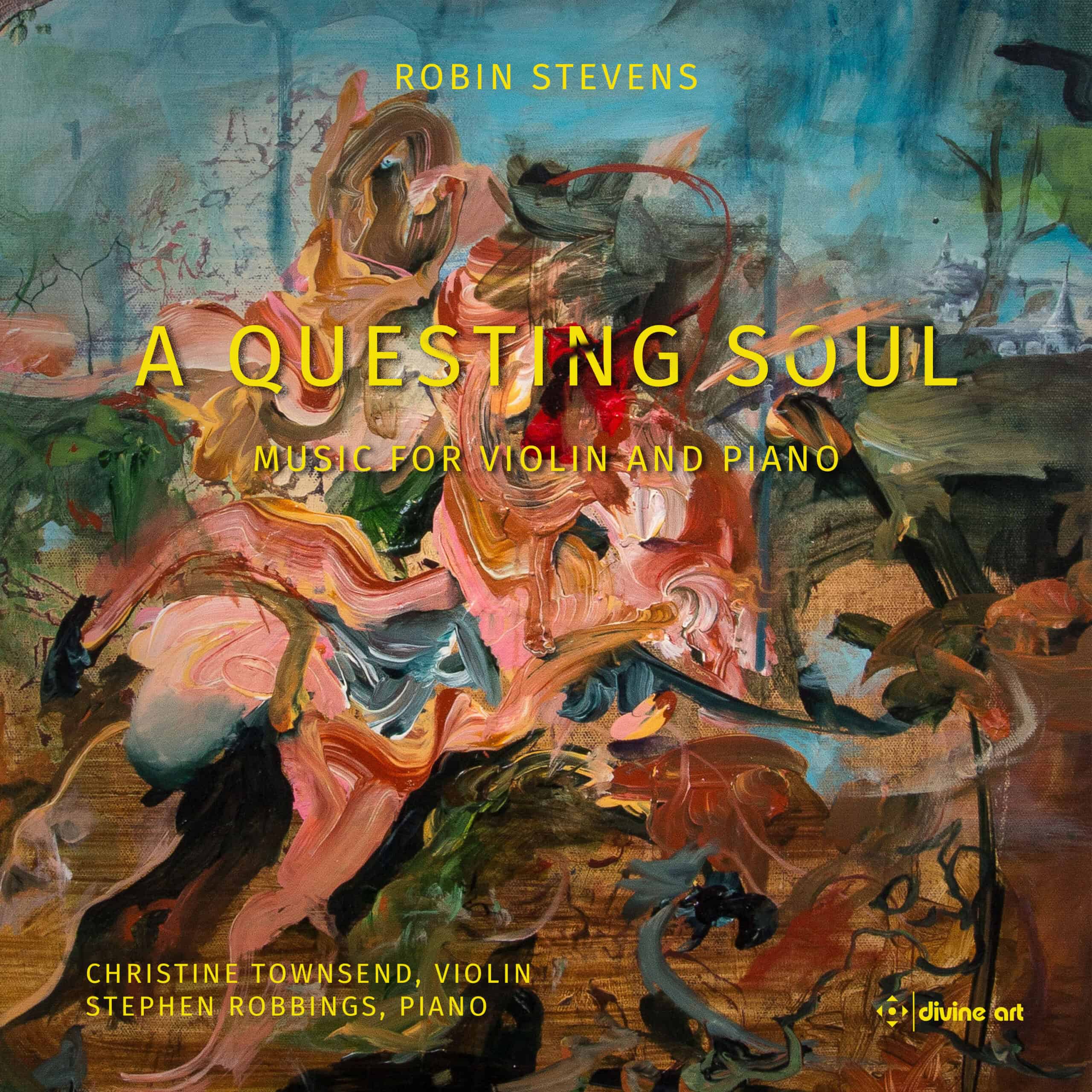
    Robin Stevens: A Questing Soul

    American Record Guide 2025 Critic’s Choice

    Robin Stevens’ A Questing Soul, his fifth album with Divine Art, offers a compelling portrait of a composer whose work has evolved over nearly three decades. This collection spans a broad stylistic spectrum, charting Stevens’ progression from the lush Late Romanticism of his early works to the more dissonant and experimental idioms of his later compositions. Throughout, Stevens balances technical innovation with an underlying sense of lyricism, humour, and tonal clarity, making this album a rich listening experience for those who appreciate the depth and variety of contemporary chamber music.

    The two most substantial works on the album—Fantasy Sonata and Sonata Tempesta—were composed during Stevens’ late twenties and represent key milestones in his early output. The Fantasy Sonata, written for violinist Christine Townsend and pianist Stephen Robbings, presents an intensely focused sound world built around the octatonic scale. Its single-movement structure moves from a soulful, lamenting introduction to more turbulent, faster sections, culminating in a joyfully intense peroration. Sonata Tempesta, in contrast, is a large-scale, four-movement work whose expansive form allows Stevens to weave together moments of lyrical beauty and stormy intensity. Both pieces showcase Stevens’ ability to combine complexity and accessibility, creating compositions that are intellectually stimulating yet emotionally resonant.

    The album also includes a number of shorter works, or “miniatures,” which offer Stevens the opportunity to explore new compositional ideas on a smaller scale. Pieces like Stratospheric! for solo violin and Toccata for solo piano demonstrate his flair for virtuosity and dynamic contrasts, while others, such as Cri de Coeur, evoke more contemplative, intimate soundscapes. These miniatures are fascinating in their own right, offering a glimpse into the composer’s more experimental tendencies.

    One of the album’s more unusual works, Scherzo in Blue, brings jazz influences into Stevens’ instrumental music—a rarity in his oeuvre. The piece is infused with “blue notes” and jazzy piano chords, creating a playful yet sophisticated contrast to the more classical structures found elsewhere on the album.

    The title track, A Questing Soul, reflects the essence of the album: a compact tone poem for solo piano that alternates between dreamy lyricism and muscular, assertive themes. The piece encapsulates Stevens’ ability to juxtapose contrasting musical ideas, leaving listeners with as many questions as answers—an approach that defines much of his work.

    With its blend of large-scale sonatas, experimental miniatures, and the intriguing title track, A Questing Soul offers a comprehensive view of Robin Stevens’ compositional range. This album will appeal to those with an interest in the intersections of modernism, Romanticism, and contemporary chamber music.