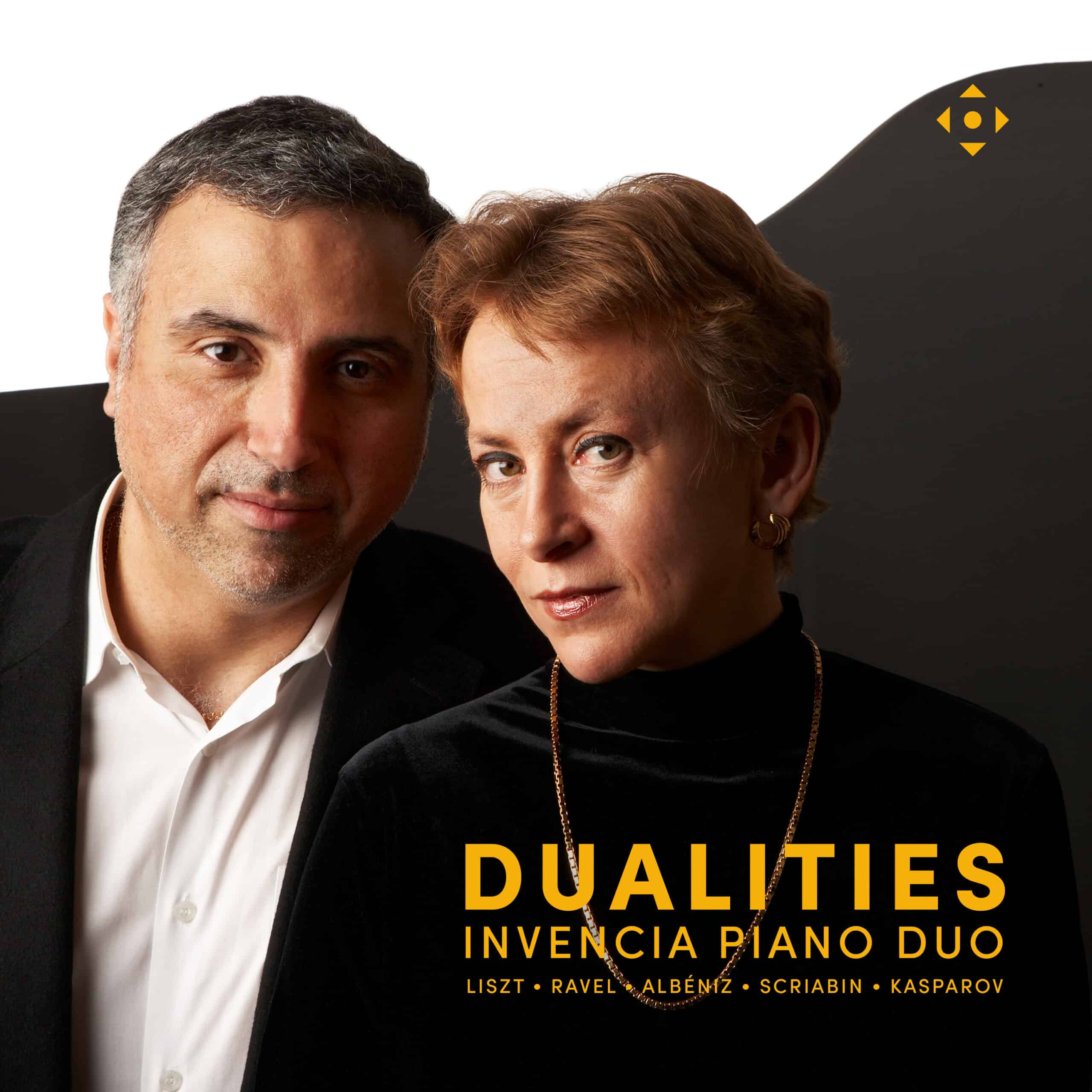
Andrey Kasparov, one half of Old Dominion University-based Invencia Piano Duo (Oksana Lutsyshyn is the other), writes that his desire was to enrich the two pianist repertoire by arranging solo piano pieces that definitely require more than two hands to play – one assumes his tongue was slightly in his cheek as he write this but his point is well taken; Liszt’s Totentanz presents fearsome challenges to the solo performer, Albéniz’s Iberia was described by pianist Blanche Selva as unplayable! when the composer first presented it to her, Scriabin’s late Vers la flamme is packed with challenges of rhythm, voicing, pedalling and more while Ravel’s La Valse is full of trade-offs of what is actually playable, whether that is in Ravel’s own transcription or one of the elaborations that have appeared since – there is even a version for left hand alone by Raoul Sosa. Of course pianists can and do play all these works in their original manifestations, or original transcription in the case of la Valse, so the question is just how successfully do the arrangements work? For the most part I think they work well.
Liszt did arrange his Totentanz, the dance of death, for two pianos – he did it twice by mistake according to Alan Walker’s catalogue in Franz Liszt, The Man and His Music (Barrie and Jenkins 1970). His arrangement however simply has the second piano playing the orchestral part of the concertante version so Kasparov has arranged it so that the orchestral and solo parts are evenly divided between the two pianists. It is very effective and is especially noticeable at the heavenly music, that optional cadenza that is added to the canonic fourth variation, where there is a richer texture that does nothing to disperse the delicacy of this angelic version of the Dies irae. One might ask for a little more terror in the final variations but this is nonetheless an successful performance. Moving from Gregorian chant and Liszt’s overt virtuosity to a more reflective work by Kasparov himself, the only piece here originally conceived for two pianists, in this case at one piano. It is based on Lutheran chorale melodies, mostly Built on the rock and a Mighty Fortress though Lord of our life and The Law of God is good and wise are also worked into the fabric of the piece. The opening is a dialogue between the medium and high registers of the piano in a slow meditative chordal style. Two chorale melodies are then played in a conversational manner above a syncopated accompaniment before the textures grow denser and more energetic rhythmic motifs take over; there is a clear growth of intensity from the very beginning but it is the lone voice of A Mighty Fortress that is heard dying into nothingness against low clustered chords closing the piece. Kasparov’s other original work here is Cadenza for LvB. It was originally a solo piano piece conceived as a cadenza to the first movement of Beethoven’s Piano Trio in C minor op.1 no.3 but was later transcribed for two pianos. Much of its writing occupies a confused, kaleidoscopic world that only allows fragments and hints of themes to break through. The opening is a guide for all, hypnotic repeated notes that gradually reveal a theme in slow shifting pitches coupled with sudden changes of dynamic and articulation. When the trio’s first melody recognisably appears it is hesitant in the extreme and shifts almost immediately into more extremes of texture and rhythm that contain nuggets of recognisable figures and themes like phantoms half seen; it is quite a shocking piece, certainly when compared to the more mindful Lutheran Chorale fantasy.
The rest of the recital will be more familiar. Scriabin’s Vers la flamme, toward the flame, was one of his very last works, a work that grows in intensity from its early, quietly enigmatic writing to a luminous impassioned climax. Kasparov’s arrangement allows for great clarity in the writing that can be lost in a solo performance where the pianist has to balance perhaps three competing rhythms, melody and accompaniment and frequently changing registers. It allows the slow emergence of themes and texture to flourish and to bring out the clarion fanfares and bell-like textures easily. All very good and as a two piano arrangement this is excellent. What I miss is the struggle; yes Kasparov keeps the tremolos throughout that a solo pianist has to miss to reach a chord at the other end of the piano but the mind fills this in and the kind of emotional desperation that Horowitz brought to this piece, that agony as he fought through to the ending, screaming defiance is lessened. Two movements from Albéniz’s Iberia are more successful for me; the duo, here on two pianos, bring a wonderful calm to Evocation, while still finding colour and a wonderful line. I really enjoyed Triana, such an evocative piece in any case and with clever use of register and articulation Kasparov brings a suggestion of castanets and tambourines playing. The grand F sharp major iteration of the main melody toward the end is magnificent and it is a fantastic portrait of this part of Seville. They finish with Kasparov’s transcription for piano duet of Ravel’s la Valse, his choreographic poem. It oozes old world charm but with Ravel’s wit weaving through every line of Kasparov’s arrangement and the Invencia Piano Duo’s is deliciously suave and wonderfully grand. Lucien Garban made a duet version of the piece but Kasparov has instead recast it and includes so much more that it sounds like both players have a piano of their own to work from. The recording has a rich piano sound that makes this a marvellous conclusion to this very interesting recital.