Catalogue Connection: 21123

  • In the Mirror Fanfare Review

    Someone somewhere must be spending a great deal of time researching music for cello and piano by women composers. In this same issue of Fanfare I am reviewing A Cello Galaxy of British Women Composers as well as this collection by women of diverse nationalities. Both releases are on the same label, Divine Art. This one is titled In the Mirror: Music by Women Composers, and where A Cello Galaxy consists of music in a Romantic or late Romantic style, much of it in the British pastoral tradition, In the Mirror is more modern, though not particularly adventurous.

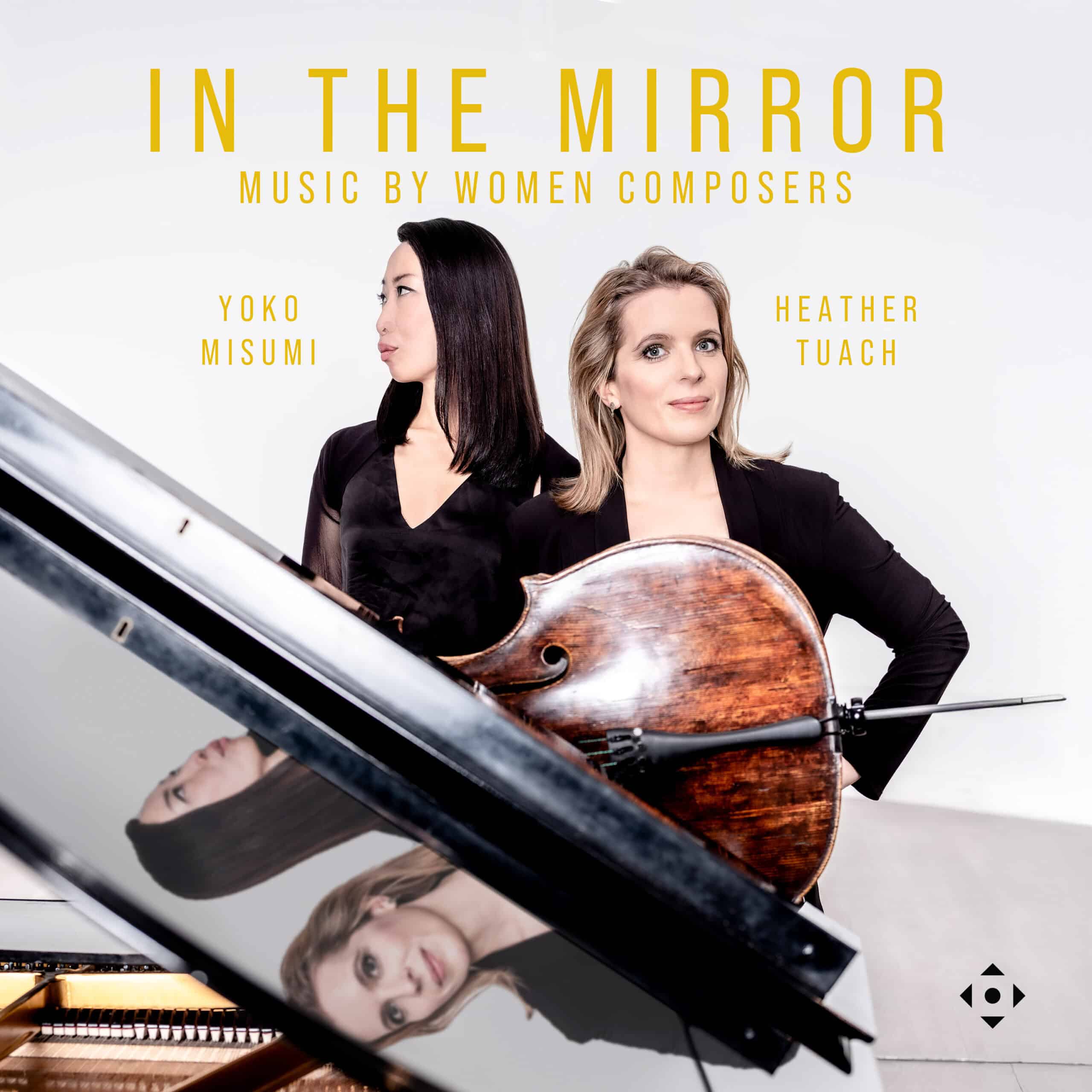
    Cellist Heather Tuach and pianist Yoko Misumi put this program together wanting to emphasize its “soothing and contemplative qualities.” In a personal note Misumi writes about a cancer diagnosis in 2021 that put her career on hold as she underwent treatment. Her recovery allowed her to resume both her music career and her role as a mother. The music here is the music she and Tuach concentrated on after that traumatic experience, with its focus, as Misumi writes, on calmness and peace.

    The composers represented here come from the U.S. (Montgomery and Higdon), England (Johnson, Hubicki, Maconchy, and Parkin), Canada (Coulthard and Morlock), Bulgaria (Tabakova), Estonia (Mägi), Germany (Heller), and France (Boulanger), which insures a variety of musical voices. The longest piece, at 12 minutes, is In the Mirror by Liz Dolnot Johnson, which is the album’s title work. Two of its four movements were originally composed for chorus: they were arranged for this program by the composer.

    Two of the strongest pieces here are Jennifer Higdon’s exquisite Nocturne, which starts quietly, rises to an emotional climax, then retreats back into silence, and Jessie Montgomery’s Peace, which involves her personal struggle to come to terms with sadness. Candidly, although everything on the program is worth hearing, as an overall experience I found its lack of variety wearing. By the time I was halfway through, I found myself longing for the contrast of a spirited Allegro. A better way to experience this program is to listen to a few pieces at any one sitting.

    There is a single upbeat work: the third of Nadia Boulanger’s Trois pièces, a vigorous dance marked Vite et nerveusement rythmé. It comes as the last of 18 tracks, and offers relief from the near stasis that preceded it.

    The performances are strong, the recorded sound is natural, the program notes are helpful. There is not a single work that I was not glad to encounter, and I will return in the future, only not at one sitting.
  • BBC Music Magazine In The Mirror Review

    I was left rather captivated by this collection of works, seemingly deeply felt by Tuach and Misumi who deliver committed and soulful performances. There’s a sense of introspection throughout, some sadness, but all of it with a reassuring vein of glimmering light. Tabakova’s Whispered Lallaby and Liz Dilnot Johnson’s title work are highlights.

  • In the Mirror MusicWeb International Review

    Here is another adventurous recording. These composers may not only be unknown to you but new to the general catalogue. Heather Tuach and Yoko Misumi have really taken their music to heart: they play with amazing passion and commitment.

    Of the better-known composers, Nadia Boulanger’s Trois pièces clearly show her indebtedness to Fauré, especially in the opening Modéré. Elizabeth Maconchy’s Vigil from her Divertimento is one of five miniatures composed for the great William Pleeth. This one is rather thoughtful, even introspective, as can often be the mood of several of these works. It also seems that Pleeth gave a broadcast performance of the rather forgotten Ivy Parkin’s Three Pieces for Cello and Piano. The Aria played here, a lushly lyrical work, is the middle movement.

    I was much taken with Barbara Heller’s Lalai – subtitled ‘Lullaby which awakens you’ – based on a song written by a group of Iranian intellectuals executed in 1973. Dedicated to all Iranian women, it depicts a mother who sings to her baby explaining how its father has been arrested and imprisoned.

    Esther Mägi was the senior lady of Estonian music until her death at 99. Her music tends to pop up on Radio 3 in the middle of the night! The Psalm builds beautifully to a bell-chiming climax, and the cello part is almost folk-like in the lyricism.

    I imagine that you have quickly grasped how enterprising this disc is, and eight more composers are represented. I will just focus on three who especially interested me.

    Liz Dilnot Johnson’s work gives the disc its title. The opening movement of In the Mirror is entitled For Hester, who was the composer’s mother. Its quiet melancholy, in a way, sets the mood for quite a large slice of the recording. The other movements are Jigbaredosh, a more quixotic piece dedicated to Johnson’s sister. Lacrimosa is an arrangement from a choral movement in her Requiem Mass When a Child is a Witness – requiem for refugees. It is in a slow but impassioned style. The whole work is diatonic and has no nasty tricks up its sleeve. It ends with the easy-going On the Malvern Hill (I wonder which one). This is very much in the English tradition of one hundred years ago. It has a very exciting and rhythmic section as it moves on, that could possibly be inspired by a folk-dance.

    Misumi and Tuach have arranged two of the items. One of them, Peace by the American composer Jessie Montgomery, was written ‘after great sadness’ in the first Covid lock-down. It has a quiet intensity about it.

    Canadian composer Jocelyn Mortlock was often inspired by birds. In Halcyon, she reminds us of the story of Alcyon and Ceyx who metamorphosed into kingfishers and could calm the waters (hence halcyon days). This beautiful, impressionist and evocative picture, again, is slow in tempo and of a melancholic nature.

    And perhaps that is the problem with the programme. The moods, and possibly the styles, are not contrasting enough, even if each piece is worth its place and worth hearing, especially in these magical performances. The musicians are very vividly recorded, and the booklet is a good example of its kind. There are some colour photographs, and concise but noteworthy details about the composers and each of the pieces. Worth exploring.

  • In the Mirror British Music Society Review

    This album is a selection of works by 20th and 21st century composers chosen by the performers who are members of the Greenwich Trio. The album shares its title with that of the first piece by Liz Dilnot Johnson who has provided a set of four pieces arranged especially for this release. 

    I was particularly struck by the third piece of the set, Lacrimosa, which is taken from the composer’s large-scale work When a Child is a Witness – requiem for refugees, which I had the pleasure of reviewing some months ago. The transcription is most effective, with the sombre tone colour of the cello adding an additional sense of desolation. The contrast with the fourth movement, On Malvern Hill, is very pronounced, the set ending with what sounds like a pastoral jig, yet I detect no debt to earlier examples of the idiom, which in British music are hardly lacking.

    Another virtue of the disc is the juxtaposition of well-known and established figures with others, who are less familiar. Jennifer Higdon, Jocelyn Morlock, Elizabeth Maconchy and Nadia Boulanger are all prominent names, even if Boulanger’s compositions have been overshadowed by her extraordinary work as a teacher of composition. The first two pieces in her group began as pieces for organ. 

    The most substantial works are Lalai by Barbara Heller, based on a song written by a group of intellectuals who were executed in Tehran in 1973 and Halcyon by Jocelyn Morlock. The larger canvass for these pieces is welcome among what is otherwise a sequence of works which are all less than five minutes duration. 

    I would hope for the appearance of a second album containing a similarly constructed programme of music by women composers for the same forces, which explored examples of longer items from the repertory. The expressive variety in those which have been selected on this occasion is extraordinary, but the brevity of some of the pieces leaves one a little unsatisfied.

    The performances are deeply committed and the recording is beyond reproach with a perfectly natural-sounding balance between the two instruments, which is not an easy thing to achieve. This is a beguiling release which makes an excellent case for this repertoire without an attempt at special pleading. This is simply first-rate music superbly performed. It would also be an excellent introduction for any listener who may be timorous about exploring contemporary music.

  • In the Mirror

    In the Mirror

    A Profound Tribute to Reflection and Resilience

    In the Mirror is an exquisite collection of works by contemporary women composers, masterfully interpreted by cellist Heather Tuach and pianist Yoko Misumi, both members of the celebrated Greenwich Trio. This album is not just a recording—it is an emotional journey born of reflection, healing, and hope. The title piece, composed by Liz Dilnot Johnson, was commissioned specifically for this project, setting the tone for an album steeped in introspection and serenity.

    The repertoire features original works and new arrangements by renowned composers including Dobrinka Tabakova and Jessie Montgomery, whose contributions enhance the album’s contemplative spirit. Each piece carries its own story, from Jocelyn Morlock’s bird-inspired Halcyon to Jennifer Higdon’s nocturnal reverie Nocturne. These works are tied together by a shared exploration of human resilience and the quiet strength found in moments of introspection.

    The project began during the upheaval of the COVID-19 pandemic and became deeply personal for pianist Yoko Misumi, who underwent successful cancer treatment during its recording. Returning to the piano after her recovery, Misumi found solace and renewal in these compositions, describing the experience as “an emotional and musical healing.”

    Highlights include:

    • Liz Dilnot Johnson’s In the Mirror, a poignant four-movement work dedicated to personal loss and renewal.
    • Jessie Montgomery’s Peace, composed during the pandemic and adapted for cello and piano with the composer’s blessing.
    • Dobrinka Tabakova’s Whispered Lullaby, an evocative piece inspired by Goethe’s Faust.
    • Margaret Hubicki’s lyrical Lonely Mere, a tribute to the serene landscapes of the Malvern Hills.

    The album is both a celebration of female creativity and a testament to music’s power to comfort and inspire. Listening to  In the Mirror is an opportunity to pause, reflect and take in moments of profound calm amidst life’s turbulence.

    This is a must for admirers of contemporary chamber music, fans of women composers, and anyone seeking solace and beauty in music