Catalogue Connection: 21125

  • Congleton Review Corner Tales of the Glens Review

    I assumed this would be Scottish but one lives and one learns: “Tales of the Glens” is a journey through Ireland’s Glens of Antrim, Capparelli playing compositions by Hammond.

    The centrepiece of the album is work for pianist and storyteller, “Tales from the Sea of Moyle”, and I guess this would be make or break for how often anyone would play / if they would buy the album— it is 50 minutes long, a mix of dialogue and playing to evoke the mood of what is being narrated.

    Liz Weir and Colin Urwin tell the tales. I’m a big fan of Irish radio station documentary series (Doc on One, check it out) as much for the lilting accents as the fascinating tales and eccentric people (and also of itinerant storyteller Ian Douglas, who can be seen locally), and while Urwin’s melodious tone stands repeat plays, I initially found Weir less so.

    However: repeated plays means you get into the stories, and repetition of much-loved old tales does not lead to weariness but instead something new being discovered each time.

    The first section of the CD is music and as I got more into the stories, the tunes seemed to carry less import. Capparelli’s playing, as it is throughout, is sensitive and conveys a depth of feeling, and the tunes are all nice (in the nicest sense of the word nice). Mostly not what you’d leap out and call Celtic, more music that conveys an image of rural countryside. It includes one piece by Ireland’s earliest celebrated composer, the blind harpist Turlough O’Carolan.

    The stories are solid tales of the world between ours and the mystic universe we abut: dwellers beneath the sea, people turned into wolves and a woman who gets a job on a lonely, mysterious island for seven years and then regrets leaving.

    This is out on Divine Art, ddx 21125.

  • Tales of the Glen Fanfare Review

    This release, titled Tales of the Glen, is based on the folkways and heritage of a particular place, the Glens of Antrim in Northern Ireland. Pianist Anthony Capparelli traveled there ten years ago on a graduate fellowship, pursuing his interest in Celtic storytelling and musical traditions. He lived in the region and was introduced to storyteller Liz Weir—she participates here, along with another Irish storyteller, Colin Unwin. The bulk of the program, however, is for solo piano. In keeping with Capparelli’s passion for the subject, Philip Hammond (b. 1951) is an Irish composer whose music is often inspired by folk songs. Miniatures and Modulations is a suite of short piano works inspired by traditional harp tunes collected by Edward Bunting (1773–1843). Hammond has adapted the harp originals for piano in a charming, delightful way. Pianist Anthony Capparelli has chosen 13 pieces for this program, working with the composer in choosing which ones to include. Their selections cover a wide range of moods from the lyrical to the witty. A particular quality present in much of the suite is playfulness, credit for which goes to both Hammond and Capparelli for bringing this element out. We get two versions of each tune, a literal transcription and Hammond’s more pianistic arrangement.

    There is a prior recording of the entire suite (Grand Piano 702) with pianist Michael McHale; it received an enthusiastic review by Jim Svejda in Fanfare 38:6. I can only echo his thoughts on the music: “And on repeated hearings, each of these miniature tone poems—for that’s clearly what they are—also begin to seem all the more profound and original, one of the key symptoms of genuinely important music. Which is not to say that this important music isn’t also a tremendous amount of fun; in fact, a waggish (and very Irish) humor informs many of the works as well.”

    The suite is followed by two original piano pieces. Aoife Óg is a brief work dedicated to the young daughter of a friend of the composer’s. It is both playful and lyrical. The booklet gives no indication of the meaning of the title, but Aoife is a Celtic girl’s name that means “beautiful, radiant,” and Óg is attached to a given name to show that it belongs to the younger holder of the name.

    The single longest solo work on the program is Forgotten Longing, in which Hammond’s style is very different from everything else here. It is alternately brooding and melancholic, sometimes turbulent. There are hints of Debussy and Ravel in the keyboard writing, but without being imitative. I found this an absorbing eight-minute piece filled with nuance, especially in Capparelli’s compelling performance.

    Lasting over 46 minutes, the major work on the disc is Tales from the Sea of Moyle for piano and two narrators—Liz Weir and Colin Unwin collaborated on the work with Hammond and perform them here. Some of the stories are original, some are retellings of Irish legends. There are tales of mystery, loneliness, the powers of nature, and of fairies and ghosts. In each case the music is appropriate for the mood. Although no printed text is provided, the diction of both narrators is perfectly clear, and the balance between piano and speaker is ideal. The words are forwardly presented with the piano either in the background or forward as called for. Both storytellers recite their tales well, but Urwin is the more expressive.

    This is an enchanting disc. The notes are very helpful, including well-written summaries of each of the tales. I think general listeners will find enjoyment here, but those of Irish heritage will feel a special resonance.

  • Tales of the Glens Textura Review

    Before engaging with Tales of the Glens, those unfamiliar with Northern Ireland’s Glens of Antrim might do well to use a map of the region to orient themselves, especially when Anthony Capparelli’s piano album of Philip Hammond’s material locates itself at this picturesque part of the world. North of the Glens, situated along the east coast, one finds the village of Ballycastle and Rathlin Island, whereas farther south lies Ballygally. These places and others surface in the recording’s most striking piece, the seven-part Tales from the Sea of Moyle (2021), a collaboration between Hammond and professional storytellers Liz Weir and Colin Urwin. Their commanding Irish voices, Capparelli’s playing, and Hammond’s writing collectively distill the essence of the area into musical form.

    The seed for the project was planted years ago when Capparelli became enchanted by the village of Cushendall and the local tales that go hand-in-hand with rural communities. A chance meeting with Weir also proved pivotal in familiarizing him with her work and her involvement in the storytelling tradition. Capparelli’s affection for the region deepened as he returned to it in the years after that initial exposure. Intent on creating an album that would honour the area he’d grown to love, the pianist teamed with Belfast-born composer Philip Hammond (b. 1951) on a project that would capture the spirit of the Glens, its people, and its folklore.

    Now residing in Gent, Capparelli is originally from Wisconsin, but his early exposure to folk and Irish traditional music helps explain why he connected so strongly with the area. Tales of the Glens clearly resonates for him with deep meaning, as evidenced by his words, “I hear the sounds of waves on Cushendun beach with the Mull of Kintyre shrouded in mist across the water, the clinking of glasses and the rush of fiddle tunes in the pub, mournful curlews in the bog, and stories being told around a turf fire.” The versatile Capparelli has worked with many other artists, including Kronos Quartet, JACK quartet, pianists Orion Weiss and Emanuel Ax, and with members of Lorelei Ensemble. Hammond is likewise a man of many talents: a graduate of Queen’s University Belfast (where he received his doctorate in 2003), he’s recognized as a composer, teacher, broadcaster, and performer.

    In augmenting Tales from the Sea of Moyle with solo piano works,  Tales of the Glens offers a splendid sampling of Hammond’s work. Two standalone pieces appear midway through the set, with premiere recordings of Aoife Óg (2020) and Forgotten Longing (2011) preceded by selections from Miniatures and Modulations (2011). A cycle comprising over twenty pieces of traditional harp tunes gathered by Edward Bunting, the work appears here in thirteen parts, with twelve of them six pairs that couple an original from the Bunting collection with a re-imagining by Hammond. The work charms instantly with Bunting’s graceful transcription and Capparelli’s elegant rendering of the poignant “If to a foreign clime you go”; indicative of the extensive changes Hammond brings to the material, his playful version dramatically distances itself from the tone of the original. Similarly, whereas “An Irish Lullaby” is in Bunting’s haunting treatment sparse, in Hammond’s the material unspools in a quietly dazzling shimmer. “The Little and Great Mountain” exudes an almost Bach-like stateliness in its Bunting form; the Hammond version recasts it as a brooding mystery waiting to be solved. As one pair cedes its place to another, it’s fascinating to witness the transition from the folk character of the original to Hammond’s imaginative makeover.

    Dedicated to the young daughter of a friend of Hammond’s, the brief Aoife Óg sparkles with childlike excitement and energy, while Forgotten Longing, inspired by John Hewitt’s poem “Ireland,” expresses the enigmatic mystery of the Glens of Antrim through a chords-heavy series of brooding passages, discomfiting harmonies, wistful gestures, and a general sense of restlessness. Enlivened by the distinctive voices of renowned storytellers Weir and Urwin and the attentive piano of Capparelli, Tales from the Sea of Moyle (2021) sets the scene with an instrumental prelude whose expansiveness anticipates the richness of the stories to come. Weir’s first with “The Rathlin Fairies,” which sees her inspired story of mischievous pixies complemented by jittery piano playing that peppers, pokes, and jabs at the narration like the fairy tree pricking the blackberry-picking boy Jim. As gripping is Urwin’s narration in “Marina Jane,” which recounts the tragic tale of an old woman living in a stone hut on the beach of Ballygally Bay. Capparelli catches the attention first, however, with torrential piano playing evoking an 1823 storm that washed a boat ashore containing a dead mother and day-old girl given the name Marina Jane. Urwin’s the narrator in the work’s longest part, “The Last Wolf,” which across thirteen minutes recounts a chilling encounter in 1712 between a grey wolf and pony-riding priest in the forests outside of Carnlough and the startling discovery on the latter’s part that the creature can not only speak but is in fact a curse-suffering “man in wolf’s clothing” desperate for the priest to save his dying she-wolf. In these and the other stories, Hammond’s piano writing partners beautifully with the storytellers’ words, with each component reinforcing the impact of the other and the keyboard part often musically embodying details of the stories. Closing the work’s circle effectively is a short, dreamlike postlude that incorporates a sprinkle from “The Rathlin Fairies” to resolve it even more satisfyingly.

    This wonderful recording is distinguished by many things, Hammond’s imaginative compositions, of course, but also terrific playing by Capparelli and arresting recitations by Weir and Urwin. While the release earns its recommendation from Tales from the Sea of Moyle alone, the solo piano pieces accompanying it add greatly to the project’s value.
  • Tales of the Glens British Music Society Review

    American pianist Anthony Capparelli, now resident in Belgium, presents his own choice of piano music by the Northern Irish composer Philip Hammond (b. 1951). The music illustrates the composer’s dedication to his home region of the Glens of Antrim. Hammond’s love of the traditional music of Ireland is illustrated in the opening selection of seven piano pieces originally for harp, in piano transcriptions collected from the 1792 Belfast Harp Festival by the organist Edward Bunting (1773 – 1843). 

    The music includes one piece by Ireland’s earliest celebrated composer, the blind harpist Turlough O’Carolan. Each of these is played in the opening Selections from Miniatures & Modulations (2011). These original transcriptions are eachfollowed by Hammond’s own pianistic expansions in styles, ranging from lyrical to dramatic, and fiery piano virtuosity. 

    The folk core of the music is never lost and, as Capparelli writes in his accompanying note, ‘I hear the sounds of waves … shrouded in mist across the water, the clinking of glasses, … fiddle tunes in the pub, mournful curlews in the bog, and stories being told around a turf fire’. Hammond’s tuneful music brings all such folksy scenes vibrantly to life.

    After two of Hammond’s solo piano pieces, the short and delightful child-centred piece Aoife Óg, and the extensive Ireland inspired Forgotten Longing, we come to the heart of the recording, five stories spoken by Liz Weir and Colin Urwin, with filmic piano backgrounds composed by Philip Hammond. 

    Celtic tales of humans spirited away by fairies, or peoples from beneath the sea, are brought to life by the two story-tellers with their sense of magic magnified by Hammond’s piano music. The music has a clear folk background. In one case, The Last Wolf cleverly uses the hymn tune All Creatures of our God and King with its original words by St Francis of Assisi. The Priest absolves the wolf and his wife of a curse making them, in a sense, werewolves, but apparently these are much gentler than those from elsewhere in European folk tales.

    The stories are all surprising and hugely entertaining. The accompanying piano music, played with considerable virtuosity and depth of feeling by Anthony Capparelli, takes us back to childhood into that extraordinary dream-world of Celtic imaginings. 

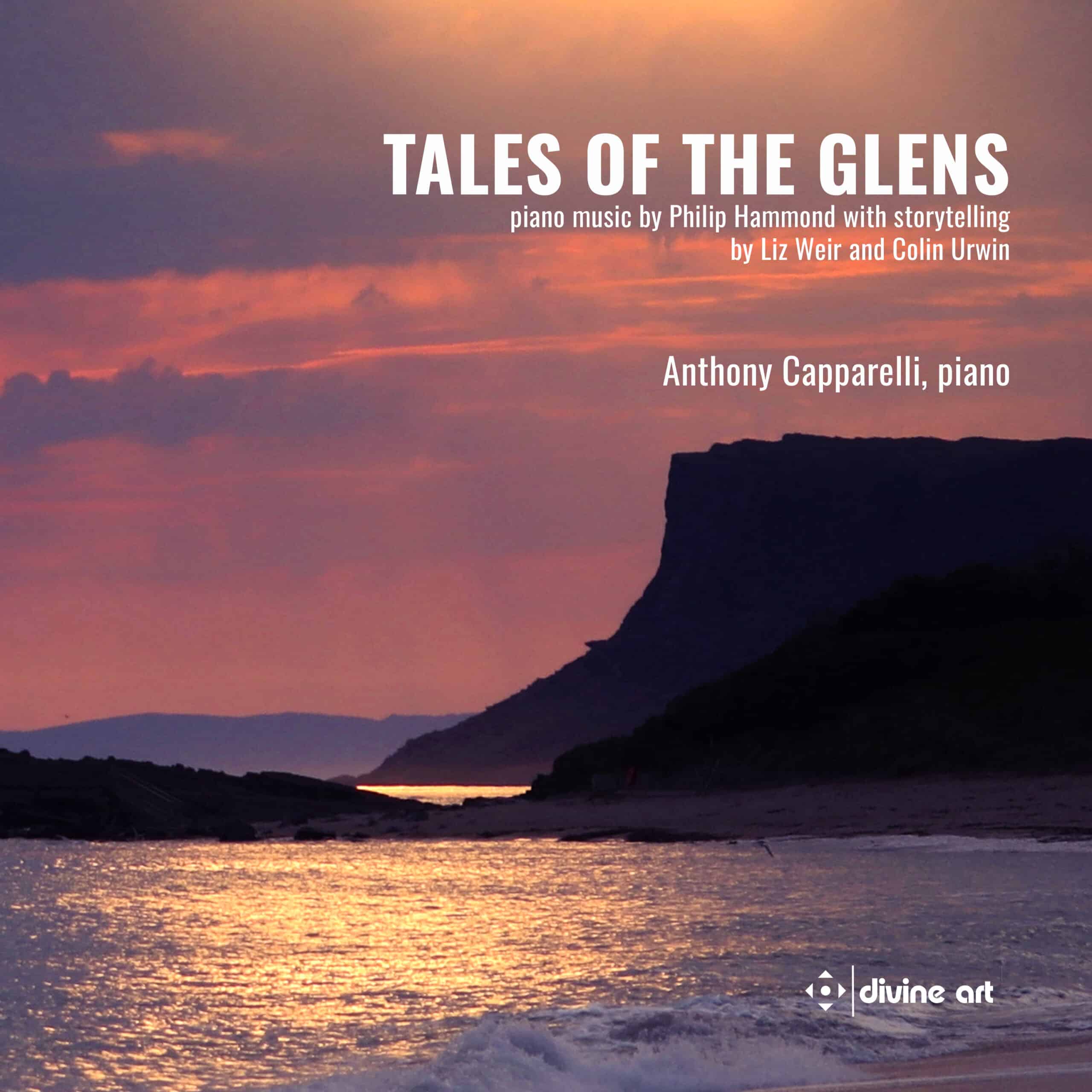
  • Tales of the Glens: piano music by Philip Hammond with storytelling by Liz Weir and Colin Urwin

    Tales of the Glens: piano music by Philip Hammond with storytelling by Liz Weir and Colin Urwin

    Tales of the Glens is a journey through Ireland’s Glens of Antrim, as depicted in Anthony Capparelli’s piano album of compositions by Philip Hammond. Inspired by years of immersing himself in Celtic and Scandinavian traditions, Capparelli’s collection beautifully captures the essence of this picturesque region.

    During his tenure as a Thomas J. Watson Fellow, Capparelli delved deep into rural communities, discovering the profound impact of traditional storytelling and music. Guided by the esteemed Liz Weir, a renowned storyteller, he found himself enchanted by the village of Cushendall, where the tapestry of local tales and melodies fueled his passion.

    Teaming up with acclaimed composer Philip Hammond, Capparelli aimed to create an album that not only honours the spirit of the Glens but also transcends musical genres. Through thematic resonance and evocative melodies, each composition pays tribute to the people, folklore, and landscapes that have left an indelible mark.

    The album features selections from “Miniatures and Modulations,” showcasing Hammond’s innovative interpretations of traditional harp tunes. From the whimsical charm of “The Little and Great Mountain” to the poignant allure of “Open the Door Softly,” listeners can experience these ancient melodies in a fresh light.

    The centrepiece of the album is an innovative multi-movement work for pianist and storyteller titled Tales from the Sea of Moyle. A collaboration between Anthony Capparelli, Philip Hammond, and two of Ireland’s most renowned bearers of the storytelling tradition, Liz Weir MBE and Colin Urwin, this work tests the boundaries of collaboration between art forms. Each story is set along the Antrim coast and delivered by the commanding voices of Weir and Urwin, offering the listener guidance, and sometimes warning, on their journey.

    Originally from Wisconsin, USA, Anthony Capparelli is a versatile pianist with a diverse musical background. He has performed solo and chamber music in six countries, showcasing his love for modern repertoire influenced by his upbringing in folk and Irish traditional music. Capparelli has toured extensively in the Midwestern USA, Ireland, and the UK as a chamber musician and has coached with renowned ensembles and pianists such as the Elias String Quartet, Kronos Quartet, Orion Weiss, and Emanuel Ax.

    With a passion for vocal repertoire, he has participated in masterclasses with prominent vocalists and trained at the International Opera Academy. Capparelli’s commitment to accessibility in music is evident through his teaching and performances in unconventional venues such as rural pubs, hospitals, senior care homes, and prisons. Holding a Doctorate of Musical Arts from the University of Iowa and a Postgraduate Soloist Diploma from KASK/Conservatorium in Belgium, he now resides in Gent, Belgium.