Catalogue Connection: 21130

  • Jazz Journal Between the Lines Review

    This debut from British pianist Ophelia Gordon is a solo album – but features two musicians. Ukrainian pianist Nikolai Kapustin (1937-2020) perches on his protégé’s shoulder to observe her renditions of 20 of his tunes. It’s probably sent here for review because Kapustin’s work blends classical structures with rhythmic and harmonic ideas from the jazz tradition. However, it’s fully composed, with no improvisation. Some may thus question the jazz value but it is nevertheless a perspective on jazz, much composition begins as improvisation, and Gordon is a very polished player.

    That polish glimmers on the contours of the clear-cut fiddly bits and intricate twiddly bits that characterise the music. Big Band Sounds Op. 46 is a sparkling ragtime-ish number that evokes an imagined silent movie. The piano sound is gorgeously warm and Gordon’s enunciation of each twisting phrase is deliciously crisp. Prelude No. 11 in B Major is another peppery piece, where listeners glimpse more of Gordon’s personality through the track’s funky attitude and swaggering blues feeling. Prelude No. 5 in D Major is a dreamier tune that Gordon nudges along with great skill. Eight concert etudes turn a blazing spotlight on the pianist’s fast-flying fingertips. It’s a collection of high-energy excursions that unleash endless avalanches of sonic matter. Clearly, Gordon has achieved outstanding levels of instrumental proficiency and has wolfed a triple helping of Weetabix, too.

    This is a toe-in-the-water release that introduces an impressive talent to the world. It would be interesting to hear Ophelia Gordon playing jazz standards with a trio and improvising.

  • Between the Lines Textura Review

    Many classical composers have woven jazz into their works—Gershwin, Stravinsky, and Bernstein come to mind—but this solo piano collection of material by Ukrainian composer Nikolai Kapustin (1937–2020) takes the idea to the extreme. Performed with breathtaking verve by British pianist Ophelia Gordon, Kapustin: Between the Lines collapses whatever boundaries exist between the genres when the material, as notated as it is, exudes the boundless exuberance of jazz. That it’s Gordon’s debut album frankly boggles when the technique showcased throughout is so extraordinary. While jazz pianists from Art Tatum and Oscar Peterson to Bill Evans, Chick Corea, and Herbie Hancock are referenced in the liner notes, Gordon’s dynamic playing—on this collection, at least—gravitates more in the direction of Tatum and Peterson than ones more inclined to minimalism and understatement.

    She’s an alumnus of the famous BRIT School who studied music outside classical before undertaking her Master’s studies (she’s also currently on faculty at Alleyn’s School). Growing up in a musical family, Gordon attended Durham University and City University London and has worked as a pianist since graduating. Currently enrolled at Trinity Laban Conservatoire, she received her formal training in classical music while being exposed to jazz at home and artists such as Oscar Peterson, Courtney Pine, and Bill Evans. Her attraction to Kapustin’s music was immediate, in large part because his material, while formally classical, incorporates the infectious drive of jazz. It’s meticulously notated, yes, but its vitality and excitement give it the electricity of an improvised performance. Kapustin was nominally a classical composer (he’s credited with over 160 works, including sonatas, concertos, and solo piano pieces), but the presence in his music of swing, jazz harmony, and blues inflections gives it its distinctive character.

    Recorded on a 1961 Steinway Dat Trinity School, Croydon in December 2024 and April 2025, the album couples two piano cycles, Concert Etudes, Op.40 and 24 Preludes in Jazz Style, Op.53 (from which Gordon selected eight), with four standalones. The first, a personal favourite of Gordon’s and originally written for big band and piano, Big Band Sounds, Op.46 is no less striking in this solo piano treatment, especially when she digs so fervently into its swinging rhythms and jazz harmonies. The authority with which she plays makes for performances that are consistently dazzling and jaw-dropping, and the clarity with which her playing’s captured is a credit to the album’s production team. The tone set, Gordon moves on to selections from 24 Preludes in Jazz Style. Ranging widely, the eight segue between jazz-inspired expressions that are soulful, lyrical, blues-drenched, and vibrant. Whereas the poetic elegance of “No.5 in D Major” calls Evans to mind, the swaggering B Major eleventh is steeped in blues and soul (Gordon’s nickname for the piece “Ray” could refer to Bryant but also Charles) and the A-flat Major seventeenth works stride into its glorious presentation (“Oscar” presumably alluding to Peterson). As rousing are the soulful “No.19 in E-flat Major” and rhapsodic “No.23 in F Major.”

    Gordon channels the introspective splendour of Evans and Jarrett in a probing examination of Contemplation, Op.47 before turning to a riveting rendition of Kapustin’s Paraphrase on ‘Aquarela do Brasil,’ for Piano, Op.118. Based on Ary Barroso’s 1939 “Brazil,” the piece found Gordon playing along with a samba beat to lock into the infectious groove. Arguably Kapustin’s best-known set of pieces, the eight-part Concert Etudes is next, with the music advancing from the towering dynamism of the “Prelude” to the suitably intoxicating “Reverie,” rapturous “Reminiscence,” and enticingly playful “Pastoral.” Boisterous episodes appear too, the bluesy, boogie-woogie-inflected roller coaster “Raillery” and furious “Finale” particularly memorable. As if what precedes it isn’t dazzling enough, Gordon caps the release with a spellbinding take on Paraphrase on Dizzy Gillespie’s Manteca for two pianos, Op.129 that involved her recording both parts, the rhythm part first and the melodic material second.Gordon states, “I dream of a world where classical and jazz musicians can perform side by side, with no gatekeeping or barriers.” For her, Kapustin makes that dream a reality when it positions itself seamlessly between genres, and she’s entirely correct in pitching the release as “a celebration of that in-between space—where rhythm dances with form, where freedom and structure meet, and where labels fall away.” As debuts go, Kapustin: Between the Lines is, frankly, stunning. Hearing her confidently roll through one challenging setting after another as if it’s the easiest thing in the world makes for an exhilarating ride.

  • MusicWeb International Between the Lines Review

    Nikolai Kapustin never saw himself as a jazz musician. He wrote: ‘I’m not interested in improvisation…All my improvisations are written, of course, and they became much better; it improved them.’ Whilst for some the idea of an album of wholly notated jazz pieces might be anathema as a point of principle, most people listening to Ophelia Gordon’s well-chosen recital might be inclined to agree with the composer. In his act of fusing jazz idioms with broadly classical structures there’s an obvious degree of creative calculation, but that never seems to inhibit the air of spontaneity which pervades.

    There’s also lots of variety. The opening piece, Big Band Sounds, with its swing rhythm and brassy textures is instantly evocative of the form in Gordon’s characterful solo rendition. And there is a homage to individuals as well as genre in the Jazz Preludes that follow, with tributes to Bill Evans and Oscar Peterson amongst others mixed in with an attractive array of forms in the eight selections. Gordon captures the mood of introspection perfectly in Contemplation, which comes next, and it was an inspired decision to follow that with the Paraphrase on Aquarela do Brasil. As Gordon says in her booklet notes, Kapustin doesn’t just cover Ary Barroso’s famous standard in this piece, he ‘rewires’ it. The samba is never far away but the elements of the fantastic and virtuosic which one might expect in a concert paraphrase are very much present too in this sparkling account.

    The Eight Concert Études which come next are probably Kapustin’s best known and most frequently recorded pieces, often played as encores, but it’s a highly enjoyable experience to hear them together here, as if one’s experiencing a whistle-stop tour of the history of jazz piano. With real flair and verve Gordon takes us from Art Tatum to Chick Corea with some interesting stops en route. There are some interesting Russian influences too: harmonies and chords which wouldn’t be out of place in Rachmaninov and at times a scabrousness that feels almost Shostakovian.

    The final work is an ambitious realisation of another paraphrase, this time on Dizzy Gillespie’s Manteca. Kapustin wrote it for two pianos. Gordon writes that after unsuccessful attempts to find another pianist, she recorded the ‘rhythm’ part and then played the ‘melody’ part alongside it. This sounds in some ways like an obvious and straightforward solution but in practice needs a high degree of musical sensibility as well as technical skill. It succeeds triumphantly here. Gordon gives us the in the moment intensity and excitement of a live performance, revelling in another ingenious Kapustin reinvention, and showing us again that she is the ideal advocate for the composer’s music, All in all, great fun. 

  • Kapustin: Between the Lines BBC Magazine Review

    It has taken some time for Nikolai Kapustin’s very distinctive musical voice to achieve the level of popularity it richly deserves. Way back in 2000, when Steven Osborne released his pioneering recording of two Piano Sonatas and the Op. 53 Jazz Preludes for Hyperion, to be followed four years later by an equally dazzling recital on the same label from Marc-André Hamelin, only a limited number of people outside Russia were even aware of his achievement. Indeed, many encountering this music for the first time remained sceptical, believing there was a fundamental incompatibility between Kapustin’s assimilation of various jazz idioms and the Russian virtuoso piano tradition. To be fair, Kapustin never claimed to be a jazz composer. But in the sophisticated nature of his melodies, rhythms and harmonies, the music gives the impression of sounding spontaneous and improvisatory, even though everything is fully notated.

    Notwithstanding the huge technical difficulties of Kapustin’s piano writing, achieving freshness and above all exuberance remains a challenge even for the most seasoned performers. In this respect, British pianist Ophelia Gordon, who is the latest convert to Kapustin’s cause, has a decided advantage in bringing a much more joyously jazz-like feel to the music. She really knows how to make Kapustin’s melodic lines and rhythms swing, but is equally sensitive to the reflective sultry sides of his musical expression. Admittedly, Hamelin offers a more daredevil approach, delivering the faster Concert Études at breakneck speed, whereas Gordon’s measured conception occasionally sounds a little tame. Nonetheless, there is much to enjoy on this vividly recorded disc, the ultimate highlight being the exhilarating Paraphrase on Dizzy Gillespie’s ‘Manteca’ for two pianos, where Gordon has recorded both piano parts to brilliant effect.

  • Kapustin: Between the Lines Scherzo Review

    Now, the young Brit Ophelia Gordon has equipped her debut album with her favorite pieces from Kapustin’s 161 works, and one is amazed at how deadly courageous and straightforwardly she punches the unplayable material into the Steinway, which is nevertheless very present, as if she deliberately wanted to set herself apart from all the plush club atmosphere. No, Ophelia Gordon emphasizes the avant-garde side, the incredible inner complexity of these meticulously polished structures down to the last detail with a completely pedal-less, energetic conciseness, thus fragmenting the life-giving “groove” and everything seductive in the exuberance of contrapuntal sharpness. Nevertheless: a strong plea for a still underestimated genius who has opened up completely new worlds for the “classical” piano repertoire.

  • Kapustin: Between the Lines Gramophone

    Long among the Soviet Union’s best-kept musical secrets, Ukrainian-born Nikolai Kapustin belatedly found appreciation for a distinctly classical take on jazz pianism such as eschews improvisation for rhythmic precision and emotional stability. Numerous ‘classical’ pianists have been taking up this music that, for Ophelia Gordon, is most certainly a labour of love.

    As succinct as they are evocative, the Preludes are an ideal way into Kapustin’s sound-world and Gordon conveys accordingly the taciturn aura of the Fifth, uproarious boogie of the 17th, knowing playfulness of the 18th and genial syncopation of the 23rd from this selection. The Concert Études find Kapustin’s idiom at its most concentrated and if Gordon has the measure of specific pieces – oblique mood swings of ‘Reverie’, cascading textures of ‘Reminiscence’, tail-chasing élan of ‘Raillery’ or unforced suavity of ‘Intermezzo’ – others such as Catherine Gordeladze and Marc-André Hamelin audibly draw them into a more finely balanced whole.

    It is in the other pieces that Gordon’s prowess comes into fullest focus – whether the sassiness of Big Band Sounds, an encapsulation with few peers, or the unfailing poise of Contemplation with its luxuriant if never cloying harmony. The knowing playfulness of Aquarela do Brasil is ideally judged and the ‘Manteca’ Paraphrase – a rare foray into the two-piano medium but here played double-tracked – exudes a panache of which Dizzy Gillespie would surely have approved. Gordon’s full-on approach can verge on the unyielding, yet her belief in this music is its own justification and makes this recital well worth investigating.

  • Classical Music Sentinel Between the Lines Review

    I assume that one could say that when composer and pianist of Russian-Jewish descent Nikolai Kapustin (1937-2020) was jotting down his music he was inadvertently inventing a new genre at the same time. Dare I call it “Jazzical”? What makes it unique is that it totally sounds like freely improvised jazz, but then isn’t because each and every note is annotated and built within a fully structured work. Now dyed-in-the-wool jazz pianists will question its validity because if it’s not off the cuff improvised, it’s not bona fide jazz. And classical music pianists will denounce its unusual harmonic and rhythmic layout.

    Nonetheless it’s a joy to listen to and if you’re an accomplished pianist it must be a thrill to play. The simple fact that piano virtuoso extraordinaire Marc-André Hamelin performed and recorded some of these pieces is proof of that. What makes this music so difficult and challenging to play is that despite the fact that it’s all written down for you to learn, you still need to make it sound instantaneously improvised as if you’re making it up as you go along as if you were Oscar Peterson for example.

    British pianist Ophelia Gordon has an edge here in that, according to the booklet notes she “grew up surrounded by the sound of jazz, although all my formal training was in classical music.” She goes on to explain that “Kapustin’s music is not just ‘jazz for classical pianists’. It’s his own language that no other composer, regardless of genre, could ever copy. His music doesn’t sit neatly in any one box – and that’s exactly what pulled me in. His pieces borrow from jazz, speak the language of classical form, and groove like something altogether new.” Her playing captures and projects the ‘spur of the moment’, the ‘swing’ elements of Kapustin’s music better than Hamelin, and all of it without missing a beat.

  • Between the Lines Prospect Review

    Ukrainian composers Nikolai Kapustin, who died in 2020, wrote piano pieces that revived old-school titles like “Etudes” and “Preludes”, which he injected with the jitterbug of stride piano, boogie-woogie and funk grooves. The act of writing jazz-sources rhythms down can kill their feel stone dead, but pianist Ophelia Gordon’s rolling left hand and rhythmic aplomb makes Kapustin’s pieces snap into life. “Big Band Sounds” feels like a collage of asides from Gershwin songs the swingtastic “Paraphrase on Dizzy Gillespie’s Manteca” had me dancing round my speakers. A delight.

  • Apple Music Kapustin Review

    Kapustin’s thrilling, toe-tapping piano jazz is performed with virtuosic daring.

  • Between the Lines Pizzicato Review

    Nikolai Kapustin’s piano music is certainly entertaining, but it is more than that. For one thing, it is extremely challenging technically, and it would certainly be wrong to emphasize only its jazz character. The structures are often very classical, and all of his music is carefully and meticulously crafted.
    The Eight Concert Etudes are light-hearted, melodious, and often very virtuosic works, in which it is somewhat difficult to understand the meaning of the individual titles such as Rêverie or Pastorale, even though Ophelia Gordon certainly makes an effort to differentiate between the moods. The melodious Intermezzo and the energetic Finale are particularly enjoyable. Another highlight is the hectic and restless Paraphrase on Dizzy Gillespie’s Manteca.

    Ophelia Gordon plays eight pieces from the twenty-four jazz-style Preludes, and she does so with admirable ease: the rhythmic accuracy and richness of color are captivating.

    Unlike other performers such as Osborne and Hamelin, Gordon approaches these scores more from the perspective of a jazz pianist than a classical one. However, she also knows how to avoid neglecting other characteristics. The result is a truly great album and an important one in the discography.

  • The Cross Eyed Pianist Between the Lines Review

    Nikolai Kapustin (1937–2020) occupies a distinctive place in 20th- and 21st-century music. A classically trained pianist and composer, Kapustin cleverly fused the formal, structural rigour of classical music with the rhythmic vitality and improvisational idioms of jazz. His works defy easy categorisation: though they sound spontaneously jazzy, they are entirely notated in classical form, leaving no space for actual improvisation. This paradox became the hallmark of his style.

    Born in Horlivka, Ukraine, Kapustin studied piano at the Moscow Conservatory, under Alexander Goldenweiser, at a time when jazz was still viewed with suspicion by Soviet authorities. Kapustin’s fascination with American jazz pianists like Art Tatum, Oscar Peterson and Erroll Garner led him to explore the genre secretly and he absorbed its harmonic language, rhythmic energy, and phrasing to create his own compositional language. His music is vibrant, cerebral, witty, exuberant and alive.

    British pianist Ophelia Gordon makes a striking recording debut with this album of works by Nikolai Kapustin, drawn to his music as it reflects her own background (she grew up in a household full of music, both jazz and classical), her musical versatility and her desire to challenge the barriers between different genres of music.

    Ophelia says, “I dream of a world where classical and jazz musicians can perform side by side, with no gatekeeping or barriers. Kapustin’s music makes that dream feel possible. It sits beautifully in the space between genres. It speaks directly to jazz musicians through its harmony and rhythm, and to classical musicians through its texture and form.”

    This album is a celebration of the space “between the lines” where Kapustin’s music sits. In preparation for the recording, Ophelia tracked down many long out-of-print vinyl recordings of the composer’s own performances to find the essence of Kapustin’s voice. The recording is also a milestone in that it’s the first full release of Kapustin’s music by a female British pianist.

    The album opens with Big Band Sounds, Op. 46 (1986), a piece rich in swing and the textures and timbres of Big Band jazz. Ophelia sashays through it with panache, making a bold opening statement for the rest of her debut album.

    Selections from the 24 Preludes follow. Based on Chopin’s model, most of the Preludes presented here are upbeat and foot-tapping, but No. 5 in D Major is more wistful, with hints of Bill Evans. Contemplation follows, a gentle, introspective piece which conjures up a late-night smoky jazz club. Ophelia gives this a wonderful spaciousness, so much so that it sounds improvised there and then.

    The Paraphrase on “Aquarela do Brasil” is Kapustin’s take the famous Brazilian standard “Brazil,” composed by Ary Barroso in 1939. Ophelia played along with a samba beat “to lock into the groove” and the piece has a joyful, pacey mood, rich in colour and textures, with occasional moments of almost Lisztian bravura.

    The eight Concert Etudes are probably Kapustin’s most well-known pieces and each has a distinct character – punchy, impressionistic, groovy, funky, the Etudes reflect the influences of jazz greats such as Erroll Garner, Art Tatum, Bill Evans, Chick Corea and Herbie Hancock. Ophelia really revels in this music, switching effortlessly between the different characters of each Etude – from the shimmering sixths (perhaps drawn from Chopin?) to the driving energy of Toccatina. There are sonorous bass sounds and hints of Rachmaninov in some of the chords, reminding us of Kapustin’s heritage. Performed here as the complete set, the Etudes are witty, poetic, fierce, relentless, and often beautiful too.

    To close, the Paraphrase on Dizzy Gillespie’s “Manteca” for Two Pianos. With its nod to the virtuosic paraphrases of Franz Liszt, with its dramatic flourishes and sparkling fioriture, the piece has a wonderful vibrant energy. Unable to find another pianist with whom to record the piece, Ophelia learnt both parts herself:

    “The process was lengthy and difficult but incredibly rewarding. I split the parts into “rhythm” and “melody.” Though both switch roles, it was essential to record the rhythm part first, then play the solo part alongside it. I now perform this live with the rhythm coming through a PA system!”

    ecorded on a characterful 1961 Steinway, the piano sound is rich and warm, colourful and immediate, and engineered with a microphone setup designed to balance the immediacy of a jazz trio with the depth and clarity of the classical solo piano. Ophelia plays with a natural virtuosity which never feels contrived nor forced, completely at home with Kapustin’s rhythmic vitality, and myriad harmonies and textures. She clearly loves this music because, as she herself says in the notes, it allows her to “be all of myself at the piano”.

    With detailed notes by Ophelia Gordon herself, lending a more personal take on traditional liner notes, this is an impressive debut recording that leaves one wanting to hear more from this bold and authentic artist.
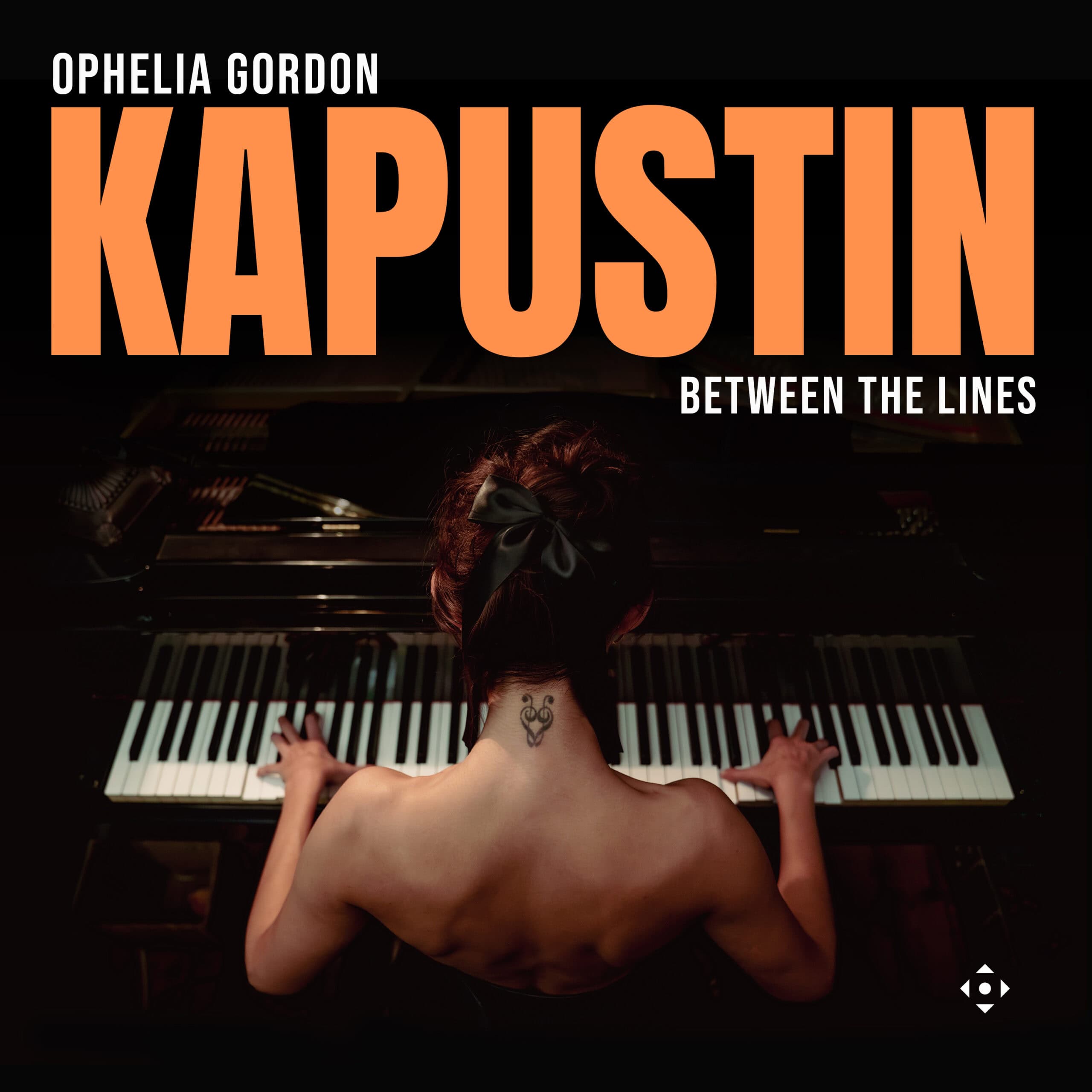
  • Kapustin: Between the Lines

    Kapustin: Between the Lines

    Ophelia Gordon & Kapustin: It’s about the balance of respect and personal creativity – Pizzicato

    Electrifying debut album from a bold new voice in classical piano.

    British pianist Ophelia Gordon makes a striking debut with this album of works by Nikolai Kapustin, the Soviet composer whose music fuses the harmonic language and rhythmic drive of jazz with the formal precision of classical composition. Though Kapustin’s music sounds improvised, every note is meticulously written – jazz in spirit, but classical in structure.

    Gordon brings rare authenticity to this repertoire, having tracked down long out-of-print vinyl recordings of Kapustin’s own performances in a personal search for the composer’s true voice. The programme is carefully curated to offer a compelling listening arc, capturing Kapustin’s wit, lyricism, and fire with both intimacy and flair.

    Recorded on a characterful 1961 Steinway D, the album’s sound is warm, immediate, and rich in detail – engineered with a microphone setup designed to balance the immediacy of a jazz trio with the depth and clarity of classical solo piano.

    This release marks two milestones: the first full Kapustin album by a British female pianist, and the first classical album by a BRIT School alum. With a growing reputation for fearless artistry and cross-genre fluency, Gordon offers a vital new perspective on one of the most original piano voices of the 20th century.

    https://youtu.be/nMM7MastvBM&w=720