Catalogue Connection: 21131

  • Environments The Journal of Music Review

    Environments is a substantial portrait album of Northern Irish composer Greg Caffrey, featuring four orchestral works written between 2011 and 2021. It is his first solo album since 2010’s First Constructions in Nylon(Cactus Records), and by far the most ambitious. For the project, Caffrey has paired up with the Ulster Orchestra under Sinead Hayes, who is the conductor of the Hard Rain SoloistEnsemble (HRSE), which Caffrey set up in 2013 and of which he was the artistic director until stepping down last year.

    Environments opens with a threnody. Aingeal II (2021) was composed in memory of someone close to Caffrey, and its opening gesture – an angry descending figure followed by an extended tremolo, accompanied by knells on the tubular bells – has a raw emotion that foreshadows the directness of much of the music on this album. (There is also an Aingeal I, or just Aingeal, dating to 2009 and scored for clarinet quintet.)

    At twenty minutes, the most substantial work on the album is A Terrible Beauty. This comprises three movements that were written as self-standing works between 2013 and 2017–19 (Caffrey gives different final years). Originally written for HRSE, we hear them here in versions for sinfonietta orchestra. Each is a response to a poem by W.B. Yeats.

    The first, ‘These are the clouds about the fallen sun’, homes in on the first line of ‘These Are the Clouds’. Although there is plenty of movement in this piece, it is movement that goes nowhere, taking place within a larger stasis. It is an atmospheric work; the atmosphere is desolation. The second, ‘Things fall apart; the centre cannot hold’, is less cataclysmic than Yeats’ ‘The Second Coming’. It has a hellish opening, but soon settles down. It has unexpected moments of quietness and gentleness, and more generally takes a moderate tempo and contains no big surprises or sudden shifts. In the final piece, ‘…for peace comes dropping slow’, Caffrey also departs from the tenor of Yeats’ poem. Here, he switches the foreground and background: where Yeats dwells on his Innisfree lake isle, only in the last lines snapping out of his reverie to city roadways and pavements grey, what Caffrey gives us is angular and tense, only latterly approaching a bucolic tempo, and only at the very end giving us something like consonance.

    Caffrey does not misunderstand Yeats’ poetry. A Terrible Beauty, rather than merely dramatising the poems, instead investigates and reframes moments in them. Nor did Caffrey choose his lines at random: as he writes in the liner notes, his selection ‘charts a trajectory expressing deep loss and sadness, then desolation and anarchy and, finally, an uneasy tranquillity.’ A Terrible Beauty is an interesting, detailed and expressive work. The orchestral arrangements are also convincing, although I preferred the timbral clarity of the chamber originals (which can be found, for example, on HRSE’s A Terrible Beauty (Diatribe, 2021)).

    Soloists and contrastsThe two Environments that give the album its name are less bleak than Aingeal II and A Terrible Beauty. They are based on a contrast between a soloist and orchestra, but are not concerti: virtuosity is not a concern, and they are rather explorations of musical contrasts. In Environments I (2011), the solo instrument is piano (the pianist here is Daniel Browell). It is an abstract work but a compelling one. Harmonic movement is thematised, with one instrument (not always the piano) often seeming to dictate chord changes, and the overall harmonic structure of this work has a very well-judged arc and balance. The contrast of sustain and attack is explored nicely too: the piano sometimes echoes the glockenspiel, sometimes the string section’s long sustain.

    In Environments II (2012), the solo instrument is guitar (here Craig Ogden, who was the performer on Caffrey’s First Constructions in Nylon). Caffrey, a guitarist himself, writes sensitively for the instrument, and fits it into the orchestral context well too: he uses its sharp attack and fast decay to great effect, and uses it effectively both as a foreground and a supporting instrument. The guitar can sound thin in an orchestral context, but Caffrey, instead of fighting against this, uses it to ‘complete’ (Caffrey’s apt word) the rich and sustained but less crisp sound of the string orchestra. Ogden’s orchestral awareness deserves credit here too.

    The musical portrait Environments creates is of an expressive composer who is yet careful with details. Throughout the album, Caffrey combines big gestures with a sensitive attention to each instrument and how it is balanced in and contrasts with the larger ensembles. Sometimes these details are a bit puzzling (I was nonplussed by some of the seemingly random pizzicati in Aingeal II), but these missteps are rare.

    Hayes and the Ulster Orchestra play with confidence and bite, giving good accounts of all the works. However, tuning issues in the strings are occasionally distracting and more seriously, the orchestra does not always have the litheness to do full justice to the music, which would have opened up more if performed with greater dynamism.

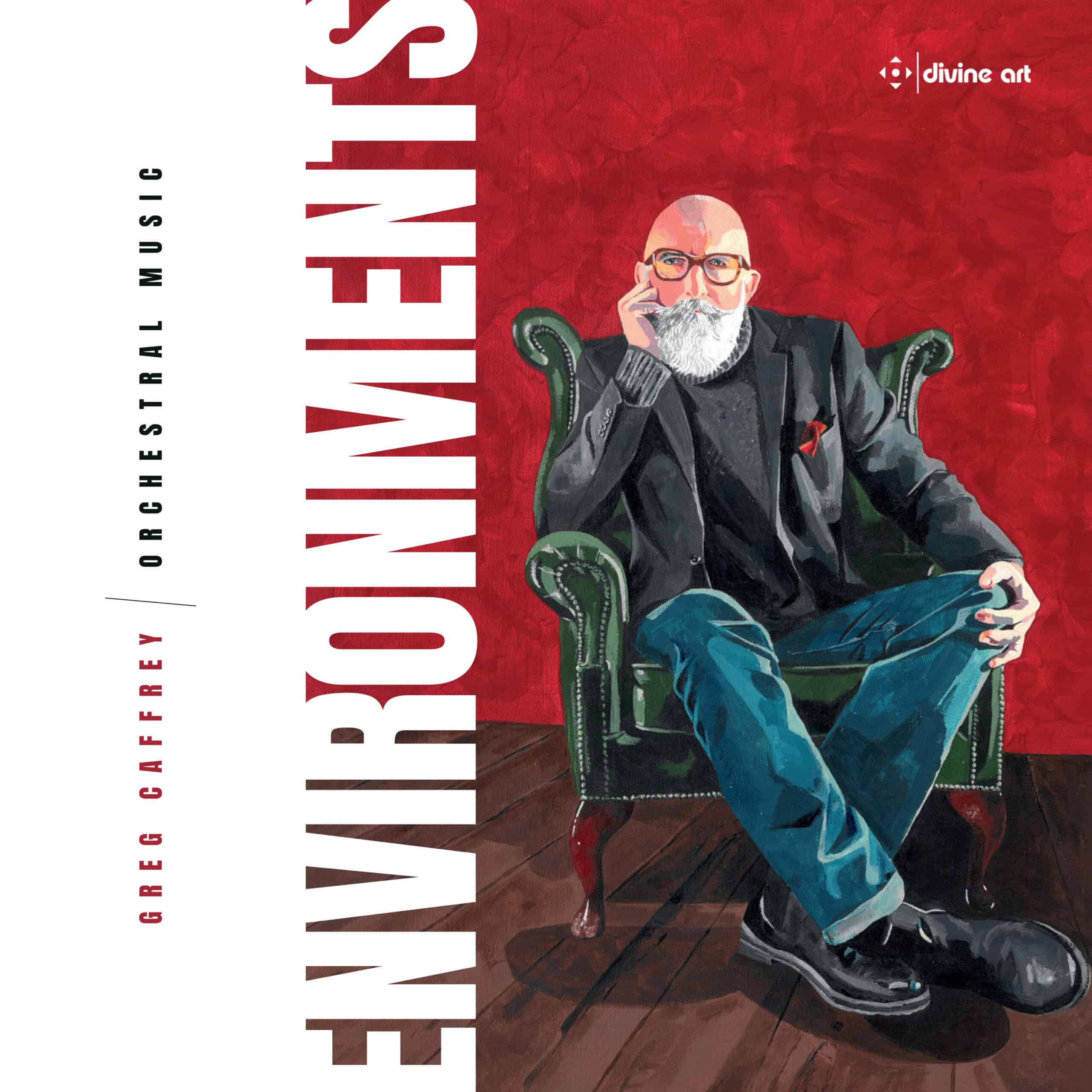
    A final word must also be given to the booklet: it is beautifully produced and features some useful context by Caffrey, but what really sets it apart are the excellent acrylics by Paula Caffrey. Each (apart from the cover painting) corresponds to a work on the album. As standalone works they drew me in through their use of volume and framing.
  • Caffrey Environments Fanfare Review

    Just past 60, the Northern Irish composer Greg Caffrey is old enough to have been shaped by The Troubles in his native Belfast. The intensity of the strife made music education in his school impossible, but he went on to obtain degrees through the Ph.D. at Queen’s University Belfast. In his composer’s note Caffrey sketches in his memories of a terrible time but doesn’t claim that any of these four orchestral pieces refers to it. The closest we come is in the first piece, the nine-minute Aingeal II, where the angel of the title was “a person close to me. This beautiful person endured such pain and tragedy in her short life.”

    Scored for string orchestra and percussion, the music’s poignant effect of “beauty, pain, and suffering” would be suitable for a piece about The Troubles, not as a depiction of violence, which is absent in the music, but as a human response in the aftermath. Caffrey’s chosen mode isn’t anywhere near the cutting edge of New Music, since he writes notated scores for acoustic instruments. His harmonic language roams around the same terrain as Bernard Hermann’s scores for Hitchcock movies, principally in Caffrey’s fondness for haunting atmosphere. It seems reasonable to take a sidelong glance at Peter Maxwell Davies, Oliver Knussen, and Magnus Lindberg for similarities in Caffrey’s use of the orchestra and his ability to put sophisticated gestures into accessible expression.

    The two title works, Environments I and II, which together occupy about half an hour, communicate very little in their modest, neutral title, but Caffrey considers them among his most intuitive pieces. They were composed in Paris during residencies in 2011 and 2012. In keeping with the two solo instruments that are prominently used, Environments I is on a symphonic scale suitable for the piano, while Environments II is reduced to a chamber string orchestra in keeping with the quiet solo guitar. Despite some varying differences, both display Caffrey’s preferred orchestral sound, which amounts to a signature (as with Herrmann).

    His sound revolves around dramatic gestures interrupting a sustained mood, with flecks of color from percussion, woodwinds, and brass. Forward motion and development are often less important than diving into the soundscape each piece is based on. In Environments I the piano is prominent, but much of the time it is the leading voice in the texture, not a conventional concerto soloist.

    By ear I can’t follow the technical feature that Caffrey says he is exploring without actually describing it. But his sound is riveting in a way that displays a considerable ability to directly communicate with the listener. The effect is like lively stasis, if I can put it that way. Environments II works on the same principles and uses strings asimaginatively for color as the full orchestra in Environments I. The guitar is forwardly placed (without microphones it would be hard to hear in the concert hall), and as usual in guitar works with orchestra, solo passages are provided to make it more audible. Percussion aside, this is a piece for bowed and plucked strings that has a certain abstract angularity, which makes it more austere than the other works on the program. The piece that comes closest to being programmatic is A Terrible Beauty, the title taken from W. B. Yeats’s poem Easter, 1916. That week historically marked an armed insurrection against British rule by Irish republicans, the same conflicting forces as in The Troubles half a century later. Each of the work’s three movements takes a line from Yeats to suggest Caffrey’s response to a poem. But the essence of the score is similar to Aingeal II, in that what is terrible attempts to exist beside what is beautiful. It’s a rich subject for classical music going back centuries (the St. Matthew Passion could have been subtitled “A Terrible Beauty”).

    Caffrey took eight years to compose the individual movements as free-standing pieces, which originally existed in chamber form to be premiered by an ensemble he founded and headed for a decade. Momentum and drive feature more prominently than elsewhere, giving a sense of dissonant propulsion only occasionally accented by a longer lyrical passage sounded in the upper strings. Although A Terrible Beauty lasts only 20 minutes, I didn’t find that there was enough invention or variety to sustain interest, but I imagine Caffrey sees this piece as his most advanced and exploratory. It is certainly the hardest listen on a program noted for its immediacy.

    The performances by the Ulster Orchestra under conductor Sinead Hayes seem to be expert, committed, and well prepared, even if such things are hard to judge in unfamiliar contemporary music. The piano and guitar soloists in the two Environments aren’t given virtuoso parts, but Daniel Brownell and Craig Ogden perform with real presence.

    Caffrey emphasizes that this was a major project of great personal significance for himself. The outcome is a happy one, and much of the music holds definite appeal for general listeners who are attuned to the poignant border between beauty and pain. 

  • Environments British Music Society Review

    The Ulster composer Greg Caffrey is a new name to me, though I have been aware of the Hard Rain Ensemble that he founded a decade ago.

    Aingeal is a tribute to a loved one. Strings scurry downwards, a bell tolls, and we are clearly listening to a threnody – somewhere between Pärt and Pettersson? Long shimmering chords, a glowering tam-tam, the sinister rattle of percussion. The music isn’t going anywhere much, nor is it trying to, it is a jagged meditation on loss.

    Bells again launch Environments II, but soon a guitar (the great Craig Ogden) picks out a theme to be examined and explored through a sequence of cool meditation, brief urgency, and at last an abrupt silence; a glittering twelve-minute musical mobile. 

    A Terrible Beauty is a response to, rather than a setting of three poems by Yeats. Again, long string chords – warmer now – are coloured this time by wind and brass. Though not in any way illustrative, like the other pieces this music evoked in me clear mental pictures, this time of the hushed and teeming jungles painted by Douanier Rousseau.  If the first part is all expectation, the rest (‘Things fall apart’) is mostly action, as scraps and fragments of theme are juggled and tossed; and while sounding nothing like him, the music retains throughout, much of Webern’s absolute lucidity and clarity.

    In Environments 1 the piano wanders through another lush landscape – sometimes serene, sometimes menacing – of shimmering colours and delicate flecks of light: again, the music evoked (in me) pictures – the long shadows of De Chirico, the cool abstraction of Ben Nicholson – maybe I need to get out more. At sixteen leisurely and ruminative minutes this is the longest single piece on the disc, and the only one that maybe slightly outstayed its welcome.

    If the music inhabits a somewhat circumscribed sound and emotional world that puts him in good company with others outside the mainstream (eg Robins Stevens and/or Walker): and on first acquaintance it is definitely rewarding – only time will tell how durable it may be.  Recording and presentation are excellent, even if the promotional blurb (‘transports listeners on a visceral journey through the depths of human experience’ etc.) is a tad overblown. The Ulster Orchestra copes admirably with some very exposed writing. This, then, is contemporary music that comes highly recommended. 

  • Greg Caffrey: Environments

    Greg Caffrey: Environments

    Introducing “Environments,” from acclaimed composer Greg Caffrey, a poignant journey through landscapes both physical and emotional. Recorded in the heart of Belfast at the historic Townsend Street Church, this album captures the essence of a city marked by its tumultuous history and resilient spirit. Caffrey’s compositions, brought to life by the renowned Ulster Orchestra, reflect his own personal journey from the streets of West Belfast to international acclaim.

    Opening the album is “Aingeal,” a deeply personal work written in tribute to a loved one. Set against a backdrop of strings and percussion, the music captures the raw emotions of grief and loss, offering solace and catharsis in its haunting melodies.

    Environments I and II,” are two pieces born from Caffrey’s residencies in Paris, showcasing his mastery of orchestral composition. From the grandeur of a full symphony orchestra to the intimacy of chamber music, these works explore a range of rich sonic landscapes. Each note is imbued with the composer’s profound connection to his surroundings, offering a window into his creative process.

    “A Terrible Beauty,” the centrepiece of the album, unfolds over three movements inspired by the poetry of WB Yeats. Caffrey’s response to the poetry is both evocative and introspective, weaving together themes of beauty, pain, and resilience. With each movement, the music transports listeners on a visceral journey through the depths of human experience, culminating in a profound exploration of the human spirit.

    Through “Environments,” Greg Caffrey invites listeners to reflect on their own environments, both internal and external, and discover the beauty in life’s most poignant moments.

    Conducted by Sinead Hayes with soloists Craig Ogden (guitar) and Daniel Browell (piano).

    Environments II:
    Prizewinning work in the International Conductors Union Composition Contest, Ukraine 2021

    A Terrible Beauty:
    Recommended work’ in the 4th Uuno Klami Composition Prize