Catalogue Connection: 21136

  • James Cook Organ Works Klassik Review

    The English label Divine art has long been committed to an internationally little-known composer.

    For the 60th On the occasion of the composer James Cook, the busy Scottish organist Kevin Bowyer recorded two of his nine organ symphonies. Organ symphonies are not the typical oeuvre for British composers, but Cook, whose musical career is unusual, is also an exciting personality. He only briefly studied composition at the University of Oxford in 1994, a large part of his musical creations goes to sacred music.

    The organ symphonies No. 8 ‘Olympian’ and No. 9 ‘Apollonian’ presented here were both created in 2006, and can be described by their harmonic concept as an update of the French organ symphonies of the late 19th century. century. The eighth symphony is four movements, with two substantial corner movements, a quotation from the Baroque combines the reference to Mount Olympus with a ‘stairse into heaven’. In fact, the music is deeply spiritually transcendental, but cannot be assigned to a Central European, British or international tradition in terms of pon. Even if the middle clauses are called ‘Anglaise’ and ‘Pastorale’, this has nothing in common with the so-called English Pastoral School. ‘Pastorale’ is formally perhaps one of the strictest sentences in terms of sentences, perhaps one can build a bridge to Max Reger’s passaglie and canon-like organ-like movements on the one hand and to polyrhythmics on the other.

    Comparable to the French organ symphonies, the Ninth Organ Symphony is seven-sent, with only the final movement of an extensive scope. Cook described the symphony as a work of light and movement, and this, according to Cook, describes a long hot summer day trip to the sea in Victorian and Edwardian times. One wishes that Cook would bring less extra-musical thoughts into his music – this distracts a little from their qualities and rather highlights the eclectic weaknesses.

    We know from his discography that Bowyer has no technical difficulties, but his tonal aesthetics have changed significantly in recent years compared to his Sorabji and Alkan recordings. Always curious about unknown terrain, this is precisely the essential constant of his discography: the unknown, the surprising, the unfamiliar. Cook offers plenty of this, and Bowyer’s creative skills can be expressed unbroken. The recording was made on Bowyer’s ‘house organ’ of the Glasgow University Memorial Chapel, a 1927 Willis organ that was renovated by Harrison & Harrison in 2005. Since the renovation, Bowyer can be heard regularly on this organ.
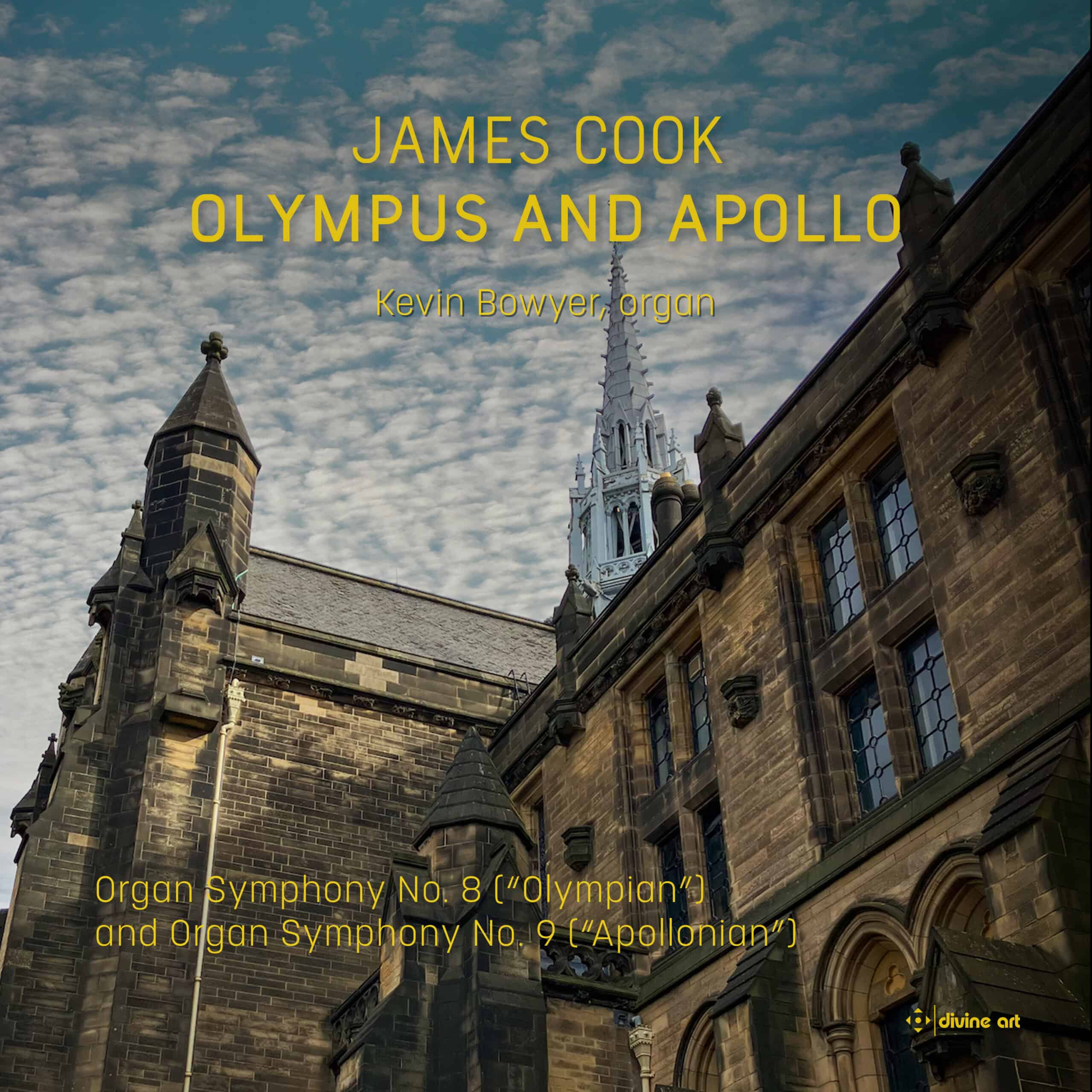
  • James Cook Olympus and Apollo Pizzicato Review

    James Cook wrote his 8th and 9th symphonies in 2006. They are works in the tradition of the French organ symphony, concertante works on a liturgical instrument without reference to sacred acts. However, the gods do play a role in James Cook’s compositions, which refer to Greek mythology.

    Symphony No. 8 is about Olympus, about natural atmospheres cloaked in mystical, dark, shimmering timbres. Kevin Bowyer orchestrates this atmosphere with great sensitivity, constantly striving to build tension and break through the twilight with brilliant clarity.

    However, some lengths prevent a consistently intense narrative structure, which is also due to the inner architecture of the symphonies. In Symphony No. 8, long outer movements frame the relatively short middle section.

    In the Ninth, the slow final movement is longer than the preceding six movements combined. This work also contains many beautiful, original ideas (the short march and the Presto that follows it).

    The symphony refers to Apollo, the god of light, and depicts a day in early 20th century England with sunrise, country walks, hustle and bustle, and the fading of daylight. Once again, Kevin Bowyer uses bright colors that fade like a fine shadow toward the end.

  • James Cook: Olympus and Apollo

    James Cook: Olympus and Apollo

    Divine Art presents two stunning organ symphonies by renowned composer James Cook, performed by the eminent British organist, Kevin Bowyer. Making his debut on the Divine Art label, Bowyer brings to life Cook’s Symphony No. 8 (“Olympian”) and Symphony No. 9 (“Apollonian”), both crafted in 2006 and masterfully orchestrated in 2011. This remarkable recording took place on the majestic organ of Glasgow University Memorial Chapel in 2023.

    James Cook, a prolific composer born in 1963, studied composition at Oxford University and has since created a vast array of music, including operatic extracts, sacred choral works, and an impressive collection of organ compositions. This new release marks the ninth album of Cook’s music by Divine Art, showcasing his continuous evolution as a composer.

    The Olympian Symphony, Cook’s eighth symphony, is an expansive and evocative piece inspired by Mount Olympus, the mythical home of the Greek gods. It consists of four movements: Soliloquy, a meditative and introspective movement that builds to a powerful climax before gently fading away; Anglais, an energetic and angular dance in 2/2 time, contrasting leaping intervals with scalic melodies; Pastorale, a serene nocturnal scene, mostly quiet with a dynamic central section, concluding with a whispering ppp; and Expansum, grand and noble, featuring majestic chords and sweeping passages that suggest an endless journey. Prefacing the symphony, Cook includes a quote from John Trapp: “Should we not be as serious and sedulous in building staircases for heaven as the wicked are in digging descents to hell.”

    The Apollonian Symphony, Cook’s ninth symphony, depicts the vibrant and varied experiences of a long summer’s day by the seaside in Victorian or Edwardian times. It comprises seven movements: Introduzione, where dawn breaks on a summer morning; Allegro, capturing the excitement of starting the day’s adventures; Allegretto, reflecting a mellow, reflective mood at noon; Alla Marcia, as a military band parades by in the afternoon; Presto, with a playful street urchin mocking the band as it passes; Prestissimo, where the day grows more intense as the late afternoon heat gives way to early evening revelries; and Adagissimo, concluding the day as the visitor retreats to the tranquility of a forest, ending the night in peaceful reflection. The finale is titled with Cook’s own words: “Fractious day yields to sublime night.”

    Kevin Bowyer, celebrated for his unparalleled skill and daring performances, has captivated audiences worldwide. Born in Southend-on-Sea, Bowyer trained at the Royal Academy of Music and further honed his craft under the guidance of David Sanger. His illustrious career includes numerous accolades, such as the prestigious Medal of the Royal College of Organists and the “Lifetime Award” from the German Record Critics in 2023.