Catalogue Connection: 21137

  • Pitfield: String Chamber Music MusicWeb International Review


    A critic once told me that George Butterworth was a composer who never wrote a piece of music that was unattractive; the same verdict may well apply to Thomas Pitfield, as well. I have been immersing myself in his music over the last few days and have found every piece I encountered to be beautiful, interesting and fastidious in craftsmanship. I think the time really has come for Pitfield’s music; once unfairly passed over for being unfashionably melodious and traditional, the wheel has now come full circle and his positive qualities can be appreciated by audiences new to his compositions. It seems extraordinary to me that much of this engaging music has lain forgotten for decades.

    The Piano Trio No. 1 is, for me, the highlight of this disc. I appreciate its emotional directness, its emphasis on melody and its appealing and subtle harmonies. In each of the three movements, the listener feels that not a note is wasted, with textures beautifully wrought, so that clarity and warmth are both maximised. It is an extraordinary piece, which seems to pack a huge amount of interest into a relatively small time span (sixteen-and-a-half minutes). The first movement charms the listener from the opening bar and skilfully combines English and French stylistic features; Pitfield may possibly have used the piano trios of Moeran and Ravel as points of departure. The second movement is, if anything, even more rewarding; the profusion of striking melodies is certainly a notable feature of this work. The finale rounds off this immensely lovable piece in compelling fashion.

    The second Piano Trio is far more challenging than the first. I was a little puzzled by the moniker “Lyric”. This is undoubtedly an important work, but listeners need to hear it several times before its many strengths are fully grasped. I like the slightly acerbic feeling of the first movement, as different ideas seem to be colliding into each other, jostling for the listener’s attention. The second movement, marked “Larghetto solenne”, is perhaps the finest part of this trio, with its quirky and unexpected central section. The finale resumes the tense mood of the opening. It is interesting to hear echoes of Arnold Bax here; one passage (from 3:44) reminds me a little of Bax’s strident, yet magnificent “Saga Fragment”. Throughout this movement, the momentum scarcely flags until the final bars, which unexpectedly close the work in a tranquil mood.

    The Epigraph for violin, cello and piano is an attractive miniature that is full of disarming simplicity. A critic might complain that it is a little too short; like Oliver Twist, I feel that I want more here. This is surely preferable, however, to a piece that outstays its welcome. 

    I love the Cello Sonatina of 1955; this eleven-minute work is a real winner. In the first movement an unexpected musical influence seems to creep in (from 1:33) – Constant Lambert! One interesting feature of this disc is how each piece is so different. I have noticed that Thomas Pitfield never repeats himself – he appears to have an inexhaustible range of moods at his disposal. The lyrical second movement has an enchanting, bittersweet quality. This is English melancholy in its truest sense, that glorious fusion of sadness and beauty, when “our sweetest songs are those that tell of saddest thought.” Pitfield’s idea of melancholy is certainly not the same as Birtwistle’s, which is more akin to the misery one feels when our rubbish isn’t collected on time. 

    The substantial Cello Sonata is the final item on this disc. It is another major discovery and an important addition to the repertoire. The writing for the cello is extremely fine, which is not unexpected, as this was Thomas Pitfield’s own instrument. I feel that the piano writing is rather big-boned, however, but the composer skilfully balances his textures so that the cello is never drowned out. This is an imposing piece that combines lyricism and drama in equal measure.

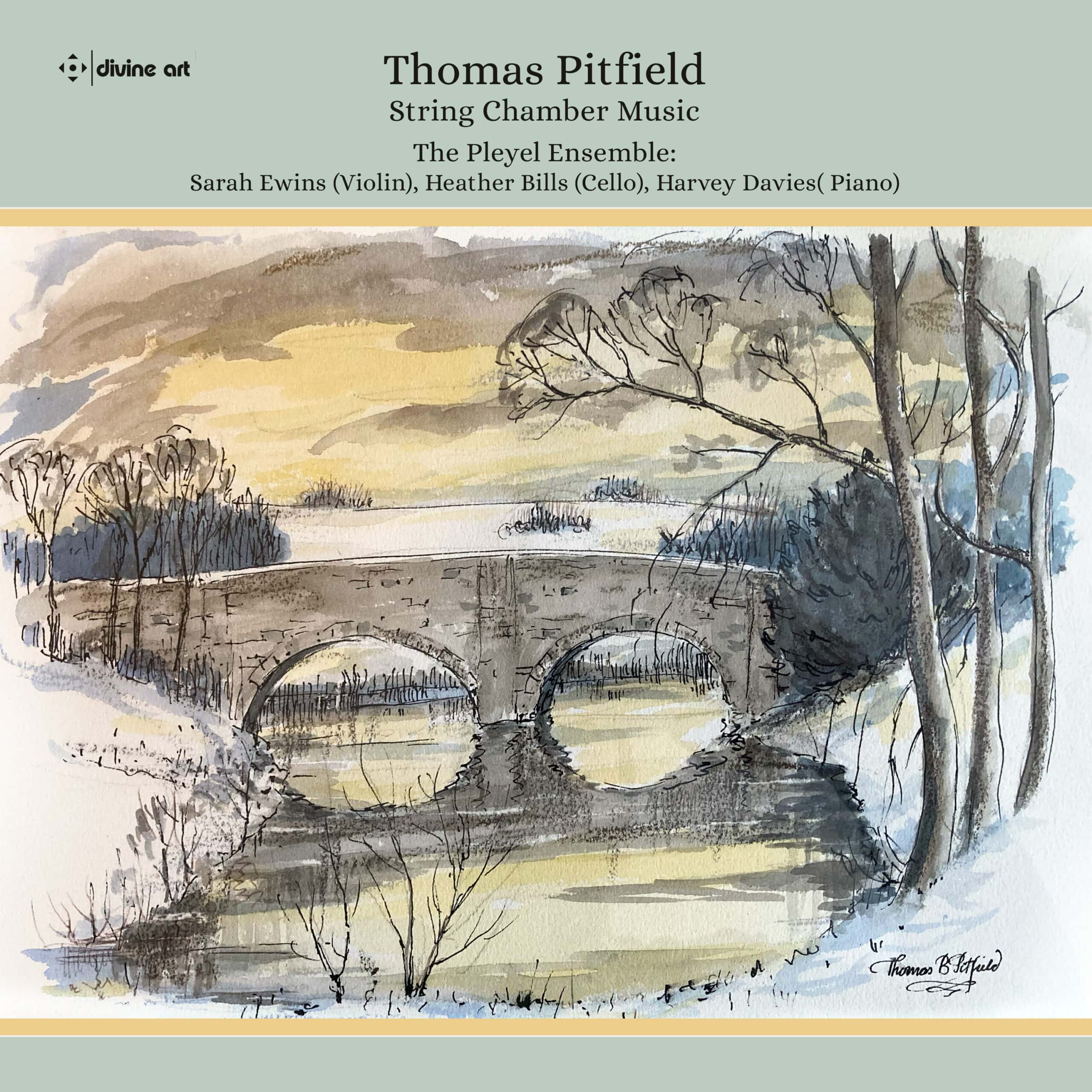
    Throughout this disc, the sound is excellent and the performances are exceptionally alert and sensitive. The booklet notes are also interesting and informative. I very much like the cover image, which is a watercolour by the composer of “Weaver Bridge at Church Minshull, Cheshire”. Thomas Pitfield was certainly an extremely talented artist, as well as composer. The artwork seen here is firmly in the English watercolour tradition of John Varley (1778-1842), with trees elegantly framing the picture, the water in the centre and a Romantic sky.

    There can be no doubt that this is a first-rate disc and I welcome it with much enthusiasm. This new recording should help to advance Thomas Pitfield’s fast-growing reputation and hopefully lead to many more performances of music by this rewarding composer.
  • Pitfield String Music Fanfare Review

    Thomas Pitfield (1903–1999) was an astonishing polymath. Among his other talents he was a poet, artist, composer, engraver, mechanical engineer, furniture maker, and teacher. Given such a wide array of interests, one might expect his music to be that of a dilletante, which is absolutely not the case. Born in Bolton in greater Manchester, Pitfield was a gifted composer, influenced by the music of Vaughan Williams and Delius alongside the French Impressionists. Every piece on this program would be at home in a serious chamber music concert.

    Pitfield possessed a pronounced gift for melody as well as for harmonic and contrapuntal development. His idiom is tonal and quite conservative for its time. The result is music that is immediately appealing but that also rewards repeated listening. These works are tightly constructed and concise—the Second Piano Trio is the longest at 17:39.

    The two piano trios are largely lyrical. The first was composed in 1930 and dedicated to Alice Asbury, who was to become Pitfield’s wife in 1945; they remained married until his death 65 years later. The trio is urgent, even impassioned, in its lyrical outpouring. The influence of Debussy is felt in the first movement. Piano Trio No. 2 was composed in 1948–49 and is less expansive, with more jagged rhythms, although the finale returns to the composer’s predominantly lyrical style. The very brief Epigraph for piano trio is based on a theme by Anton Arensky. The Cello Sonata from 1938 is closer to the Second Piano Trio than the First, displaying sharp rhythmic interjections and forceful contrasts, particularly in the dramatic first movement. The second movement, a lovely arietta marked Andantino dolce, could serve as a gentle lullaby. A light Scherzino and a brilliantly virtuosic Toccatina conclude the work. The Sonatina for Cello and Piano was published in 1944 (we don’t know when it was written), but it doesn’t reflect the horrors that England experienced during the war. The music is lighthearted and seems slightly jazz-influenced.

    The Pleyel Ensemble is a Manchester-based group that changes personnel based on the instrumental needs of the music they are playing. They have a particular commitment to British music. The three members heard on this disc, Sarah Ewins (violin), Heather Bills (cello), and Harvey Davies (piano), do themselves proud. They play with energy, tonal beauty, and affection.

    I can enthusiastically recommend this disc to listeners looking for unusual repertoire that still finds new things to say in an old-fashioned manner. If you enjoy Vaughan Williams and Walton, it is difficult to imagine Pitfield’s chamber music not appealing to you. The recorded sound is well balanced, but I wish the program notes were more informative about the individual pieces.

  • Pitfield String Chamber Music MusicWeb Review

    The Divine Art label has been doing very well by British composer Thomas Pitfield in the last year or so. In addition to this disc, Divine Art recently issued a twofer Thomas Pitfield – His Friends and Contemporaries (review), and earlier in 2024 a recording of his songs (DDX21119). With recordings on other labels, Pitfield is getting the exposure he deserves. He was more than a musician. He was a polymath: poet, memoirist, artist, calligrapher, engraver, woodworker.

    The shortest piece here, the Epigraph for violin, cello and piano, perfectly sums up Pitfield’s musical style: jagged rhythms, a melodic line derived from Delius and Vaughan Williams, a distinct sense of harmony, and a distinct sense of humor. All these elements are already evident in the early Piano Trio No.1, which he wrote for his future wife Alice Astbury. The piece is rather more impressionistic than his later music, but his rhythmic complexity is already there, not to mention the grasp of structure: the last movement, quite complex, is a real workout for the performers.

    John Turner, the esteemed recorded player and friend of Pitfield, points out in his notes that the cello was Thomas Pitfield’s own instrument. We have here two large-scale works for the instrument. The Cello Sonata is a fully mature work, written not only with knowledge but with love for the instrument. The opening Variations movement is somberly impressive. The central Pastoral Interlude may remind some listeners of Moeran’s Cello Sonata, although Pitfield’s work predates that by several years. The Epilogue gives prominence to the piano. It develops the work’s material with the composer’s unique brand of humor.

    About ten years later Pitfield wrote his short Sonatina. While brief, it is an even more substantial work than the Sonata. Pitfield’s command of his material is prominent here, as he combines the increasingly lyrical element in his work with seriousness and humor in the Preludio. He adds interesting harmonic twists in the Arietta and the Scherzino, before finishing with a typically rhythmic Toccatina.

    The last piece here is the Piano Trio No. 2 “Lyric”. As mentioned above, lyricism was an increasingly important element in Pitfield’s mature music. This powerful work offers each of the performers a chance to shine. In the opening Allegro marcato, pianist Harvey Davies brings out the composer’s adroit part-writing. Cellist Heather Bills has perhaps the most challenging role with the Larghetto movement. She keeps the mood constant through rapid-fire tempo changes. In the last movement, we again have a tempo of Allegro marcato, but this movement is much more dramatic than the first. Violinist Sarah Ewins rises to the occasion with very forceful playing.

    The Pleyel Ensemble comprises eleven players, but only three perform here. It was co-founded in the Manchester area in 2011 by the married couple, Heather Bills and Harvey Davies. They bring great understanding and warmth to Pitfield’s music. Sarah Ewins’s playing is so dynamic that I almost wished there were more trios here. Pitfield would surely have been very pleased with this disc. It will add to the continuing rediscovery of his music.

  • Pitfield: String Chamber Music MusicWeb Review

    One needs to know that Thomas Baron Pitfield was a polymath: not only a prolific and skilled composer, but an artist, poet, teacher, author, cabinetmaker and ornithologist. It has been said that he hid many more lights under his bushel. To be sure, he is not one of the “towering giants” of British music. On the other hand, he has been unfairly ignored on the wider stage of concert halls and recital rooms. I had noted earlier that I enjoyed, and genuinely warmed to, the pieces of his which I heard.

    Stylistically, Pitfield is hard to define. Frederick Delius, Ralph Vaughan Williams and Percy Grainger may spring to mind. He makes use of folk song, and adapts it to his own classical style. To my knowledge, he never indulged in dodecaphony or flirted with the avant-garde. His compositions always have tuneful melodies, interesting harmonies and a strong understanding of instrumentalists’ needs.

    I began with the bewitching Sonatina for cello and piano. John Turner’s liner notes say that the “cello was Thomas Pitfield’s own instrument, and he received lessons in his youth from the cellist Katherine Moorhouse, the first wife of the Manchester composer Eric Fogg (Uncle Eric of BBC’s Children’s Hour), both of whom became hospitable friends to Pitfield.” He dedicated the Sonatina to the onetime Principal Cellist of the Hallé Orchestra, Oliver Vella, and to Oliver’s wife Sheila. It is delightful, with inventive moments especially in the opening Allegro risoluto and the dreamy Arietta. At just shy of eleven minutes, the sonatina is not a didactic miniature. The tyro would need a strong technique to give a good account, especially of the concluding Toccatina. The two soloists here give an impressive performance.

    The liner notes sadly do not comment on the Sonata for cello and piano in D minor. The opening Variations contain Rachmaninovian pianism, counterpointed to more “English”-sounding passagework. The piece is eclectic – to its detriment, as some may argue. I loved the dreamy Pastoral Interlude, where echoes of Delius abound, with significant effect. Other stylistic models follow in the ‘middle eight’. I can imagine Pitfield exploring his beloved Dunham Massey, a great park south of Manchester. The Sonata is rounded off with a folksy Allegro Epilogue. Are there nods to a well-known Christmas carol in these pages? It is hard to understand why – like so much British music – this splendid sonata is not in the standard repertoire.

    The short Epigraph for violin, cello and piano is based on “fragments from an ostinato by the Russian composer Arensky, written for The Arensky Trio”. It is a thoughtful, pensive little number. 

    Ever since my introduction in 1977 to Schubert’s Piano Trio in B flat major, op.100, I have been an enthusiast of the genre – especially, I must add, trios devised by British composers. Pitfield’s dedicated the Piano Trio No.1 in C major to his wife-to-be, Alice M Astbury. The New London Trio premiered it on 16 March 1933 at an Oxford University Press private concert.

    It is difficult to pin down the sound world of this piece. It is by turns pastoral, romantic and edging towards an incipient modernism, especially in the final movement. Here and there, a folk tune emerges and then is cast aside. Yet this is not cow-and-gate music, despite debt to several then-contemporary composers, including RVW, and to York Bowen’s pianism. The liner notes explains that “this substantial and serious early work is in a much more harmonically advanced style than his later music, and exhibits few of the distinctive footprints of his later works”. Enjoyable and deeply felt, the Trio enchants but does not seriously challenge.

    The Arensky Trio gave the premiere performance of the Piano Trio No.2 in F minor at a concert celebrating Pitfield’s 80th birthday, on 6 May 1983 at All Saints Church, Altringham. John Turner notes that it remains unpublished. Despite the Lyric soubriquet, it is rather astringent in mood, but not difficult to listen to.

    The opening Allegro marcato uses a bouncy folklike theme, whose title is always just on the tip of the tongue. The two-part second movement opens with a long Larghetto solenne theme for solo piano, before it turns into a beguiling scherzo, marked Allegro quasi allegretto, for all the players. The piano dominate again for a number of bars before the movement concludes melancholically. The Allegro marcato finale fairly bounces along, with lots of extravagant pianism and vivid string playing. Here and there, a quieter interlude tries to impose itself, with little success. This characteristically “molto perpetuo” movement concludes in quiet reflection.

    The well produced booklet  could have offered a little more analysis and commentary on the works. There is a good introduction to the composer, and notes on the performers. The cover sports the evocative watercolour Weaver Bridge at Church Minshull, Cheshire, from the garden of Weaver Cottage, a fine example of Pitfield’s achievement as an artist. 

    There is nothing to compare the performances to. No matter: they exude brilliance, technical competence and a sympathetic understanding of Pitfield’s music. The recording is clear and vibrant.

    I hope the disc succeeds in introducing these attractive works to a wide audience, including other piano trio ensembles. The blurb is spot on: “This album offers a glimpse into Pitfield’s artistic vision and craftsmanship. Pitfield’s compositions are filled with elegance, lyricism, and emotional depth.”

  • Thomas Pitfield: String Chamber Music

    Thomas Pitfield: String Chamber Music

    This is a remarkable collection of 5 compositions for strings by Thomas Pitfield, performed with thoughtful skill by members of the Pleyel Ensemble. This album of Pitfield’s string chamber music is accompanied by two further Divine Art releases – The Songs of Thomas Pitfield performed by tenor James Gilchrist and pianist Nathan Williamson and Thomas Pitfield (DDX 21119): His Friends & Contemporaries, including works from a fine collection of composers (DDX 21246)

    These albums serve to shed light on Thomas Pifield’s considerable contribution to British music. Throughout his tenure as a composition teacher, Pitfield played a pivotal role in shaping the careers of notable composers like John McCabe, David Ellis, and John Golland, the latter of whom also shared a close personal friendship with Pitfield. Despite being somewhat overshadowed by the achievements of his contemporaries, Pitfield’s legacy lives on through a revival of interest in his music.
    This album offers a glimpse into Pitfield’s artistic vision and craftsmanship. Pitfield’s compositions are filled with elegance, lyricism, and emotional depth. His music not only showcases his technical skill but also reflects his genuine love for the art form and his dedication to inspiring future generations of musicians.

    The Pleyel Ensemble was formed in Manchester in January 2011. They are friends and colleagues who draw on a wealth of experience gained through many years of music-making. Since forming, they have given over 200 concerts, and have an enormous and varied repertoire of chamber music. The Pleyel Ensemble was delighted to be chosen as Making Music Recommended Artists for the 2016/17 and 2019/20 seasons and has appeared at Music Societies and Festivals all over the UK.

    The ensemble takes its name from the Classical composer Ignaz Pleyel (1757-1831), a brilliant musician and businessman, who, in addition to writing a large body of accessible chamber music, helped increase the popularity of this wonderful kind of music-making amongst amateurs and professionals as both music publisher and piano manufacturer in the early nineteenth century.