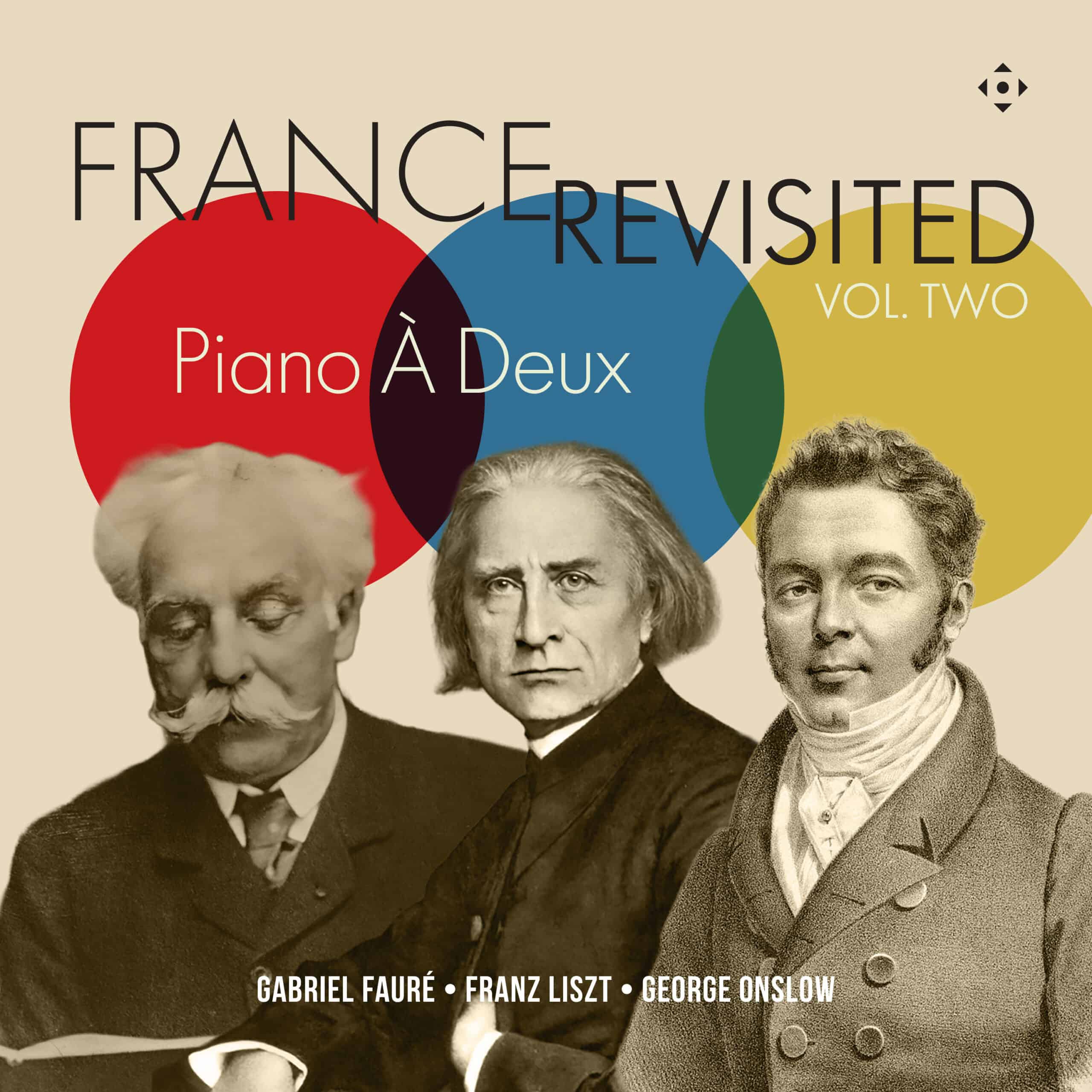
Catalogue Connection: 21142

  • France Revisited, Vol. 2 MusicWeb Review

    France Revisited, Vol. 2 MusicWeb Review

    This piano duet recital is a little out of the ordinary. Fauré’s Dolly Suite is standard territory but it is usually paired with familiar duets by Bizet, Debussy or Ravel, not Liszt’s Hungarian rhapsody and certainly not a piano-duet Sonata by Georges Onslow, a composer whose light has only relatively recently begun to glow after over a century of neglect. A little of that glow was contributed by the present duo team with their first volume of France Revisited (review). It included the first of his two sonatas for piano duet and six unpublished piano solos. A brief biography can be found in that review. Onslow’s published output concentrates on chamber music, with over eighty string quartets, quintets and assorted trios, sextets and septets. There are also operas, four symphonies and a scattering of piano works. Some composers may have been jealous of his wealth but he evidently had talent. Publishers such as Breitkopf und Härtel, C.F. Peters, Pleyel and Shimrock, amongst others, would not have spared printing time on him if that was not the case.

    Onslow wrote this second sonata when he was developing a reputation as a composer of instrumental music, though admittedly this was mostly outside France. In France, they were more interested in opera; Onslow’s L’Alcalde de la vega and Le colporteur were performed in Paris in the 1820s. In an attempt to promote his instrumental work, publisher Camille Pleyel described Onslow as Our French Beethoven, perhaps a teeny-weeny bit of hyperbole. The drama of the sonata’s opening movement certainly suggests the comparison, though the style is more akin to the writing of Hummel or Kalkbrenner. As with the first sonata, Schubert is hinted at in the lyrical second theme. This is reinforced by the sway of the second movement minuet with its quasi-duet between lower and upper pianist and the distinctive predominating motif. The largo introduction to the finale serves as a slow movement. Its rising octave immediately put me in mind of the slow movement of D.960, though the mood is different. The finale proper is lighthearted, a little like Mendelssohn, but the opening of the movement reminded me strongly of Saint-Saëns’s concertante Africa fantasy, enough so that I feel he knew this work. It certainly had its admirers, and no less musical giants than Chopin and Liszt performed it together in 1834.

    Fauré wrote Dolly Suite, a staple of the duet repertoire, for Régina-Hélène, aka Dolly, daughter of the singer Emma Bardac. The lilting berceuse was gifted for Dolly’s first birthday; the stumbling scherzo Mi-a-ou recalls the two year old’s attempt at her brother’s name. Dolly’s garden is evoked in a flowing song without words. The fourth piece, a delightfully sparkling waltz, concerns Bardac’s dog Ketty; the published title is Kitty Valse though Fauré write Ketty on the manuscript. The penultimate Tendresse is closer in mood and harmony to Fauré’s early nocturnes than the berceuse or Dolly’s garden. The finale, the high spirited Spanish Dance, could have come from the pen of Fauré’s friend Emmanuel Chabrier.

    Liszt is a cosmopolitan figure but is really the only connection to France when it comes to the inclusion here of his famous rhapsody. The music is Hungarian, arranged here by Liszt’s Weimar pupil Franz Bendel born in Schönlinde, now Krásná Lípa, in what was Bohemia. Neither Liszt nor his Rhapsody require description but, as the booklet is silent about Bendel, perhaps he deserves a few words. He studied with Josef Proksch, a blind musician who went on to teach Bedřich Smetana. He toured widely and taught at, amongst other institutions, Karl Tausig’s Schule des Höheren Klavierspiels. He was also a prolific composer. Although his masses, symphonies and chamber works have faded from view, some of his many, many salon piano solos used to crop up in old star folio type collections. I first heard an Anton Rubinstein song by playing Bendel’s rather straightforward transcription in my teens. In his adaptation of the rhapsody, he changes the key to C minor and simplifies some figuration, possibly in a nod to the intended amateur market. Yet his is Liszt after all, and Bendel can only do so much and still retain authenticity so Liszt’s mini cadenzas in the lassan, the slow opening section, are all there. Pianists Robert and Linda Ang Stoodley restore some of the figuration and add cadenzas of their own creation. One is a link to the friska, the fast section; the other greatly extends Bendel’s existing cadenza at the point where Liszt invites performers to strut their stuff. In this, they continue a tradition that can be heard in recordings ranging from Rachmaninov and Rosenthal to Hamelin and Maltempo.

    The performances here, all first-rate, match the moods and idioms of this varied programme.

  • France Revisited, Vol. 2

    France Revisited, Vol. 2

    This ravishing disc includes some of the finest works ever written for the piano. It is a continuation of the France Revisited series with the piano duo Piano À Deux.

    Comprised of Robert Stoodley and Linda Ang Stoodley, these pianists are certainly no strangers to the Divine Art label, taking on the mantle of the Goldstone and Clemmow duo.

    Fauré’s Dolly Suite is a delightful collection of six pieces for piano four hands, originally composed for the daughter of Emma Bardac, who later became the wife of Claude Debussy.

    The suite remained close to Fauré’s heart and was revisited several times, eventually being orchestrated in 1906 by Henri Rabaud. The original piano version was first premiered in 1898 by Alfred Cortot and Édouard Risler. Stoodley and Ang interpret the work with consummate panache, and the duo version adds a special light to the wonderful Fauré melodies.

    The disc continues with Liszt’s monumental Hungarian Rhapsody No 2, probably one of the best-known solo pieces in the piano repertoire, from a composer who stands like a colossus in the pianist world, crossing geographical boundaries. Piano À Deux have taken Bendel’s arrangement for four hands, adapted it and written their own cadenzas, returning the piece to its virtuosic persona. A barnstormer of a piece, the interpretation is up there with the very best.

    Though born in France, George Onslow came from English heritage, and his music was highly regarded by leading figures such as Robert Schumann and Felix Mendelssohn. Admired by his publisher and contemporaries, he was even dubbed the ‘French Beethoven’, though his reputation gradually faded over time.

    While exploring lesser-known repertoire, Piano À Deux uncovered Onslow’s duet sonatas tucked away in a neglected library collection. Their Op 7 Duo Sonata featured in the first volume of France Revisited, while Sonata No 2 in F minor, Op 22 appears in this second instalment.

    Performed frequently in the past by virtuosi such as Frédéric Chopin and Franz Liszt, the work is conceived on an expansive scale. Symphonic in character, it clearly reflects the strong influence of Ludwig van Beethoven on Onslow’s musical language. Once again, the piano duo shows remarkable energy in their interpretation, and the work comes out extremely well.

  • London Light Music France Revisited Vol. 2 Review

    There has been more music written for the piano than for any other instrument and we have over the last 11 years occasionally reviewed approachable soloist albums. Aware of this, the Divine Art label has kindly sent us this release.

    It is a tuneful trio of works played by the husband-and-wife piano duo Robert and Linda Ang Stoodley. The couple met on a Christian dating website, married in 2008 and formed Piano À Deux two years later. They have performed with distinction internationally and earned praise on TV’s ‘Britain’s Got Talent’. They are also popular with luxury cruise line passengers.

    So, we have Gabriel Fauré’s delightful Dolly Suite, Franz Liszt’s well-known and well-liked Hungarian Rhapsody No.2 (the four hands arrangement a premiere recording) and George Onslow’s Sonata No.2. Anglo-French born in 1784, the last named was often called the “French Beethoven”. He was quite famous for a time but his music fell out of favour after his death in 1853. The duettists are credited for their part in researching and reviving his work.

    The exemplary booklet notes include details of two earlier Piano À Deux albums on this label that received critical acclaim, and now here is another hour of fine pianism, on a Steinway Model D instrument, which your reviewer is pleased to commend.

  • France Revisited, Vol. 2

    France Revisited, Vol. 2

    On 17 April 2026, Divine Art is delighted to present France Revisited, Vol. 2, the second volume of French music for piano four hands from Piano Á Deux, the husband and wife team of Robert and Linda Stoodley.

    France Revisited, Vol.2 includes Gabriel Fauré’s Dolly Suite, George Onslow’s Sonata No.2 in F Minor, Op 22, and the Hungarian Rhapsody No.2 by Franz Liszt, arranged for four hands by Franz Bendel with new cadenzas by Piano Á Deux – this is the premiere recording.

    Fauré’s Dolly Suite is a charming set of six duets for four hands, written for the daughter of Emma Bardac, who eventually married Debussy. The Suite was often re-visited by Fauré, and in 1906 was arranged for orchestra by Henri Rabaud. The piano duets were first premeired by Alfred Cortot and Édouard Risler in 1898.

    Born in France but of English descent, George Onslow’s music found approval from elites like Robert Schumann and Felix Mendelssohn, being crowned the “French Beethoven” by his publisher and other contemporaries, although later falling out of favour. During their research into less well-known composers, Piano Á Deux discovered Onslow’s duet sonatas in a dusty library drawer. The Opus 7 Duo Sonata was recorded for the first volume of France Revisited and the Sonata No.2 in F Minor, Opus 22 is heard in this second volume. Given many performances by Chopin and Liszt, it is conceived on a grand scale, symphonic in structure and reflects the Beethovenian aspects of Onslow’s style.

    Liszt’s Hungarian Rhapsody No.2 is probably one of the best-known solo pieces in the piano repertoire, from a composer who stands like a colossus in the pianist world, crossing geographical boundaries. Piano Á Deux have taken Bendel’s arrangement for four hands, adapted it and written their own cadenzas, returning the piece to its virtuosic persona.

    An adventurous piano duo with a wide repertoire which includes major classical works and their original arrangements from the world of opera, film and musical theatre, Piano À Deux have performed in countries like Singapore, Italy, Germany and Finland to standing ovations. Meanwhile their concerts on cruise ships have won them a large following of seasoned concertgoers as well as new audiences who are delighted by their unique themed programs, exquisite music-making and charisma blended with humour.

    “Novel programming presented with charm, humour and drama, combined with their original arrangements has won them many fans worldwide. Surprisingly, Robert & Linda met online, not through music. They married in 2008 and “Piano À Deux” was formed in 2010. Piano Á Deux have been hailed as being worthy of taking on the mantle of longtime Divine Art recording artists Goldstone and Clemmow, a duo whose career was aborted by the untimely death of Anthony Goldstone. Their playing in ‘France Revisited‘ Vol 1 was praised as “piano four hands …at its very best..”