Catalogue Connection: 21145

  • Estrellita MusicWeb International Review

    This recital of Spanish songs derives from a series of concerts given by an organisation from San Francisco called LIEDER ALIVE! The songs are by early-20th-century composers Fernando Obradors, Manuel de Falla, Enrique Granados, Alberto Ginastera, Xavier Montsalvatge, Consuelo Velázquez and Manuel Ponce. Even lieder aficionados may not encounter all these songs often. There is plenty of enjoyment on offer, even if much here would be new to many, beyond the familiar Falla set. All songs draw from Spanish classical poetry. While some have newly composed tunes, others use regional folk melodies, widely remembered if not always written down before. So they act as a way of preserving heritage, and will appeal to art song lovers, folksong admirers and perhaps most first-time listeners.

    The songs are not so Spanish as to have guitar accompaniment, but occasionally they deploy the piano in a guitar-like way. In a number of songs, the piano also exploits its own characteristic complexity. Thus in the opening Obradors selection, the fugal accompaniment of the song La mi sola, Laureola belies the simple lyrics of the text. In the cradle song from the same set, Con amores, the poem recalls the singer’s infancy. The piano suggests a lullaby, but fear not – it is too hypnotically entrancing to lull you to sleep.

    Three of Granados’s twelve Tonadillas en estilo antigo (tunes in the old style) have been chosen. Each is entitled La maja dolorosa (the sorrowful woman), but with different texts. They portray the Woman’s response to the death of her beloved, and show that variety can be achieved even with the universal emotion of keening upon bereavement. This delightful triptych is succeeded by the one piano solo on the disc, from Granados’s piano suite Goyescas.

    The next song is the most familiar by far: Besame mucho (give me many kisses) is a standard heard in many idioms and arrangements. The sixteen-year old Consuelo Velázquez wrote the original heard here in response to that Granados piano solo. Pianist Peter Grünberg arranged it for soprano Esther Rayo.

    Falla’s Siete Canciones populares españolas (seven popular Spanish songs) was one of the composer’s calling cards, the first work to announce his importance to the world. It is also unusual in that he imports unchanged folk and popular material, just adding his own harmonic spice in the piano part. This rightly forms the centrepiece of the recital. Esther Rayo does these charming songs full justice. She catches the idiom, and finds the flavour of each of the chosen items. (Why not do all seven?)

    But then Rayo is vocally persuasive throughout the recital, and the pianist gives her excellent support; sample his introduction and accompaniment in Falla’s irresistible Jota, and the final Polo. The Montsalvatge and Ginastera selections are just as agreeable, as is the title song of the disc, the Mexican Manuel Ponce’s Estrellita, placed last. This “little star” is another familiar favourite, and a suitably sensuous close to a highly attractive recital.

    There is a suitable acoustic for this intimate genre, which the recording has caught well. The booklet has good notes in English, and full song texts in Spanish with English translations.

  • Estrellita Brazen Head Review

    New from the ever-exploring divine art label comes a collection of often sultry songs by a group of 20th-century Latin composers, beginning with a name that is, perhaps, not at all well-known: Fernando Obradors (1897-1945) a Catalan conductor who, in his relatively short life, does not seem to have strayed far from his native Barcelona.

    Six of his short songs, from a large-scale collection – Canciones clásicas españolas – launch the CD, and we are at once in a world of captive hearts, “kisses as unaccountable as the number of hairs on my head”, passionate beating hearts, “rash and painful love”. This is music to mirror a landscape, a climate, a temperament, but also demonstrates the desire of a Spanish national – or nationalist? – composer to establish a lieder/songbook tradition for his country. However, without an equally passionate interpretation of the work, the stories distilled into these intriguing songs would probably not communicate quite as well. That is why we would do well to celebrate the CD’s artists, two US West Coast-based musicians: Esther Rayo, a dramatic soprano voice, accompanied by Sydney-born pianist, Peter Grunberg, who clearly holds the piano part here to be a voice in its own right. Sometimes shimmering, as if in the world of Ravel, or at other times with all the ease of a cabaret song, the piano emerges on this album as belonging to the centre of the stage.

    Yet it is Esther Rayo’s voice which leads this CD of seduction – a voice known in the world of opera (Tosca and La Bohème in Italy) and sacred oratorio – an instrument able to switch between the sighs of the song, El majo celeso (“From the lovely person I’m falling for”) to the painful, fatal love of La maja dolorosa(The Sorrowful Woman) by Enrique Granados (1876-1916) – a composer fascinated by the Spain of Francisco Goya. A more modernist vitality informs the music of Xavier Montsalvatge (1912-2022) and two of the South American composers who are also featured on the album, Mexico’s Consuela Velazquez (1916-2005) and Argentina’s Alberto Ginastera (1916-1983) – the latter composer actually having heard the young Peter Grunberg toward the start of his career performing Gershwin’s Rhapsody in Blue.

    The spirit of Spanish folk-poetry is again to the fore in six songs by Manuel de Falla, possibly the best-known of the composers featured here – a figure often spoken of in the same breath as Stravinsky, Ravel and Debussy, whose earthy ballet suites combine all the energy of The Rite of Spring, yet mixed with the dances and raw emotions of the rural folk of Iberia – at least, the folk who live in our and the composer’s imagination. This journey through a culture and people ends with the song from which the CD takes its name: Estrellita – Little Star – by Mexico’s Manuel Ponce (1883-1948) – in which the singer implores the light shining in the heavens to: “Come down and tell me if he loves me a little, because I cannot live without his love”.

    I listened to these works and wrote this review as the snow settled in early January, the weather service announcing the movement of a “cold front across the country”. But closing one’s eyes and sinking into the warm hillsides and dusty village streets of Spain, Mexico, Argentina, it was as if music had the power to take me to another dimension. The CD, a firm recommendation.

  • Estrellita Fanfare Review

    Esther Rayo’s new album Estrellita (Little Star) is a collection of Spanish-language songs from the first half of the 20th century, a time when the distinction between “classical” and “popular” music was considerably blurrier than it is today. As the anonymous liner-note writer for this release explains, “In contrast to the distinction implied in current English usage between the phrases ‘classical music’ and ‘popular music,’ the words ‘classical’ and ‘popular’ when applied to music in the decades before the second world war were words with similar meanings.”

    I would date the division between “classical” and “popular” music considerably earlier than that. It really began with the advent of ragtime in the late 19th and early 20th centuries. As ragtime was succeeded by jazz, swing, rhythm-and-blues, and rock ‘n’ roll the wedge between classical and popular music was driven deeper and deeper, until the connection was severed altogether. And they remained apart despite various attempts to bring them back together—the “symphonic jazz” of Paul Whiteman in the 1920s, the “progressive jazz” of Stan Kenton in the 1940s, the “Third Stream” music of the 1950s, the “progressive rock” of the 1970s.

    Esther Rayo was born in California but was surrounded by Spanish and Latin American music from her earliest days. For Estrellita she picked a fascinating selection of songs, all written in Spanish but not all by Spanish composers. Alberto Ginastera was Argentinian and the two pieces here closest to what’s commonly thought of as “popular music,” Consuelo Velásquez’s “Bésame Mucho” and Manuel Ponce’s “Estrellita,” are from Mexico.

    The pieces are mostly in chronological order, and one can hear a slight but unmistakable evolution in the sophistication of the musical language from the relative primitivism of Fernando Obradors to the more sophisticated Enrique Granados and Manuel de Falla and the outright, albeit conservative, modernism of Xavier Montsalvatge and Alberto Ginastera. Montsalvatge also incorporates a few jazz licks into his selections. The texts likewise show a similar advance, from the 16th century poems Obradors set to the contemporary literary pieces the other composers used. Velásquez and Ponce wrote their own texts.

    Esther Rayo sings the songs on this album with a remarkably clear, pure tone. Falla’s Siete Canciones Populares Españolas were premiered in 1915 with zarzuela (Spanish operetta) singer Luisa Vela and Falla as pianist. Falla made the first recording in 1930 with coloratura soprano Maria Barrientos, though it was eclipsed by another 1930 recording with mezzo-soprano Conchita Supervía and Frank Marshall on piano. Ironically, despite their reputations as opera singers, both Supervía and Victoria de los Ángeles, on her 1955 disc with Gerald Moore, sang them in a much more “folky” style than Rayo, adding growls and smears and rolling their “r”‘s. Rayo sings Falla’s songs with opera-style tone.

    When I first got Rayo’s Estrellita for this assignment, I chuckled at the irony that I was being asked to review for Fanfarea program that included a song, “Bésame Mucho,” that The Beatles had covered. (They didn’t put it out commercially during their years as a working band, but they played it at their auditions for Decca and EMI in 1962, and the EMI version was finally released on the first volume of The Beatles’ Anthology in 1995.) The anonymous annotator was actually ahead of me, referring to versions not only by the Beatles but Andrea Bocelli, a singer on the cusp between classical and popular music.

    My one aggravation with this album is that two of the song cycles—the Falla and Montsalvatge’s Cinco Canciones Negras—are given incomplete. The Falla is missing the next-to-last song, “Canción,” while the Montsalvatge leaves out the middle, “Punto de Habañera.” While luckily there are complete recordings of these cycles readily available (de los Ángeles did Cinco Canciones Negras on Cantos de España in 1962, albeit in an orchestrated version), including the missing songs would have added just four minutes to the total running time and made this release more valuable.

    At least the first book of Obradors’s songs and Ginastera’s cycle are both given complete, and while we get just three of Granados’s 12-song Tonadillas en Estilo Antigo, the ones we do hear form a continuous whole. They are subtitled La Maja Dolorosa (The Sorrowful Woman), and they tell the story of a young woman whose lover has just died. Together they make a remarkable musical portrait of the heroine going through the stages of grief as she reconciles herself to his death and, in the last song, chooses to focus her thoughts and memories of him on the happiness they shared.

    All in all, Estrellita is an excellent release. The songs themselves are almost all about love—mostly obsessive love—and Rayo and her accompanist, Australian-born Peter Grünberg, are very much on the same wavelength. The album successfully creates a romantic, elegiac mood. Grünberg also gets one piano solo on the disc, “Quejas, o la maja en el ruiseñor” from Granados’s cycle Goyescas, though since Granados later set this to words and inserted it into an opera of the same title, it would have been nice to hear Rayo sing it. Estrellita is a lovely look at a musical world that is largely unknown to all too many people outside Spain or Latin America.

  • Estrellita Fanfare Review

    This is a wonderful collection of Spanish language songs for voice and piano. Lyric soprano Esther Rayo is joined by renowned pianist and conductor Peter Grünberg. They have been performing this repertoire since they first collaborated in 2017. The recital of this music was first given in a series of concerts given by the San Francisco based teaching and performance organization Lieder Alive! and this is their debut album. The songs are by early 20th century composers: Fernando Obradors, Manuel de Falla, Enrique Granados, Alberto Ginastera, Xavier Montsalvatge, Consuelo Velázquez and Manuel Ponce.

    Esther Rayo was born in California where Spanish music and language have always been close her heart. In my own library there are very few collections of Spanish songs and I was pleased to read that Rayo was guided by some legendary recordings by Montserrat Caballé and Victoria de los Angeles that I do know and have actually seen them perform in recital, long ago. This is a wide-ranging program that includes folk tunes and original melodies. Rayo’s operatic roles have included Tosca, Mimi and Suor Angelica and she brings her abilities with Puccini’s long soprano lines to this Spanish music. It is some of the most beautiful singing I have heard recently.

    This release is a must for any art song aficionado. There is plenty of melodic and harmonic charm to go along with the rhythms we all expect from Spanish music. It is well-ordered and flows quite well. Pianists will especially enjoy the virtuosic accompaniments and even get to hear Grünberg in one substantial solo number – Quejas, o la maja y el ruiseñorfrom Granados’s Goyescas. Grünberg has performed privately for Ginastera and plays the very difficult piano parts in Canciones Populares Argentinas with flair, imagination and in perfect ensemble with Rayo.

    Divine Art’s recorded piano sound here is full-bodied and excellently produced and engineered by Matt Carr. Rayo’s voice carries through the layers of piano notes just right. Along with full texts and English translations, Grünberg contributes excellent program notes which are indispensable in repertoire that is not widely known. Recorded in 2024 in California, this is truly a top recommendation for those who want to explore some fantastic Spanish songs with performances to match.

  • Estrellita Mundoclasico Review

    “a selection of intimate works, some emblematic, others less known, which oscillate between tradition and modernity. But all of them, without exception, celebrate the Spanish soul and its Hispanic American heritage, its light and its authenticity. Esther Rayo invites you to this experience, as unforeseen as it is captivating, and she does it with the infinite warmth and sweetness of her timbre. Peter Grünberg, with a very well articulated interpretation and sober in its exquisiteness, greatly delights listening.… Rayo and Grünberg offer dazzling performances here. As in the master’s canvases and engravings, the musical palette recreates the painter’s imagination.… The pianist also handles with skill the various pauses in the narration, as well as the abundant trills, worthy of Domenico Scarlatti.… Esther Rayo’s interpretation is luminous, always in tune with the language of each composer… Pianist Peter Grünberg is an inspired companion, who brings true authenticity to these pieces. Recorded by sound engineer Matt Carr at St. Stephen’s Episcopal Church, in Belvedere (opposite the wide San Francisco Bay), California, United States, offer a close and intimate sound and a perfect balance.”

  • Estrellita Gramophone Review

    For her debut recording, California-based soprano Esther Rayo has chosen a varied programme of Spanish and Latin American canciones. Rayo’s warm, sweet tone and silky-smooth legato is especially successful in tender, lyrical songs, such as ‘Con amores, la mi madre’ from Obradors’s Canciones clásicas españolas or ‘Zamba’ from Ginastera’s Cinco Canciones populares argentinas, both of which she sings with touching intimacy. And she evokes the fragrant memories of Montsalvatge’s ‘Cuba dentro de un piano’ from the Cinco Canciones negras with an appropriate sense of nostalgic longing, while in faster songs, such as the ‘Canto negro’ from the same set, she dances nimbly through the syncopated rhythms.

    At times, however, she seems more concerned with sculpting beautiful phrases than in vivid characterisation. The wild emotions in Granados’s ‘La maja dolorosa’ triptych are muted, for example, and she hardly differentiates between the two voices in Obradors’s ‘El majo celoso’; Joyce DiDonato’s recording of the latter (Eloquentia, 10/07) demonstrates just how dramatic this brief song can be.

    Pianist Peter Grünberg is the more extrovert of the duo, in fact, and his articulate, unfussy playing is a joy throughout. His solo moment in ‘Quejas, o La maja y el ruisenor’ from Granados’s Goyescas is admirable even if it doesn’t quite erase memories of Alicia de Larrocha’s quasi-improvisatory legerdemain (Decca, 12/77). I didn’t much care for his over-complicated arrangement of ‘Bésame mucho’, even if its placement following the Goyescasmovement that inspired Velázquez’s popular tune is clever indeed.

    Happily, ‘Estrellita’ – the recital’s closing selection – fares far better. Rayo and Grünberg perform Ponce’s sentimental number without a trace of sentimentality, and the chasteness is surprisingly affecting.

  • Estrellita Fanfare Review

    This is a disc to cherish, a mix of the well-known and the “why haven’t I heard his before?”. Rayo and Grünberg have chosen their repertoire carefully, and lavish love, experience and wisdom upon it. 

    Only a couple of the texts to songs of the Obadors selection here are not by that well-known composer  Anonymous. The text of the first on show here, “El paño mouno” is by Juan Ponce. Its placement is perfecly judged; it feaures solo voice, sans piano, after an initial flourish (which itself shows how well recorded the Steinway piano is). “La mi sola” is the text, appositely. Esther Rayo’s voice is ravishing, but not overbearing in its timbre; Grünberg’s incisive playing fits the cut of the music perfectly. Cristóbal de Castillo furninshes the wods of “Àl amor”. A witty song of excess in love, Rayo is as playful as you like; careful listening reveals how accurate the melodic lines are, even at speed. Anonymous asks why his heart stays awake when is master wants to rest. The piano part is markedly difficult in its disjunction, and Grünberg is superb, specifically how in the transitions from staccato to legato; Rayo’s handling of the text is as careful as if this were a Schubert song; we intrinsically believe the questionings. There is no missing the Spanish rhythms of “El Majo celoso” (The Jealous Majo). The tale is charming, of a lady concerned with the jealous motions of her present lover. To a text by Juan Ancheta, “Con amores, la mia madre” is a song about a mother putting her child to sleep, a lullaby shot though with nostalgia. Here, pulse and rhythm dance to create a song culminating, here, with the most exquisite floating high note from Rayo. Finally for the Obradors set, the anonymously penned “Del cabello más sutil” (Of the softest hair). Washes of sound from the piano remain firmly non-French Impressionist, but very much of the composer’s place and time. A song of longing, the text is infinitely touching; so is this performance. 

    Some might be familiar with Lucrezia Bori’s 1937 performance of another Obradors song,  ”Sonsejo” (with an unnamed pianist), a master performance in this repertoire. José Carreras is rather less persuasive with Martin Katz in “Corazón, porque pasais?” (the third song heard here). Three of the six pieces selected by Rayo and Grúnberg un up on an album by Kathleen Kim on Decca, but they are accompanied by guitar (Jong Ho Park), well performed by both, so a useful alternative take. It is the final song that has the most competition though, from the likes of Carreras, Kathleen Battle, Elly Ameling and Shiley Verrett. Big guns (I’d be hard pushed to pick between Verrtt and Ameling; this last surprised me somewhat).  

    Granados is more familia ground. Rayo stands her own against the hallowed Victoria de los Angeles in the three “sorrowful women”. The songs are actually three different reactions to bereavement. We certainly feel the protagonist’s pain in the first, with the piano notably heavy with grief. And while Victoria de los Angeles is indeed impressive, Rayo also goes up against Pilar Lorengar, with Alicia de Laroccha on the piano, an unforgettable account that leaves one chllled and numb. Rayo and Grünbeg are almost there, and certainly hold their heads high. The second of the three songs deals with denial as part of the grief process; it is multivalent, as realizations of mortality jostle with denials. Here, I find Rayo more convincing than Lorengar; it is Lorengar’s slightly quick vibrato hat gets in the way. The combination of Rayo’s smooth line and Gürnberg’s guitar-like staccato in the third is a winning one. Rayo’s lower extension is superb, too; I find her just as convincing as my preferred version of this song, Teresa Berganza and Félix Lavila on Decca,

    Good to have a piano “interlude” to break it up, especially since Grünberg has shone so far. It is from the third book of Goyescas, “Quejas, o la maja y el ruiseñor”. Grünberg is close in his response to de Larrocha in the later recording; a tad over-langorous. The extremely talented pianist Javier Perianes in his recent (2023) recording offers a fresher take (I like him here more than my esteemed colleague Huntley Dent: Fanfare 47:5). 

    The 1941 song Bésame mucho by Consuelo Velázquez is ostensibly phenomenally crafted easy listening music. Small wonder Joseph Calleja recorded it with the BBC Concert Orchestra (resident more at BBC Radio Two than the more Classically oriented Radio Three; although the lines are getting blurred these days). From Domingo to Alagna, they opt for orchestra; here, we have a mysterious, brilliantly non-easy listening intro; the entire song’s foundations are reframed to a more sophisticated space. Still a. slinkily sexy one, but we seem to enter the dark side of sensuality. There’s more to the text’s request for kisses than one might think, Rayo and Grünberg seem to be saying. This is a whole other proposition (if you’ll pardon the pun), and.a far better one. Forget Calleja and friends; this is where it’s at.

    Another selection from a set of Canciones populares españolas: this time, six out of the seven (just omitting the sixth, “Canción”) by de Falla. Love with a capital “l” is how the present booklet notes describe these songs, and how right they are. Grünberg’s crisp playing in “El paño mouno” underpins Rayo’s beautifully smooth lines. Few singers get “Seguidilla murciana” so right as here, Grünbeg’s playing is so preternaturally even and nuanced; Rayo tells the story of infidelity compellingly. Together, Rayo and Grünberg convey the intense sadness of “Asturiana” spellbindingly, while Grünberg triumphs over the difficulties of the opening of “Jota” with seeming ease. Duets between Rayo and piano lines wok superbly, but most of all it is the color both musicians glean from their respective instruments (with the voice as instrument) that impresses here. It is fascinating, too, how they create a haze in “Nana,” but again it is nothing like a French Impressionist haze; this is far more region-specific and carries its own mystery in this lullaby. Finally, the lament of being cursed in love (Love!) that is “Polo”, the piano guitar-like in one sense gesturally but here a powerhouse of energy of its own. Falla’s snake-charmer’s melodic shapes are beautifully, smoothy done by Rayo. 

    The list of contenders here is cast, including all the usual suspects in this repertoire (de los Angeles, Carreras, Berganza et al). But I enjoyed Rayo/Grünberg as much as any of them. They also boast compellingly present sound that underlines the involving aspect of their riveting performances.

    It is really good to see music here by Xavier Montsalvatge, albeit a selection from his most famous piece, the Cinco Canciones negras. I have long been fascinated by this composer: Naxos has done sterling work, and it was a pleasure to be at the UK premiere in  October 2013 of his opera El gato con botas (Puss in Boots: in a 1996 chamber version by Albert Guinovart). That piece was written in 1948, so while the there is good work being done, there is clearly yet more to achieve. The principal competition for the songs here is surely Montserat Caballé and Alexis Weissenberg (the LP was reviewed in Fanfare 03:6). Rayo has Caballé’s clarity of diction, and almost matches her story-telling qualities, while Grünberg almost takes us into the realms of a smoky late-night jazz club at one point. Fascinating. It is the second we hear (No. 3 in the set) that is truly heart-rending, though, “Chévere” (The Dandy), a curious mix of violence and regret. The lullaby is the most famous of the set, for sure, and is heard in a lilting performace where dissonances cut like the Dandy’s knife. The “Canto negro” is one of those songs with a chattering piano part that requires complete evenness, which is certainly the case here. Dialogue between vocal line and biting piano accents is perfect, and Rayo despatches the line with huge character. 

    Alberto Ginastera certainly is better known than Montsalvatge, but there are still pieces that need a helping hand: it is wonderful that the Miró Quartet has released a vibrant recording of the string quartets recently on Pentatone, for example. The 1943 Canciones Populares Argentinas perhaps do not need quite a leg up, and benefit from a fine recording by Lawrence Brownlee and Iain Burnside on Opus Arte (see Lynn René Bayley’s review in Fanfare 37:2). I have not always been a fan of Brownle, but a recent Opera Rara disc of Donizetti songs convinced me  beyond doubt of his merit. The first song begins here with a nervous repeated note from Grünberg; Rayo adds to the nervous tension. This is almost like a live performance, but with all the right notes. The move to “Triste” (Sad) is stark indeed, and Rayo and Grünberg’s holding of the inter-phrase silences is superb; as is Rayo’s upper register, with no sense of strain whatsoever. “Zamba” is a sad example of that dance, of twisted love logic that seems to the protagonist , at least at the moment of creation, to make sense. I love the dissonances Ginastera brings to a lullaby (“Arroró”), subtly nudged by Grünberg; Rayo’s half-voice, almost offering a vocalise but then morphing into words, is beautiful. And so to a cat. Not one in boots this time, but one that is most boisterous. The piano par is fiendish, and Grünberg gives his all; it is up to the singer to match him, and how Rayo throws herself into the text. This is a superb close to the set (and would make a perfect encore to a recital, too). 

    It would make a terrific close to the recital here, too, but it is not what actually ends the disc. This is the titular track, Estrellita (Little Star), by Manuel Ponce. The booklet noes suggest the star’s brilliance and clartiy are at the heart of this recital, and I would agree. The song is a lovely little morsel, and the link is clever. It works as an outro; I just do not find it their best performance though, despite a nicely soaring soprano line at the end.

    That is, though, a tiny caveat: this is a major release. Rayo is a star, and not a little one; Grünberg is the perfect collaborative pianist. For someone looking for a first disc of songs of this ilk, this would be perfect; Rayo and Grünberg have completely internalized this repertoire. But it will also bring enrichment to jaded old listeners and critics (such as myself). Superb. 
  • Estrellia Fanfare Review

    Spanish songs are peripheral for general listeners despite the wealth of melody, color, and vibrancy that they represent. It takes an international opera star like Victoria de los Angeles to bring even the most popular songs by Falla into the limelight, and she did her best to record many more Iberian composers. Decades can pass with few first-rate singers taking up the torch, which makes it particularly delightful that American soprano Esther Rayo presents this broad selection from seven composers in songs composed during he first half of the 20th century. Without being an international Spanish opera star, Rayo is a first-rate exponent of this material—to my knowledge, there hasn’t been a Spanish song recital of this caliber in a long time.

    The program includes six selections from one of de los Angeles’s specialties, Falla’s irresistible Siete canciones populares españolas, which Rayo sings with more than a touch of the great singer’s piquancy. But Rayo’s warmly feminine timbre reminds me more of Teresa Berganz. She uses her voice very musically, reflecting a deep familiarity with Lieder, which Rayo has performed notably, particularly from her base in the Bay Area. The ornamentation and melisma so typical of Spanish vocal style comes easily and naturally to her; she phrases sensitively with attention to the text. Her comfort zone is wide enough to encompass idioms that range from folksong to art song. Rayo also has the gift of communicating immediately with the listener, in no small part thanks to her voice’s tonal beauty.

    Except to specialty collectors, these 27 songs are likely to be either unknown or only sporadically familiar, with the exception of the popular hit, Bésame mucho, by Consuelo Velásquez. This brings up a salient point from the very readable program notes by pianist Peter Grünberg. Spanish composers of the era of Falla, Granados, Albéniz, et al. drew upon native musical roots that cannot be distinguished as popular instead of classical, or vice versa. The first group of songs on the program are selected from the seven books of Clássicas canciones españolas by the Catalan composer Manuel Obradors, where the word “clássicas,” Grünberg informs us, is being applied to both the well-known poems Obradors set and the melodies that endured and attained classic status over the centuries. 

    The same deep-dyed cultural heritage enters the entire program while taking on individual mood, color, and rhythm from each composer, all the way to Alberto Ginastera’s thorough knowledge of Argentinian folk traditions in his Cinco canciones populares argentinas of 1943. But as Spanish composers confronted the flowering of modernism in the decades after 1900, they became aware of new harmonies, which led to a second, more sophisticated strain of expression through their piano writing. Ginastera is among the most original in this regard, but Paris was a beacon and a portal to the cosmopolitan musical world for Spanish composers starting with Falla, Albéniz, and Grandos. 

    It could be argued that Debussy, Ravel, and the general impact of Impressionism were important stepping-stones in their development. In songs the main impact comes not in harmonic innovation—melody is the driving force rather than harmonically—but in flashes of keyboard virtuosity. Grünberg, with his extensive experience as both pianist and conductor—he has long associations with the San Francisco Opera and San Francisco Symphony—succeeds in being a strong collaborator, particularly in the interjections of bravura writing that show up, beginning with Obradors’s “Al Amor.” 

    The main impression one comes away with is that the combination of seductive, vibrant melody and sophisticated piano writing created a kind of golden age for Spanish songs after 1900. Grandos owes his chief fame, for example, to Goyescas, but in the three songs by him that Rayo sings, the piano writing is just as personal. All three are devoted to the sadness of majas, the name applied to young women of fashion who cropped up in the bustling street life of 18th-century Madrid to flirt and fall in love with majos, the young men they met. Rayo beautifully creates the maja’s passionate melancholy, to coin a term, just as she conveys the sultry exoticism of three Canciones negras by Xavier Montsalvatge. 

    The lusciousness of this recital carries through to the final song, “Estrellita,” by the popular Mexican composer Manuel Ponce. The tenderly loving way that Rayo shapes the song, along with the purity of her tone and the artistry of her delivery, is a perfect example of how classic and popular merge in this repertoire. It doesn’t take away from the enjoyment of this release that it is also an education in the essence of Spanish song. 

  • Estrellita Fanfare Review

    The title of this bewitching album from Esther Rayo and Peter Grünberg comes from Manuel Ponce’s well-known song “Estrellita”, with which it concludes. It’s a perfect choice musically and thematically. All of these compositions have about them that coruscating luminescence of “una estrellita” (“little star”). There are other unifying characteristics: all are by composers from Spanish speaking countries; all have a sense of tradition; and all speak with the colorful and thrilling contemporary harmonic language of the early to mid-twentieth century.

    Manuel Obradors showed his profound debt to the past in his Canciones clásicas españolas which sets traditional Spanish poetry going back a number of centuries. Rayo and Grünberg begin their recital with a selection of six songs from the seven books of Canciones Obradors produced. And what a beginning! “La mi sola” starts off with the shortest of flourishes on the piano before we hear Rayo, unaccompanied, singing the first lines of Juan Ponce’s medieval poem “La mi sola”, “my one and only”. In those few seconds of music we’re at once aware of a very special voice, lyrical, sensitive, and mesmerizing. As the group of songs proceeds we’re aware too, that like of all the composers on the disc, Obradors writes for the piano as interestingly as he does for the voice. Take “Al amor”, for example, rendered beautifully by Grünberg, where the piano suggests the torrent of kisses, “besos sin cuento”, Rayo is singing of. Equally the arpeggiated piano figuration in “Del cabello más sutil”, provides not just an accompaniment but another dimension to the voluptuous melody floated by Rayo.

    Although he is perhaps best generally known as a composer of piano music, Enrique Granados, was an accomplished writer of song, as his 12 tonadillas en estilo antiguo demonstrate. Rayo and Grünberg give us three of them, all entitled “La maja dolorosa” (“the sorrowful woman”. These portray the responses of three women to the death of their husbands, or lovers. The first is truly operatic (indeed, there is an orchestral version) where Rayo effortlessly navigates the challenging and highly dramatic vocal part. The second, a brilliantly imaginative setting of the woman’s dream, in which her lover lives, where she is brought back to reality with a jolt by an echo in the piano of a phrase that concludes the vivid first song. The third has a dignity about it superbly captured by Rayo, whose voice here has real nobility. Grünberg’s piano playing has a deceptive simplicity to it, suggesting the strings of a guitar or mandolin.

    In the most perfect set of juxtapositions, Grünberg then gives us an opalescent rendition of “Quejas, o la maja y el ruiseñor”, the fourth movement of Granados’s Goyescas, his suite of piano pieces inspired by the paintings of Goya. It serves as a fascinating variation on the preceding songs in that when Granados later chose to expand his piano pieces into an opera, the aria which this piano piece becomes is concerned with depicting a woman’s sleepless night before her lover fights a duel at dawn. It’s a great piece of programming, the more so because the piece that follows it by Consuelo Velázquez is a reply to “Quejas”. Astonishingly Velázquez was only 16 when she wrote it, using the same first five notes as those in “Quejas”. Rayo captures brilliantly the mercurial nature of both the writing and protagonist in Grünberg’s arrangement. 

    The six selections from Manuel de Falla’s Siete canciones populares which follow are a delight. Deeply idiomatic, varied and characterful, they are inhabited with flair and feeling by Rayo and Grünberg, taking us from region to region and mood to mood in what feels like the most immersive of travelogues. The contrast and transitions between the last three in particular is wonderfully achieved where we move from love song in “Jota” to lullaby, “Nana”, to a quite different love song, “Polo”, with magical facility.

    Less familiar but equally beguiling is the selection from the Cinco canciones negras of Xavier Montsalvatge. Written just over 30 years after the de Falla, these songs play with the mixture of musical influences experienced in the Caribbean islands. The distinctive rhythm of the habanera pervades “Cuba dentro de un piano”, a lazily nostalgic evocation of the old Cuba, and also “Canción de cuna para dormir a un Negrito”, a beautiful lullaby, one of Montsalvatge’s best known compositions. In contrast, the setting of Nicolas Guillén’s “Chévere” has a disturbing modernistic sharpness to it, brilliantly echoing its startling opening, “The dandy of the knife thrust/himself becomes a knife”, so the listener can never settle. Another distinctive dance, the rumba, fuels the final song “Canto Negro”. Rayo and Grünberg again show themselves perfectly attuned to Montsalvatge’s virtuosic collage. I was particularly taken with Rayo’s appropriately affectless performance of “Chévere”, and the sheer exuberance with which the pair tackle “Canto Negro” is transportive. My only slight regret is the absence of the second song in the collection. “Punto de Habanera”. Having four of the five performed so memorably makes me very much wish it had been included.

    Alberto Ginastera’s Cinco canciones populares argentinas are contemporaneous with the Montsalvatge selection. These folk-inflected songs have an obvious place in a recital such as this, but more obviously show musical mid-century influences than Montsalvatge does. I hear Bartók particularly in some of the more dissonant harmonies and the uncluttered texture that Ginastera seeks, although the Spanish/Latin-American idiom is still absolutely to the fore. The use of cross-rhythms in some of the songs is also of course a Bartókian device and Grünberg provides a masterful and self-effacing realization of the brilliant use to which Ginastera puts them in “Chacarera”, the first song of the set and “Gato”, with which it concludes. Rayo too is wonderful throughout, my particular favorite of the set being her unsentimental interpretation of the lullaby “Arrorró”. In his excellent liner notes Grünberg recounts touchingly his own meeting as a young man with Ginastera. I’ve no doubt the composer would resoundingly approve of these performances.

    So to Ponce’s “Estrellita”, which Grünberg affectionally and accurately describes as an “evergreen”. Evergreen or not, there is a winsomeness and vitality to the performance here, typical of the approach throughout, which makes it sound as fresh as when it was first heard in Mexico City in 1912. It’s the best possible way to end one of the best song recitals in recent memory, as enjoyable as it is revelatory.

  • Estrellita

    Estrellita

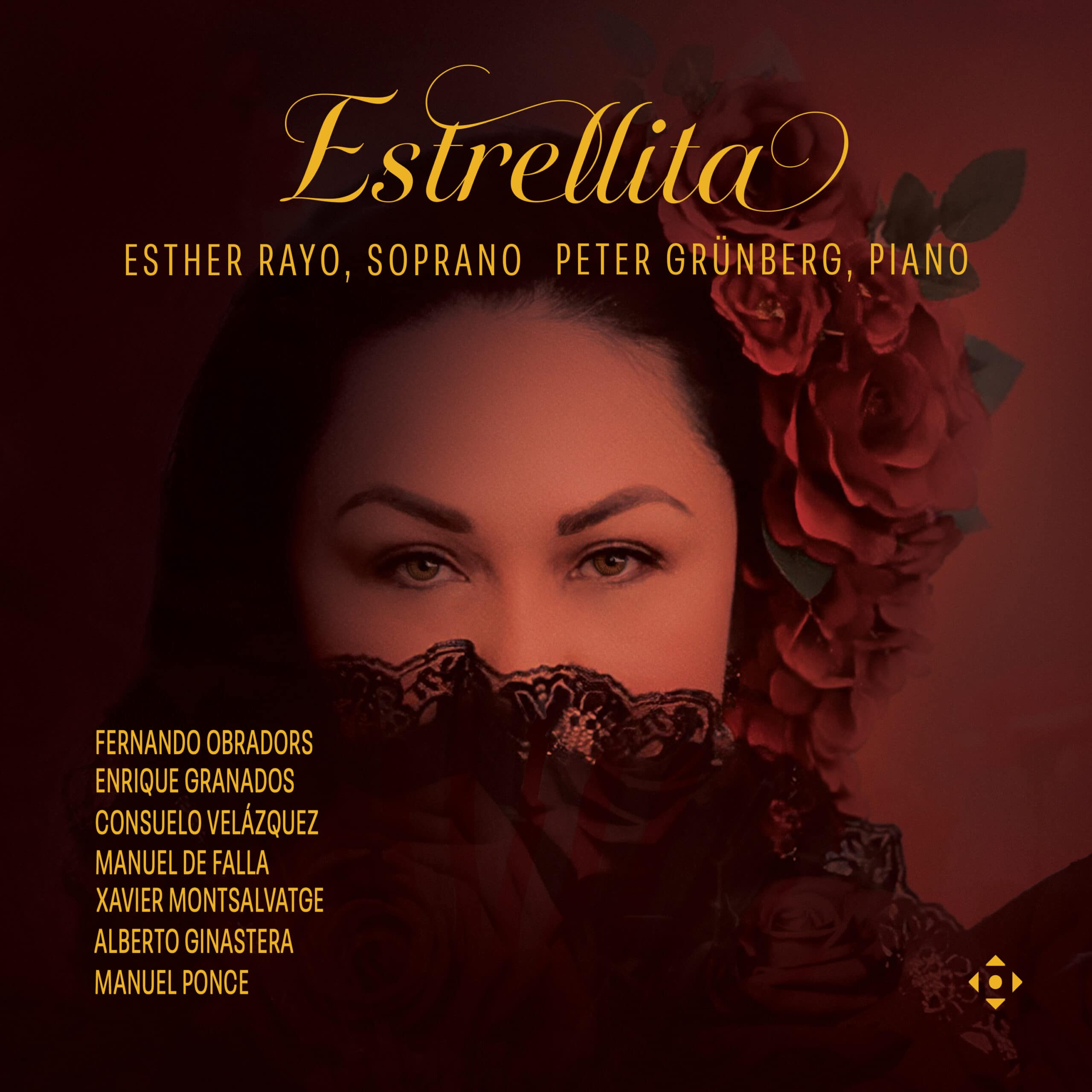
    Divine Art is delighted to announce a superb collection of sensuous classical Spanish language songs for voice and piano, from the sublime musical partnership of lyric soprano Esther Rayo and renowned pianist and conductor Peter Grünberg. This program of works was first heard in a series of concerts given by the San Francisco based teaching and performance organization LIEDER ALIVE!

    The songs are by early 20th century composers: Fernando Obradors, Manuel de Falla, Enrique Granados, Alberto Ginastera, Xavier Montsalvatge, Consuelo Velázquez and Manuel Ponce. Drawing from Spanish classical poetry and regional folk melodies, these vibrant song cycles offer appeal to art song aficionados and first-time listeners alike.

    Born in California, and surrounded by Spanish music and language, this music is close to Esther Rayo’s heart. Her connection with these songs started when she was introduced to the music of Manuel Obradors while in college. Obradors offered the perfect starting point for her continued study and discovery of Spanish art song, and she was guided by the great 20th century sopranos Montserrat Caballé and Victoria de los Angeles, who kept this music alive.

    While she was at graduate school in 2017, Esther was introduced to Peter by Maxine Bernstein, Founder and Director of LIEDER ALIVE! and they made an immediate musical connection around the works of Spanish language composers. LIEDER ALIVE! helped provide opportunities for Peter and Esther to perform this music together, alongside its standard mission of promoting German Lieder. Over the years they continued to study and learn more classical Spanish repertoire, resulting in this, their debut album together. And, even after all these years, they still feel they’ve only just scraped the surface of this wonderful repertoire!

    https://youtu.be/JpWnLkto2wM&w=720