Catalogue Connection: 21146

  • Frisson Fanfare Review

    Frisson Fanfare Review

    Frisson is the creation of conductor and arranger Shea Lolin. In his introductory comments to the new Divine Art CD release, Lolin discusses the history of Harmoniemusik, ensemble works popular in the late 18th and early 19th centuries that feature horns, bassoons, and various treble-clef instruments. The Franz Krommer Octet-Partita, op. 57 (1807) (two oboes, two clarinets, two bassoons, contrabassoon, two horns) and the Strauss Serenade (1881) (two flutes, two oboes, two clarinets, two bassoons, contrabassoon, four horns) are works in the Harmoniemusik tradition. Lolin continues: “My aim is to showcase the woodwind orchestra as a contemporary evolution of Harmoniemusik, challenging the misconception that it is merely a scaled-down version of a full wind orchestra.” The Krommer and Strauss (and indeed all the works on Frisson) are heard with a full complement of wind orchestra instruments (including saxophones), ranging from piccolo to contrabassoon. To be sure, the Krommer Octet-Partita and Strauss Serenade as arranged by Lolin emerge with greater richness and variety of sound, not to mention increased dynamic range. One may certainly argue that what we hear on Frisson is not what Krommer and Strauss intended. But as someone who has no objection, and indeed enjoys, Stokowski’s Bach orchestrations, and Mahler’s retouchings of Beethoven and Schumann Symphonies (to name a few examples), I’m in no position to complain. That is especially the case given Lolin’s keen ear for woodwind sonorities. Lolin’s tasteful arrangements, as realized by the Czech Philharmonic Wind Ensemble’s (CPWE) crisp execution and flawless blending of the various instruments, produce an immensely pleasurable experience. 

    The remainder of Lolin’s arrangements are of orchestral works. Cécile Chaminade’s Concertino (1902) for flute and orchestra receives a masterful performance by soloist Fiona Sweeney. The flutist’s beautiful tone and virtuoso realization of Chaminade’s challenging score are a delight. Constant Lambert’s Romeo and Juliet (1926) was one of only two works by British composers to be performed by Sergei Diaghilev’s Ballets Russes (Lord Berners authored the other ballet). On this recording, Lolin and the Czech Philharmonic Wind Ensemble perform a sequence of excerpts recommended by the composer: “Sinfonia: Romeo and Juliet meet at the ball”; “Siciliana: The professor teaches a pas de deux”; “Sonatina: The lovers are separated”; “Adagietto: The death of Juliet”; “Finale: The curtain falls.” Lambert’s sprightly Neoclassical orchestral score prominently features the winds. It fares well in Lolin’s arrangement that displays a light touch throughout. In 1995, Guy Woolfenden composed a work inspired by Henry Purcell’s incidental music for the play The Gordion Knot Unty’d. Gordian Knots (1995) began as a piece for clarinet choir. In 2010, Woolfenden created the woodwind orchestra arrangement, retitled More Gordion Knots. The three brief movements—Air, Chaconne, and Jig—feature, like Lambert’s Romeo and Juliet, a Neoclassical take on music with a foundation in English melody and dance. Woolfenden’s colorful scoring complements the music to perfection. 

    The winds of the Czech Philharmonic have long been one of the cornerstones of the ensemble’s greatness and distinctive sonic profile. The CPWE plays with distinction throughout the recording, which boasts superb, detailed sound. Colin Clarke gave this recording a warm recommendation in the Mar/Apr 2026 Fanfare (49:4). I second his opinion with enthusiasm.

  • Frisson American Record Guide

    Frisson American Record Guide

    Woodwind Orchestra is an ensemble of woodwind instruments only, meaning with saxophones but without horns. Such ensembles began in central Europe around 1750 with instruments that were usually paired, playing in groups of 5 to 8, though they reached sizes much larger on occasion. Among the earlier examples is the Serenade for 31 wind instruments from 1779 by Spanish-Austrian regional court official and violinist-composer Juan Carlos de Ordonez, an early member of the Viennese Society of Musicians from June 1771, shortly after it had begun in April. These groups played outdoors as well as inside. Handel’s Music for the Royal Fireworks in 1749 was of this ilk though using trumpets, horns, and percussion. Much more information is available at the Woodwind Orchestra Online Portal, woodwindorchestra.com. There may be such an ensemble near you. For example, American saxophonist and conductor Logan Barrett has founded the Middle Tennessee Woodwind Orchestra for the Nashville area. English conductor, composer, clarinetist, and arranger Shea Lolin led the Bloomsbury Woodwind Ensemble of London, founded in 1993, from 2005 to 2021 while commissioning and preparing performances of 15 new works.

    There are three albums now that present some of them. It was in 2014 that Legni gave us Twisted Skyscape (M/A 24, p. 150) with pieces by Gary Carpenter (b. 1951), Philip Sparke (b. 1951), Adam Gorb (b. 1958), and Christopher Hussey (b. 1974). This release was followed by Chromosphere with a similar program from Divine Art (J/A 24: new). All arrangements, the selections here are the Partita in F, Op. 57 (1806) by Franz Krommer, Serenade in E-flat, Op. 7 (1881) by Richard Strauss, Concertino in D, Op. 107 (1902) by Cécile Chaminade, written for flute and piano originally, a suite from the ballet Romeo and Juliet (1925–26) by Constant Lambert, and More Gordian Knots (1995/2010) by Guy Woolfenden, written for clarinet choir in its first form and adapted by the composer.

    My expectation for what to hear was high because of Bohemia’s long history of providing wind players across the continent—but especially to Vienna nearby—and in particular the euphonious Serenade in D minor by Dvořák. These Czechs sound gorgeous. There is excellent balance from treble to bass, clarity, and contrast to both the playing and recording. Superb intonation indicates the pinnacle of woodwind playing.

    Seeing Timothy Reynish among the backers of this recording would not rescue it if it were a dud. Many more had faith in Lolin’s project too. Consider me converted to the cause.

  • Midlands Classical Music Making Frisson Review

    The wind players of Bohemia have always had a deservedly fine reputation, think of Mozart’s delight at finding such brilliant clarinet players in Prague, and this splendidly played disc shows that the tradition is thriving.The versatile Czech Philharmonic Wind Ensemble have recorded music from Beethoven, Mozart and Dvorak to an album devoted to contemporary British music on 2024’s ‘Twisted Skyscape’. This new release is an eclectic one, of arrangements of pieces for woodwind orchestra by the Ensemble’s conductor Shea Lolin. It opens with the Octet Partita in F major, Op.57 by the prolific Moravian-born Franz Krommer, a huge favourite in Beethoven’s Vienna. Lolin fills out the musical textures but so subtly it sounds authentic Krommer and does the same for the youthful Richard Strauss’s Serenade (op.7) His arrangement of Cecile Chaminade’s Concertino, Op.107 of 1902 , originally for flute and piano and arranged by the composer for flute and full orchestra, sounds splendid in its new guise and gets a star solo role for Scottish flautist Fiona Sweeney. Despite Lolin’s ingenuity those familiar with the orchestral original of Constant Lambert’s ballet suite ‘Romeo and Juliet’ may miss the brassy swagger of the Sinfonia and the sighing strings of ‘The Death of Juliet’ but there is much to enjoy in Lolin’s wind textures and the band’s virtuosity. The final piece is British composer Guy Woolfenden’s ‘More Gordian Knots’, based on Purcell’s music for ‘The Gordian Knot Unty” which was composed for a theatrical work by the Royal Shakespeare Company. Lovers of wind music will relish this album.

  • BBC Music Magazine Frisson Review

    Although the album artwork highlights Scottish flautist Fiona Sweeney, Frisson is less a flute showcase and more a celebration of the brilliance of the wind ensemble as a form.

    Sweeney’s principal moment comes in Chaminade’s Concertino, a single-movement staple of the flute repertoire known for its passionate cadenza and technical demands. She shines, presenting long melodic phrases with a charming tone and rarely breaking lines for breath. The ensemble remains tightly synchronized, delivering crystal-clear entries and unified articulation.

    That synchronicity defines the Czech Philharmonic Wind Ensemble throughout the collection. With a title like Frisson, one expects lightness and excitement — and that is delivered in abundance. The rich recorded sound lends immediacy, with lower winds providing a supportive bass while preserving the delicacy of higher instruments, particularly in Franz Krommer’s Octet.

    The programme offers surprises. Constant Lambert’s ballet Romeo and Juliet, originally taken up by Diaghilev’s Ballets Russes in 1926, is less well-known than its origins suggest. The players relish its vibrant syncopation and melodic interplay. In Guy Woolfenden’s Purcell-inspired More Gordian Knots, a darker tone emerges, with a Chaconne building toward densely woven textures.

  • MusicWeb International Frisson Review

    This is a thoroughly enjoyable disc. The brainchild – indeed passion – of conductor/arranger Shea Lolin, it is presented as a modern expansion of the 18th Century Harmoniemusik ensemble. In a preface to the liner, Lolin briefly explains the historical development of this small woodwind group from a sextet of players in the court of Emperor Joseph II, expanding to eight, then ten players, adding flutes, contrabassoon and combining clarinets with oboes. As Lolin writes, the result was a richer fuller timbre and the repertoire for such ensembles ballooned by the 1830s to include over 10,000 works.  To quote Lolin with regard to this new disc; “My aim is to showcase the woodwind orchestra as a contemporary evolution of Harmoniemusik, challenging the misconception that it is merely a scaled-down version of a full wind orchestra”.

    To achieve this, the works performed here are all new arrangements by Lolin of scores that existed for different ensembles – the exception is Guy Woolfenden’s More Gordian Knots. The liner lists 3 flutes (3rd doubling piccolo), 2 oboes, 6 clarinets (although one is marked as “Woolfenden only”), bass clarinet, contrabass clarinet, 2 alto saxophones, tenor saxophone, baritone saxophone, 2 bassoons, contrabassoon and harp (Chaminade only). Most notable here is the absence of any horns which were an early addition to the original Harmoniemusik ensemble. It is not clear whether this complete line-up play in every work but the collective sound is every bit as sonorous and rich as you would hope. Add to that more than a hint of the unmistakable ‘woodiness’ that Czech/Slovak and Central European orchestras and their wind sections used to have as their trademark sound and the result is a delight.

    Franz Krommer’s Octet-Partita opens the disc. Although his dates are close to Beethoven’s Krommer’s musical style harks back to Mozart. From the opening bars the rich and full sound of the Czech Philharmonic Wind Ensemble impresses – I really like the discreet presence of the saxophones (in lieu of the horns, perhaps?) warming the middle textures while the bass instruments give a powerful foundation to the timbral mix. Solos are played with real elegance and sensitivity. The recording was made in the famous Dvořák Hall of the Rudolfinum in Prague. Engineers can sometimes struggle in this acoustic with full or large orchestras but here Producer Mikel Toms and Engineer Vitek Kral have produced genuinely excellent results with plenty of detail but a pleasingly warm and supportive overall acoustic. The closing Alla polacca embodies the good-natured spirit of the work and the collaborative skill of the playing. I do not know the original work at all but to my inexpert (not a woodwind player!) ear this transcription sounds effective, idiomatic and thoroughly enjoyable to play.

    Richard Strauss’ early Serenade Op.7 is a much more familiar work. It was scored for pairs of flutes, oboes, clarinet and bassoons with four horns and a contra-bassoon completing the line-up. In its own right this new performance/version is very beautiful with wonderfully unaffected phrasing and immaculate ensemble playing. Again, the saxophones deputise for the horns – I would be lying to say I do not miss them but the ear soon adjusts and enjoys the music-making rather than fretting over the scoring. The inclusion of Cécile Chaminade’s Flute Concertino Op.107 is perhaps rather unexpected but delightful. In the liner Lolin does not explain why he chose to arrange this piece but that said it receives another very appealing performance from the Czech players accompanying British flautist Fiona Sweeney. Again, the engineering is very successful at allowing the solo part prominence within the all-wind sound picture with sounding inflated. The smaller scale of the whole ensemble brings the sound stage closer to the listener than is often the case in the full orchestral version with Sweeney proving to be an ideal combination of lyrical and virtuosic as required.

    Constant Lambert was one of those rare musicians of ferocious talent across a wide range of musical disciplines. As the liner notes, his enduring legacy has proved to be his major role in the creation of a world class British national ballet company – the Vic-Wells ballet becoming Sadler’s Wells Ballet which ultimately spawned the Royal Ballet Company. Lolin’s choice of five movements from his ballet Romeo and Juliet is again as inspired as it is unexpected. It is still astonishing to consider that this ballet was commissioned by Diaghilev for his world-famous Ballets Russes when Lambert was barely twenty years old! Along with a Lord Berners score these were the only two works written for Diaghilev by British composers. The story of the initial meeting bears brief repetition.  Lambert went along with William Walton to meet the impresario as moral/practical support as Walton was in line for a Ballet Russes commission. Walton’s piano playing of his proposed work was so clumsy and his natural reticence left Diaghilev distinctly underwhelmed in direct comparison to the articulate and literally brilliant Lambert – who got the commission instead. Lolin has followed Lambert’s own suggestion extracting a five-movement suite from the complete (albeit brief) ballet. The style of the original score translates very well to wind orchestra both in the manner of the original neo-baroque titles; Sinfonia, Siciliana, Sonatina, Adagietto and Finale but also the musical idiom itself. Lambert blends textural clarity with jazz-like syncopations and piquant harmony all of which sound particularly effective in this ensemble. The fourth movement Death of Juliet is a striking contrast with plaintive quite austere solo lines again beautifully poised and phrased. It is in music like this that the sheer talent of Lambert – even at such a young age – is fully apparent. As a composer if his enduring fame still rests on the novelty of The Rio Grande, which to my ear has dated quite badly, the music performed here shows how effective and fluent a composer he could be. I imagine this was completely unknown to the Czech musicians before the sessions but they clearly relish the buoyant textures and bustling energy of the arrangement here. I would go as far to say that I think this is quite possibly more effective in this version that the full orchestral original.

    Guy Woolfenden’s More Gordian Knots that completes the programme was inspired by a study of Henry Purcell’s theatre music specifically his score for The Gordian Knot Unty’d (1691). Woolfenden wrote this score in 2010 and as mentioned before, this is the only work presented here not arranged by Shea Lolin. The three movements are Air, Chaconne and Jig and are a modern reworking of the Purcell original by Woolfenden – as an aside the same Purcell work was arranged by Holst. The tempo of Woolfenden’s Air is distinctly stately compared to what might be considered a more ‘historically aware’ approach but this does allow some of the new scrunchier harmonies and textures to register effectively. The closing Jig is witty and light-hearted conclusion to the disc, although I do wonder if the Lambert selection might have made for a more telling culmination of this genuinely effective programme.

    This is a very well presented, well played, beautifully engineered and skilfully arranged programme. Quite why “Frisson” was chosen as the umbrella title escapes me, but that is my only very minor quibble. It is a recital well worth investigating by the simply curious or woodwind aficionados alike.

  • Frisson Gramophone Review

    The Czech Philharmonic Wind Ensemble should need no introduction; just as well, as there is no note about them in the booklet! However, as many have noted, theirs is a virtuosity of the highest order, audible on their many recordings, ranging from Mozart serenades, Beethoven wind music and Dvořák to a wide range of more modern fare. I reviewed their previous release for Divine Art last year, the scintillating contemporary collection ‘Chromosphere’ directed by Shea Lolin (2/24).

    This new album is a marvellous collection of music old (Krommer) and new (Woolfenden though inspired by Purcell), familiar (Strauss) and less so (Lambert), all in arrangements for full wind ensemble, mostly made by Lolin in 2025. His aim was to ‘amplify the sonic magnitude of the original works, breathing new life into classical pieces while maintaining their essence’ and it must be said that he has succeeded very well overall. Yes, one does miss the trumpets’ bright clarity in the Sinfonia from Lambert’s ballet suite Romeo and Juliet (1924-25) or the emotional depth of texture the strings bring to “The Death of Juliet’, but there are gains from the euphonious nature of the wind ensemble in Lambert’s spiky score.

    The arranger’s touch was necessarily lighter in Krommer’s Octet-Partita (1806), the first of some 13 for, essentially, two wind quintets without flutes. The omissions are rectified very subtly, with a few additions to fill out the textures, an approach replicated neatly in Strauss’s marvellous early Serenade (1881). Both pieces work well in these expanded versions, though some will undoubtedly prefer the originals. Guy Woolfenden made his own wind-ensemble arrangement of Gordian Knots for clarinet choir (1995; the concluding Jig is a Purcellian chaconne rooted on Lilliburlero), tweaking the title and amplifying his music’s ‘sonic magnitude’ in the process. At the heart of the programme is Cécile Chaminade’s mellifluous Flute Concertino (1902), fitting Lolin’s wind-band setting like a glove. Fiona Sweeney is the persuasive soloist, holding her own in a part recorded by eminent competition, Emanuel Pahud (Warner, 10/21) and James Galway (RCA, 10/77, 1/78) not least. A frisson, indeed! 

  • Frisson Fanfare Review

    This is a lovely idea: music for winds that should be better known, performed by wind orchestra. This is obviously a labor of love from Shea Lolin, whose previous releases include Twisted Skyscape (Fanfare 47:4) and Chromosphere (not reviewed).

    If ever there was a composer whose music fits the concept of Harmoniemusik like a glove, it was Fanz Krommer (1759–1836). His works are as much a joy to play as they are to listen to, and heard in Shea Lolin’s arrangement, contrasts are heightened without altering the underlying ethos of the music. Listen to the beginning of the development section of the first movement of Krommer’s op. 57 Octet-Partita. More than eight players here, but the spirit remains. It is interesting to compare this recording with the original scoring via the Netherlands Wind Ensemble’s Philips recording, which is a classic, sprightly and free. Inevitably, one hears the shifts to the minor more in the Czech performance, and gestures become more marked (even gothic!). Heft does not mean lack of velocity: the Menuetto under Lolin dances along beautifully (it is marked Presto, after all). The Andante cantabile makes quite a mark via the Czech players: that characteristic richness and deep bass of the Czech Philharmonic itself pays great dividends here. And what fine oboe playing from Jana Brožková. There is the most remarkable moment when Krommer just concentrates on a sonority, too: he is not just background fluff to outdoorsy events, but a really talented composer. The leaner sound of the Netherlands ensemble remains powerful, though. I confess to having bad memories of the final movement: there is a high horn solo that requires an eighth-note top C, almost like a “pop,” on an off-beat, and fair to say it never went well. I seem to remember I once tried to sing the high C (sounding F) through the instrument instead of playing it; that went even less well. Lolin circumvents the problem by putting the relevant phrase on saxophone, on which there is considerably less sense of contained panic. Busy arpeggiations in this “Alla polacca” go swimmingly via the Czech players. All great fun.

    And it is simply lovely programming to have Richard Strauss’s op. 7 Serenade of 1881 here in a few new colors. The piece is a tremendous outpouring from the heart that should be played much more often. The recording has more interesting moments of sax color, but it maintains the warmth of this early work. Again, the Netherlands ensemble released a classic recording of the original (Fanfare 14:4) and it is worth comparing the scorings. Saxophones might not sound particularly Straussian, but Lolin’s take is nothing if not interesting, and the playing is unfailingly beautiful. Again, the warm Czech sound is perfect. Admittedly the climax around six or seven minutes in does sound rather bloated, and the passage after nine minutes is rather heavy. But do give this a try.

    You might well be concerned about the Gallic delicacy of Cécile Chaminade’s Concertino for flute and orchestra with wind band. Worry not. This is a brilliant reimagining, in which massed winds exude a sense of Frenchified elation when called for. Flutist Fiona Sweeney excels, although one might find the close placement in the sound image a step too far (it is a bit intrusive). Sweeney appeals more than Susan Milan (Fanfare 14:2) and even Sharon Bezaly (but Bezaly is better recorded: Fanfare 37:3); Sweeney’s cadenza is little mystery tour all of its own, and the elision back to background woodwind glow is one of the highlights of the album.

    Constant Lambert’s Romeo and Juliet was one of only two English ballets performed by Diaghilev’s company. There is quite the story behind it: apparently because of a disagreement between Lambert and Diaghilev, the latter put the parts under police guard lest Lambert tamper with them. If you want to hear all the ballet, Norman del Mar with the English Chamber Orchestra on Lyrita is the place to go, recorded in July 1977 at Kingsway Hall, London, all charm (and complete). Arthur Lintgen loved it as well, in Fanfare 31:5, while in more modern times there is always John Lanchbery with the State Orchestra of Victoria on Chandos (similar high praise from Paul A. Snook in Fanfare 24:5). I have a soft spot for Lyrita recordings, though, so that is the one I return to. Here we have selections: “Romeo and Juliet Meet at the Ball” retains the bright breeziness of the music (I defy you not to smile) while hammering home the deliberately destabilizing dissonances. The Neoclassical aspect seems emphasized here, perhaps because winds and Neoclassicism have their precedent in Stravinsky. The siciliana that follows, “The Professor Teaches a Pas de deux,” has a cheeky little limp to it, while some of the sonorities seem to link to Pulcinella. Some sterling bassoon work here, too. There is a kind of controlled chaos to the opening of “The Lovers Are Separated,” while imitation is used to suggest the chase. There is a “Death of Juliet,” featuring dissonances of a sort of exquisite pain, again quite Stravinskian. Finally, the eminently chirpy “The Curtain Falls” is as chipper as they come, and performed with the peckiest staccato here. The arrangement is deft, and true to the composer’s vernacular. It should be noted that the movements featured here are the ones the composer himself suggested may be extracted.

    To my surprise, Guy Wolfenden (1937–2016) makes his debut as a composer in the Archive here, with the late (2010) piece More Gordian Knots. Wolfenden was no stranger to writing for concert band, and indeed this is the one piece on the disc not in arrangement by Lolin. There are three movements, “Air,” “Chaconne,” and “Jig.” These are Gordian knots as, in 1995, Wolfenden had been inspired by Purcell’s theater music while searching the English master’s songs for Thomas Southerne’s play The Wives’ Excuse. And so Gordian Knots for clarinet choir was born. It is no surprise that there is this trajectory, given Wolfenden’s time as Head of Music at the Royal Shakespeare Company for full 37 years. Inspiration came from Purcell’s music for The Gordian Knot Unty’d of 1691, with the finale, “Jig,” using the tune Lillibulero as a ground bass (a technique beloved of Purcell, of course). More Gordian Knots is not a “second suite”: it is an arrangement by the composer of the original for wind orchestra. The present conductor gave the premiere of the arrangement, in 2010, with the Bloomsbury Woodwind Ensemble. Wolfenden’s writing and scoring are impeccable, as is this Czech performance. There is real lyricism to the “Air,” too, and one cannot but help notice a kinship between Wolfenden and Lambert. The “Chaconne” sounds far more objective, and far more veiled (some lovely clarinet solos here), and with the ground bass come hints of harmonies from Purcell’s time. A contrabassoon, clearly, underscores the final cadence before that concluding “Jig” brings sunshine.

    A beautifully programmed, supremely well executed disc, finely recorded in Prague by producer Mikel Toms and engineer Vítek Kral. Recommended.
  • Frisson Apple Classical Review

    A fine range of works demonstrates the charm and versatility of this ensemble.

  • Pizzicato Frisson Review

    On this album, the Czech Philharmonic Wind Orchestra members demonstrate their exceptional talent. First up is Franz Krommer’s heartwarming and fresh Partita. The musicians’ wonderfully fluid performance, full of pulsating life, will fill listeners with enthusiasm for this beautiful partita, which is far too rarely played. In this arrangement by Shea Lolin, the musicians render it enchantingly as musical fun.

    Strauss’s Serenade is charming, as are virtually all of Shea Lolin’s arrangements.

    The beautiful and lyrical Flute Concertino by Cécile Chaminade gives Scottish flutist Fiona Sweeney the opportunity to shine in this wonderfully flowery work.

    Constant Lambert (1905-1951) composed his ballet Roméo et Juliette for Serge Diaghilev’s Ballets Russes. The evocative piece premiered in 1924.

    Finally, we hear More Gordian Knots by British composer Guy Woolfenden (1937-2016), a piece that is bold in the outer movements and lyrical in the middle movement, inspired by Henry Purcell.

    Impressed by the wit, exuberance, and pathos of Purcell’s theater music, he first composed a work for clarinet ensemble. The woodwind orchestra version, with the new title More Gordian Knots, was arranged by the composer and premiered in November 2010 under the baton of Shea Lolin. The Czech Woodwind Orchestra tackles the score with skill and enthusiasm. The homogeneity of the very transparent-sounding orchestra is impressive.

  • London Light Music

    A tuneful start to the new year comes from the 19 woodwind players of Gramophone magazine’s Orchestra of the Year in 2024.

    The opening and longest work is Octet -Partita in F Major, Op.57 by the Czech composer and violinist Franz Krommer (1759-1831), who was a contemporary of Beethoven and for a time in the 19th century his works for wind were more popular than those of the great man. It is followed by Richard Strauss’ (1864-1949) Serenade Op.7, written at the age of seventeen, eleven years after his first composition!

    Nearly quite forgotten nowadays, Cécile Chaminade (1857-1944) composed more than 400 pieces and had a definite gift for melody. She is represented here by her best remembered Concertino, Op.107 beautifully played by Fiona Sweeney, a highly accomplished Glasgow-born flautist.

    Someone possibly better known to readers is Constant Lambert (1905-1951) who wrote the symphonic jazz choral work The Rio Grande and was instrumental in the birth of British ballet. We have here the 14’46” of five tracks: the first tableaux for the ballet of Romeo and Juliet (originally called Adam and Eve), which only lasted for around half-an-hour but came to the attention – the first English composer to do so – of the legendary impresario Sergei Diaghilev.

    The final work is More Gordian Knots by Guy Woolfenden OBE (1937-2016), a distinguished British composer and conductor who was Head of Music to the Royal Shakespeare Company for 37 years. Originally written for clarinet choir, with the inspiration coming from the composer Henry Purcell, it is the retitled woodwind orchestra version heard here.

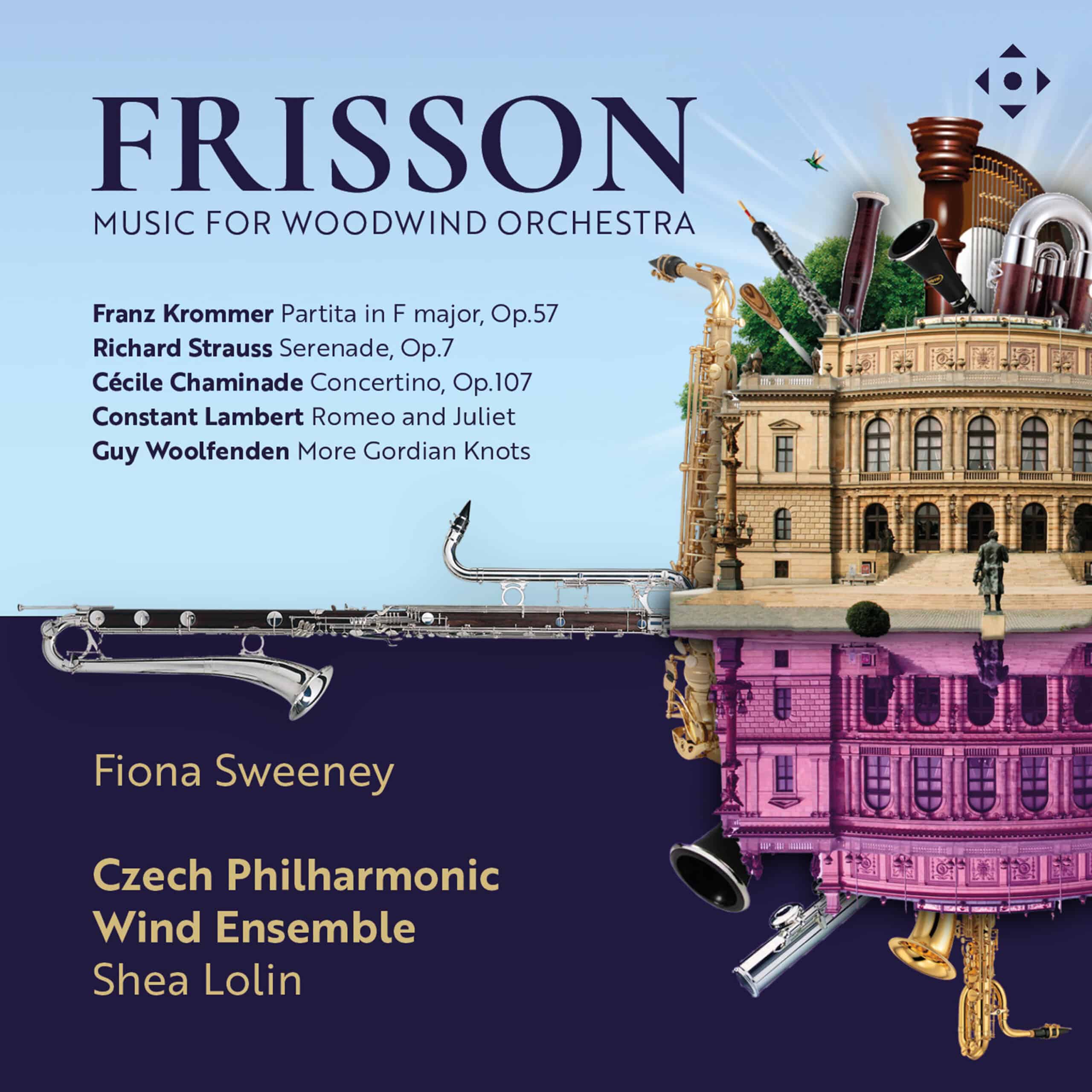
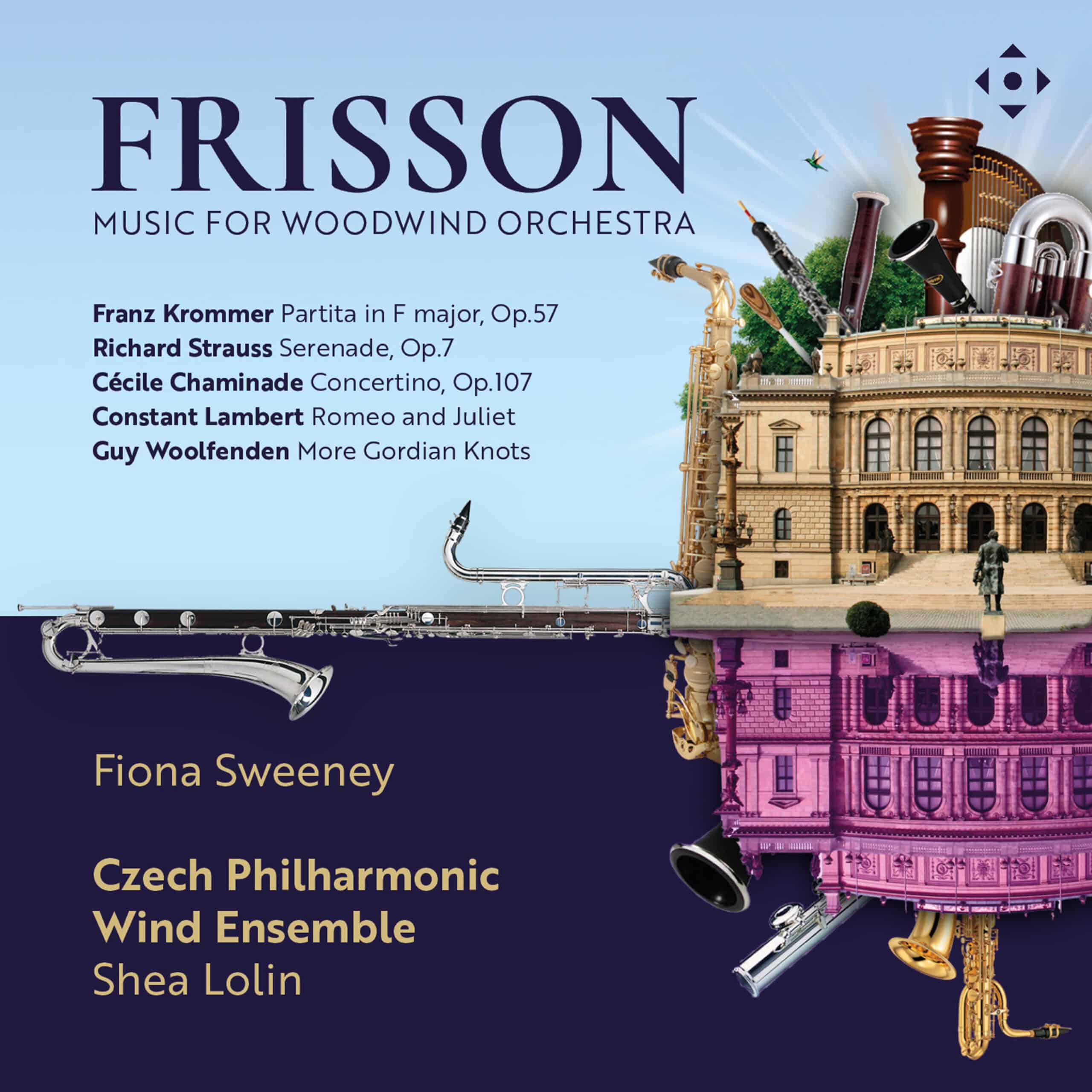
    This is the only work not arranged by the Ensemble’s British conductor, Shea Lolin, who is widely regarded as a woodwind orchestra visionary. He is also responsible for the album cover artwork, design and booklet notes with several colour photos – the best package I have seen for some time. Interestingly for me, Lolin is a graduate of the Colchester Institute in the town (now city) where I was born.

    A rewarding recording, especially the Krommer, and well done to the label for setting such a high standard both of performance and presentation.

  • Frisson

    Frisson

    On 9 January 2026, conductor Shea Lolin presents Frisson, an exciting new album of music for woodwind orchestra and his third recording with the principal woodwind players of the Czech Philharmonic (Gramophone’s Orchestra of the Year 2024). Frisson follows the release of the ground-breaking Twisted Skyscape, the first album devoted entirely to new music for woodwind orchestra, and Chromosphere, which focused on contemporary repertoire.

    Frisson marks Shea Lolin’s 20-year involvement with the woodwind orchestra and celebrates its evolution from the early eighteenth-century genre of Harmoniemusik – formal ensemble music for pairs of winds – to its modern form.

    The album features a superb programme of arrangements for woodwind orchestra by Shea Lolin, all originally commissioned by the Bloomsbury Woodwind Ensemble. He expands Franz Krommer’s exquisite Octet – Partita in F major, Op. 57 and Richard Strauss’s youthful Serenade, Op. 7, creating a broader sonic landscape while maintaining their essence. Also included is Cécile Chaminade’s beloved Concertino, Op. 107, arranged for woodwind orchestra and featuring young Glaswegian flautist Fiona Sweeney, who makes her debut with the Czech Philharmonic on this release. Completing the album is More Gordian Knots by Guy Woolfenden OBE, a spirited reimagining of Purcell’s music for The Gordian Knot Unty’d, written during Woolfenden’s remarkable 40-year association with the Royal Shakespeare Company.

    “Through the collection of works on this album, I hope to demonstrate the rich potential and unique character of the modern woodwind orchestra, highlighting its distinct identity in the world of ensemble music…The album’s title Frisson refers to my feelings towards this recording and the milestone it represents. It also reflects the amazing playing from the Czech Philharmonic Wind Ensemble.” – Shea Lolin

    “Splendidly mellifluous performances by the Czech Philharmonic Wind Ensemble conducted by Shea Lolin… Lolin and the players… show off their virtuosity, flawless intonation, and ensemble. Recommended.” – Guy Rickards, Gramophone review of Chromosphere.

    Shea Lolin has been involved in nearly every aspect of the classical music industry, including performance, conducting, and management. Over the past two decades, his notable achievements include contributing to the regeneration of east London ahead of the 2012 Olympics and collaborating with prominent Czech orchestras, including the Czech Philharmonic. His work in Czechia was acknowledged by the Czech Centre in London in 2024, the same year the Czech Philharmonic was awarded Orchestra of the Year by Gramophone. In 2025, he was elected the Chair of BASBWE (British Association of Symphonic Bands and Wind Ensembles). shealolin.co.uk