Catalogue Connection: 21219

  • Handel Harpsichord Suites 1: IRR review

    (Joint review of vols 1 and 2)

    The young Gilbert Rowland – having studied, confusingly perhaps, under Kenneth Gilbert (as well as Millicent Silver and Fernando Valenti) – emerged from an era (the 1960’s) permeated, in harpsichord terms, by heavy instruments tuned to modern pitch and with an indiscriminate fondness for 16-foot couplings that unnervingly sounded like someone singing an octave below the melody.  As owners of Rowland’s previous Scarlatti and Soler albums will expect, all that is now swept aside: these modern recordings of HandelHarpsichord Suites are cleanly and most listenably played on a smaller instrument tuned to Baroque pitch, identified in Volume 2’s booklet note (though not volume 1’s) as a 2005 copy by Andrew Wooderson of a two-manual keyboard after Goermans (Paris, 1750).  The music is conveyed with impeccable fingerwork and an admirable sense of style honed over 40 years.

    Even these four well-filled discs – their components imaginatively shuffled so as not to present all the best suites first – are not the whole picture.  Still to come is the first of the Eight Great Suites of 1724 (HWV426 in A major) plus the final two bin-ends (in D minor and G minor) of publisher Walsh’s unauthorized cobbling together of a follow-up volume (1733).  The discs do contain four further Miscellaneous Suites towards Handel’s total of 25 or so.  Rowland’s Volume 2 ends on the G major Chaconne with (just) 21 variations, also known as lesson No.3, HWV435: the same-key  Chaconne with no fewer than 62 is surely to come in a future volume, along with the Six Great Fugues, plus the famous Fantasia in C and other items from ‘The Ladys Banquet’ (another Walsh compilation).  This series could and should – run and run.  Meanwhile, snap up these albums without delay and bask in some unfailingly delicious playing.Michael Round

  • Handel Harpsichord Suites vol. 1 – Consort review

    The two-CD set is the first volume of what will presumably be a series of recordings of the 25 or so keyboard suites for harpsichord by Handel, who published only two collections of such pieces. Firstly in 1720 he published the set of eight so-called Great Suites that are heard and recorded frequently, and a further collection entitled Suite de pieces pour le clavecin was published by Walsh 1733. The nine ‘suites’ contained in this print are a most random selection of works including a Chaconne, and a Prelude and Chaconne. Other suites in the set lack some of the movements associated with the genre: no. 1, for example, consists of a prelude, sonata, aria with variations and a minuet in the relative minor. Further suites were left in manuscript form, probably written for pupils; some of these works are quite substantial, but are heard only rarely.

    Recorded at Holy Trinity Church, Weston, Hertfordshire, each of the two CDs reviewed here contains four suites. The first CD opens with the Suite in D minor, the third of the 1720 set. Our attention is grasped right from the start with the demanding virtuoso prelude that utilises the full compass of the keyboard, making much use of arpeggiated figures. The following Allegro fugue is well-ornamented, as are the stylised Allemande and Courante. The extremely ornate embellishments printed in the Aria contrast well with the increasingly virtuosic variations, the concluding Presto being played with much panache, but not so fast that the contrast between the full chords and the two-voice texture is blurred and lost.

    This is followed by the Manuscript Suite in A, HWV454, with the standard four movements of allemande, courante, sarabande, and gigue, each movement being Italianate in style. It is probably an early work: the ternary-form sarabande in particular owes much to Italian vocal style, while the gigue recalls Italian string compositions, with its imitations of double stopping, here taken at a brisk but not over-fast pace. The short suite in E minor HWV438, containing only an allemande (which is here played with a subtle application of inégalité), sarabande and gigue, is taken from the 1733 collection; the tempo chosen for the sarabande makes it sound closer to a courante. The brilliant gigue in 24/16 contains its own written-out repeats, and is played at a rapid pace.

    The far more substantial Suite in C, HWV443, opens with a präludium which, after some fiery scales and sequential passagework, is followed by a fugue, and the traditional four dances, all played at a leisurely pace which allows Gilbert Rowland to bring out the ‘part’ writing. The suite concludes with an eight-bar chaconne on a standard harmonic progression also used by Pachelbel, with no fewer than 49 variations (although none of them is repeated in this recording). The tempo slows considerably for the highly chromatic variations 36-40 and then picks up again most effectively.

    The second CD opens with the suite in G minor HWV439 from the 1733 print, the allemande and courante here given an appropriately improvisatory feel; the sarabande (also found in a revised form in the 1720 collection) is played with great sensuality and the moto perpetuo gigue is performed at a pace sufficient to give the listener the feeling of a tour de force, without being overwhelming. This is followed by the seven-movement suite in G, HWV441, also taken from the 1733 print, which consists of an allemande, an allegro that is basically a variation of the allemande, courante, aria presto, a ritornello menuetto in 3/8 and a lively gavotte with double, both in rondo form, before the suite concludes with the gigue.

    The imposing suite in E minor HWV429 follows, taken from the set of 1720, with the opening fugue being taken at a much faster tempo than some performances, but it does just succeed. The remaining four traditional dances are played at a more leisurely tempo that brings out their subdued nature and lush harmonies. The CD closes with a solid performance of the suite in E major HWV430, also from the 1720 set, which concludes with the well-known air and variations known as The Harmonious Blacksmith.

    The standard of playing is very high indeed, with some crisp articulation, appropriately added ornamentation in the repeats and a subtly convincing application of inégalité. The generally well-chosen tempi show an understanding of the architecture of each movement. Gilbert Rowland has written some informative notes on each suite and there is a brief biography of his studies and career, but regrettably there is no information about the instrument used. With a considerable variety offered by the pieces included, this is a most enjoyable recording. I look forward to future CDs in the series, so that we can hear more of the lesser-known and rarely recorded suites.
  • Handel Harpsichord Suites vol. 1 – ARG review

    Rowland is an evenhanded and intelligent player. His ornaments are always tasteful, but it is his changes of texture that add interest and variety. Since such changes are not notated, the harpsichordist is charged with improvising them. Most often they involve moving between a dry and wet sound, or combining those two sounds to bring out one voice over the other. Rowland makes some fascinating choices that are not typical. He is not afraid to play dry arpeggios. Often the default sound on harpsichord is sustained with all notes sounding in a chord. He also seems to take delight in the sticky finger-twister fugues; although we know from the sounds he is making that it is not easy, it is not unpleasant either. Lovers of Handel’s music will appreciate Rowland’s commitment to the rich musical world of these suites.

  • Handel Harpsichord Suites vol. 1 – Classical Music Sentinel Review

    In 1924, Ernest Walker published a text book titled A History of Music in England, in which he wrote: “The great bulk of Handel’s instrumental music is mere jog-trot solid conventionalism of the kind that could apparently be reeled off ad infinitum, and virtually destitute of any invention worth the name.” A somewhat misguided exaggeration painted with a wide brush, which most likely came about from direct comparison of George Frideric Handel‘s music with that of his exact contemporary, Johann Sebastian Bach. The problem lies in the fact that you can’t compare the two. They viewed and tackled the art of making music in two dramatically different ways. Bach is the poster boy of stoic German art, centered around the choir loft and the organ console. Music meant to inspire, to further enhance man’s ascension towards God, and to establish new inroads within the creation of music itself. His music is a profound and personal statement of his art. He was always searching for music’s deep dark hidden meaning. Handel on the other hand, the German who settled in England after travelling the world, was an extrovert who viewed music more as a pleasure meant to entertain, and not meant to arouse deep reflection. No complex counterpoint, no harmonic ambiguities, no obscure hidden messages anywhere within his music. Whereas Bach’s harmonic structure and development was always along a horizontal line, Handel’s was mostly vertical, in other words chordal rather than contrapuntal.

    Notice right away the basic keys in which these Suites for Harpsichord were written. No distant keys like F-sharp minor for example anywhere in sight. These were simply written to educate and challenge the interpreter, and to merge together the Italian, French and English styles that were popular at the time. Handel’s music for keyboard was an amalgam of for example, Scarlatti, Lully and Purcell. Straightforward, highly ornamented and driven more by variation than by counterpoint.

    That is the approach and interpretation taken here by Scottish harpsichordist Gilbert Rowland, whose many Naxos recordings of music by Soler and Rameau have been very well received. The playing is lively, spirited and devoid of any mechanical delivery that renders so many harpsichord recordings unenjoyable. The segments in the minor modes are given the right touch of sobriety and darker color. The phrasing is always shaped and well manipulated to reinforce the melody and forward momentum of each piece. Rowland’s fluid and well accented fingering never allows the music to settle into repetitive tedium, but instead seems to give repeated lines a slightly different inflection. After all, these are dance movements that make up these suites, and Rowland seems to give each one a different flex of the knee, a wider step, a deeper bow. You can almost smell the powdered wigs. There is no mention in the booklet notes as to which harpsichord was used for this recording, but it is probably a Ruckers -Taskin late 18th century model, with enough variety in stops to alter its sound to fit the music’s character. All very well reproduced in this fine Divine Art recording.

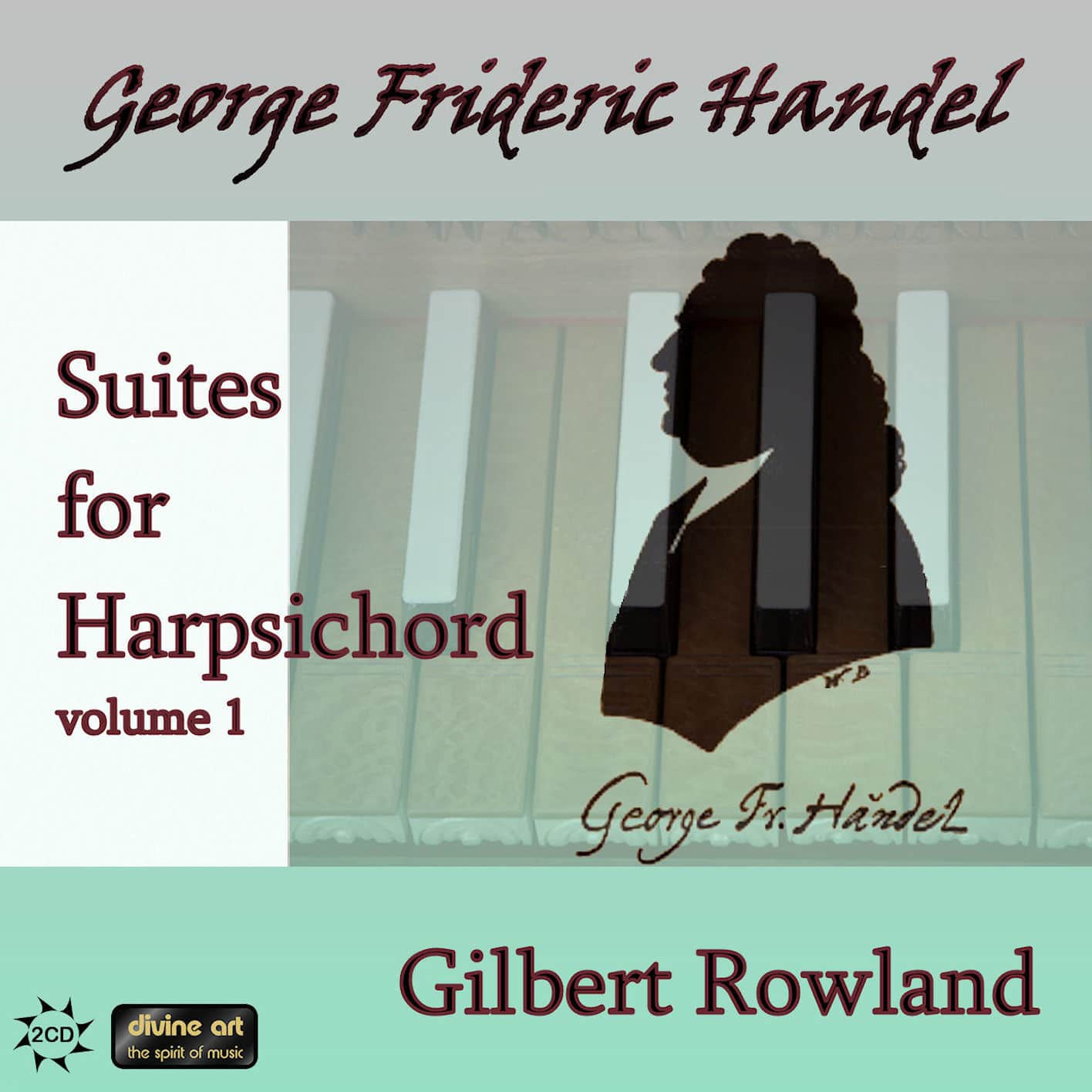
  • Handel: Suites for Harpsichord, Vol. 1

    Handel: Suites for Harpsichord, Vol. 1

    Acknowledged without reservation as the greatest composer working in England in the 18th century, Georg Frideric Handel is revered worldwide as a master composer. His Harpsichord Suites are among the finest instrumental works of the period, and eight of those are presented here by Gilbert Rowland, one of Europe’s foremost harpsichordists.

    These two well-filled discs are a real bargain for such accomplished performances.

    More details for Volume Two and Volume Three.