Catalogue Connection: 21221

  • International Record Review – Marc Rochester – 21221

    I can do no better than quote the opening sentence of the closely knit booklet which comes with this release: ‘This Haydn Society 2CD set features little-known chamber works from the first and last decades of the composer’s life.’ The raw, distinctly rustic nature of the music, coupled with the unrefined vigour of the Jessop Haydn Ensemble recorded in what sounds like a small rural schoolroom (but is, actually, a room in the decidedly urban setting of Sheffield High School), presents a vivid picture of youthful high spirits in the first Notturno , not least its exuberant closing ‘Presto’ with its buoyant hunting-horn calls. If we take that opening sentence at face value, we might realistically expect this to be the work of a teenager possibly reflecting the country life around the Rohrau of his childhood. It is no such thing.

    Neither is it the reflective reminiscence of an old man, content in his retirement from the strains and stresses of courtly existence. It is, in fact, something written amidst the hustle and bustle of Vienna and intended for the King of Naples. He had commissioned Haydn to write eight Notturni – in his booklet note Antony Hodgson suggests there were originally nine – all of which were composed between 1788 and 1790. They were originally scored for two lire organizzata (hurdy-gurdy like instruments with strings and pipes), and revised for performance in London during Haydn’s 1791-92 English tour, with more familiar instruments taking the place of the lire organizatta and, in Nos. 3 and 4, violins in place of the clarinets. These are the arrangements performed here.

    The first of the Nortturni is unique in that it contains four movements, a jolly ‘March’ setting it all off in great high spirits. All the others are in effect three-movement divertimenti offering, even in the more serious movements (such as the occasionally serious-minded ‘Adagio’ of No. 2 or the vaguely sorrowful ‘Adagio’ of No. 3), music of essentially occasional nature. It is all unfailingly charming and full of delightful moments but of not great musical or intellectual depth. As such it might seem ideal ground for an ensemble formed with the express intention of allowing present-day young players to develop their skills in eighteenth-century performance practice. However, the Sheffield University students who form the core of the Jessop Haydn Ensemble would seem to have a lot more developing to do. Considerable tuning and intonation problems, some poorly disciplined ensemble work (they are badly caught out by the long pauses in the opening stanza of No. 3) and a sense of random rather than carefully prepared balance within the ensemble gives this playing a distinctly rough-and-ready feel. Denis McCaldin, no stranger to working with student musicians, allows them all to enjoy themselves with minimal directional prompting and, while it has a strongly homespun feel to it, this approach undeniably underlines the essential joviality of this music.

    Also comprising students – this time from one of London’s premier conservatories – and again unobtrusively conducted by McCaldin, Director of the Haydn Society of Great Britain, the Trinity Haydn Ensemble is a much more polished and assured group and its recording – in Blackheath Concert Halls – is much more warm and spacious. It plays the last two Notturni , works of a more symphonic character than the preceding six, along with the six Scherzandi . These were published in 1765 and are four-movement works of a decidedly symphonic outlook; indeed, Haydn originally described them as such. The musical ideas may be short-lived and rarely subjected to any serious development, but this is unquestionably the work of Haydn; not perhaps, fully mature Haydn but certainly a Haydn well into his manhood years. There are plenty of special moments: an endearing ‘Minuet’ for flute against a delicate pizzicato accompaniment in No. 1, a gloriously vibrant finale to No. 2 which reveals some impressive collective virtuosity from these young players, a magical ‘Adagio’ from No. 4 which seems to tiptoe along with impeccable graciousness, and some tremendously robust unison writing in the finale of No. 6 – all of which is delivered with complete authority by these tautly disciplined players.

    Ultimately, however, you may be wondering where music from the first and last decades of the composer’s life is to found on this disc. So am I.
  • MusicWeb International – Johan van Veen – 21221

    The music on these two discs falls into the category of entertainment. That suggests that it is all easy-listening stuff, but that is a mistake. The composer is none other than Haydn, and one can leave it to him to make the best of such pieces, and produce something which is well fit for repeated listening.

    Two series of compositions have been recorded here. The first are eight Notturni which were originally written for an ensemble with two lire organizzate . As the repertoire for the baryton is almost exclusively due to Prince Esterházy’s lust for music to play on his favourite instrument, the music for lira organizzata is the result of the love of King Ferdinand IV of Naples for this instrument. He commissioned several composers to write for it, like Adalbert Gyrowetz and Ignaz Pleyel. It is a token of his wide-ranging reputation that Haydn received the commission to compose concertos for two lire organizzate from Ferdinand in 1786. Apparently the King liked them so much that he asked Haydn to compose more. This resulted in the Notturni , again scored for two lire organizzate . One of them was to be played by the King himself, the other by Norbert Hadrava, an Austrian diplomat who had developed the instrument especially for Ferdinand. The lira organizzata is a development of the hurdy-gurdy, an instrument which had always been popular in Naples. It was equipped with a small keyboard and a crank handle through which sounds were produced by the Flötenwerk (small organ pipes) and the Saitenwerk (sympathetic strings), which were tuned an octave apart. Unfortunately no specimen of this instrument has survived, and therefore it is impossible to play the music as it was written. When Haydn travelled to London in 1795 he took the concertos and Notturni with him, but in arrangements. The parts for the lire organizzate were set for either two transverse flutes or transverse flute and oboe. The original versions have not been preserved.

    The Notturni all comprise three movements, with the exception of H II,25 which has four. In six of the Notturni the flute(s) and oboe are joined by two clarinets, two horns, two violas, cello and double bass. In the other two (H II,27 and 28) the clarinets are replaced by violins. The inclusion of clarinets is remarkable, since Haydn – unlike Mozart – never particularly favoured this instrument. Moreover, the chapel of the Esterházys had no clarinets whatsoever.

    The rest of this set is filled with six Scherzandi which were probably written in 1761, the year Haydn took up his job as Vice-Kapellmeister in the service of Paul Anton I, Prince Esterházy. The title was invented by Breitkopf, the publisher who printed these pieces in 1765. In the catalogue of his own works Haydn called them ‘symphonies’. There are strong similarities between these six pieces. All are scored for transverse flute, two oboes, two horns, two violins and bass. The structure is also identical: they are all in four movements – allegro, menuet, adagio and presto. The trios of the menuets are solos for the transverse flute. The prestos are by far the shortest. Despite the many similarities Haydn achieves considerable variation in content. It seems that these pieces were intended as a sort of cycle. Anthony Hodgson, in his liner-notes, states that they can be divided into pairs each of which is characterised by the interval of a fifth: F – C, D – G, E – A.

    The name of Haydn as the composer guarantees that this is not music which goes in one ear and out the other. It is surely also great stuff for musicians to play. That comes well to the fore here. The ensembles on the two discs are different. “The Jessop Haydn Ensemble was formed as a collaborative project between the Haydn Society of Great Britain and the University of Sheffield in 2012. It offers young prospective professional musicians the opportunity to develop their skills in aspects of 18th-century performance practice through recording and performance”, we read in the booklet. One cannot sufficiently appreciate such an initiative. It must be a great experience to have the opportunity to play this fine music by one of the greatest masters in music history. It is also understandable that the participants and also the people who support them would like to have a recording of their playing. However, I don’t think it was such a good idea to put it on disc for a wider market. There are just too many shortcomings, in ensemble and especially intonation. The fast movements from the Notturno in G (H II,27), for instance, are sometimes pretty painful. I wonder whether this recording does the participants in these performances any favours.

    The programme of the second disc is played by the Trinity Haydn Ensemble which “was created in 2009 as part of a Haydn bicentennial collaborative project shared between members of Trinity College of Music and the Haydn Society of Great Britain”. There is no information about the players in the booklet, but some internet searching suggests that most of them were about to graduate or had already finished their studies at the time of the performances. These are of a different level in comparison with those on the first disc. Ensemble and intonation are much better, albeit not perfect. The performances also profit from a better recording.

    All the players on these discs use modern instruments, but play more or less in period style. That clearly comes off better in the performances by the Trinity Haydn Ensemble. The Jessop Haydn Ensemble spend too much effort in playing the notes correctly and in tune. In all the pieces a harpsichord participates in the bass part. This seems a rather questionable practice. In Esterházy Haydn often did not use harpsichord in pieces for instrumental ensemble or full orchestra.

    The music on these two discs is highly enjoyable and entertaining. However, considering the performance quality I doubt whether they are suitable for repeated listening. I would instead recommend a wonderful set with the Notturni and the Scherzandi and also the lira concertos and the ‘baryton octets’ performed by Haydn Sinfonietta Wien, directed by Manfred Huss. These offer the opportunity to hear this music in its full glory.

    [*note from the label: we readily acknowledge the shortcomings of the student performance however as one other reviewer stated a certain amount of ‘homespun appeal’ suits this music and is most certainly closer to period authenticty perhaps!]. The CD certainly bears repeated and appreciated playing in our store and cafe.

  • The Consort – Elizabeth Rees – 21221

    This is an unusual CD of music by Haydn (1723-1809) which is rarely heard. Writing music up to his death at the age of 77, Haydn’s output was very large, with 104 catalogued symphonies, about 80 string quartets, 125 trios with baryton and very many more compositions of all kinds. These two discs feature 8 Notturni and 6 Scherzandi , each lasting about 10 or 15 minutes, and written for up to ten instruments. They can be thought of as shortish symphonies: indeed, in the Entwurfkatalog of his own works, Haydn lists the Scherzandi , which he wrote in his forties, under the section containing symphonies.
    He wrote the Notturni over twenty years later; they began life as a commission for King Ferdinand IV of Naples , each featuring a pair of what was the king’s favourite instrument, the lira organizzata , which combined elements of the hurdy-gurdy and the positive organ. Haydn revised these works for Salomon’s Hanover Square concerts in the 1791-2 London concert season. For these performances, Haydn rearranged the two lira parts for flute and oboe and strengthened the continuo group with a double bass.

    The production of this CD is the result of an interesting collaboration between the Haydn Society of Great Britain and two separate ensembles, which could well offer a valuable model for future recordings of music by other composers. In the first CD, Denis McCaldin, Director of the Haydn Society, conducts the Jessop Ensemble in a project based at Sheffield University Music Department in 2012, designed to offer young prospective professional musicians the opportunity to develop their skills in aspects of 18 th -century performance practice, through recording and performance.

    In the second CD, Denis McCaldin conducts the Trinity Haydn Ensemble, which was created in 2009 as part of a Haydn bicentennial collaborative project shared between members of Trinity College of Music, London , and the Haydn Society of Great Britain. Both groups of young performers give enjoyable renderings of these works, with their elegant slow movements, delicate minuets and lively allegros; the tone of the Trinity Haydn Ensemble is particularly crisp. Congratulations to Divine Art Recordings for bringing another page of musical history to life.

  • American Record Guide – Greg Pagel – 21221

    These little-known works are arrangements of pieces Haydn originally composed for an instrument called the lira organizata, sort of a tabletop hurdy-gurdy, with orchestra. I found some online examples, and it’s a colorful little instrument, but these versions, with the solo part arranged for winds, are better.

    According to the notes, the Trinity Haydn Ensemble is students of Trinity College of Music, and the Jessop Haydn Ensemble was formed to offer “young prospective professional musicians the opportunity to develop their skills in aspects of 18th Century performance practice through recording and performance”.

    While this is not a perfect performance, I applaud their efforts. First, it’s a double CD. That’s a big project, even for professionals. Second, rather than record something that’s been done to death, like the Surprise Symphony, they’ve chosen some seldom-recorded works that may be of some historical interest. If not for this recording, I don’t think I’d have ever heard these charming pieces. What these young players may lack in experience, they make up for in enthusiasm, and the soloists get quite a workout.

    The very detailed notes probably include everything there is to know about these works.

  • Haydn: Complete Notturni & Scherzandi

    Haydn: Complete Notturni & Scherzandi

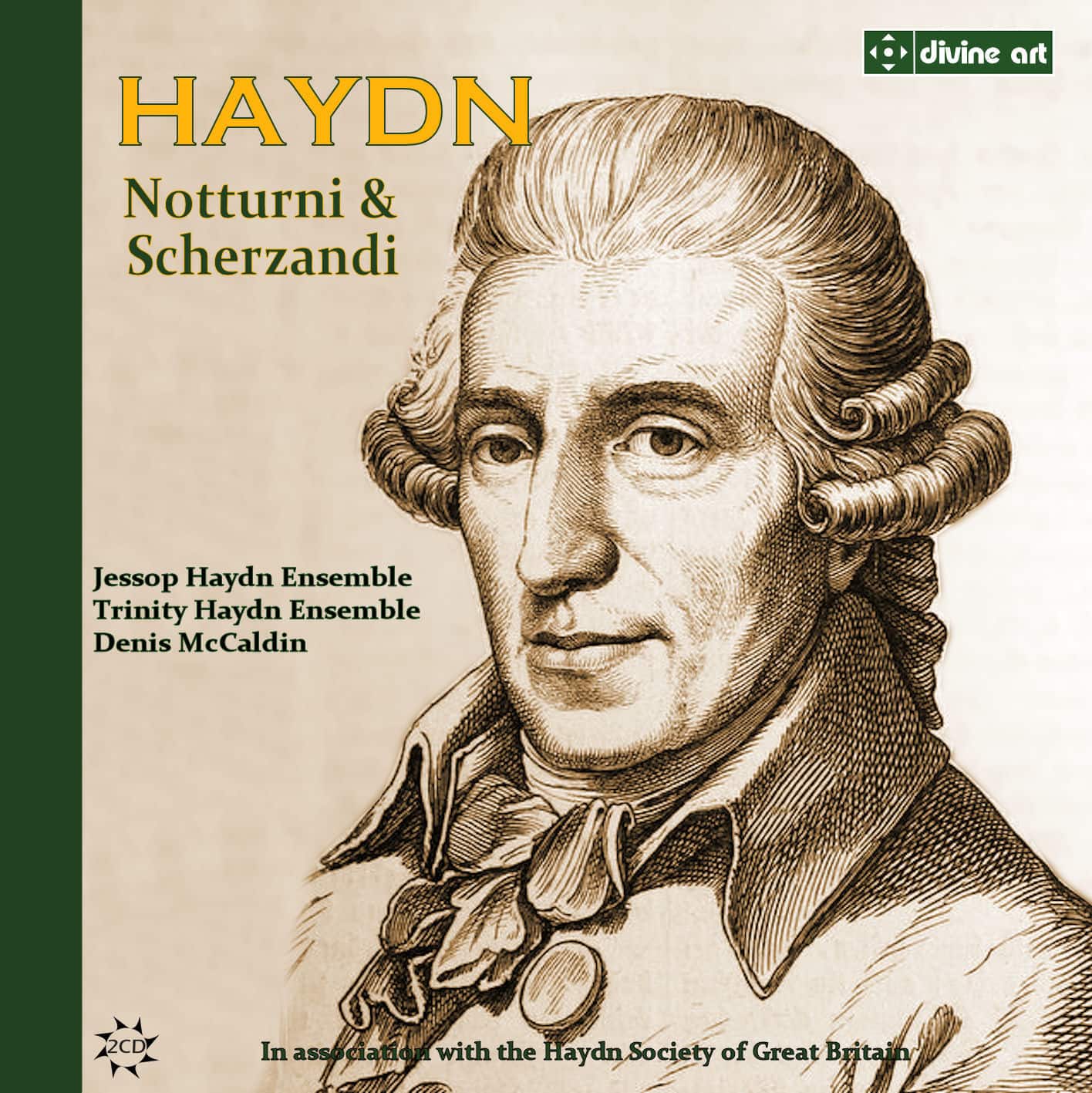
    Among the chamber orchestral works of Joseph Haydn, these are relatively little known – his eight Nocturnes and the six Scherzandi are lovely unassuming but well balanced pieces ideal for both concert hall and salon.

    This release has been sponsored and supported by the Haydn Society of Great Britain whose President, Denis McCaldin, is also the conductor here.