Catalogue Connection: 21223

  • The Classical Reviewer – Bruce Reader – 21223

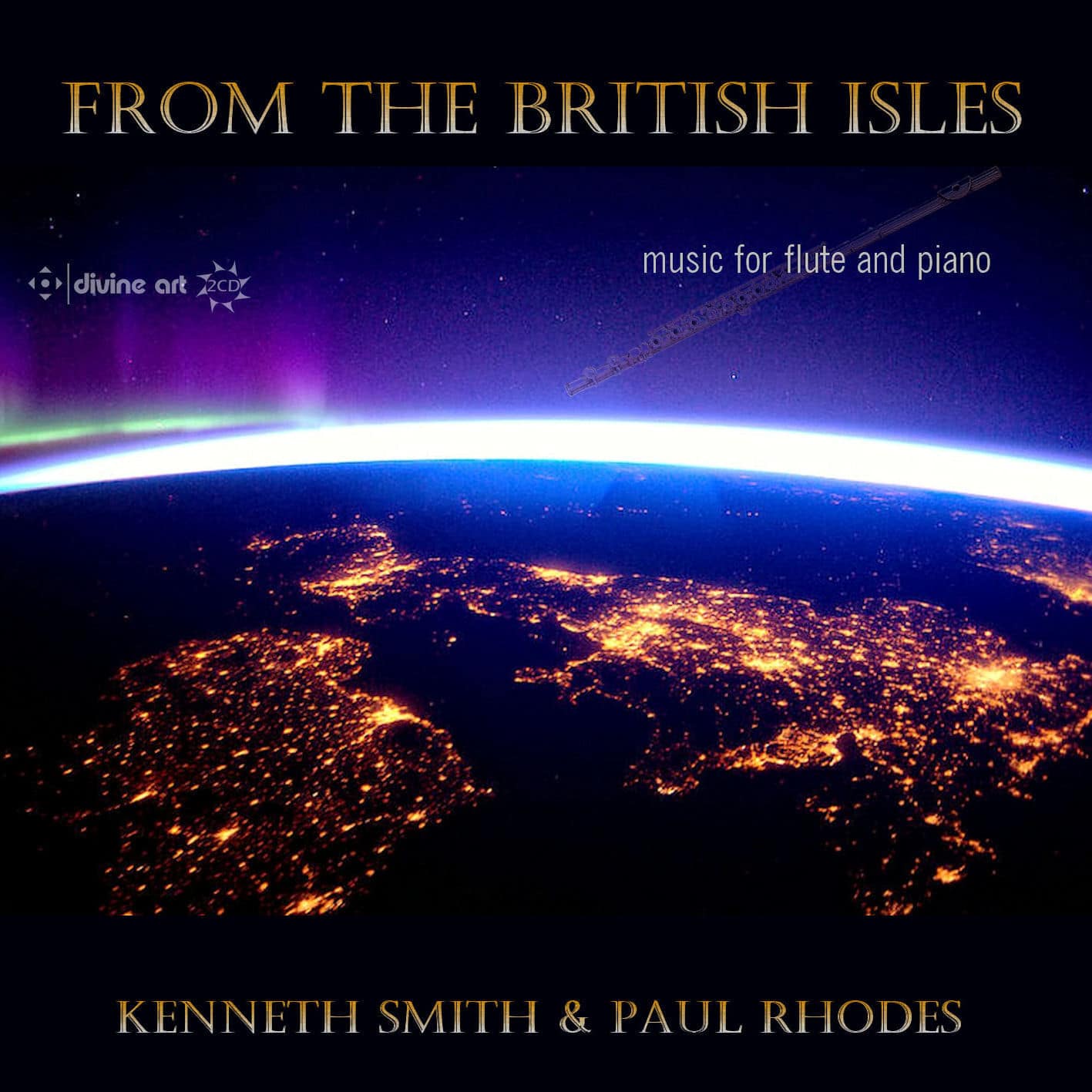
    Divine Art Records have just released a 2 CD set of British works for flute and piano entitled From the British Isles featuring flautist Kenneth Smith and pianist Paul Rhodes. The cover alone will be enough to attract the interest of casual browsers but this new set contains many fine works, some by composers that are rarely recorded, all in very fine performances indeed. The recordings on this new set were made at three different venues between 1989 and 2007 and all provide excellent sound.

    First we have the Sonata for Flute and Piano, Op. 121 by Malcolm Arnold (1921-2006) . There is a lovely little flourish from the flute in the opening of the Allegro with the piano setting a dramatic contrast. Throughout, these two fine artists bring out all of Arnold’s quixotic yet dramatic flair. In the Andantino Paul Rhodes leads with a leisurely melody for piano, soon picked up by Kenneth Smith whose tone draws much feeling from Arnold’s bittersweet writing. There is some fine rhythmically varied playing in the Maestoso con molto ritmico that these two players build to fine effect with some absolutely terrific playing from Smith; a superb fluency before a brilliant coda. This is a quite irresistible performance.

    The music of Granville Bantock (1868-1946) has become better known in recent years due to a number of recordings made by Hyperion Records. He is represented here by his Pagan Poem published in 1930. It is a reflective little piece that grows in animation providing many opportunities for these players to show their superb technique whilst revealing the many lovely facets of this piece.

    Peter Lamb (1925-2013) had a busy career, both as a composer and music administrator, initially working for two international record companies before an appointment as Deputy Manager of the Bournemouth Symphony Orchestra. He helped to establish the Bournemouth Sinfonietta and for ten years he was Head of Music at Peter Symonds’ College in Winchester, later lecturing at the University of Southampton.

    The Con moto of his Sonatina for Flute and Piano (1973) has a forward driving thrust, freely melodic in nature, with a more languid section midway. Kenneth Smith draws some really fine legato lines in the Andante , Paul Rhodes adding a breadth to the music in this particularly lovely movement. These artists work so well together. There is a fine interplay in the Con brio as this final movement rushes ahead full of fine invention.

    Cyril Scott (1879-1970) is another composer who has benefited from recordings of his music . His The Ecstatic Shepherd is an intoxicating little piece for solo flute given here a finely controlled performance that reveals every little nuance of this very attractive work.

    The Romanza of Kenneth Leighton’s (1929-1988) Serenade in C Major, Op. 19a (1949) opens with rippling piano phrases before being immediately joined by the flute in a melody that is fresh and beautifully flowing. This is a gorgeous, mellifluous performance. The Scherzo darts around, full of charm and life with some terrific articulation from Smith and spot on ensemble between these players. Rhodes provides some wonderfully nimble phrases. Finally we are led into the Pastorale where there is a flowing outpouring of pastoral beauty.

    Next we are taken to a much earlier composer, John Ranish (1692/3-1777) whose Flute Sonata in B Minor, Op. 2, No. 3 was published in 1744. It sits very well with the other works on these discs with a lovely Adagio that has very attractive flute decorations, a nimble and lively Allegro that has a lovely lightness of texture with an irresistible melody and a terrific Giga to conclude. Beautifully played.

    Richard Rodney Bennett’s (1936-2012) Summer Music was published in 1983 and opens with Summer Music: Allegro Tranquillo where we are returned to the pastoral feel of the finale of Leighton’s Serenade with more fine interplay between these artists as the attractive melody weaves its way forward. There is a lovely, gently moving Siesta: Lento e dolce to which this flautist brings a lovely warmth and Games: Vivo a rhythmically buoyant movement, full of lightness and fun, these two artists bringing fine ensemble and a sense of enjoyment, giving the feel of a live performance.

    Disc 2 opens with William Matthias’ (1934-1992) Sonatina for Flute and Piano. There is a really lively Allegro that receives some absolutely terrific playing from both these artists, terrific articulation from Kenneth Smith. The contrasting Andante cantabile brings a beautifully flowing melody, very much the core of this work, with some exquisite flute passages and pianism of the utmost sensitivity. There is phenomenally accurate playing in the final Allegro Vivace with terrific phrasing as this rhythmically difficult movement hurtles ahead.

    Eugene Goosens (1896-1952) is known more for his conducting than composing which is a great pity. There was a very fine 3 CD release of his orchestral works conducted by Vernon Handley on the ABC Classics label a few years ago that is worthwhile seeking out. His Persian Idylls, Op. 17: No. 1. The Breath of Ney (1918) is arranged here for flute and piano by Paul Rhodes. It brings an immediate atmosphere as the flute rises up suddenly out of the opening piano motif with some lovely, languid piano phrases as the flute weaves it way forward, Smith producing some very fine sounds.

    The Moderato of Peter Lamb’s Sonata for Flute and Piano (1988) soon picks up a rhythmic pulse that alternates with the opening flowing line, beautifully realised here with terrific breath control from Kenneth Smith. The lovely, flowing Aria – Adagio brings something of a timeless feel with rhythmic variations of the theme that bring a little more drama. The Allegro is brilliantly played with superb ensemble and with a brief gentler interlude.

    Thomas Dunhill (1877-1946) has gained some attention through recordings of his songs and chamber music. Here his Suite for Flute and Piano (c.1935) has a gentle, beautifully shaped Allegro moderato and an Andante amabile e placido that has a lovely simplicity with these fine artists bringing fine care and sensibility, finding every little inflection. There is a beautifully sprung Allegro poco scherzando , superbly played by both, before an Adagio non troppo; quasi-improvisata that flows beautifully and freely with Smith drawing some very fine phrases and textures. The work concludes with a playfully vibrant Allegro molto – quasi presto given spot on precision and a lovely flourish to end.

    Howard Blake (b.1938) will never be able to escape his fame as the composer of the song ‘Walking in the Air’ for the 1982 film The Snowman. It revealed him as a particularly fine melodist but has tended to overshadow his other compositions. His Elegy has an equally melodic nature rising up with a fine flute theme with some fine piano passages. Indeed, this is something of a melodic gem beautifully played here with this fine flautist weaving a terrific line as the piece progresses through moments of haunting beauty.

    Edwin York Bowen (1888-1961) is yet another British composer who has had to rely on recordings for his posthumous reputation . This 1992 recording of his Sonata for Flute and Piano, Op. 120 (1946) was a premiere recording . Lovely flute arabesques gently open the Allegro non Troppo with a fine piano accompaniment. There is a forward moving melodic invention as the movement develops, not without occasional hints of Debussy. These artists give a beautifully controlled performance as the music ebbs and flows. The Andante piacevole brings some beautifully mellow sounds as the music gently flows its way forward, these players finding much variety of tone. There is some very fine precision in the fast moving Allegro con fuoco with Kenneth Smith and Paul Rhodes again revealing their intuitive partnership.

    This is a very fine set indeed with some of the finest performances of works for flute and piano I have heard. The booklet and presentation are up to Divine Art’s usual high standards with first rate notes from Kenneth Smith and Paul Rhodes. If the repertoire appeals, do not hesitate in acquiring this fine set.
  • MusicWeb International – Brian Wilson – 21223

    This is the seventh album from Kenneth Smith and Paul Rhodes on Divine Art, all listed in the booklet. I’ve missed its predecessors but my colleagues have written appreciatively of several of them. I’m pleased to make amends now and hope to catch up with some of the earlier releases. While putting this review together I’ve been listening with enjoyment to By the River in Spring , music by Hamilton Harty, Edward German, Michael Head, William Alwyn, Havelock Nelson, Thomas Dunhill, Kenneth Leighton and Stanford Robinson. (DDA25069).

    These are not new recordings – the earliest were first issued by ASV – but their release on a two-for-one set is very welcome. Two items on ASV CDDCA739 are not included here. Delius’s la Calinda is apparently no great loss; though there would have been room to have included it, it came in for some criticism when the CD was released in 1991. I do wonder, however, why the arrangement of Elgar’s The Curious Doll was omitted – again, there would have been room, but we have a fine performance of the whole Nursery Suite , together with Wand of Youth and Dream Children from Bryden Thomson and Norman Del Mar on a budget-price Chandos CD.

    John France has already reviewed the set in considerable detail, work by work, so I need only add that I very much enjoyed these performances, though I wouldn’t propose listening to the two hours straight through. Several of the pieces were receiving their recording premieres when the ASV CD was released and several still exist only on this album, the two works by Peter Lamb, for example, who wrote the notes for ASV, retained here for his own music. The notes are informative, though the booklet does contain a couple of mistakes which John France has noted: the opus number for the Arnold (121 not 21) and the date of birth of York Bowen (1884 not 1888), both easy slips to make but they should have been spotted.

    I listened to the download from classicsonline.com, which came complete with pdf booklet – still, regrettably, not always a given. It’s in mp3 only, very good of its kind, but at £15.98 about the same price as you might expect to pay for the discs or slightly more. Classicsonline has been superseded by its new high-definition sibling, COL HD:LL, where you can find the set in lossless sound, equivalent to CD quality, for £15.99. The new HD:LL doesn’t allow me to give hyperlinks, as I have been wont to do, but each offering has a code: UPC: 809730122323 should help you find what you want.

    You can, however, find a better deal from Qobuz: stream from there – or sample if you don’t have an account – and you’ll find a lossless download available, with booklet, for £11.99. There’s still too much variability of pricing of downloads: competition is fine, but not when the download costs as much as or more than – often much more than – the CD, even sometimes from the same dealer.

  • The Chronicle – Jeremy Condliffe – 21223

    Unusually for Divine (at least since we’ve been getting their products) this comes in a lavish package that suggests a sort of Now That’s What I Call English Music. Never fear, this is Divine and the album is a serious double CD from the flute and piano duo, playing both old pieces (some long unavailable) and new recordings. It features works by British and Irish composers, from the early 18th to the late 20th century. As a collection of works, it echoes Hoddinott above, in that it’s technical rather than warmingly organic, if you see what we mean, though the quirkiness makes it a nice listen.

    Sonata by Malcolm Arnold was written for James Galway and ends with a rakish air, as the flute weaves its way round the piano. Bantock’s Pagan Poem is sad, reflective and atmospheric, if not slightly mystical, while we like Scott’s The Ecstatic Shepherd , which is equally mystical, albeit the mystery of the Orient and not the Pagan (we wondered if the members of Gong ever heard it).

    On CD2, William Mathias’s Sonata for Flute and Piano is playful, despite being serious while Eugene Goossens’ The Breath Of Ney adds Persia to the CD’s travels. Walking InThe Air composer Howard Blake supplies the delicate Elegy.

  • Fanfare – Colin Clarke – 21223

    These two discs of music from the British Isles for flute and piano reveal a staggering variety of approaches. The twofer is actually a set of reissues, and recording dates are 1989, 1992, and 2007. The second disc, originally entitled The Reed of Pan and on the ASV label, was reviewed by Kevin Bazzana in Fanfare 17:4 in a brief and somewhat dismissive review: “The music is pleasant enough. All the pieces feature the ingratiating, impressionistic, rather faceless tonal idiom so prevalent in twentieth-century English music”: I remain unsure about the designation “Impressionistic” but I take the point about the tonal idiom, and even of it being rather faceless (having been exposed to masses of this stuff of this ilk every Saturday morning in a weekend music school in Bury, Lancashire, UK, for years on end in my formative years).

    Interesting that the compilation starts out with Malcolm Arnold’s Flute Sonata, a piece whose first movement is rather more dissonant than one might expect from this composer. It is nearly three minutes in to the first movement before one of that composer’s long, lyrical melodies makes itself known. Paul Rhodes’s playing seems intent at various points on playing up a debt to Hindemith (and indeed here are two composers fully conversant with the idea of Gebrauchsmusik). The finale is typ­ical Arnold high-jinks, contrasted here with Bantock’s Pagan Poem, wherein the flute seems initially to put an English slant on Debussy’s Prelude de I’apres-midi d’unfaune. This is a far finer work, fragrant (though of ancient English hills, rather than the pastoral ones of, say, Vaughan Williams); in a similar vein is Cyril Scott’s enigmatic The Ecstatic Shepherd for solo flute.

    By his own admission, Peter Lamb (1925-2013) holds no terrors for the conservative listener. The sonatina is the first of the 2007 recordings heard on this twofer (the Arnold was from 1989, the Bantock 1992) and it is immediately closer in the sound-space. The central Andante is actually rather lovely (it sounds more like an Adagio, though), and Smith’s breath control is everything one might ask for. Lamb has admitted a French influence in his writing, and actually ends the work with a short quote from the opening of Poulenc’s Flute Sonata. His 1988 Flute Sonata is heard on the second disc and includes a beautifully written opening moderate, varied and interesting; a pity the central Aria is somewhat nondescript.

    The Leighton was written in 1949 but was lost for a full 40 years. The piece holds much beauty in its opening “Romanza,” while the spikier, active central scherzo offers plenty of challenges to both players. The work ends with a “Pastorale” of much delicacy. Another work that had to wait for publication was William Mathias’s Sonatina (1953, published 1987). Less than eight minutes in toto, it is nevertheless expertly crafted and includes a haunting central Andante cantabile. Richard Rodney Bennett’s Summer Music (published in 1983) includes a rather sophisticated central “Siesta” before the spike “Games” rounds off this effective and successful piece.

    Eugene Goosens (1893-1962) wrote The Breath ofNey in 1918 (a ney is a type of Persian flute). His work is perfumed (but still recognizably English), and actually one of the finest pieces in the present collection. It’s also good to see a piece by Thomas Dunhill (1877-1946), an underrated composer whose cause has been taken up by a variety of labels, and this is a happy addition. Particularly lovely is the Andante amabile eplacido, the first of two slow movements. Certainly, this is one of the highlights of the program.

    Readers may be familiar with the name Howard Blake for his “Walking in the Air” from The Snowman. The Elegy here was originally the slow movement of his clarinet concerto, where it was called “Ceremony.” There is no doubting Blake’s melodic gift, and there are moments of harmonic magic here, too.

    The name of John Ranish (died 1777) was new to me (he’s also new to the Fanfare Archive). Active for most of his life in Cambridge, he wrote 20 sonatas. Obviously we hear the accompani­ment here on modern piano; the piece is actually quite a fine one, particularly the opening Adagio. The contrast in idiom, in the context of the present program, is indeed welcome, and the performance here is most stylish. Finally, there is York Bowen’s Flute Sonata of 1946 (again, a work that lay in MS for over 40 years). The long (nearly nine minutes) first movement is wide ranging and exudes a sense of Brahmsian breadth; the Andante piacevole is English through and through.

    Kenneth Smith was principal flute of London’s Philharmonia Orchestra for many years, so that should give some idea of his pedigree and stature. All performances are of the highest standard.

  • MusicWeb International – John France – 21223

    This double CD of flute and piano music is a rare treat. The concept is to showcase British music for flute and piano written – with one exception – during the twentieth century. There are one or two relatively well known pieces that are complemented by some unknown gems. Most of the composers are familiar names to British music enthusiasts, however, Messrs. Ranish and Lamb are new to me, and, I guess to many other listeners as well.

    Where does one begin to explore this excellent compilation? I suggest with what is probably the best known piece: Malcolm Arnold’s Sonata for Flute and piano, op.121; the liner notes quote op.21. Unsurprisingly, this work was written for, and dedicated to, Sir James Galway who gave the premiere in Cardiff on 19 March 1977. This is typical of the composer’s ‘colourful, exuberant and entertaining’ style. It does have some slightly more serious moments in its progress, especially in the calm middle movement, but any angst is blown away by the jazzy Latin ‘con moto ritmico’. It is a joy.

    I then explored the shorter pieces. Granville Bantock’s Pagan Poem is a work that looks to the mysteries of ‘far-off lands’ and antiquity for its inspiration. It is sad and melancholic in mood, and explores a wide variety of the flute’s tonal resources; a little masterpiece.

    I have always been a fan of Cyril Scott: I am grateful that so much of his music is currently available on CD. I did not know his exotic The Ecstatic Shepherd. Influenced more by the Idylls of Theocritus than the hillsides of England this lovely piece presents the listener with a hypnotic unfolding melody that espouses a drowsy afternoon in the nymph-haunted hills and meadows of Sicily.

    Richard Rodney Bennett was a composer of many parts – from jazz to film scores, symphonies and concertos and his music remains a largely undiscovered country. The three-movement Summer Music (1983) lives up to the promise of its title. This is urbane music that depicts a ‘siesta’, some beach ‘games’ as well as summer moods in general.

    Eugene Goossens was born in 1893, not 1896 and died in 1962 not 1952 as the track-listings on page 3 suggest: the dates are correct in the programme note section. His ‘The Breath of Ney’ (‘The breath of Ney floats down the valley’) is a miniature that is way too short. It’s the first of two Persian Idylls which were originally settings of two poems by the music critic Edwin Evans. The second (not recorded here) is The Heart of Kalyan. ‘The Breath of Ney’ has been arranged by Paul Rhodes for flute and piano.

    Unfortunately, Howard Blake tends to be largely recalled for his film score to The Snowman — as well as a vast number of arrangement and transcriptions he has made of this piece. Yet his compositional achievement is far wider. His catalogue includes hundreds — some 667 currently listed on his website — of works ranging from full blown concertos, symphonies and ballet scores. The present Elegy was originally the slow movement of a Clarinet Concerto, but was re-presented in its current form in 1992. It is a complex, involved work that is ‘beautifully suited to the expressive qualities of the flute’. There are two concerts of Blake’s chamber music in London on 25 March and 17 April 2015.

    An older generation of composers is represented by the 18 th century John Ranish. I have not heard of him, so was grateful for the concise mini-bio in the liner-notes. Seemingly, Ranish, who was born in 1692/3 lived most of his life in Cambridge playing and teaching the flute. Historical records show that he was well-respected and popular. He wrote twenty sonatas or ‘Solos for the German Flute with thorough-bass’ which were published in two volumes as op.1 (1735) and op.2 (1744). The present sonata is the third from Volume 2. This is a typically baroque work in three movements: ‘adagio’, ‘allegro’ and ‘giga’. The liner states that that they are ‘not particularly distinguished works’ which may be the case. However, I thought this example was musically satisfying and often quite beautiful in tone and mood. If the other nineteen are only half as good as this sonata they deserve to be heard.

    Another composer that I have not come across before is Peter Lamb (1925-2013). I wish that the notes had included some biographical references to him. I quote his Facebook page which gives brief details. Peter Lamb was born in London and studied initially at Trinity College of Music and latterly with the composer Arthur Benjamin. Much of Lamb’s subsequent career was spent as a musical administrator with record companies and as deputy manager of the Bournemouth Symphony Orchestra. He was also one-time Head of Music at Peter Symonds’ college in Winchester and lectured at the University of Southampton for eight years. His compositions include a wide range of chamber music, a number of unaccompanied choral works as well as a Concerto for viola and string orchestra. This CD introduces two of Lamb’s chamber works.

    Lamb’s Sonatina for flute and piano was composed in 1973 and is dedicated to his daughter, Cleone. The liner quotes the composer’s programme notes, the gist of which is that this is a ‘light-weight work in three movements presenting no problems to contemporary ears and designed simply to give pleasure both to the performers and their audience.’ Stylistic markers would be the neo-classical world and ‘Gallic charm’ of Francis Poulenc and Lennox Berkeley. The later Sonata for flute and piano (1988) is similar in intention and mood but is considerably more substantial in its construction and melodic adventures. It is a superb piece. On the basis of these two works I would love to hear the above-mentioned Viola Concerto.

    One of my favourite works on this album is William Mathias ‘ early Sonatina for flute and piano. This was completed on 8 January 1953 whilst the composer, aged 18, was living in Whitland, Carmarthenshire. It was first heard on 18 April of the same year at St Cecilia’s House, London. The work won a composition prize in the 1953 Inter-college Eisteddfod. The Sonatina was dedicated to the flautist Lamond Clelland and pianist Margot Bor. It fell into desuetude until the composer revised it in 1986 and was subsequently published.

    In many ways this piece is not typical of Mathias’s music as he matured yet it is an impressive work with memorable tunes. The opening allegro has some tight rhythmical action that is clearly exacting to pull-off. The middle movement is leisurely and reflective in its tone, however, it is soon pushed out of the way by an energetic ‘allegro vivace’ which propels the music to an exciting finish. It is a wholly competent work for a young composer.

    Anything by Kenneth Leighton interests me immediately. In this case it is a ‘new’ work – one that I have not come across before. The Serenade in C op.19a was composed during July 1949 and was revised four years later. It was dedicated to the composer’s friend Gustav Born who played the flute. It was first heard at an Oxford University Music Club and Union concert on 13 June 1950. The Serenade is from a time when Leighton was influenced by the ‘pastoral’ school of music epitomised by Finzi and Vaughan Williams. There are nods to William Walton as well. This English ‘pastoral’ mood is prominent in the final movement.

    Thomas Dunhill ‘s Suite for flute and piano, dating from around 1935, is an attractive and straightforward work that is technically accessible to younger and less virtuosic players. Yet its effect belies this relative simplicity. There are five contrasting movements including the imaginative ‘adagio non troppo: quasi improvisata’ which allows the players’ musical imagination some scope in interpretation. I was particularly impressed by the wayward finale.

    York Bowen ‘s (born 1884, not 1888 as track-listings state) Sonata for flute and piano, op.120 is the big romantic work on this CD. In fact, I was amazed at just how much passion, romance and power can be invested in a work for flute. The work is post-war, having been composed in 1946. It was dedicated to Gareth Morris. The notes point out that this Sonata is ‘one of the most substantial and well written works for the flute by a British composer …’ I agree with the sentiment that suggests it is ‘perplexing as to why it remained on a library shelf in manuscript for over forty years’. I particularly enjoyed the beautiful ‘English’ mood of the ‘andante piacevole’ which seems to hark back to an imagined idyll. The finale is a dynamic, energetic and exuberant tour de force .

    One forgets that Bowen was born a Victorian, came to maturity at the start of the Edwardian era and survived into the age of Rock and Roll. His music tends to reflect a quixotic mood, long deemed to have become passé, but which is unfailingly attractive to listeners.

    The liner essay for this CD is excellent in spite of those few date errors that have crept in. I would have liked to have seen the dates of all the pieces included in the track-listings or in the notes.

    One must not get too carried away with the repertoire and ignore the excellent playing by flautist Kenneth Smith and pianist Paul Rhodes. These are stunning performances from first to last. I accept that in many instances it is not possible to compare versions of these pieces, as there is no (or little) competition. The important fact is that this recital grabs and ultimately holds the listener’s attention.

    If you like this collection you may well enjoy another Divine Art collection from these two musicians: By the River in Spring ; not to mention a long deleted British flute music collection on ASV CDDCA768 ( Folk and Fantasy ).

    This two CD set is a fine compilation that will prove attractive and essential to all British music enthusiasts and all lovers of flute music.

  • MusicWeb International – Steve Arloff – 21223

    There can hardly be a more magical-sounding combination than flute and piano as this two CD set amply demonstrates. It also shows how widely ranging and diverse is the musical language of this assemblage of British composers some of whom are hardly known and unfairly neglected.

    Malcolm Arnold is not one of those and his Sonata for Flute and Piano which was premiered by James Galway, to whom it was dedicated, in 1977 is a captivating work. It’s full of virtuosic moments but also crammed with musical ideas of the highest order. From its opening our attention is gripped by the mysterious air created by the flute’s main theme while the piano stalks it in a threatening fashion. Then suddenly a calmer atmosphere asserts itself and the two instruments are harmoniously intertwined with shared material until the main themes return. This finally gives way to a relaxed and gentle ending. The slow movement is lyrically beautiful with the flute holding you with a mesmeric melody. This weaves its spell upon you while the piano’s role is to inject a counterpoised and sometimes almost percussive contrast. The joyful concluding movement is Arnold at his typical fun-loving best with a jazzy edge dominating.

    Granville Bantock is a name one knows but not well enough. What a shame that is when you hear the sheer quality of the music on offer here. Written in 1930, the year he was knighted, Pagan Poem is a deliciously tuneful piece that shows off the flute’s many wonderful qualities. Peter Lamb is a name that is new to me and his Sonatina for Flute and Piano is a wonderful work to serve as an introduction. It is interesting to read his programme note in which he self-deprecatingly says that it is “… a lightweight work … presenting no problems to contemporary ears and designed simply to give pleasure to both the performers and their audience”. That is enough to endear him and his music to me. I was also interested to read that he wished to “echo the exuberance and variety of expression I so admire in many French writers”. Indeed it has many of the qualities that one associates with French music; a kind of puckish fanciful whimsy. He likens the final flourish that ends the work to the opening of Poulenc’s Sonata which he says he hopes he would have enjoyed. I’m sure he would have.

    Cyril Scott ‘s The Ecstatic Shepherd makes you wish to hear more of his music as this piece for solo flute is simply gorgeous. The same can be truthfully said about Kenneth Leighton’s Serenade in C . Reading that he composed it when he was only 20, and even though he revised it four years later, it stands as testimony to a composer gifted with natural talent. It was sad to read that it had lain forgotten for almost forty years after he’d sent it for appraisal to the then principal flautist of the Philharmonia Orchestra. That’s the same orchestra that the soloist here, Kenneth Smith, has been principal solo flautist with these past 27 years. Peter Lamb is quoted in the booklet notes with a highly accurate and telling description of the work.

    It was a joy to discover the music of John Ranish whose name was completely unknown to me. His delightful Sonata in B minor is one of a series of twenty he wrote for German Flute with thorough bass that were published in 1735 and 1744. This one is the third of the set of twelve from 1744. It is then back to the future from the eighteenth century to the twentieth with a work by the prodigiously talented Richard Rodney Bennett, his Summer Music . Bennett was equally at home writing and performing music for film and TV — including for an episode of Dr. Who and for the film Murder on the Orient Express — and jazz, famously acting as an accompanist for the likes of Cleo Laine, Marion Montgomery and Claire Martin. The interesting thing is that despite his abilities in all these genres he never descended into crossover. His music remained rooted in whatever genre he was writing in. Summer Music is well named for it simply shines with a feeling of sunlight in its melodic lines — a gloriously uplifting experience. The middle movement, subtitled Siesta , would be the perfect accompaniment to a relaxing afternoon in a hammock in a beautiful English garden.

    Moving on to the second disc we have a lovely work by William Mathias representing Wales with his Sonatina . This was written in 1953 yet was inexplicably unpublished for over thirty years and unperformed until 1986. Its lively opening movement fairly races along, demanding much from both musicians. The central Andante Cantabile offers a short rest before the final Allegro Vivace picks up the pace again in a breathlessly propulsive dash for the finishing line. Although short, Eugene Goossens ‘ The Breath of Ney is thoroughly charming. It successfully creates an air of mystery in keeping with its Middle Eastern influence. The Ney is an ancient Persian flute which can be heard played by multi-instrumentalist Avi Adir on YouTube; well worth the detour.

    As I have said above, I had not come across the composer Peter Lamb before and I feel chastened by that. Combining a busy career as a composer with music administration — he was Deputy Manager of the Bournemouth Symphony Orchestra — he composed many works including a Duologue for oboe and piano, a String Quartet, Concerto for viola and string orchestra, Wind Quintet and many unaccompanied choral works. His Sonata for Flute and Piano is a beautiful and quintessentially ‘English’ work redolent of all that is best in British music. Lamb, in words that bring to mind those he used concerning his Sonatina for Flute and Piano (see above), said of this work that he wished to add to the repertoire of an increasingly popular instrument. He “… hoped (that it) would bring pleasure to performer and listener alike.” There is no doubt that it scores highly on both counts. I can also admit that Thomas Dunhill is another composer whose name was unknown to me. Although it sounds as if it might be from the seventeenth century he was born in 1877 and his Suite for Flute and Piano also falls into the category of spellbindingly and charmingly evocative music. It is instantly appealing with a superbly flowing nature. As the booklet notes observe it is both suitably challenging yet ‘accessible to younger players offering them a complete and mature concert piece to perform’.

    Howard Blake is best known for his score for Channel 4’s 1982 film The Snowman and especially the song Walking in the Air . However, with over 650 works to his credit there is plenty more that should capture our attention among which is his Elegy , a re-working for flute and piano of the slow movement from his Clarinet Concerto. This works perfectly for the beguiling qualities of the flute. Coming to the final work on this 2 CD set we have the première recording of Edwin York Bowen ‘s Sonata written in 1946 but unperformed until this recording was made in 1992. That fact is surprising since it is considered ‘… one of the most substantial and well written works for the flute by a British composer …’ as the booklet notes point out. At almost 18 minutes long this brilliantly virtuosic three-movement work captivates the listener at every turn. This can be felt from its expressive opening movement through its wonderfully restful and lyrically beautiful slow movement, so very typically English, to its energetic and scintillating concluding finale that shows off the playing of both musicians so very effectively.

    Both Kenneth Smith who is a true wizard on the flute and Paul Rhodes, a equal partner in every way are perfect vehicles through which to show off all that is best in these British compositions for flute and piano. This set is one to cherish and enjoy forever. The only flaw is in the various mistakes and misprints between cover and booklet including Goossens’ date of death being given as being 1952 on the cover and the correct date of 1962 in the booklet.

  • American Record Guide – Todd Gorman – 21223

    Kenneth Smith and Paul Rhodes have been playing together since 1986 and produced many recordings. Their 3-disc set commemo­rating the eminent French flutist Paul Taffanel (Divine Art 21371, May/June 2011: 198) belongs in every major library and woodwind collection. Here is a reissue of two previous recordings with a small addition. It surveys British flute music of the 20th Century, and there is also a sonata from the baroque flutist-composer John Ranish. The composers range from Granville Bantock (1868-1946) and Thomas Dunhill (1877-1946) to William Mathias (1934-92) and Peter Lamb (1925-2013).

    The primary value of this program is that the selections are not played often, though all the pieces are published and certainly worth hearing. The style of these compositions is straight­forward, tonal, and easily understood.

    Smith was principal flutist of the Philharmonia Orchestra of London for nearly 30 years. His sound is rich and expressive and places him among the well-known British students of French flutist Marcel Moyse, who include Geoffrey Gilbert, Trevor Wye, William Bennett, and James Galway. The breathtaking beauty with which he plays the Adagio that opens the sonata by John Ranish is reason enough to get this recording. I did encounter a rather dull-sounding piano more than I would like, though the playing is quite fine. All the interpretation and phrasing is tasteful, exuberant, and shows that the two musicians are pre­senting these little-known pieces with as much commitment and artistry as anyone could.

    Flutists should not hesitate to add anything by Kenneth Smith to their collections .

  • New Classics – John Pitt – 21223

    Kenneth Smith, principal flute of the Philharmonia for over 30 years, and his long standing duo partner Paul Rhodes, have established themselves at the forefront of the Romantic and Classical flute music arena. Their many recordings first for ASV and then for Divine Art have received glowing reviews and this double CD set includes a host of major works for flute and piano by some of the most influential composers of the 20th century (as well as a couple from earlier), all from Britain and Ireland. As well as the world premiere recording of Peter Lamb’s Sonatina, there is music by Malcolm Arnold, Granville Bantock, Cyril Scott (The Ecstatic Shepherd), Kenneth Leighton, John Ranish, Richard Rodney Bennett (the delightful Summer Music), William Mathias, Eugene Goossens, Thomas Dunhill, Howard Blake (Elegy) and Edwin York Bowen. These sonatas, sonatinas and suites demonstrate Smith and Rhodes’ usual panache, musicality and virtuosity on their seventh CD for Divine Art.

  • From the British Isles – music for flute and piano

    From the British Isles – music for flute and piano

    The third in a series of albums by this leading flute and piano duo (and their seventh recording for Divine Art) in which we welcome back some iconic recordings previously issued by ASV (and long unavailable) together with some new recordings; this 2 CD set at mid price has several major works by British and Irish composers, from the early 18th to the late 20th century. As ever the duo demonstrate both remarkable virtuosity and also super musicality and depth in these mainly ‘Romantic’ works. The set is provided in luxury packaging at no extra cost, with detailed notes on the music. From the funfilled quirky and jazz-inflected Sonata by Malcolm Arnold through more ‘serious’ pieces by Leighton and Mathias, back to the late baroque sonata of John Ranish, this program is a perfect compilation of lyrical music for flute and piano.