Catalogue Connection: 21225

  • Fanfare – Bertil van Boer – 21225

    Here is the final set of harpsichord suites, the first disc of which was reviewed back in 2012 (35:3) by Christopher Brodersen and the second from 2013 by myself (37:1). Having had the space of several years and given the comments made back then, this third set seems to have taken many of these into consideration. The sound is still robust, but the articulation seems cleaner, and Gilbert Rowland has played around a bit more with his tempos and ornaments. Registrations too seem to be occasionally better used to the music’s advantage, such as in the soft Allemande of the Suite in A Major. This in turn has given a nice depth to the set. Among the pieces, the lyrical Sarabande of the D-Minor Suite (HWV 447) is lyrical, but his continuous use of ornaments causes the work to unfold at a soft, even mincing pace with fine nuances. This contrasts with the equivalent movement in the second D-Minor Suite (HWV 448), where the constant ornaments are almost maniacal. Of course, the former leads directly into a sort of frenetic gigue, while the latter concludes with a full-bodied chaconne, a more powerful and virtuoso movement. The first work on the second disc, another D- Minor Suite (HWV 449) opens with a Prelude that could easily have been written by J. S. Bach, com­plex harmonically and certainly worthy of being called a fantasia with its broad compass of the in­strument in runs and scales. Of course, Bach would have extended it beyond the brief span of this Prelude, but certainly the grandeur is there. The remainder of the works on the disc get progressively shorter, which is not surprising given that they are all probably early works and may either have been unfinished or else the remaining portions are lacking. Here too, though, there is a sampling of Handel’s ability to vary work continuously. In the G-Major Suite (HWV 442), the second of the two movements consists of a huge Chaconne (with 62 variations, no less, lasting over 17 minutes). These range from simple chordal outlines to rather complex virtuoso lines, and in between Handel inter­sperses some more cautious lyrical variations.

    As with my first review, this is not music that one should listen to at one go, since it can sound the same over time as the metallic timbre of the harpsichord tends to outweigh the subtleties of the ornamentation. Rowland’s performances have grown over the course of the set, and I find that this is a fitting culmination with solid playing and a fine sense of ornamentation. While there might be some caution on individual suites in terms of performance style, I find that this will be a good edition to have.

  • MusicWeb International – John France – 21225

    George Frideric Handel’s keyboard music suffers neglect for two major reasons. Firstly, he is largely overshadowed by his contemporary Johann Sebastian Bach whose vast catalogue of keyboard music is widely performed and recorded. It is regarded as essential study for all professional and aspiring pianists and harpsichordists. Furthermore, Bach is considered to have substantial intellectual and transcendental content denied to Handel. At present, the Arkiv catalogues lists nearly ten times the number of CDs devoted to Bach’s keyboard works as to Handel’s. Some of Handel’s Suites have only two currently available recordings. Secondly, Handel’s other music has ‘overshadowed’ his contribution to the keyboard repertoire. Listeners are more likely to turn to his Water and Firework Music , Messiah and even the operas rather than devote time to his harpsichord works.

    Handel wrote a great deal for the harpsichord including around 25 suites and many smaller standalone pieces such as lessons, chaconnes, fugues and fantasias. Musicologists divide the Suites into a number of collections. Firstly there are the ‘Eight Great Suites’ (HWV 426-33) published in 1720. There were followed some thirteen years later by another six which are dubbed ‘The Second Collection’ (1733). There are also many other individual suites. The dating of all these works is fraught with difficulties. Rowland suggests that some were composed before Handel left Germany bound for Italy in 1707. The remainder were ‘probably’ written in England after he settled there in 1712. The present CD includes the last examples of the genre (Suite in D minor, HWV 447 and the Suite in G minor, HWV 452) that Handel wrote around 1739 for Princess Louise, the daughter of King George II.

    The Suites themselves are different to Bach’s examples. They are designed with less concern for perpetuating the historic ‘dance’ movements. Although Handel made extensive use of these, he also introduced chaconnes, variations and fugues into his suites. The liner-notes point out that the one work the Suite in F (HWV 427), not on this CD; actually contain none of the traditional movements. Another feature of these suites is the duration. They range from Suite in G minor, HWV 451 at just under six minutes to the massive Suite in D minor, HWV 449 which is just shy of 24 minutes.

    I do not intend to major on each individual Suite. The present selection is made from both the principal collections as well as the miscellaneous group. The second disc concludes with the massive Chaconne and 62 variations from Suite in G major, HWV 442. The CD is worth buying for this alone and Rowland’s playing is admirable throughout.

    These suites are played on a two-manual French harpsichord ‘after Goermans’ of Paris (1750) built by Andrew Wooderson in 2005. The sound of this instrument is simply stunning: it has been superbly recorded.

    Gilbert Rowland made his debut at Fenton House, Hampstead in 1970 and first appeared at the Wigmore Hall in 1973. He has given many recitals and broadcasts over the years which have established his reputation as one of the leading harpsichordists in the United Kingdom. His recordings include music by Soler, Scarlatti and Rameau.

    The liner-notes, written by Rowland are most helpful. After a short overview of the genre, he gives a succinct description of each of the suites. These notes are also printed in French and German. There is a colour copy of Philippe Mercier’s (1689-1760) well-known painting of the composer.

    I have not heard the first two volumes of this cycle of Suites . However, based on this present two CD I can only imagine that they will be equally successful.

  • New Classics – John Pitt – 21225

    George Frideric Handel began his life in Germany, the son of a barber-surgeon, and died an English citizen, the most renowned musical figure of his day and a national treasure. Whereas his contemporary and fellow countryman, Johann Sebastian Bach, composed for the church and his patrons, Handel composed for the general public. Acknowledged as the greatest composer working in England in the 18th century, Handel continues to be revered as a master composer and his Harpsichord Suites are among the finest instrumental works of the period.

    When the thirty-five year old composer set about making an authoritative edition of his finest harpsichord music in London, he claimed he was ‘obliged to publish …because surreptitious and incorrect copies …had got abroad’ – referring to a pirate edition which had appeared in Amsterdam. Handel’s new 1720 publication of Suites was drawn from a stock of work going back in some instances to his teenage years in Hamburg, where he had received his early training from the organist Zachau at his birth place, Hallé. From the manuscript it is clear that most of the music was composed by 1717/18, and that after 1720 Handel virtually abandoned solo keyboard composition.

    In the first biography of the composer, published in 1760, John Mainwaring wrote that ‘Handel had an uncommon brilliancy and command of finger, but what distinguished him from all other players who possessed these same qualities was that amazing fullness, force and energy which he joined with them. And this observation may be applied with as much justness to his compositions, as to his playing.’

    This latest double-CD release in Divine Art’s excellent recordings of Handel’s unjustly neglected harpsichord suites features exquisite performances by veteran musician Gilbert Rowland. Glasgow-born Rowland is one of Europe’s foremost harpsichordists and the first two volumes of his series received excellent reviews. The third and final instalment does not disappoint in the splendid playing and outstanding instrument, a two-manual French harpsichord ‘after Goermans’ of Paris (1750) copied and built by Andrew Wooderson in 2005.

  • The Consort – Douglas Hollick – 21225

    This further volume in Gilbert Rowland’s complete recordings of Handel’s harpsichord suites presents ten suites – the first of the Eight Great Suites in A major published in 1720, two from the 1733 publication, and miscellaneous works from different periods in Handel’s life. As with the previous volume, it is fascinating to have both early and mature works by Handel presented together, and Rowland has once again provided comprehensive notes on the music and its music, while the recorded sound is excellent.

    A comparison between the Preludes of the A major Suite HWV 426 which opens the first CD, and that of the D minor Suite HWV 449 which opens the second CD shows much more fluency of movement in the improvisatory texture of the latter. This D minor Suite has seven movements, and so is more substantial than most others; it is one of the most enjoyable in this compilation, with a lovely Aria and Variations and a greater variety of dance types than the other more standard four-movement suites.

    Also very interesting are the two suites HWV 447 and 452 which were written in 1739 for Princess Louisa, daughter of King George II, who would have been about fifteen years old at the time. This is most attractive music, not so often heard, and draws some fine playing from Rowland. Other highlights for me were the lovely Sarabande from the B flat Major Suite HWV 440 from the 1733 collection – the filigree decoration in this is wonderful – while the lively ten variations of the Chaconne from the early Suite in D minor HWV 448 have echoes of the instrumental dances in Almira (1705), composed around the same time in Hamburg.

    The Suite in G major HWV 442 which concludes the second CD is hardly a suite at all – just a Preludio and the impressive Chaconne with 62 Variations. Despite the undoubted grandeur and variety in these variations, I am left wondering whether Handel might be scraping the barrel – possibly trying to see how many more variations he could write than anyone else at the time.

    The complete recording of Handel’s harpsichord suites is a tremendous undertaking, and if amongst the wealth of Handel’s music in this third CD I have a few small reservations – for instance a rather heavy Ouverture to the D minor Suite HWV 448 which ends the first CD, and ornaments and trills which are sometimes not quite so flowing as I would prefer – nevertheless this will be a hugely enjoyable recording for all those who appreciate Handel’s genius.

  • The Classical Reviewer – Bruce Reader – 21225

    Gilbert Rowland’s previous volumes in his series of Handel’s Suites for Harpsichord for Divine Art have proved to be superb, something I found when reviewing Volume 2 back in April 2013. Now with Volume 3, Rowland completes this series in a release that is just as impressive. Again Rowland plays a copy of a two manual French harpsichord after Goermans (Paris 1750), built by Andrew Wooderson in 2005.

    Of Handel’s works for harpsichord HWV426-455 (Händel-Werke-Verzeichnis) Gilbert Rowland excludes only HWV446, a Suite for Two Harpsichords of which only the music for one instrument survives and HWV455 that, whilst listed as a harpsichord suite, is in fact a keyboard arrangement of Handel’s orchestral Ouverture HWV336 and Suite HWV354 . All of Handel’s 27 Suites for Harpsichord are here in this series including Handel’s the Suites de Pièces (1720) known as the Eight Great Suites and Suites de Pièces known as the Second Volume (1733-34), as well as the Chaconne in G major HWV435.

    It is the first of the so called Eight Great Suites , the Suite in A major, HWV 426 published in 1720, that opens Volume 3 with a Prelude that reveals some beautifully rich sonorities, expertly laid out with some lovely flourishes as well as a fine expansive sound. There is a beautifully poised Allemande with a great clarity of line before Rowland brings some fine energy to the Courante , extracting more fine sonorities. The Suite concludes with a terrific Gigue, full of rhythmic bounce, a true dance rhythm.

    The Suite in D minor, HWV 447 along with the Suite in G minor, HWV 452 is one of a pair written in 1739. Both are the last such pieces that Handel wrote. The Allemand e has a lovely, relaxed quality, exquisitely drawn with a Courante that has a natural flow, again with a lovely transparency of line. The Sarabande is particularly attractive before a nicely sprung Gigue to conclude.

    The Suite in G minor, HWV 452 also opens with an Allemande but this time with a great forward impetus. With the Courante, Rowland again brings a fine flow, a lovely overlaying of musical lines. The leisurely Sarabande is quite lovely before a Gigue that is full of energy and spirit with Rowland bringing some fine textures and sonorities.

    The Allemande of the Suite in B flat major, HWV 440 , from the Second Collection of 1733-34 is beautifully paced with Rowland bringing subtle little tempi variations. There is a nice steady pace to the Courante allowing every line to be revealed, always a fine momentum. The Sarabande brings some quite exquisite variations with some phenomenally fine playing from this harpsichordist before the Gigue that has great rhythmic bounce.

    The Ouverture of the Suite in D minor, HWV 448 brings a fine full tone showing this to be a really grand overture before dashing off in a terrific theme. The Allemande has a poise and delicacy that contrasts well, not to mention occasional beautifully rich deeper sonorities. The following Courante moves forward quickly with a great fluency and terrific phrasing before Sarabandes I and II bring a leisurely flow, beautifully laid out with a lovely poise. There is a lively Chaconne to end this Suite with Rowland bringing a terrific forward drive, great panache and a terrific conclusion, so fluent. This really is fine playing.

    The second disc of this set opens with the Suite in D minor, HWV 449 . As with the Suite in D minor, HWV 448 it is another of the Miscellaneous Suites probably composed before Handel left Germany in 1707. It is a substantial piece in seven movements, beginning with a terrific opening Prelude where Rowland really grabs the attention, finely paced and phrased with great fluency before an Allemande that has a fine natural forward flow and some lovely details. It is Rowland’s fine phrasing and sense of momentum that makes the Courante so fine before the gently flowing Sarabande. The Aria of the Aria and 7 Variations brings a lovely little theme that is taken through a great series of variations with a non-stop flow of great fluency, beautifully controlled with varying tempi, drawing lovely sonorities. The Giga has some very fine rhythmic subtleties brought out by Rowland before we reach the lovely, rather gentle Menuet.

    The Suite in G minor, HWV 453 takes us back to the earlier compositional life of Handel, c.1705-06. This four movement work opens with an Ouverture , stately and beautifully laid out with lovely decorations before arriving at a fine forward flow. The Entrée is wonderfully lively, full of joy before the poised Menuets I and II that receive some lovely subtle changes of tone and sonority. The Chaconne has such well-chosen tempo allowing the music to unfold beautifully.

    The incomplete Suite in C minor, HWV 445 was also written around 1705-06 and consists of just three movements, a lovely expansive, florid Prelude before a gently flowing Allemande with lovely phrasing and lovely decorations and a Courante that really draws the ear with its lovely harmonies.

    Suite in G minor, HWV 451 is another incomplete Suite, this time consisting of just two movements and dating from c. 1703-06. The Allemande is thoughtfully presented, again with such lovely variations of sound drawn from this lovely instrument. The remaining Courante has a lovely buoyancy.

    Another work from around 1703-06 is the Suite in G major, HWV 442 . It opens with a short, sparkling Preludio before launching into the Chaconne and 62 Variations. The stately chaconne precedes a tremendous outpouring of variations. If you are not already bowled over by Rowland’s playing by now, this will surely captivate the most jaded ear. Gilbert Rowland brings spectacularly fine playing as Handel’s marvellous invention pours out. Absolutely terrific.

    Gilbert Rowland draws so many lovely phrases, colours and textures to add to his terrific fluency, joy and sheer panache. He also brings natural authority and command. The recording again made at Holy Trinity Church, Weston, Hertfordshire, England is absolutely first class and there are excellent booklet notes by Gilbert Rowland.

    The combination of Handel, Gilbert Rowland, Wooderson’s fine harpsichord, the recording venue at Holy Trinity Church, Weston, Hertfordshire and the recording engineer John Taylor is unbeatable providing, as it does, a collection of these wonderful suites that I will return to again and again.

    Sometimes with a project of this kind everything comes together as it does magnificently in this series. At mid-price these discs should be snapped up without delay.
  • American Record Guide – Bradley Lehmann – 21225

    Handel’s published Eight Great Suites of 1720 are well known. There is another rather sloppy volume from 1733, The Second Collection, with eight more suites and a few individual pieces. Gilbert Rowland’s set here, “Volume 3” of a now-complete cycle of three two-disc pack­ages, stays mostly outside that core. It has one suite from 1720 (426 in A), one from 1733 (440 in B-flat), and eight other suites that were not published in Handel’s lifetime. Some of those suites are fragmentary, with only two or three movements. In a sense, this release cleans out the bottom drawers of the Handel keyboard repertoire, giving us music that is not readily available elsewhere. Some might argue that its obscurity is deserved, as there is plenty of formulaic note-spinning here —Handel at less than his best. It can’t all be wonderful.

    Collectors will already have their own favorite recordings of the Eight and perhaps some of the Second Collection. I am happy with Jory Vinikour’s and with Michael Borgstede’s 4CD set of those two collections. Both Borgstede and Vinikour project a more impro­visatory delivery and sensitively-varied touch than I hear from Rowland here. Their styles give us Handel as a master of stagecraft. Rowland seems to be caught up with attention at the note level, rather than the phrase level of larger gestures. He sometimes slows down for technical difficulties and then speeds up again when the music becomes easier. He also shows a bit of clumsiness with dotted rhythms and uses a crude-sounding but unidentified temperament that doesn’t handle sharps very well. I noticed a few finger slips and some questionably-chromatic sliding ornaments that would have benefited from retakes and editing. Rowland could have used a lighter touch in courantes and sarabandes to bring out the hemiolas and to give a stronger sense of dance. In short, I wanted to hear more flair, grace, and drama in his performances.

    Still, I don’t want to quarrel too much with this. Rowland has completed his six-disc project, and there is some strong, heroic playing in this final set. He takes all the repeats and uses some enterprising embellishments. The Chaconne in G (422), a 17-minute piece with 62 variations, is remarkably exciting here as the grand conclusion. Borgstede omitted this “monotonously simple” chaconne from his set, saying in his booklet that he doesn’t like this “obvious sin of Handel’s youth” well enough to play it. For collectors who do want Handel’s scraps, or to finish Rowland’s complete series, here they are.

  • The Chronicle – Jeremy Condliffe – 21225

    Having spent the week listening to Sebastien Fagerlund’s intellectually stimulating music, it’s a big jump to Rowland’s presentation of Handel’s harpsichord music, whose aim is “merely” to entertain. Handel is renowned for his operas and orchestral pieces but turned out a large volume of keyboard music, which is largely overlooked. This double CD seeks to address this.

    Veteran player Rowland is a renowned harpsichordist so the standards are high. He plays crisply and it’s entertaining; we’d guess much of the music on here was originally written to dance to in cultured soirees. Not much else to say: two hours of harpsichord, if that floats your boat it’s out now on Divine Art.

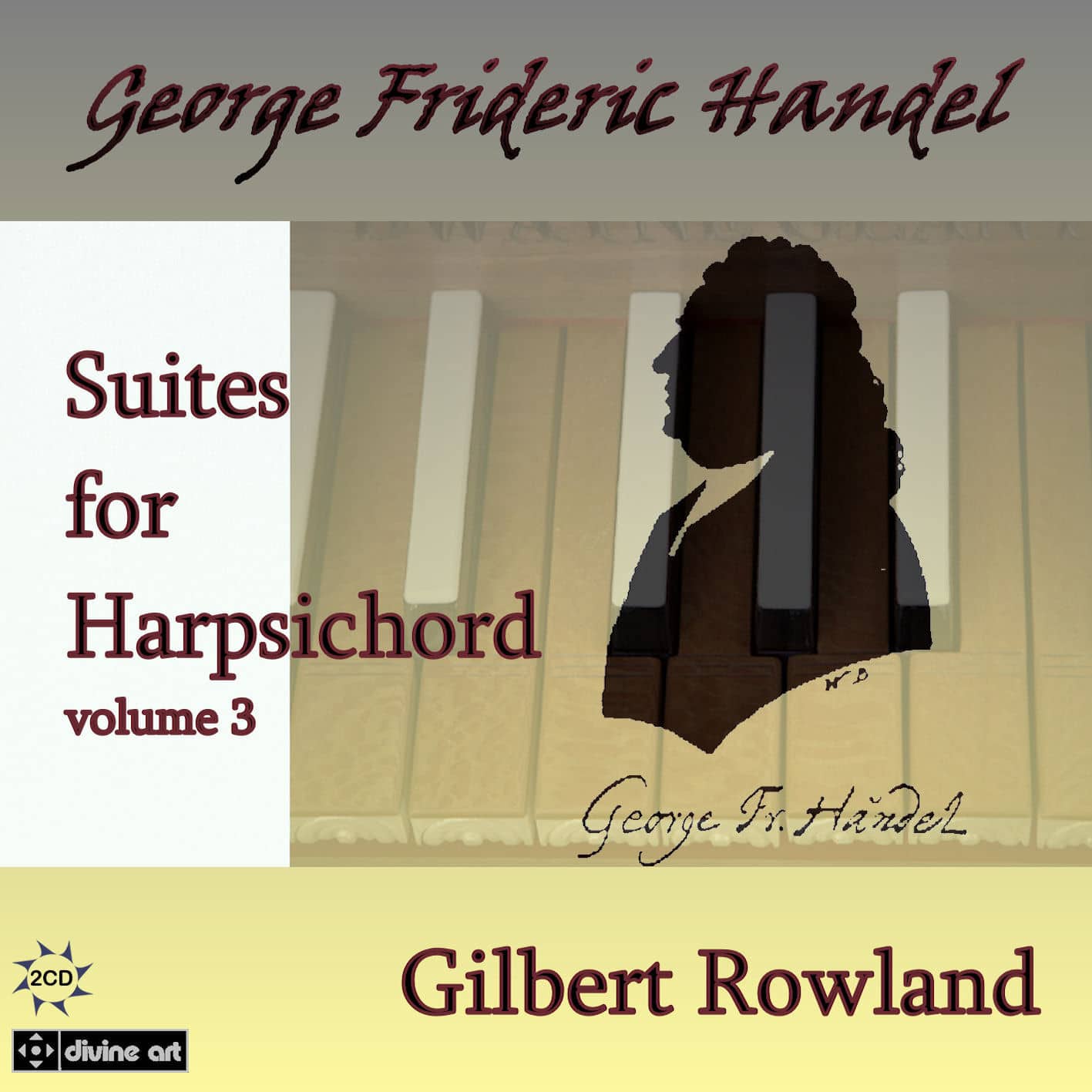
  • Handel: Suites for Harpsichord, Vol. 3

    Handel: Suites for Harpsichord, Vol. 3

    Acknowledged without reservation as the greatest composer working in England in the 18th century, Georg Frideric Handel is revered worldwide as a master composer. His Harpsichord Suites are among the finest instrumental works of the period, we are privileged to present exquisite performances by Gilbert Rowland, one of Europe’s foremost harpsichordists. The first two volumes received very positive press reviews and this third and final installment will not disappoint in the splendid playing and excellent instrument.

    More details for Volume One and Volume Two.