Catalogue Connection: 21226

  • Fanfare – Dave Saemann – 21226

    Jonathan Östlund is a young Swedish composer residing in London. For the most part, his music on the present CDs is very enjoyable to listen to. He seems to have discovered his true voice at a relatively early age. Östlund’s music possesses the most vital ingredient for a composer: He makes you want to listen to him. Judging from the music here, Östlund already has become a sure hand at writing miniatures. That is an unusual gift, for it requires the ability to match brief forms to melodic shapes. This resembles finding the perfect setting for a beautiful jewel. It certainly helps that Östlund has a genuine affinity for lyricism. He does not produce big Romantic melodies yet, but that may come eventually. Think of how long it took Ralph Vaughan Williams to start writing beautiful tunes. Östlund possesses a notably poetic spirit, with a touch of sentiment and melancholy. He balances this with an impish wit that is really quite delightful. He comes across as a quite likable young man, if one is to judge overall from his compositions. It just goes to prove that you can be a Romantic artist without engaging in heavy-duty suffering. You may not turn out a Symphonie fantastique this way, but what you do compose still can have value. I think Jonathan Östlund is a very valuable young fellow.

    Lunaris , the album’s title work, is a lovely melisma for soprano, piano, and a recording of the black-throated loon. It effectively introduces you to Östlund’s world. He joins the distinguished company of Ottorino Respighi and Einojuhani Rautavaara in employing recordings of bird song. Opus Pocus Fantienne is a delightful little divertissement for flute and piano. The same combo performs a wistful composition called Phantasion. Air dans l’air is a witty title for a witty solo piece that deftly explores the flute’s coloristic possibilities. Eleonore Pameijer has a ball with it. Lumière d’étoiles is an alternately spiky and dreamy work for piano, in which the black-throated loon makes an eerily distant appearance.

    One of the album’s most appealing pieces is the Fantasia on Scarborough Fair . Östlund very wisely does little to disguise the tune as it passes back and forth among an ensemble of flute, cello, and piano. I wonder if he knows the Simon and Garfunkel version of the melody. Such is the beauty of the theme that when I described the Fantasia to a group of people not interested in classical music, they all wanted to hear this composition. Rencontre is a sort of Swedish version of the tango for flute and piano. Was Östlund inspired by Astor Piazzolla’s Histoire du Tango for the same instruments? The Wizard is basically a humoresque for the interesting combination of flute, violin, cello, and piano. Rêverie—Jeux de pluie is beautifully, idiomatically written for string quartet. A fantasy in four parts, it is the album’s most successful work in exhibiting its composer’s distinctive voice.

    Night-struck is an atmospheric and edgy piece. It begins with a gently quizzical “Invocation” for solo cello, while the work’s last notes for piano imitate a bird call. Cellist Alexander Zagorinsky and pianist Einar Steen-Nøkleberg give it a superb performance. Winter Vigil for piano represents Östlund’s poetic streak at its best. It gives you the feeling of someone looking out a window at a snow covered landscape. Blandine Waldmann plays imaginatively. Rêve et Lune for soprano and piano is a kind of Scandinavian take on Rachmaninoff’s Vocalise. Miroir d’un mirage for piano is the longest and least successful work on the album. Its title and those of its movements are an homage to the Ravel of Miroirs and Gaspard de la Nuit , but there is little here in the way of thematic integration. The piece is held together through rhythmic patterns, with small evidence of Östlund’s lyric gift. It’s certainly worth listening to, yet I doubt it has staying power. La Féerique et Pierrot for soprano vocalise and piano has a delightfully enchanted atmosphere. There is a brief appearance by the black-throated loon. The Frog Pond for bassoon and piano is a charming bit of vaudeville filled with croaking sounds. Bassoonist Ursula Leveaux relishes her depiction of the frogs. Music at Moonrise is a good bagatelle for violin and piano. It segues into a slightly different version of Lunaris to end the album.

    The performances throughout these CDs range from committed to excellent, and the sound engineering is very good. Jonathan Östlund is an engaging composer who clearly has a bright future ahead of him. Anyone who relishes lyricism and a poetic spirit should find much to enjoy in this album.

  • Pizzicato – Remy Franck (translation by Stephen Sutton) – 21226

    Natural and night experiences characterize the compositions by Jonathan Östlund on two CDs by Divine Art . The album titled ‘ Lunaris’ includes vocal instrumental and chamber music . Östlund writes in a tonal manner and his evocative compositions have no reservations ; creating soundworlds of fantasy, Östlund seems to have no end to his reservoir of inspiration.

  • Fanfare – Huntley Dent – 21226

    Swedish composer Jonathan Östlund, newly moved to London, has been composing and gaining increasing recognition for two decades. That doesn’t happen unless you create an amalgam of personal stylistic gestures that appeal to audiences. Östlund’s signature, like Debussy and Schumann in the great tradition, merges atmosphere, mystery, fantasy, and fairy tale. In this collection of 16 chamber works, the title Lunaris indicates a fascination with moonlight, the night, and nature’s creatures, both real and imagined. The sensation of Nachtmusik is so strong that one can approach these two discs as a single narrative of encounters by moonlight.

    Östlund supports this perspective by bookending the program with a hauntingly mysterious sound, the cry of the black-throated loon ( Gavia arctica ), that, like the recorded birdcall in Einojuhani Rautavaara’s Cantus Arcticus , thrusts music and Nature together—it’s an amazing cry, reminiscent of coyotes and deranged (loony) spirits at the same time. As a scene-setter, Östlund’s one-minute miniature, Lunaris , employs a lyric soprano (Ruxandra Ibric Cioranu) in wordless vocalise and the piano (Blandine Waldmann) to imitate the notes of the loon’s song before the music finds its own improvisatory, rhapsodic response.

    The main tradition of composers with strong poetic inclinations is to rely on both improvisation and rhapsody, so the thrust of Östlund’s imagination feels familiar on the one hand, while his personal vocabulary—striking, often repetitive rhythms, dashes of Shostakovich and Prokofiev, diatonic harmonies that bend in other directions, and remembrances of vocal traditions from Arabia and the Orient that decorate the lyrical line with melismatic flourishes—is markedly original. Impressionistic titles are chosen that Debussy would be happy to own ( Jeux de pluie, Rêve et lune, La Féerique et Pierrot ), but the music isn’t quasi-Impressionist. One senses instead the stomp of folk dancers and even a crossover number, Fantasia on Scarborough Fair , that treads the path of Percy Grainger.

    The longest work here is a 27-minutes piano suite Miroir d’un mirage , that references Ravel’s Miroirs and underlines the homage by naming the six movements O-N-D-I-N-E (after a section of Gaspard de la nuit ), but that’s almost a misdirection, since we are not in the sparkling world of a water sprite. Östlund’s piano style is robust, rhythmic, and earthy, often relying on seed motifs as short as a single interval, which then get repeated and worked through without losing the germ of the idea. (Blandine Waldmann returns as the excellent solo pianist.) For a sense of mounting passion, my favorite work is Night-struck , a suite for cello and piano whose short three movements are entitled “Invocation” (given to cellist Alexander Zagorinsky alone), “Electrifying” (now joined by pianist Einar Steen-Nøkleberg), and “Astray.”

    The imaginary character who feels central to the composer’s lunar fancies is Pierrot from the commedia dell’arte (not to worry, his version doesn’t imitate Schoenberg’s), evoked in verse by Östlund: “the moon was lulling Pierrot / whose ‘wine-ding’ road involved Bordeaux.” In other words, we get a dash of mischief, as in the burbling bassoon sounds in Frog Pond and some sweet lulling, as in a solo flute number, Air dans l’air . Solos, duets, and trios occupy much of the program, but I was impressed by a 12-minute string quartet, Rêverie—Jeux de pluie , where Östlund begins with chord progressions accompanied by twiddling cello, quickly moving into improvised territory that grows organically from those elements. The music is quick on its feet, ringing changes that last only a few measures while building through accessible harmonies to eerie passions—and that’s just the first four minutes. The rest of the piece, expertly played by the Cellini Quartet, displays the composer’s talent for long-breathed melody and Romanticism spiked with piquant flecks of dissonance.

    Östlund’s artist’s bio lists a clutch of awards and festivals where his punning wit and earthy naturalism have been welcome. I’m happy to welcome those qualities, too, and feel enriched by stepping into his world of fancy free.

  • The Chronicle – Jeremy Condliffe – 21226

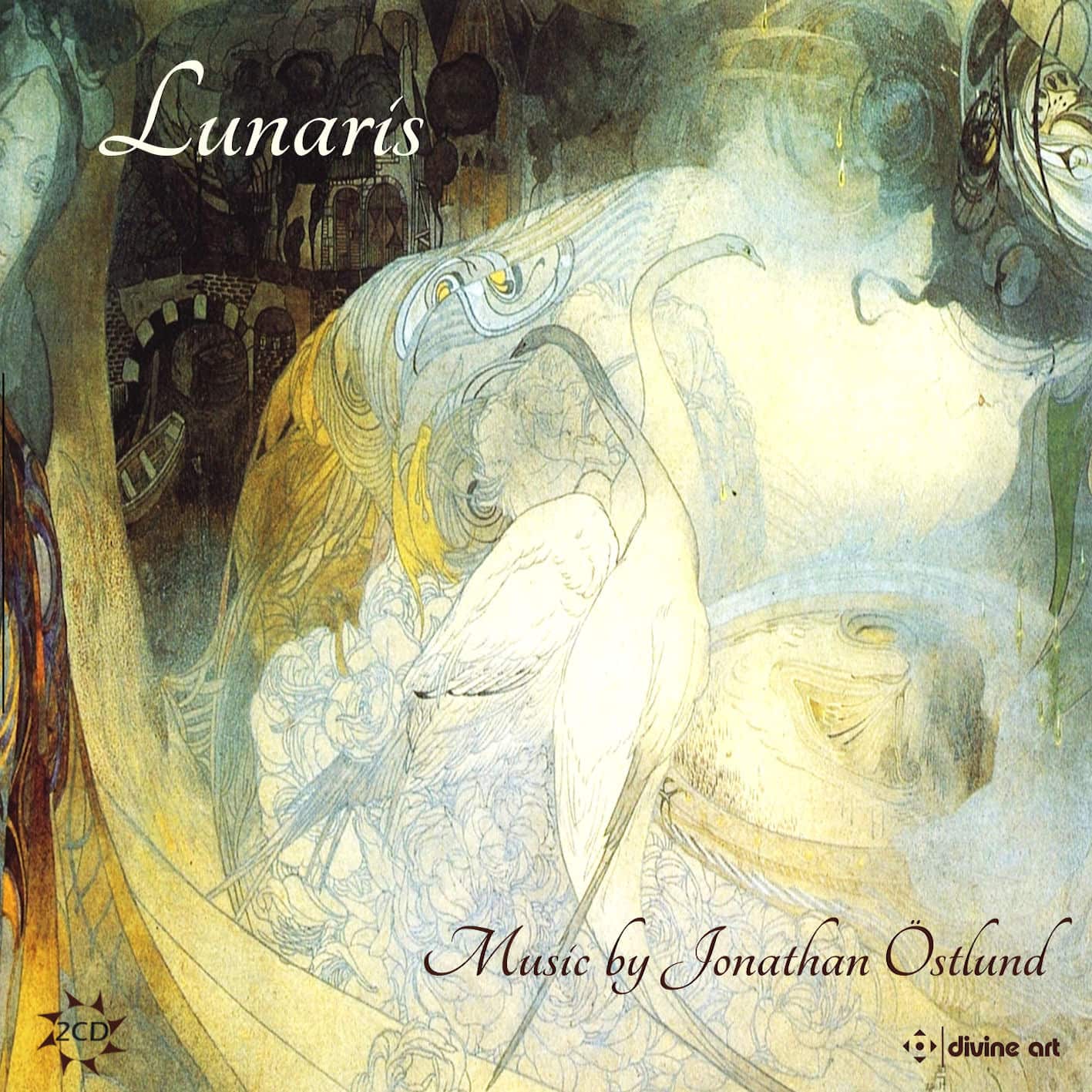
    Trying to describe this double CD in a short review is like condensing War And Peace into 25 words. There’s just too much going on to do it justice. The sleeve does a good job, suggestive as it is of dreamy, other-worldly soundscapes featuring unicorns and maidens in ponds.

    The CD opens with a haunting bird cry — it’s the black-throated loon (possibly as seen on the sleeve artwork) — and piano and voice mimicking that cry. Then it’s Opus Pocus Fantienne , which features piano and flute and possesses a magical air; it sounds like the music to a 60s children’s television programme set in space or a wood, Pogles’ Wood meets Clangers. That’s not derogatory: it’s got a playful feel (see the title) and that other-worldly quality. The same is true of Phantasion , a solo flute section being particularly Clangers-ish , and the flute-heavy Air Dans L’Air.

    Lumières d ‘Etoiles changes the tone, with a faster section of piano that’s almost a danceable folk tune — we reviewed some Percy Grainger the other week, and the opening section is much like a Grainger sea shanty. Fantasia on Scarborough Fair presents a dreamy rendering of the famous folk tune.

    CD2 opens reasonably conventionally with Night Struck and Winter Vigil, with the land of fairies and unicorns staying quiet until Rêve et Lune, thanks to soprano Ruxandra Ibric Cioranu (she who sings with loons from CD1). The longest piece is the 27m 28s of Miroir d’un Mirage, the six movements called O-N-D-I-N-E.

    We had to resort to Mr Google, which told us that Gaspard de La Nuit was a suite of pieces for solo piano by Maurice Ravel, based on the poem Ondine, a tale of a water fairy singing to seduce the observer into visiting her kingdom deep at the bottom of a lake. Opening with migratory aquatic birds, tales of water fairies? There’s a definite watery theme going on, though it’s all quite earthy at the same time. Other parts of the album, such as the string quartet (played by the Cellini Quartet) Rêverie (Jeux de Pluie are more traditional.

    A fascinating piece of work, guaranteed to make your dream­like reveries seem all the more fantastical. Incidentally: Amazon was only able to suggest one other option in its “people who liked this also like”…. facility, an Eric Satie; normally it suggests at least half a dozen, an indication of this work’s singularity.

  • New Classics – John Pitt – 21226

    Jonathan Östlund is a young Swedish composer who is winning acclaim for his attractive, imaginative and accessible music. He is being championed by some of Europe’s best musicians, several of whom have come together to perform on this album of chamber music and solo instrumental pieces inspired by nature. Evoking the magic of night in all its guises from the dark to the whimsical this lyrical new music has an individual sound and is in turn picturesque and witty.

    Highlights on this double-CD collection of timeless and sophisticated music include the magical title piece (for voice and piano), Lumière d’étoiles (piano solo), Rêverie – Jeux de pluie (string quartet), Rêve et Lune, The Frog Pond (for bassoon and piano) and Music at Moonrise. The talented young performers are the excellent Romanian-born soprano Ruxandra Ibric Cioranu, cellists Lydia Hillerudh and Alexander Zagorinsky, pianists Yoana Karemova, Blandine Waldmann and Einar Steen-Nøkleberg, Ariel Jacob Lang (violin), Ursula Leveaux (bassoon), Eleonore Pameijer (flute) and The Cellini Quartet.

  • The Classical Reviewer – Bruce Reader – 21226

    Swedish composer Jonathan Östlund received a BA and MA in Composition at Lulea University of Technology, in Sweden, studying under the guidance of Professor Rolf Martinsson, Professor Jan Sandstrom and Professor Sverker Jullander. Östlund has had several of his works chosen to be part of the London Schubert Players Invitation to Composers and was 2012 finalist of the Oslo Grieg Festival, winning the Public’s Choice Award for his Sonata for Cello & Piano Night-struck , premiered by Alexandr Zagorinsky and Einar Steen-Nøkleberg.

    He was awarded first prize in the Leicester Symphony Orchestra Composers’ Composition with his Celebration Fanfare & Procession which was premiered during the Leicester Symphony Orchestra’s 90th Season Gala. In 2013, his composition Lumière d’Étoiles received a world premiere in the U.K. and a French Premiere. In the same year he was a finalist in the Composers’ Competition of the Festival Mondial De L’Image Sous-Marine. In 2014 a number of Jonathan Östlund’s works were performed at London’s Cadogan Hall and in 2015 his work Ethereal Night’s Ascendance for symphony orchestra won a special mention in the IBLA Grand Prize Competition in which he was also appointed to the Most Distinguished Musician category.

    Divine Art Recordings have recently released a 2 CD set of instrumental and chamber works by Jonathan Östlund entitled Lunaris , performed by the Cellini Quartet , Ruxandra Ibric Cioranu (lyric soprano) , Alexander Zagorinsky (cello), Lydia Hillerudh (cello), Ariel Jacob Lang (violin), Einar Steen-Nøkleberg (piano) , Eleonore Pameijer (flute) , Blandine Waldmann (piano), Yoana Karemova (piano) and Ursula Leveaux (bassoon).

    Lunaris , for lyric soprano and piano, opens with bird calls and the sound of running water before soprano Ruxandra Ibric Cioranu vocalises around Blandine Waldmann’s piano line. Cleverly the lines of the soprano and piano complement the sounds of nature in this brief but evocative little work.

    Opus Pocus Fantienne brings together flautist, Eleonore Pameijer and pianist, Yoana Karemova. The work opens with heavy piano chords before the flute joins to move the music ahead with the piano driving the music and flute adding freely played phrases. Eventually the music finds more of a flow before a slower middle section where a lovely flute melody is finely drawn by these players. The music picks up momentum to lead to the coda. This is a distinctive and very engaging piece.

    The same artists return for Phantasion where the flute rises languidly over a gently meandering piano line. Midway Eleonore Pameijer brings an extended solo passage, weaving some very fine ideas before the piano rejoins to have its own moment of freely developed flow. The flute re-joins to take this beguiling work to its conclusion.

    Air dans l’air (Air in the air) brings Eleonore Pameijer as solo flautist; rising up to weave a fine melody before the music gains a rhythmic, dancing nature, which in itself gains a flow through some terrific passages, superbly played here. Surely a piece for any flautist to take up.

    Blandine Waldmann is the pianist in the solo piano work, Lumière d’etoiles (Star Light). In two movements, I. brings a hint of Shostakovich’s piano style at its most manic and wild before changing to a slow flowing melody. However, soon the opening energy returns as the two themes are set against each other with the faster theme leading to the coda. II. opens with a slow, broad theme picked out by the pianist and soon developed through some delicate, finely decorated passages. Here Östlund reveals a rather more personal sound. The music rises in passion before falling gently with bird sounds appearing in the gentle coda.

    Fantasia on Scarborough Fair for flute, cello and piano is an attractive set of variations on the well-known tune to which these players, Eleonore Pameijer (flute) Lydia Hillerudh (cello) and Yoana Karemova (piano) bring some fine textures and decorations in this work that is full of fine ideas.

    Rencontre (Meet) for flute and piano brings a complete contrast with a Latin rhythm as flautist, Eleonore Pameijer and pianist, Yoana Karemova dance ahead, this flautist soon weaving some fine flourishes against an ever changing piano line. This is another very engaging piece.

    The Wizard brings together flautist, Eleonore Pameijer; violinist, Ariel Jacob Lang; cellist, Lydia Hillerudh and pianist Blandine Waldmann. The cello opens with a rising theme to which the flute, then piano and violin join to spring ahead in a buoyant rhythmic idea. Light-hearted in nature each instrumentalist has opportunities to bring playful little phrases before weaving some fine passages together as they move quickly forward. The music slows in some longer drawn phrases but soon picks up the tempo again. Later there is another slower section with tapping of bows that heralds a hesitant moment out of which the players re-discover the rhythmic buoyancy of the opening. There is a terrific swirl of music headed by the flute as the instrumentalists rush to the coda with a flourish. This is a most entertaining piece.

    The Cellini Quartet bring us Rêverie – Jeux de pluie (Reverie – Rain Games). In four movements I. finds this quartet creating some exquisite textures as the melodic idea slowly reveals itself. The music moves ahead, slowly and melancholy, interrupted by little rhythmic lifts and flights of fancy. A repeated melodic passage arrives before a rhythmic idea leads to the end. II. seems to flow out of the theme of the first movement, though finding some fine textures and a lovely theme that slowly leads ahead later. III. brings a beautiful, melancholy theme with these players weaving some lovely phrases, gaining slightly in tempo before a coda that has a playful tinge. IV. flows ahead with a fine forward momentum, a forward moving weaving of ideas that later gains in rhythm and incisive textures before the coda.

    The second disc of this set opens with Night-struck , bringing together cellist, Alexander Zagorinsky and pianist, Einar Steen-Nøkleberg in this three movement work that opens with Invocation where the cello brings a quixotic little motif that is moved around and developed with some fine playing from this cellist. The piano suddenly leaps in to join the cello for Electrifying as they work up an incisive and more dramatic theme before a gentler coda. The piano opens in a broad, leisurely theme for Astray to which the cello soon adds a fine melodic line. Later the music rises in drama and emotion before a quiet melancholy coda, though the piano does add a more dynamic chord before the end.

    Pianist, Blandine Waldmann returns for Winter Vigil , a piece that slowly develops through some quite lovely passages, conjuring some very fine images whilst giving the impression of an improvisation. At times the music gains an almost Bach like flow before rippling phrases lead to the coda. This is a particularly fine piece.

    Blandine Waldmann is joined by lyric soprano Ruxandra Ibric Cioranu for Rêve et Lune (Dream and Moon). The piano brings a delicate, rippling theme to which the soprano vocalises over some very fine piano passages, often with a bell like clarity. The piano develops the theme before the soprano later returns, the piano leading to the coda.

    Blandine Waldmann is again the soloist in Miroir d’un mirage (Mirror of a mirage), a six movement work with each movement given a letter that as a whole spells out Ondine , presumably the water nymph of Debussy’s Preludes. I. O has a fine flowing theme interrupted by a more rhythmic elusive quality, certainly rather Debussyian in general feel. II. N finds a more incisive, dramatic quality as it moves quickly forward with varying tempi, separated by little pauses. III. D brings a constantly changing tempo and elusive character, quite beguiling.

    IV. I finds more of Shostakovich’s brittle rhythmic nature as it moves around, full of playful ideas, through more flowing passages, often gentler and crystalline, yet suddenly changing tempo and dynamics. V. N rhythmically develops from the preceding section through a variety of passages, with rapid descending phrases and a myriad of developing ideas. VI. E has a slow flowing theme that develops out of a more dramatic, complex opening. It grows in dynamics through often complex musical lines before a simpler flowing passage of lovely delicacy arrives to lead to a hushed coda.

    The three movement La Féerique et Pierrot (The Fairy and Pierrot) brings back lyric soprano, Ruxandra Ibric Cioranu and pianist, Blandine Waldmann. I. Pierrot – trop fatigue pour dormer (Pierrot – too tired to sleep) finds the soprano vocalising around a shifting piano theme. Bird cries are heard as the movement develops through some fine moments. II. Après la pluie (After the rain) brings a forward moving melody with occasional passages for solo piano before III. Nuages de nuit (Night clouds) finds an even greater flow for soprano and piano who provide a terrific flowering of melody with a series of rising phrases leading to the coda.

    The Frog Pond sees bassoonist, Ursula Leveaux joining pianist, Blandine Waldmann in a piece that opens with a rhythmic, rather comic theme from the piano to which the bassoon adds its playful timbre. Soon the bassoon takes a plodding rhythm over longer piano phrases until both these players come together. The second movement brings a dramatic piano motif to which the bassoon adds wavering chords. There is a rising and falling piano motif with these players bringing a great sense of fun and much skilful playing.

    Pianist, Blandine Waldmann brings a languid theme to the opening of Music at Moonrise but is suddenly overtaken by a fast, vibrant repeated motif from violinist, Ariel Jacob Lang. The piano re-joins with a broader theme before reflecting the violin idea, both soon pushing the music ahead vibrantly with some terrific, incisive playing from both these performers. The music becomes more passionate before falling into the final track Lunaris where soprano, Ruxandra Ibric Cioranu joins. Bird cries are again heard as the soprano vocalises bringing evocative sounds over a slow theme from the violin and piano, creating a fine sense of completion as the opening theme of this set of discs returns.

    Jonathan Östlund is a composer who reveals an ability to create works that are magical, playful and energetic but always with a distinctive sound, a sound that will surely appeal to a wide audience.

    The recordings, made at Greystoke Studio, London are close but clear and detailed. The booklet notes by the composer are intentionally brief as he wishes the listener to ‘dwell upon their meanings.’ The booklet and art work are up to Divine Art’s usual high standards.
  • Svenska Dagbladet – Sofia Lilly Jönsson – 21226

    The piano and chamber music on the new album by the Swedish composer Jonathan Östlund also carries a theme, namely: the night in all its guises. We encounter, throughout sixteen pieces, personages of the nocturnal world, both real and imaginary, and although we recognise Impressionism and Romanticism Östlund’s expression is strong at all times and completely his own.

  • His Voice (Czech Republic) – Jan Hocek (His Voice): translated by Stephen Sutton – 21226

    The London-based Swedish composer Jonathan Östlund is one of those contemporary composers who writes music with natural poetic melodies and highly sophisticated harmonies, blending tradition with contemporary expression. So far, he has composed over eighty works in which poetry is the main source of inspiration. On this new 2CD set, which was recently released on the British label Divine Art, we have 16 chamber works, whose unifying element is the nocturnal atmosphere, mystery, fantasy wonderland; some songs with the texture of spun moonlight. This explains the poetic title collection: Lunaris.

    The work ‘Lunaris’ itself provides both an introduction and conclusion of the double album. This Rautavaara-like song evokes the bird Cantus Arcticus, because it includes its voice;. There are vocals by Romanian soprano Ruxandra Ibric Cioranu with French pianist Blandine Waldmann; the final track, which connects the title track to another, significantly named Music at Moonrise, also features the Franco-American violinist Ariel Jacob Lang. The first seven tracks on the first CD are marked by almost romantically colored textures, more or less evocative of Debussy and Schumann, works for flute and piano and string trios. At the piano, performance alternates between the already mentioned Blandine Waldmann and Bulgarian pianist Yoana Karemova, with the excellent Dutch flautist Eleonore Pameijer and Swedish cellist Lidia Hillerudh. I love the adventurous trio composition ‘The Wizard’ in which we even hear flashes of art-rock elements. The first highpoint in this two-hour presentation of Östlund’s chamber music, however, comes in the last four tracks of the first disc. These form the string quartet ‘Reverie-Jeux de pluie’ in which we hear the London Cellini Quartet; here is a compositional structure informed by Shostakovich and Prokofiev, in addition to the drama, emotion and dynamics, which are compounded indeed with spicy dissonances and stunning gradation.

    The second CD opens with the sumptuous three-movement ‘Night-struck’ for cello and piano duo, performed by Norwegian pianist Einar Steen-Nokleberg and the Russian cellist Alexander Zagorinsky. After that, the piano is again taken over by the great Blandine Waldmann, whose style of performance whether displaying tenderness or vigor, with a typically robust, earthy and rhythmic keystroke, has the ability to simultaneously express even the innermost emotions. It shows in the delicate five-minute solo Winter Vigil and in conjunction with soprano Cioranu in a magnificent pearl with the title ‘Reve et Lune’.

    However, not only the moonlight and night are sources of inspiration for the creative Östlund. It is also Pierrot, the pantomime character of Harlequin from commedia dell’arte, in ‘La Féerique et Pierrot’ for soprano and piano. Sensibly the composer has avoided comparison to Schoenberg, as the piece remains more rooted in traditional tonality and melody, plus a meditative mood. In Östlund’s music, there are also animals, in this case a frog – mischievously brisk in ‘The Frog Pond’ in which bassoonist Ursula Leveaux (from London’s Nash Ensemble) plays alongside pianist Waldmann. The most substantial composition is then almost 28-minue ‘Miroir d’un mirage’ for solo piano (Waldmann). The title refers to Ravel’s piece ‘Miroirs’ and tells the medieval love story of a knight errant and the water nymph, whose name is contained in the six movement titles: Ondine. The music flows with extremely flexible interpretation, with both dramatic climaxes and romantically soft sections , with variations in color, texture, emotion and narrative expression. Full of passion, emotion, fatality…

  • Fanfare – Colin Clarke – 21226

    Beginning with the otherworldly cries of the Gavia Arctica bird (also known as the black-throated loon), the music of Swedish composer Jonathan Östlund gently makes its way into our consciousness in Lunaris for lyric soprano (here Ruxandra Ibric Cioranu) and piano. Rautavaara has played with this idea, too; it is such a successful gesture that it is surprising more composers do not experiment with this. Cioranu also impresses in the fluidity of her voice in the later vocalizes Rêve et lune, La Féerique et Pierrot, and Music at Moonrise/ Lunaris (the last of which also features the violin of Ariel Jacob Lang). The lighter tone of Opus Pocus Fantienne for flute and piano might come as something of a surprise, while the decidedly French Impressionism-fragranced Phantasion for flute and piano, performed in the most miraculous manner here, gives us a clue as to what lies at the heart of Östlund’s expression. Yoana Karemova’s piano playing is particularly sensitive.

    Many of the titles used by Östlund may well imply Impressionism, Air dans l’air being one of them. For solo flute, this short five minute piece flits around playfully; the similarly evocative Lumière d’étoiles opts to include the odd reference to lighter musical genres such as jazz, while its second part explores darker regions effectively. Blandine Waldmann is superb in her keyboard color, unafraid to opt for harsher sonorities when appropriate. The Impressionist moniker is perhaps not entirely apt, as Östlund’s range of expression is wider. Some pieces do, however, sit happily with that description, the lonely and lovely Winter Vigil (expressively played here by Waldmann) being a case in point. The change to Fantasia on Scarborough Fair is abrupt; we enter a nostalgic world closer to the Scepter’d Isle. Scored for flute, cello, and piano, this is a superb piece of chamber music, scored with a deft hand. There is fun to be had here, too – the Habanera rhythms of Rencontre for flute and piano, for example. Of particular interest is the playfulness of The Wizard . Delightful.

    The four-movement Rêverie – Jeux de pluie for string quartet is given a positively radiant performance by the Cellini Quartet. This is a fascinating canvas, full of color, with the second movement veering back to the folky sentiments of Fantasia on Scarborough Fair . The inventively named Night-struck for cello and piano (the first of the three movements is for cello alone) is rather rugged, the second movement in particular, which is indicated as “electrifying.” Alexander Zagorinsky’s cello is highly expressive, not to mention passionate.

    Each disc contains one larger-scale work. For the second, it is the 27-minute Miroir d’un mirage for solo piano. Each of its six movements is prefaced by a single capital letter, which together spell “ONDINE”, a clear pointer towards Ravel, and indeed atmospheric pedal-haze is part of this piece’s expressive armory; so, too, is a more dissonant mode of expression (the second movement, for example). The lumbering gait of the fifth movement is well projected by Waldmann. It’s nice to see a piece for solo bassoon, too: The Frog Pond . Playful in extremis, Ursula Leveaux and Waldmann clearly have fun in both of its movements.

    The booklet is mainly filled with biographies of the performers. The composer states that “the inspiration, message and outline of many compositions benefits from remaining undefined”, so we are effectively left with our own ears to assess this music. That’s no bad thing. Östlund clearly has much to say, and he says it in a consistently interesting manner. Fully worthy of investigation.

  • Lunaris – Music by Jonathan Östlund

    Lunaris – Music by Jonathan Östlund

    A super showcase album of piano and chamber music from talented Swedish composer Östlund, performed by a select group of leading young European performers. Evoking the magic of night in all its guises from the dark to the whimsical this always lyrical and accessible new music has an individual sound and is exceptionally attractive. Some works include wordless voices from the soprano.