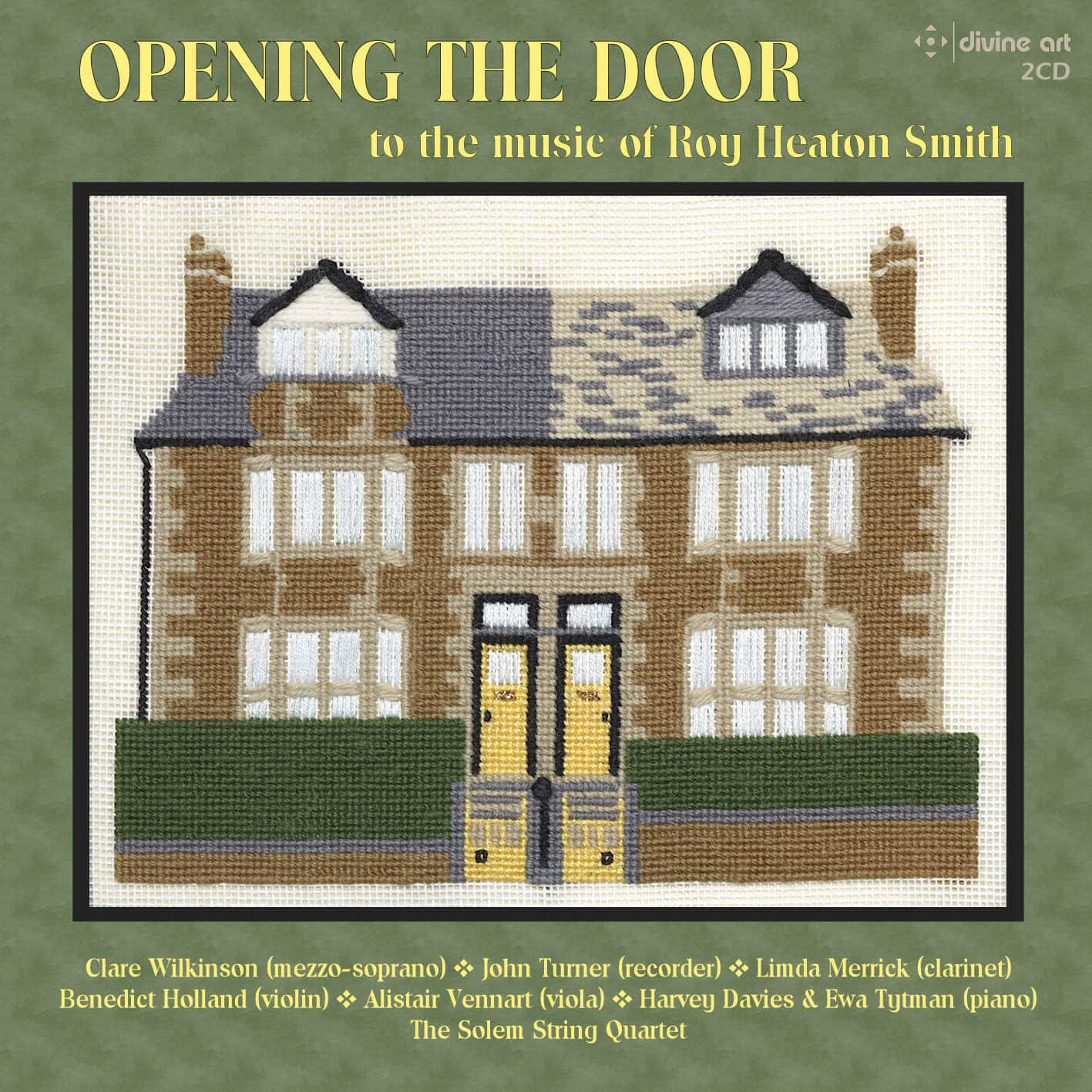
Roy Heaton Smith is probably a new discovery for many listeners. Based on the music presented on this double CD, he is most worthy of the dedicated work that has been put into the production of this unique retrospective.
A few notes about the composer are essential: I rely on the liner notes for this information. The composer was born in Middleton, Manchester in 1928 and died there in 2014. He began composing as a teenager; however, the ‘day job’ as an accounts clerk got in the way. He studied piano with Noel Walton, Sir William’s brother, and composition with Richard Hall. In 1950 he won a scholarship to attend the Royal Manchester College of Music (now the Royal Northern College of Music) where he had additional studies with Hall. Heaton Smith won the Royal Philharmonic Society Prize for his Phantasy for voices and string orchestra. For much of his career he was Head of Music at the Queen Elizabeth High School in his home town. He held this post from 1960 until his retirement in 1984.
The liner notes tell us that Heaton Smith wrote a good deal of music in a wide variety of forms. More details about these would be helpful as there is little information on the Internet or in the standard reference works. The listener will be struck by a number of musical influences in Heaton Smith’s music. He was clearly inspired by Shostakovich, Britten and Bartok, amongst others. Notwithstanding, his music is original and is not a pastiche of these composers. He certainly was not one of Vaughan Williams’ ‘corn-merchants’ (Elisabeth Lutyens) nor did he aspire to the Manchester avant- garde represented by Peter Maxwell Davies, Harrison Birtwistle and Alexander Goehr.
The opening tracks on CD 1 present the delightfully whimsical Three Bagatelles, op.46 for recorder, viola and clarinet. Most likely written for Heaton Smith’s own use, this work was probably never performed. The opening ‘scherzo’ is vivacious, the ‘dance’ restrained and the final ‘capriccio’ is ‘knockabout’ in its wayward humour. I love it!
Of more serious moment is ‘A Suite of Variations’, op37 for viola and piano. This work lasts for nearly quarter of an hour and presents six well-considered variations, preceded by a reflective theme played on the solo viola. The music progresses through a sad ‘berceuse’, an affecting arioso and a nervous toccata. The last three variations include a deeply felt ‘elegy’ a none too light-hearted ‘intermezzo’ and a thoughtful finale. The Variations were written in 1955 and dedicated to Brien Stait: it was a prizewinning work in the SPNM’s (Society for the Promotion of New Music) Harry Danks Viola Competition. It was first heard in The Great Drawing Room of the Arts Council of Great Britain, St James’ Square, London, on 6 July 1955.
I found the ‘Pastoral’ a magical experience. It quite clearly out-Britten’s Britten in its effectiveness, colourful scoring and musical interpretation of the text. This piece is based on a long poem by the Heaton Smith and is set for medium voice, recorder and viola. It was composed in 1969. The balance of the parts is near perfect in its portrayal of the composer’s imaginary, but captivating pastoral landscape.
The liner notes give little detail about the Introduction and Variations, op.24 for violin and piano. Yet, this one of longest and most impressive works on this CD. It was first performed at Aberystwyth University during July 1951 by the composer’s friend Brien Stait and an anonymous pianist. After a short ‘introduction’ played ‘feroce’ the soloists present a lovely romantic tune. This is followed by four variations. The music has a well-judged balance between aggression and reflection.
The composers Henri Duparc and Gabriel Fauré provided the inspiration for the ‘Trois Chansons Romantiques’, op.22 for mezzo-soprano and piano. They were composed during 1950 whilst Heaton Smith was studying with Richard Hall at the Royal Manchester College of Music. These songs are evocative settings of poems by Alfred de Musset, Paul Verlaine and Henri Chantavoine. In spite of their ‘retro’ feel these are commendable ‘chansons’ that are both satisfying and musically perfect. I would have appreciated an English translation of the songs, as schoolboy French does not stretch to the subtleties of a literary translation of these beautiful words.
The earliest piece on these CDs is the melancholy Passacaglia. This was the first movement of a string quartet that was subsequently abandoned: either not completed or discarded. The music was composed during the autumn of 1948, but was not finalised until May 1950. The liner notes suggest that it was never performed until the present recording was made. The music is not serial, in spite of the use of all twelve notes of the chromatic scale. There are 17 variations which maintain the mood of the opening cello solo, but provide interest by subtle string writing. It is a very beautiful piece that is far removed from the contemporaneous music of a Ralph Vaughan Williams or a Humphrey Searle.
The String Quartet written between 1951-4 is a different kettle of fish. It presents a buoyancy and energy in the ‘overture’ that chases away any gloom. There is a reflective ‘second subject’ but this is more a pause than a change of mood. The second movement is a set of variations which fulfils the function of the ‘slow movement and finale.’ This begins with a pizzicato cello solo, followed by a gradual increase in tension until the short but dynamic ‘presto’ clears the air. The composer has a masterly understanding of string writing. In spite of being a work of its time, it is a little masterpiece. Once again the present performance would appear to be the quartet’s premiere.
I was delighted by the ‘early’ ‘Sonatina alla Fantasia’, op.23 for soprano recorder and piano, composed in 1950/1. This short, but highly inventive little piece has three ‘linked’ movements: there is considerable cross-reference between the opening ‘allegro moderato’ and the closing ‘allegro scherzando.’ The middle movement is a measured ‘andante molto’ that contrasts chordal passages for piano with unaccompanied recitative from the recorder. Just here and there I found hints of Malcolm Arnold’s exuberance, especially in the fast sections.
There is a neo-classical ‘grittiness’ about the Sonatina, op.19 for piano solo (1949). The liner notes suggest that it reveals the influence of Stravinsky, Bartok and Poulenc. The bitonal ‘allegretto con moto’ is followed by a less-than-restful, but beautifully contrived ‘lullaby,’ The rondo is a tour de force, counterpoising irregular motor rhythms (if that is not a mix of metaphors) with less dynamic and almost Ireland-esque interludes. It is a complex and virtuosic work that belies the title: this Sonatina is no teaching piece. This is a work that deserves to be in the pianist’s repertoire.
I did not warm to ‘A Vision of the Future’ which is a ‘heartfelt diatribe against conflict’ composed in 1966. It is a setting of two ‘verses’: one by the composer and the other by Alexander Pope. This is just a little bit too ‘pacifist’ for my taste. I am very proud of the men and women who fought against Hitler in the Second World War, ‘In the desert and jungle/In frozen seas/Men died…’ I do not regard their sacrifice as futile (‘And for what?’). I concede the idealistic hope for peace demanded by Pope: we all do. The musical onomatopoeia is just a little bit over the top. On the other hand, I can well imagine other listeners declaring this ‘Vision of the Future’ a masterpiece, and there are certainly some wonderful moments in the work.
The Four Folksong arrangements, op.26 for medium voice, clarinet and piano were composed in 1948/9 and were revised in 1951. Tunes that were once upon a time very well-known have been extracted from the National Song Book (1905) published under the auspices of Charles Villiers Stanford. There are settings of ‘Robin Adair’, the Northumbrian ‘The Keel Row’, a wistful ‘Farewell Manchester’ supposedly dating back to Bonnie Prince Charlie’s retreat from the Lancashire city on his way up the road to Culloden. The final song is a setting of words by Alfred Percival Graves (1846-1931) ‘Good Morrow, Mistress Bright’ which brings the set to happy ending.
I found the ‘bonus’ track absolutely delightful. The Divertimento for clarinet and strings was taken from a radio broadcast made during March 1958. Stanford Robinson conducted the BBC Northern Orchestra. This work, as the title would suggest, is ‘light’ rather than profound. I found myself thinking of Prokofiev’s Peter and the Wolf as the music progressed. In fact, the composer was influenced by Schubert’s German Dances! The old AM broadcast has been restored by Richard Scott. It is a wonderful ‘find.’
The soloists are totally committed to Roy Heaton Smith’s music. It is unfair to pick out ‘favourites.’ However, I loved Clare Wilkinson’s voice in all the vocal works. And John Turner has brought his renowned enthusiasm to both the production and the performance of this music. The liner notes are excellent, with musicians’ biographies and lots of photographs. A little more analysis of some of these unknown works would have been of great interest. The texts of all the songs are helpfully included, except the translations as noted above.
I am not sure what other works Heaton Smith composed: I do know there is a well-regarded Clarinet Concerto in the catalogue. I guess that much of his output has remained in holograph. The only piece I had heard before reviewing this CD was the ‘Sonatina alla fantasia’, op.23 which appeared on the CD ‘Anthony Burgess: The Man and his Music’ (Metier MSV77202). I hope that more detail of Heaton Smith’s achievement will emerge, both in the musical press and on CD. Based on this present two-CD exploration of his music, any forthcoming performances will be essential listening for all enthusiasts of British music from the second half of the 20 th century.