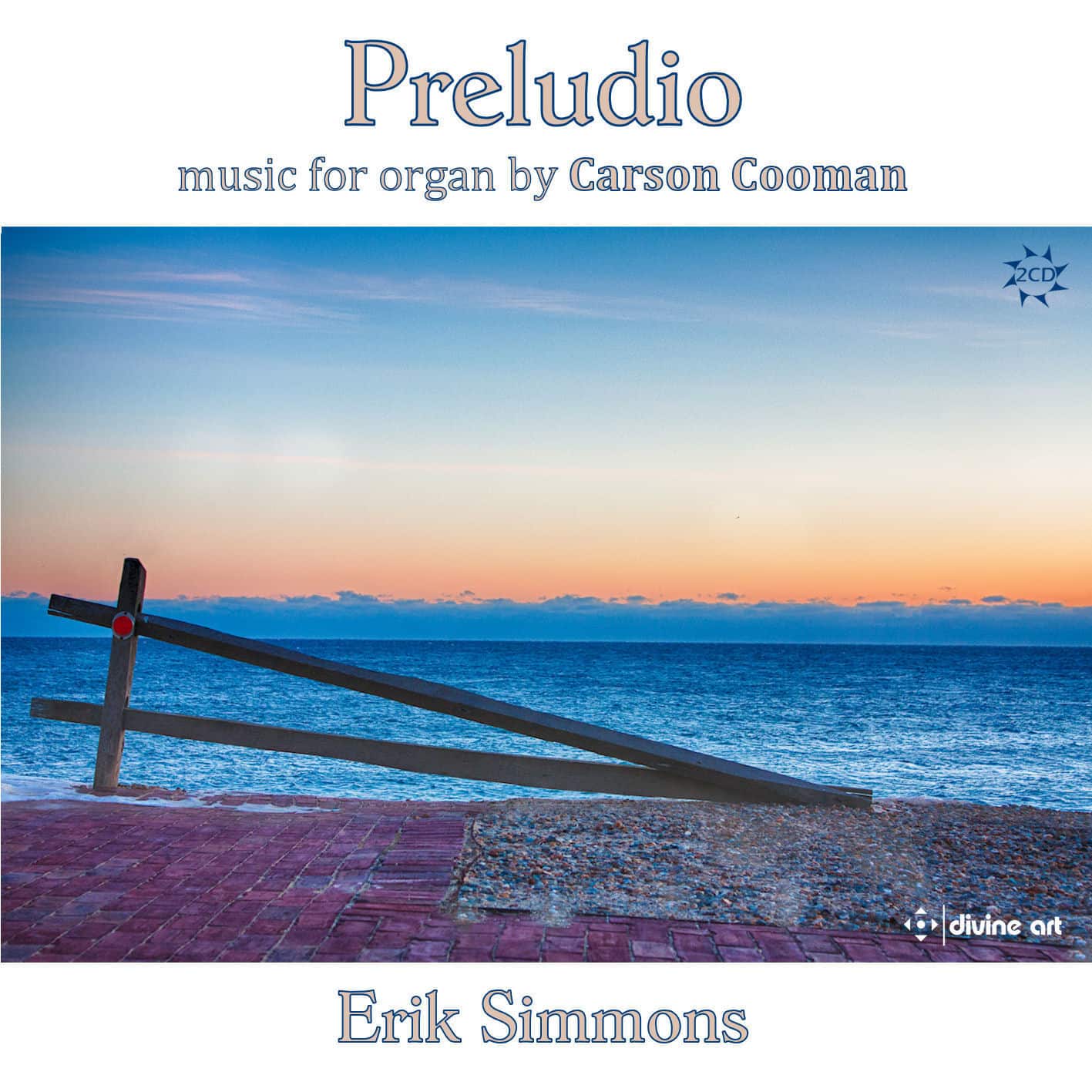
I’m beginning to feel an unspoken challenge by my distinguished Fanfare colleague Carson Cooman, viz., “Can you review my music as quickly as I can write it?” Well, so far, yes, but I’m feel¬ing the heat! If he gets any faster, he’ll leave me in the dust, and some other reviewer will have to take on some of the discs to allow us to keep current with him.
The present anthology contains two well-filled discs of organ music, the medium in which I believe Cooman has written more music than any other. This is not surprising, given that he himself is a well-known organist, and feels completely comfortable in writing for his instrument. Indeed, his compositional legacy for the instrument will surely be considered one of the more important of his era in 100 years. Whoever may be writing for Fanfare in 2117 may well be reviewing a 50-CD set of his complete music for organ (OK, yes, CDs will be thoroughly obsolete by then). Most of these pieces were written for and dedicated to particular organists, and sometimes even organ-builders. If even half of these dedicatees have performed the pieces written for them, I dare say that Cooman is the most widely performed composer for the organ who is actively writing for the instrument today. I just returned from Maine, where I’d traveled to hear organist Randall Mullin premiere my Organ Symphony. He asked me out of the blue if I knew Carson Cooman.
The works on this set span the years 2009 through 2015, and span the opus numbers 845 through 1122. Cooman writes music in a lot of different styles, but the works on these two discs are almost all very “retro” in their style, quite in keeping with titles such as Plaint, Voluntary, or Canzona that one frequently encounters in music from the late 16th or early 17th centuries. Indeed, if you were to play some of these works for a musically astute friend and ask him to guess the composer, he might be as likely to guess Michael Praetorius or Orlando Gibbons as anyone who was alive in the 21st century. In some of the works, homage to this era is in the forefront of his mind, including his Three Renaissance Dances. To be sure, this is not true of all of the works heard herein. No one would think “late Renaissance era” were he to hear the Canto e Fugato with its secundal clusters or non-diatonic tonal intrusions. Even for the pieces that are more strongly reminiscent of that era, though, Cooman has his own voice, and someone well-versed in his music will easily spot his fingerprints, which in¬clude a sure sense of counterpoint containing occasional piquant sonorities out of diatonicism, sur¬prising turns of melody, and unexpected harmonies. To quote the composer himself, “It is my hope that [these works] present a fresh look back in respectful homage, but from the distinct vantage point of my language and style as an American composer of the present age.” I must say that I think Cooman’s experiments are consistently very successful towards the above-stated goal.
The mood of the pieces varies a good bit. Many of these pieces are contemplative in style, and may be intended for liturgical use. The Roundelay, for example, would be appropriate as an offertory during a worship service, while the Rondeau I can well imagine as a joyous recessional to conclude a service. Many of the less meditative pieces, in fact, have an underlying joyful spirit pervading them. Just listen to the Kleine Spielmusik, for instance, and see if it doesn’t lift your spirits. The work that closes the set, Canzona II, is among the most majestic organ works that I have ever heard.
Organist Erik Simmons seems to be Cooman’s artist of choice for me recording of his organ music: He appears on four previous recordings of Cooman’s music residing in my collection (and there is a fifth that I do not own). Simmons does his usual splendid job in presenting these works to the listener, drawing on a wide variety of the colors possible on the organ, and playing with cleanly articulated lines (a sine qua non in this music), and with verve and spirit. The organ utilized in this set is the one found in the Basilica Maria-Himmelfahrt in Krzeszów, Poland. The instrument, built by 18th-century organ builder Michael Engler, and being rich in foundations, mutation stops, and mixtures, seems perfectly suited to this music. Simmons, however, did not have to travel to Poland to make these recordings, having made them utilizing the Hauptwerk System, a computer program wherein many of the great organs in Europe and America have been digitally sampled. Every single note of every stop on these organs is recorded, not once but with various attacks and releases, giving the organist using the program (and playing actual key- and pedal-boards) the ability to reproduce uncannily the sounds of the organs thus sampled. The acoustic ambience of the cathedrals they’re in is also captured. Randall Mullin, mentioned above, showed me the Hauptwerk System in his condominium in Maine just a few days before I wrote this review, and that is the only reason I can describe how it works here.
If you admire Cooman’s music, as I do, or if you simply desire to hear two and a half hours’ worth of finely wrought organ music by a master of the instrument, this will be a set that you will certainly want to acquire. Definitely recommended to organ enthusiasts, and to others as well.