Catalogue Connection: 21230

  • Ivor Gurney Society review of ‘Sappho, Shropshire & Super-Tramp’

    Richard Carder was championing unpublished Gurney songs, bringing them to performance, with his English Poetry and Song Society (which took the initiative for the present recording) long before most of us had even heard of them, let alone heard them.

    His vision, dogged determination, insistence on their quality, and passion for bringing them back to life, pre-empted and heralded the healthy, improved situation today, when we see many of these hitherto hidden gems, of undoubted quality, brought out of manuscript and appearing on CD with singers of note newly championing them.

    Sometimes he took and weathered a degree of flak for the urgency with which he stated his case. But he has been proved right. We owe it to him, too, that we now have Seven Sappho Songs which launches the first of these double discs, entering the repertoire, thanks to his pioneering in getting a handsome volume issued by Thames Publishing. The idea was that several of these sets of songs – settings or verses by Rupert Brooke, or F. W. Harvey, or fellow wartime poets, for instance – merited preserving as a cycle. This is the notion behind the Seven Sappho Songs, and it has to be admitted it largely works.

    On this attractively programmed Divine Art (divine art) compilation – and it is a handsomely designed production too, well laid out, with composer biographies and all texts given in full – Carder’s initiative has yielded a tangible benefit for those drawn to English art-song. As well as the Gurney cycle (which starts), he has brought together ten or so composers, mostly with birthdates spanning 1926 to 1943, to which add two more recent ones, Robert Hugill (b. 1955) and Janet Oates (b. 1970). Of these, mercifully, only one, Simon Willink (1929-2015) had died at the time of the making of this disc. Dennis Wickens is into his nineties, and Brian Daubney and Graham Garton just entering them.

    It is thus drawing attention to a range of repertoire from a period that, apart from the sterling work of the EPSS, is only just making its way into public awareness. It is even in that respect a valuable service.

    After Gurney, from each of the first three composers on disc 1 – Carnell, Watts, Wickens – he includes a cycle of six or seven songs; each. Five others are represented on CD 2 by four (or five) songs each. One or two songs from three others complete that second disc. One of the most pleasing things is the rich wealth of poetry chosen and set by all of these composers.

    The slightly fruity voice of Sarah Leonard on this divine art recording is perhaps a matter of personal taste. But she gives us the songs, warmly delivered, with some superbly articulated accompaniments throughout from the beautifully accomplished Nigel Foster. It helps that ‘The Apple Orchard’ one of three previously published items in the Gurney songs, is so light and dancing. Leonard sings it with utter charm, dainty and eloquent, a treat of a performance.

    Yet interestingly, Carder notes that he sought the advice of the late Trevor Hold, himself an English song composer of note, who told him that ‘The four unpublished [Sappho] songs were much better than the three published ones’, a judgment that gives added weight and support to Carder’s own opinion on their quality.

    The other initially scherzoish song is ‘Love shakes my soul’. Sappho’s poem is indeed violently passionate (though not all through); one senses, for the sake of variety, that the song might have benefited from being taken a mite faster – although from the way Gurney writes that might be not easily achievable. To a degree the chromatics, as in ‘The Quiet Mist’ (with more piano triplets) come across less than precise with Leonard’s quite marked vibrato.

    The need for variety arises because the bulk of the Gurney settings are on the slow side, wafting somewhat, sometimes ingeniously but sometimes with less clear intention; although rightly capture the essence of the decidedly wistful last line of song no. 7: ‘The Pleiads / Gone, the dead of night is going, / Slips the hour, and on my bed / I lie alone’ (a thought Housman was to recall’). ‘Soft was the wind’ undulates gently, the swifter rocking triplets of the piano echoed in the voice part, the key shifts still perhaps a little too wafting. ‘I shall be ever maiden’ gains in pace, the accompanying semiquavers supplying a sort of simmering underlay, notably assured; only the conclusion feels a bit abrupt, whereas that of the ‘Apple Tree’ is beautifully spaced out, a gentle end to the dance.

    The most exquisite slow song is probably ‘Hesperus’, a moving hymn to the Evening Star. It breaks into two equal verses, and comes closer to the idiom of the most expressive of Gurney settings, such as Edward Thomas’s ‘Lights Out’ (‘I have come to the borders of sleep…’). ‘The Quiet Mist’ seemed to know where it is going; but gradually the wafting in voice or piano part alike seem to be searching for apt key shifts, rather than in control of them. Is there a continental influence in some of this? Just possibly.

    The wistful last song (‘Lonely Night’) begins enchantingly, the link passage between the two verses works well, and the undoubted pathos of the desolate lines is well brought out, the end especially.

    William (Will) Carnell, (b. 1938) studied music with another gifted composer who would have sat well on these discs, Ruth Gipps, whose orchestral output has recently been championed by Chandos. A Country Lover is a collection of six poems by AEH, including the popular ‘Bredon Hill’, but also embracing other Housman verses less commonly set.

    Carnell’s first song, prefaced by a warm if slightly naïve long introduction, unfolds a lightly dancing, or prancing, amusingly confidential main tune (‘…Tis true, young man, ’tis true’). It’s not far from the attractive way Butterworth treats Housman. ‘If truth in hearts that perish’ is aptly slow, again a relatively straightforward setting, pleasantly tonal, perhaps a fraction simplistic, though it enlivens in verse 3. The whole cycle benefits from the appearance of Johnny Herford, a baritone of attractive timbre and excellent, pure enunciation, who engaging personality – like Leonard’s – enhances many of the settings on the disc.

    Bredon of course suggests bells, and Carnell’s evocation of their sound across village and fields is enchanting and not just pealing, but appealing (as Brian Daubney’s equally evocative depiction of them on disc 2 will also prove). It’s, rightly, a blithe and cheerful song till the penultimate verse, when we encounter the ominous ‘and went to church alone, and then ‘the one bell only’ – the grim tolling of the funeral summons. Both performers hold the music back to striking effect. And an attempt at a return to the blissful start yields instead a poignant hold up: ‘Oh, noisy bells, be dumb; I hear you, I will come’. Both settings of this famous Housman poem are markedly successful.

    The setting of ‘Along the field’ (‘Along the field as we came by A year ago my love and I’), a shy andante, is seemingly optimistic, but – this being Housman – there is a poignancy lurking underneath, which finds fruition in the last two lines, set perhaps a little benignly: ‘When I shall sleep in clover clad And she beside another lad.’ ‘White in the moon the long road lies’ involves a rocking, even (again) marginally bell-like accompaniment, though the second verse (‘My feet upon the moonlit dust’ ‘Pursue the ceaseless way’. is appropriately more halting, as if the journey is a difficult one, more suggestive of anxiety, of unending striving: what lies beyond? This and the last song, ‘There pass the careless people’ are somewhat similar in demeanour, although the last, interestingly, has a feel of Gurney in the vocal line.

    ‘Gypsy Girl’, the cycle by Michael Watts (b. 1937, a handsomely prolific composer now living in Majorca (and listing some 160 works at the time of this recording) evokes the ‘Green eyes, green as basil, green as a meadow’ of the espied wench. The song wafts, tenderly. There is even a feel of bells, which emerge more obviously in the second song, ‘Silver sighs’. The text (Paul Archer) is utterly beautiful, and touchingly enamoured. Are these exquisite light-stepped dreams and sighs best evoked by a wan adagio, as here? Happily the next song is vivacious: a patent scherzo, cheekily whirling along, in both keyboard and voice. It even has the slight feel of a Britten cabaret song. A skilled effort.

    The piano part, all but an ostinato, yet again seems to peal gently. Watts plays around with key, pacing and tessitura to lend these songs fractionally more bite than the preceding Carnell cycle. There is more of the unexpected here. A repeating high note on the piano suggests the ‘cold wind’ of song no. 5, ‘If the cold wind comes’, is somewhat ominous, as might suggest a ballad, not least as the poem engages ‘song of sorrow, I sing of my lost one’. As the mood grows gradually grimmer, the feeling is fraught with danger.

    Watts seems often, as in the last song, ‘If you’re light’, to be urging the music into a kind of bitonality. The text (‘You say it breaks your heart…) is itself mysterious, even fatalistic: ‘But if you’re the light and I’m the shadow we’ll become as one when day fades to night’. The dark plodding passacaglia that accompanies ‘When it’s snowing in the serranas’ is pleasingly apt. Yet here too we meet an issue mentioned above: the pacing of slow, even (here) ultra-slow songs in succession can be less than ideal. While Leonard certainly catches the gloom of the setting, which one welcomes (the ‘lone shepherd’ is indeed mourning ‘a woman he once knew’, she of the ‘green eyes’ of the first song, one wonders if such an trudging adagio is the best way to get the intensity of even these sad words across best. It’s all a bit moaning (which could of course be justified). The words are all by Paul Archer, and inspired by flamenco performers from Spain.

    The first of Dennis Wickens’ songs (‘This Life’ – seven well-chosen poems by W. H. Davies) is a decided pick-me-up. Its bugling salute sounds very much in the Britten mould, and the buoyant text (‘Good morning, Life – and all Things glad and beautiful…’) is very attractively handled. You could imagine Peter Pears relishing this song. (Wickens, interestingly, a noted singer, was Director of Music at the Royal Grammar School, Worcester and a Lay Clerk in Worcester Cathedral choir.)

    His second and third songs (about a Butterfly, and about rain yielding to bright and joyous sunburst), are both oddly slow, though in the former the second verse picks up and emerges nicely optimistic, while the latter (‘A wondrous light will fill Each dark, round drop’) grows very mysterious, relieved by some skittish writing for the piano, to which Foster brings wit and impishness.

    One naturally hopes for a successful and expressive setting of W. H. Davies’ most famous poem, ‘What is this life if, full of care, We have no time to stop and stare?’, and certainly it gets it here, a boisterousness prevailing early on, the piano line skittering, the voice riding beautifully above. ‘In the Country’, however, is another of these overegged slow settings that, here at least, somehow fails to bring out the very pretty words (‘This life is sweetest; in this wood I hear no children cry for food; I see no woman, white with care..’ . Here is joy and good cheer, even if it leads on, by contrast, to the poet’s observation, and severe condemnation, of ‘Hunger in almost every place.’ Shifts of mood are clearly indicated. But why are so many of these songs, or performances, or both, dedicated to a strangely inexpressive deep gloom? ‘a wretched life’ or ‘cursed’, ‘sad and wan’, ‘misery’ of course do suggest it. But it places too much belief in the idea that the ponderous equals the communicative. It is the main drawback of this otherwise valuable CD collection.

    ‘This Night’, sung again by Herford, brings on another dark setting, a glowering owl adding to the gloom. . The owl’s haunting ‘to-whoo’ Oh-o-o in the Davies) lends atmosphere, and, as the poet admits, ‘Has found his fellow in my mood’. Even the Moon cast a dark shadow. Pessimism, a marked grimness, prevails. Is this a murderer, not a grieving lover? Or both? (‘Thy lover is a skeleton ! “And why is that?” I question – “why?”). The figure in the owl stanzas ‘sits here alone’; the figure in the next poem is ‘lonely’. Wickens’ sly ending is rather clever; the sort of thing one looked for elsewhere in this cycle.

    Simon Willink, who died in 2015, was both an ordained priest, holding benefices in both Gloucestershire and New Zealand, and briefly Chairman of the EPSS, in whose concerts he also often sang. The beguiling words of ‘Sea and Sky’ he wrote himself. The opening is serene, fairly somnolent, floating, the piano part especially delicate and questing. The first half continues in like vein, but the voice enlivens at ‘a passing storm’ with ‘its thunderous scowl’, and the breakers ‘stabbed with crimson glory’, the setting perhaps a little benign. It has an elegance and tenderness, although why ‘the scene is beauty’ and ‘so pure, so pale’ insist on the same kind of drowsy, pensive treatment is not entirely clear. Yet it is an attractive setting for all the reservations.

    David Crocker’s settings of ‘A Great Time’ (also W. H. Davies) and ‘My Whole World’ (Alfred Warren) enliven things somewhat. Crocker was also briefly Chairman `of the EPSS, so the disc is amongst other things a tribute to several fine musicians connected to the Society. Born in Lincolnshire, and recently returned there, he spent two decades teaching at what became Leicester De Montfort University.

    ‘A Great Time’ (Davies again: he figures large on this disc, another bonus) moves along agreeably – again a hint of Butterworth. A nice use of rubato in both voice and accompaniment helps generate atmosphere and maintain a measure of variety. ‘My Whole World’, the second Crocker song – there are only two – seems a little dependent on a simple crotchet feel. Is there is a little bit of the ‘cow looking over a gate’ here?

    The elegant picking out of a skilfully devised piano part, with a kind of passacaglia feel. Though it is yet another slow song, it is possible to say there is more going on, more deftness of conceit in this song than any hitherto. It is by Sulyen Caradon, though this turns out to be an agreeable pen-name for Richard Carder himself, modestly restricting his contribution to just one song. This is undoubtedly one of the better efforts. Here the own singer is Sarah Leonard, and she catches both the spirit and the detail well. It is short, but cleverly engineered. Importantly, the song shows Carder’s skilled way with words. One of the most attractive and alluring settings.

    Brian Daubney, another closely linked with the EPSS (like Crocker briefly Chairman, and likewise closely associated with Lincolnshire) is another who sets Housman, and is successful in inventing attractive, rather cleverly wrought bell patterns for ‘Bredon Hill’ – first tinkling quavers, then some rather effective chordings, and of course latterly, the ominous single bell, here chorded. He has the idea of setting the third stanza (ending ‘…And come to church in time’), where the grim truth behind the languorous poem begins to emerge, a cappella. This song has much to commend it, from several blithely wrought stanzas to the affrontedly exclaimed penultimate line. Herford’s ability to conjure mood is a distinct bonus.

    Daubney’s ‘Boot and Saddle’ is a gratifying setting of Robert Browning, and here we find a genuine, if not scherzo exactly, something close: a fast-riding, fast-trotting song, well-judged for the equestrian ballad-like poem, set in a previous century, apparently the 17th. The mood here is not gloomy, but vivacious.Sarah Leonard achieves another success with Daubney’s high-reaching treatment of a touching, quite popular poem by Emily Dickinson , ‘Because I could not stop for Death’. Also thanks thanks to some telling pauses, the handling of the slowish ‘The Dream City’ (Humbert Wolfe, 1885-1940) works pretty well too. The ostinato below the voice is kept at the same pace: perhaps that might have been varied, by way of enlivening. Daubney’s last is a Thomas Hardy poem, ‘Waiting Both’, a conversation of sorts. The singing is nice; whether the ponderous pace is justified is another matter.

    Enter Graham Garton, by chance the third composer here with Lincoln connections (he was a cathedral chorister there, and made his first sorties into composition while still a singing boy. Lennox Berkeley was one of his teachers at the Royal Academy. He too, initially at least, is drawn to W. H. Davies, whose ‘What is this life if, full of care’ (sung by Herford) is a great deal more vivid than Wickens’ on disc I. Indeed both at the start, with its energetic piano contribution from Nigel Foster, and later we almost could be in a Britten opera. Here is a song where the pace changes, and the mood, and the word-painting is especially proficient, while the piano has many vivid touches of its own. Much of this is highly atmospheric. The accompaniment intersperses a highly dramatic manner, with lightly fingered surges, scampering indeed, all very effective; while the voice intermittently reaches up to some high notes verging on coloratura. The operatic approach could not be more apt for Tennyson’s famous ‘The Eagle’ (‘He watches from his mountain walls, And like a thunderbolt he falls’) – the last line achieved with a wonderful unforeseen suddenness.

    After the Tennyson setting, touching on graphic violence in the wild, the essence of Walter de la Mare’s ‘Song of the Secret’ is regretful: ‘Where is beauty? The cold winds have taken it…the clear naked flower if faded and dead’ is indeed sombre and wan. Too much so? Rather more effective (again Leonard) is the impish, twirling ‘The Shade-Catchers’ (Charlotte Mew, Victorian English poet, 1869-1928), with its playful interplay – both the voice and the keyboard dance – between small brother and sister, ‘scudding away on their little bare feet’.

    ‘Dawn’, a setting of William Barnes, the celebrated 19th century Dorset poet, is another restrained setting, with occasional or momentary changes in pace to lend a brief variety. It’s by Frank Harvey, another name to catch the eye. The composer has spent much of his time in Wiltshire – the reference by Barnes in his final stanza to nearby Hambledon in ‘Dawn’ was doubtless an attraction. Harvey brings an appealing pastoral feel to the earlier verses; the mood is lyrical, and in part pleasantly enraptured, a mood nicely caught. However as with many of these poems the mood darkens. The ominous chordings near the close (‘And consummation comes, and jars two hemispheres’) sum up the tragic mien of the song, for Thomas Hardy’s poem evokes the ghastly fate of the Titanic (‘In shadowy silent distance grew the Iceberg too’).

    ‘Remember’ (Christina Rossetti’s sonnet ‘Remember me when I am gone away’ suffers, one regrets, from the plodding adagio feel noted above. The thing about Rossetti’s poems, even when elegiac, is that they have a gossamer lightness of touch. Whether it is composers or performers who have a pervasive liking for grimness is not clear. Possibly the latter? Perhaps both. For her approach is positive, not maudlin. (‘do not grieve’ and ‘Better by far you should forget and smile). She has acquiesced in the departure of her friend or lover. She is consoling, not languishing.

    If Harvey’s ponderousness affects the Rossetti detrimentally, it also inhabits the short-lived American poet Hart Crane’s ‘Voyages III’, the first of Robert Hugill’s four songs here. One of the additional issues with some of these songs is that the tessitura is often not expanded to add interest and contrast. It’s certainly true here, for the vocal line emerges as a kind of inexpressive plainsong.

    ‘Gitanjali XIII’ – this comes from a celebrated collection of poems by the Nobel Prizewinner Rabindrath Tagore – feels perhaps ingeniously, like a kind of religious intoning. The poetry is delectable, the setting tender though not riveting. ‘Gitanjali II’ comes across a little better, with Leonard trying valiantly to give the words colour. It is plangent, possibly affecting, and helped slightly by an intelligent restrained accompaniment. Religious intonation in some Eastern cultures sometimes involves wailing. Perhaps that is a possible word to use here. The words are utterly enchanting: an inspired choice by the composer. Indeed divine art has already issued a disc devoted entirely to him (DDA 25053); and Quickening, a collection of his song settings by English (and Welsh) poets, was issued in 2017 by Navona Records (NV 6121). Those he sets include Ivor Gurney and Rowan Williams, the former Archbishop of Canterbury.

    What is clear is that Hugill, a composer in a wide variety of genres, his choice of texts often enough inspired, has successfully set out to place himself within the established genre of English art-song. His aspirations are fully justified. His last song here is a setting of a sonnet by Sir Thomas Wyatt (‘The Pillar’), another notable choice (in fact both discs contain a wealth of desirable verses). Again it is the rippling of the accompaniment that draws one’s attention, and admiration, for the voice part is all rather samey, despite occasional upreaching surges.

    You’d think that Janet Oates’s ‘Bee: Dance’ (think back to Dennis Wickens’ Butterfly), setting Carol Ann Duffy, would blow away the cobwebs. But all the skittish elements Oates (b. 1970) donates essentially to the pianist. The voice is left with a mush of gloomy phrases, even for ‘Besotted buzz-words, Dancing their flawless airy map’. Why, one wonders? The pianist has an afterword, and that certainly is nicely turned: for him, a treat. But the flittering is all with the keyboard.

    Four songs by Janet Oates feature here. Gratifyingly, the voice does dance in ‘Money’, another W. H Davies poem: her setting has a nice lilting manner and a spread of charming detail, voice and piano dovetailing nicely. There is some rather characterful tapping in this ditty, and some sighs and yelps in the next, ‘The King of China’s Daughter’. Here it is Edith Sitwell up to her usual wry tongue-in-cheek fun, the accompaniment cheekily featuring some entertaining keyboard clashes. Rather a success, in a tangibly modern vein.

    What better than to end with another de la Mare setting, ‘The Cupboard’; these four scherzoish songs are all sung by Sarah Leonard). ‘I have a small fat grandmamma, with a very slippery knee And she’s Keeper of the Cupboard With the key, key, key… There’s Banbury cakes, and Lollipops For me, me, me.’ That’s more like it! A hoot. Great fun.
  • Sappho Shropshire & Super-Tramp Fanfare review 2

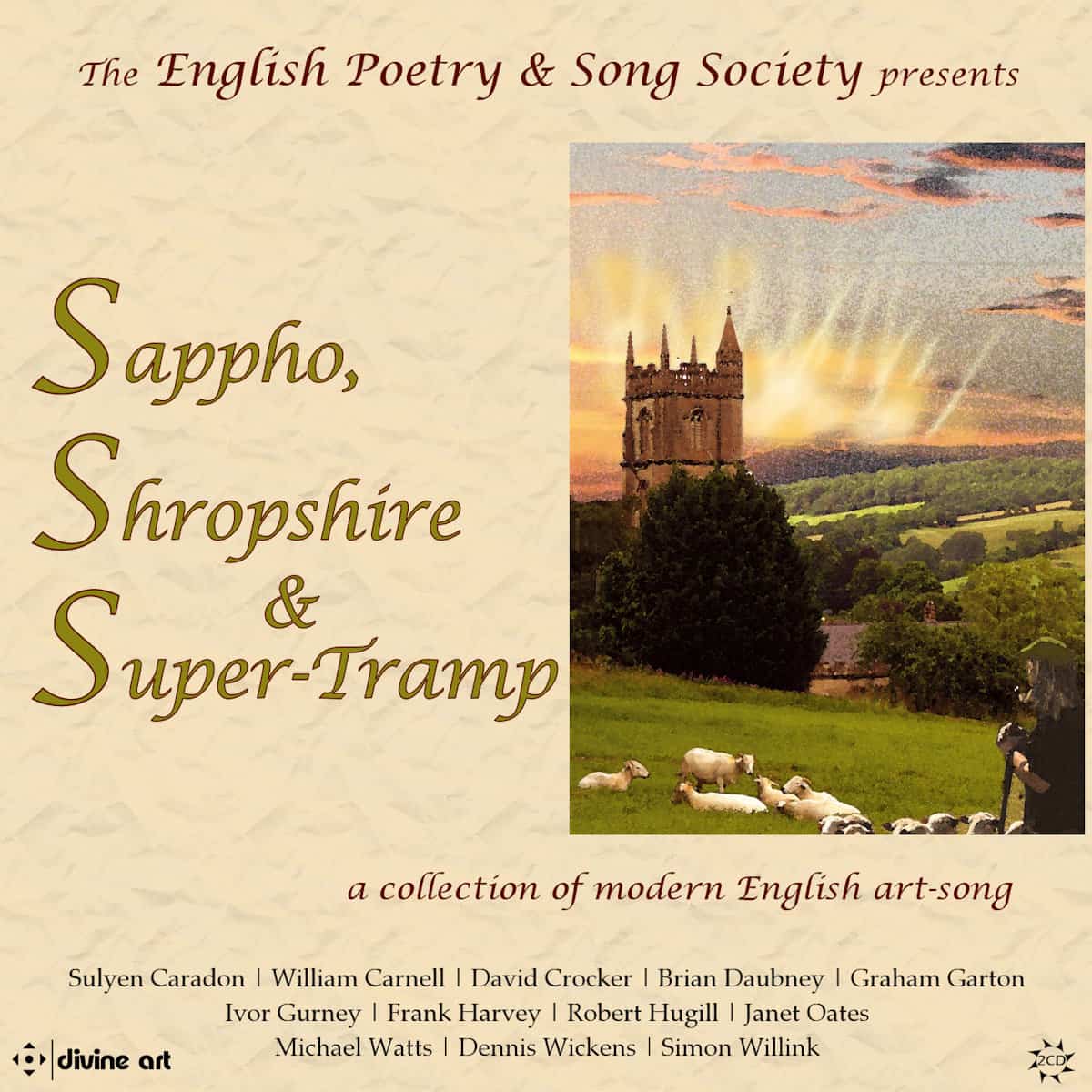
    The illustrations of England that appear on the front and reverse of the booklet sum up, surely, every person’s idea of what England is: sheep in fields with a parish church in the background, greenery everywhere. The songs on this twofer reflect that in sound, as this is the epitome of the perfect English pastoral mode of expression. And how better to do it than in song? Our guides are two fabulous singers. Little introduction is required, surely, for Sarah Leonard; baritone Johnny Herford appeared on a previous disc of music by Hugill I reviewed in Fanfare 41:3.

    The music of Ivor Gurney speaks of free-flowing lyricism. The seven Sappho Songs set William Bliss Carman. Three of the songs had been published by Oxford University Press before the balance was discovered by Richard Carder amongst Gurney’s unpublished manuscripts. The air of England does indeed blow through Lesbos in the first song, “Soft was the wind”; the third, “The Apple Orchard,” is lightness personified in song, and Nigel Foster’s accompaniment mirrors this perfectly. Leonard’s voice is perfectly suited to the luminous “Hesperus,” the fourth song, a song apparently much admired by Finzi. The love consummation, which occurs in the fifth song, is beautifully conveyed by the key area of F# Major; the sense of Rückblick in the final song is unmistakable. This is a remarkable set of songs.

    Born in Surrey, Will Carnell studied with Ruth Gipps at Trinity College, London. Here, the poet is Housman, the poems taken from A Shropshire Lad. The compositional hand at work here is light and deft in “O see how thick the goldcup flowers” and “Bredon Hill,” the first and third songs, and Herford sings with a great deal of evident relish, underpinned by Foster’s fluent piano playing. Herford’s low register proves to be firm and resilient in “If truth in hearts,” but perhaps the most musically impressive song is “Where in the moon the long road lies,” with its sense of internal journeying.

    Michael (Mike) Watts is a new name to me. Born in 1937, he transcended a career in accountancy to devote his time to composition (and to live in Mallorca). The song-cycle Gypsy Girl was premiered in 2015 and sets Paul Archer, texts inspired by the Spanish flamenco (and indeed there is a Spanish flavor to some of the music). The delicate, almost Scriabinesque piano opening to “Silver Night’’ is hypnotic; the entrance of the voice changes the heady feel to one more earthy because of the pitches chosen, which take the Scriabin influence in a different direction, fascinatingly. The piano repeated notes of the chill “When the cold wind comes” are effective word-painting. Perhaps less memorable than Carnell’s contribution, there is nevertheless much to enjoy here, and Leonard is faultless.

    Croydon-born Dennis Wickens has composed seven song-cycles so far. He studied with John McCabe in 1987. The song-cycle The Heart Oppressed has been recorded by the present pianist and Huw Williams in a disc for the English Poetry and Song Society. Herford is in fine, virile voice for the declamations of the firs: song, “A Greeting,” of the song cycle on the present disc, This Life (to words by W. H. Davies). The fragile “The Example,” which cogitates on a butterfly and how to, like the butterfly, find joy anywhere balances the busy “Leisure” (“What is this life if, full of care / We have no time to stand and stare?”). Wickens is a fine composer, creating a real sense of expectant stasis in “The Lonely Dreamer.”

    The second disc changes the format and presents individual songs instead of cycles. Composer Simon Willink therefore is represented by only one song, Sea and Sky, a setting of one of his own poems. The music is restrained and unhurried. Willink died recently (2015) and the inclusion of this song indicates some exploration of his musical legacy might be in order. Herford’s sense of the long line pays huge dividends in this performance. Neatly, Willink’s song is dedicated to David Crocker, who himself provides the next two songs. The first, A Great Time, sets the tramp-poet (hence the “Super-Tramp” of the title) W. H. Davies most beautifully: The close of the song is beautifully judged, both by composer and pianist on this recording; the companion, My Whole World, exudes nobility.

    The song by Sulyen Caradon (pen-name of Richard Carder) is of sublime delicacy, Sarah Leonard’s vocal line slowly unfolding itself over droplets of piano sound in the song Silver. Lincolnshire-based composer Brian Blyth Daubney (a student of Kenneth Leighton) now composes in his retirement. The five songs here are split between the two singers. There is a moment of Schubert’s Gretchen through a fairground mirror in Bredon Hill (more Housman) before the baritone voice sings in a most effective unaccompanied soliloquy. There’s no missing the horse invocation of the setting of Robert Browning’s “Boot and Saddle” (splendidly done by Foster). It is Emily Dickinson’s “Because I could not stop for death” that Leonard tackles, with blanched tone against a slow, high-lying tread in the piano. Time stops in this song, one of the most impressive on the whole twofer.

    A student of Lennox Berkeley, Graham Garton has held the position of director of the Academy of Music in Bermuda, among others. He has written more than 700 pieces. His song Leisure is arresting for its low, grumbling piano, frequent hiatuses, and declamatory vocal line. The music can move from second to second in style, and yet not seem contradictory to either text or compositional integrity. That sense of humor that hangs around the edges of Leisure is more explicit in the opening piano gestures of The Eagle; whereas the poignancy of the first line of The Song of the Secret, “Where is beauty?”, comes across as a heartfelt cry from Sarah Leonard.

    The warm harmonies of Frank Harvey’s Dawn surely could only hail from the UK. The legato lines are beautifully done by Herford, who also captures the depth of feeling of The Convergence of the Twain, to a poem written by Thomas Hardy on the sinking of the Titanic. The song Remember is inspired by Dido’s Lament, and there is indeed that feeling of drooping to the music as well as lachrymose leave-taking.

    It’s nice to see Robert Hugill’s music here (his Navona disc Quickening was notable). The two Gitanjali songs set Rabindranath Tagore. If Leonard is perhaps not at her most secure in the first (“Gitanjali XIII”), Herford is at his best in The Pillar.

    Finally, there comes Janet Oates, whose intention to treat voice and piano as absolutely equal partners results in the splendid play of Bee Dance, a song that slowly reveals an undercurrent of strong lyricism. Leonard and Foster are indeed equals in a song that seems to contain huge amounts of imagination. There is something of a modem setting of a folk melody to Money (which includes some extraneous tappings). Setting Sitwell, The King of China’s Daughter combines wit with a fascinating trajectory in which the singer moves from an inability to fully articulate herself through to fully-fledged lyricism. Finally, The Cupboard is a song that relishes its bitonal exploits, not to mention its inclusion of various percussive effects (clapping, tapping, and suchlike). It makes a perfect close to a simply lovely collection.

  • Sappho – review from British Music Society

    This generous 2 CD collection represents twelve British composers, the majority of them still living. Of particular interest are the first seven tracks devoted to unpublished songs by Ivor Gurney, the fruit of research by the current chair Richard Carder of The English Poetry & Song Society (EPPS) who have realised the project. Soprano Sarah Leonard who performs these, is assured in her sense of pitch but the voice is not always at ease in the higher register and the tone tends to be a little too one-coloured for my liking.

    She shares the disc with the baritone Johnny Herford, a promising young singer with clear diction who responds to the texts with warmth and intelligence, and they are both accompanied by the clean lines of Nigel Foster’s playing with impeccable ensemble.
    Other composers represented alongside Gurney are William Carnell, Michael Watts, Dennis Wicken, Simon Willink, David Crocker, Sulyen Caradon, Brian Daubney (whose songs the BMS has recorded previously), Graham Garton, Frank Harvey, Robert Hugill and Janet Oates. Many of the texts will be familiar as they are the work of celebrated English poets whose words have been set many times before.

    The songs are well crafted in most cases and although there is nothing strikingly original, they are pleasant to listen to. Of particular note was Sea and Sky, the only song presented here by Simon Willink (1929–2015) who set his own words; the result is quite beautiful and is composed in a tender lyrical vein with honesty and simplicity. The English Poetry & Song Society is to be commended for producing a booklet that contains all the song lyrics, an increasingly rare occurrence, and for making this compilation of songs available to the wider public.

  • Sappho Shropshire & Super-Tramp – Fanfare review

    In 1942 the English Poetry & Song Society began a competition for composers to set songs by English poets. There have been other recordings in this series, most recently in 2012. This new release features songs by composers who have all been prizewinners in prior competitions, as well as four past chairmen of the Society. In a word, this is a splendid compilation on two very generously filled discs, complete with printed texts in the well-written and informative booklet that comes with them.

    The opening cycle of seven poems by William Bliss Carmen, describing one of Sappho’s love affairs, is lyrical and melodically inspired. These particularly beautiful songs, placed as they are a: the beginning of the first disc, might lead a listener to believe that much of what follows will be gentle and pretty (not that those are qualities to be sneered at or taken for granted). In fact this is an extraordinarily varied and intelligently chosen program featuring a wide range of musical styles. Everything is written very well for the voice, and each song is an apt setting of its chosen poem.

    A few examples will serve to give you a fair idea of the scope of what is included here. Leisure, set to a text by W. H. Davies, is one of the seven poems in Dennis Wickens’s cycle, This Life. The poem comments on the fast pace of life that affords no time to pause and reflect on the beauty around us: “What is this life if, full of care, / We have no time to stand and stare?” The jangling nervous rhythms of the piano opening, and indeed the whole song, perfectly capture the spirit of the words. Simon Willink has set his own poem “Sea and Sky” in a gorgeous manner that draws us in as the singer reflects on the miracle of nature: “The stage is set—the scene is beauty: That of a well night silent sea beneath a sky so pure, so pale, and yet so richly tinted….” On the other hand, Michael Watts’s cycle of seven songs entitled Gypsy Girl is haunted by a dark undercurrent and the influence of flamenco (Watts now lives in Spain). “If a cold wind comes in the dark hours as you lie in bed. it’s just the sighs from one who is dead, from one who wanders the singing of songs of sorrow.” That darkness is vividly reflected in the music.

    So it goes throughout two discs of deeply engaging songs covering a spectrum of moods and emotions, all brilliantly performed. Often on recordings of unfamiliar repertoire we have to listen through barely adequate performances, but that is not the case here. Both singers are deeply engaged in communicating texts and meaning. Sarah Leonard’s quick vibrato adds color to the timbre, though the voice is not the freshest imaginable, and Johnny Herford’s light lyric baritone is capable of a wide range of color. Pianist Nigel Foster is just as involved, although I wish the recorded sound didn’t relegate him quite as far in the background as it sometimes does. I would have preferred a bit more presence to the voices and piano, but these issues are minor annoyances, not serious flaws. This is a set I shall return to often. It is recommended enthusiastically to listeners who enjoy the English song repertoire and are looking to widen their horizons.

  • Sappho Shropshire Supertramp review

    The English Poetry and Song Society was founded in 1983 and is dedicated to the pro¬motion of English Art Song through performances, recordings, and competitions for composers. English Art Song has always been a poor relation compared to its German, French, and Italian counterparts. In the words of Sir Hubert Parry, “the English prefer foreign music.” This is the fifth disc the society has sponsored; it has songs by 12 composers, 8 of whom have been prize-winners in past EPSS competitions. Included are the three cycles of the album title: 7 of William Bliss Carmen’s Sappho Songs by Ivor Gurney; 6 poems from AE Housman’s Shropshire Lad by William Carnell; and Dennis Wickens’s setting of 7 poems by the “Super-Tramp” poet WH Davies.

    The singing and accompaniment are top-notch. These performers obviously under¬stand the important role of the poetry in Art Song, so their accounts of these 52 songs display emotional depth and literary understanding. While the musical interest is uneven, I particularly enjoyed the Gurney and Wickens cycles. Listeners are sure to find others of interest—there is something for everyone here.

    Notes on the society, composers, performers, and texts. A lovely production.

  • English art song review

    I will begin this review by confessing my unfamiliarity with The English Poetry & Song Society, whose sterling efforts have resulted in the issue of several cd’s on the Divine Art label. As might be expected, the discs that precede the ones reviewed here feature early 20th Century songs by such luminaries as Vaughan Williams, Finzi, Gurney, Moeran, Ireland as well as less well-known composers.

    In the introduction to the booklet accompanying this 2 CD set, a former Chairman, Richard Carder, says that the competitions the society runs exist “as a way of increasing interest in English Art Song, which has always been a poor relation when compared with German Lieder, French Mélodies and Italian Arias; as Hubert Parry noted, The English prefer foreign music!’”

    This release has extended the Society’s reach by presenting art-songs from the middle to late years of that century and into the present day, by composers who, with the sole exception of Ivor Gurney, are much less well-known outside their own circles of excellence. I wasn’t sure what to expect in terms of style, but I suppose that I should not have been surprised that some of the settings remind me somewhat of Vaughan Williams and his near contemporaries; I am thinking here of William Carnell’s ‘White in the moon the long road lies’, and David Crocker’s ‘My Whole World’, both of which are really nice. The same comment regarding influence could apply to several of the 52 songs recorded. Naturally enough, some of the songs have music, which sounds rather bland, but that criticism can be leveled at several middle rank British composers of the first half of the last century. Some of the songs can be viewed in a different light – a couple of Graham Garton’s show signs of French influence, say Poulenc, and doubtless Britten also makes an appearance here and there.

    Influence spotters will have a great time, and for those, who like a more adventurous setting, Janet Oates’s four songs may well suffice, since, to paraphrase the notes, they focus on ‘character rather than melody’ and ‘speech rhythms are more common than lyricism’.

    It is probably best not to listen to all 52 songs in one go, as saturation may well set in, despite the natural sounding recording. The baritone, Johnny Herford, is at the beginning of his career, and his fine voice rings out with firmness and clarity. Sarah Leonard, who is a current President of the EPSS, is approaching the end of her distinguished singing career, and yet her voice is clear and mostly free of wobble. Only some threadbare tone tells us that we are hearing an older instrument.

    The booklet is very detailed, containing information about the Society, together with biographies and full song texts.

  • Sappho Shropshire and Super-Tramp – English art-song review

    First of all what this is not: it’s mostly not folk music, despite the cover and it does not feature the works of Roger Hodgson and Rick Davies; the Super-Tramp of the title is hobo turned poet WH Davies.

    This double CD is sponsored by The English Poetry and Song Society and contains music by eight society composers, each of whom has featured as prize winners in society competitions.

    The works are all English artsong — vocal music composition, usually written for one voice with piano accompaniment — and it’s a serious work.

    The songs with Sarah Leonard (soprano) are beautiful but dry, and verging on the operatic (though her rendition of Brian Daubney’s The Dream-City on CD2 is one of our favourites); Johnny Herford’s baritone brings a little more lightness.

    There are too many songs to go through them all. Ivor Gurney’s Seven Sappho Songs opens, describing one of Sappho’s love affairs on Lesbos in the 6th century BC. It is an evocative piece, Leonard creating the air of a gentle evening breeze for the first song, Soft Was The Wind. The final song, Lonely Night sees the lovers parted; it’s perhaps not unnatural that Herford’s appearance in O See How Thick The Goldcup Flowers comes as a change, William Carnell’s song cycle A Country Lover being based on poems from Housman’s A Shropshire Lad.

    Far more earthy stuff and it’s doubtful Housman with “Oh may I squire you round the meads / And pick you posies gay?” was using the last word in the same sense as Sappho’s “Softer than the hill-fog to the forest / Are the loving hands of my dear lover / When she sleeps beside me in the starlight”.

    This is not to be facetious; one of the charms of the CD is the intellectual curiosity it creates, not only in the music but in the subjects it tackles, and the texts (provided in the sleeve notes). One of those CDs that will drive you to Google more than once. (Gurney’s biography is interesting, if tragic, in its own right).

    Leonard and Herford are excellent, and despite our reservation about its technical dryness, it sparkles in its own intellectual way. The piano accompaniment comes from Nigel Foster.

  • Sappho Shropshire & Super-Tramp New Classics review

    The title of this exciting new album, ‘Sappho, Shropshire and Super-Tramp’, reflects three major threads (though not all) of new English art-song made with the English Poetry and Song Society. Shropshire is represented by several settings from A.E. Housman’s ‘A Shropshire Lad’ which has been among the most popular sets of poems for composers since its publication in 1896. From the ancient world, Sappho’s writings were set by Ivor Gurney, recently discovered, edited and published by Richard Carder. Super-Tramp is the exceptional hobo-turned-gentleman poet W.H. Davies, a Welsh poet and writer who spent a large part of his colourful life as a hobo in England and the United States and became one of the most popular poets of his time. ‘What is this life if, full of care, We have no time to stand and stare?’ – his most famous poem, Leisure, has been set to music by both Dennis Wickens and Graham Garton, here performed by the impressive baritone Johnny Herford. Soprano Sarah Leonard is the soloist for Ivor Gurney’s opening ‘Seven Sappho Songs’, a tender and beautiful song cycle based on William Bliss Carmen’s poems telling of one of Sappho’s passionate love affairs. Housman is represented by exquisite settings of ‘Bredon Hill’ by Brian Daubney and William Carnell. Altogether there are 12 composers, also including David Crocker, Frank Harvey, Janet Oates, Michael Watts, Robert Hugill, Simon Willink and Sulyen Caradon. Spread over two discs, these 52 songs, some in cycles and some stand-alone items, make this a feast of new and fascinating work for the song lover. Piano accompaniment is by Nigel Foster, who has been described as ‘today’s Gerald Moore’.

  • Sappho Shropshire and Super-Tramp MusicWeb review

    The CD liner notes begin with a sobering reflection on British music-making. Richard Carder notes that ‘[The English Poetry and Song Society] competitions for composers started in 1992, celebrating the bi-centenary of the birth of Shelley, and continued every year after that with anniversaries of various poets, as a way of increasing interest in English Art-Song, which has always been a poor relation compared with German Lieder, French Mélodies, and Italian Arias; – as Hubert Parry noted in his History of Music, “The English prefer foreign music!”

    I have always been in the minority in this matter. Although I enjoy Schubert, Wolf, Duparc et al, my preference has always been for English art-song. The first major work in this genre that I heard was John Shirley Quirk’s performance of Ralph Vaughan Williams’ magical Songs of Travel (Robert Louis Stevenson). It has been a genre that has captivated and fascinated me ever since.

    This new release from Divine Art, sponsored by The English Poetry and Song Society contains music by eight Society composers, ‘who have all featured as prize-winners in past competitions, including the three complete cycles [alluded to in] the album title, and a song by each of the four past chairmen of the society.’ It is a potpourri of fascinating music.

    Of the 52 songs on this 2-CD set, I will note several highlights-for me.

    The main event is the three song cycles by Ivor Gurney, William Carnell and Dennis Wickens. These are settings of poetry by Sappho, A.E. Housman and W.H. Davies respectively.

    Clearly Ivor Gurney is the best-known composer on this album, with many CDs devoted to his vocal music. Gurney’s Seven Sappho Songs were selected from poet William Bliss Carman’s (1861–1929) volume Sappho: One Hundred Lyrics. This book was an adaptation of several fragments by the Aeolic Greek lyric poet. Three songs were originally published by Oxford University Press, with the remaining four being edited by Richard Carder as part of a project to realise Gurney’s unpublished songs. I understand that this is the first recording of Gurney’s complete ‘Sappho’ cycle. These are beautiful songs that are full of passion and emotion: they perfectly reflect the blue skies and seas of the Isle of Lesbos.

    It is hardly surprising that Housman is represented on this disc. For many years, he was one of the foremost poets set by English composers. William Carnell has selected six songs from Housman’s A Shropshire Lad, including such favourites as ‘In Summertime on Bredon Hill’, ‘Along the Field’ and ‘O see how thick the gold cup flowers’. They are all well-crafted songs and that are in the trajectory of earlier settings. A Country Lover is splendidly sung by Johnny Herford. The work was first performed in 2007.

    When I was a teenager, I read W.H. Davies Autobiography of a Super Tramp. This fascinating ‘romp’ around Great Britain, the United States and Canada appealed to my sense of adventure and history. It was not until many years later that I discovered that Davies had also written poetry. Dennis Wickens has set several of these verses. Alas, the liner notes give no information about this work, which is a pity. For me, it is the most important and vibrant work on the CD.

    The second CD presents several standalone songs by a variety of composers as detailed in the batting-order below. These set an eclectic variety of poets, including relative rarities in the English art-song tradition such as Carol Ann Duffy, Rabindranath Tagore, Hart Crane and Edith Sitwell. More common sources for songs include Walter de la Mare, Christina Rossetti, A.E. Housman and Thomas Hardy.

    I enjoyed most of these songs, however a few especially captured my imagination. I always admire a composer who sets a text that has become a standard in another composer’s oeuvre. Brian Daubney’s ‘Bredon Hill’ is a satisfying take on a song that has been defined by George Butterworth and Ralph Vaughan Williams. Equally enjoyable is Daubney’s version of Humbert Wolfe’s poem ‘The Dream City’. This has been previously set by Gustav Holst. It is one of my favourite poems, and Daubney rises to the challenge.

    Another interesting and imaginative song is Graham Garton’s ‘The Shade-Catchers’, with text written by Charlotte Mew. Robert Hugill’s settings of Rabindranath Tagore are particularly lovely with an impressive sound-world that compliments the ‘profoundly sensitive, fresh and beautiful verse’ from this largely-forgotten poet. One of the most delightful songs on this second CD is Janet Oates settings of Walter de la Mare’s ‘The Cupboard’, complete with ‘lollipops’ and ‘Banbury Cakes’ and hand-claps. It is a little masterpiece. My favourite song here is Simon Willink’s heart-achingly beautiful realisation of his own poem ‘Sea and Sky’.

    There are plenty more interesting numbers, each of which deserves a detailed analysis.

    The liner notes have been assembled by Richard Carder, David Crocker and several of the composers. They vary in information, with Carder’s comments on Ivor Gurney being essay-length and notes on several of the composers and their contribution being little more than a couple of short paragraphs. I was not sure why Alfred Warren (1926-2014) is mentioned in these biographical notes, as I could not find any music by him: I think that he is, in fact, a poet who wrote the text for ‘My Whole World’, set my David Crocker. But I could be wrong.

    The texts of all the songs are provided which is helpful, although I would have liked the source of each text to have been included in the track-listings. Dates of composition were not included in the track-listings and are not always given in the liner notes. For biographical details of the performers, the listener is invited to visit the Divine Art Website. The performance of these songs is typically very good. Both Sarah Leonard and Johnny Herford bring considerable skill, magic and understanding to this music. The words are always clearly enunciated and are immediately understandable. The piano part is well-executed by Nigel Foster.

    This is an excellent exploration of (mainly) contemporary English art-song, written in largely, but not exclusively traditional style, and goes a long way to prove that the genre is alive and well in the early 21st century.

  • Sappho, Shropshire and Super-Tramp – English Art Song

    Sappho, Shropshire and Super-Tramp – English Art Song

    The title ‘Sappho, Shropshire and Super-Tramp’ reflects three major threads (though not all) in this exceptional album of new English art-song made with the English Poetry and Song Society.

    Shropshire is represented by several settings from Housman’s ‘A Shropshire Lad’ which has been among the most popular sets of poems for composers since its publication in 1896. From the ancient world, Sappho’s writings were set by Ivor Gurney, recently discovered, edited and published by Richard Carder.

    Super-Tramp is the exceptional hobo-turned-gentleman poet W.H. Davies.

    Altogether 12 composers and 52 songs, some in cycles and some stand-alone items, make this a feast of new and fascinating work for the song lover. Performed by top soloists Sarah Leonard and Johnny Herford, accompanied by Nigel Foster, who has been described as ‘today’s Gerald Moore’.