Asmata is a work for voices and piano whose ‘Lullaby’ (II) makes such alluring use of quarter tones (tremendously sung by Alison Smart) and ‘Red Lips’ (VIII) gives acrobatic lines to the soprano while the piano remains grounded and unassuming. ‘My Greatest Regret’ (XII) begins with big, thick chords in the piano; the morose, crying-out soprano entrance makes clear that the title of the movement is being explicitly explored in its music. Byzantine Doxology (the work on the second disc) is a magical and moving piece for unaccompanied voices where Patrick Ardagh-Walter’s bass gleams like gold, especially in the breathtaking moments where the sonic space between the bass and sopranos spans too many octaves to count. Of its eight movements, III, ‘O Lord I have Cried’ is kinetic and pleading. ‘Hosanna in the Highest’ (VI) is a luxurious, unhurried movement. ‘Rest the Souls’ (VIII) is warm and reassuring. This is very difficult music performed at a very high level.
Catalogue Connection: 21233
-
Visions of the Greek Soul review
This double CD of vocal music has an other-worldly feel, the second half of the programme being more traditional in sound. Aside from some piano, it’s all vocals (mainly soprano, plus tenor and bass). It’s a double album, in two parts: the first half is 15 songs inspired by the Muses and looking at our connection with the natural world in several ways. The whole is entitled The Anyte Collection, from the Greek poet Anyte of Tegea, with settings of poems by Dimitris Libertis, Emily Dickinson, Kostis Palamas, Alexander Pallis (who translated the New Testament into Modern Greek and caused riots in Athens in 1901 in which eight people died) and Nikos Kambas.
The second half is Byzantine Doxology for small choir a capella. Composed in 1988, it is based on a Greek Orthodox idea of “Books shall be opened”, records of a person’s life that are opened only at the day of judgment, to the sound of wailing for the sinful. Clearly it must be a worry for good Greeks to fear that they’re inadvertently and unknowingly sinning, but will only find out when the sound of wailing greets the opening of their books. When it’s too late. Talking of wailing, the first CD has some of the more challenging sections from the sopranos; odd moments can be a little striking / operatic, although as a whole it’s a calming atmospheric piece. It has a liturgical feel to it, although not as much as the overtly religious Byzantine Doxology, which combines a feel of the old (thanks to the male voices) and the more modern. The sleeve notes are good, Petridou chatting about this woman she kept meeting and a Greek she met at a talk, how she’s inspired, and thanking her mum. An interesting collection for fans of the human voice.
-
Infodad review: Visions of the Greek Soul
Cilia Petridou (born 1944) relates to Greece both personally and as a source of musical material, as a new two-CD Divine Art release clearly shows. Greek Orthodox liturgical texts form the basis of Byzantine Doxology, a very extended setting (lasting almost an hour) of sacred material whose general elements (such as Hosanna in the Highest, Peace to All and Rest the Souls) will be familiar to many listeners even if the specifics of the Greek words will not. The setting uses a small vocal ensemble – two sopranos, mezzo-soprano, tenor and two basses – that Petridou employs to produce considerable purity of sound in music that is essentially tonal but harmonically more modern than many traditional settings of religious texts. The vocal writing is skillful, although the limited number of voices means that the material – which is straightforward in meaning – tends after a while to drag a bit. There is greater variety in the 15 songs, split between two soprano voices and based on more-modern poetry, that Petridou collectively calls Asmata. The songs’ length varies quite a bit, with the first lasting less than a minute and the last more than nine minutes. The words’ sources are quite varied and not 100% by Greek poets: although six are by Dimitris Libertis (1866-1937), two by Kostis Palamas (1859-1943), two by Alexander Pallis (1851-1935), and one by Nikos Kambas (1857-1932), there are also three traditional folk poems (Lullaby, The Nun, and Red Lips); and one song, The soul selects her own society, uses words by Emily Dickinson. The use of an electric piano for the last and longest song, Sunset, produces a somewhat otherworldly effect, but most of the settings are rather straightforward, with the piano generally remaining firmly in the background even as it supports the voice. When the piano is used for mood setting, however, as in Away from You, the result is quite effective. Petridou is clearly comfortable setting the Greek words both in Asmata and in Byzantine Doxology, and the release provides English translations of all the material, so listeners unversed in the Greek language can follow along with Petridou’s evocations.
-
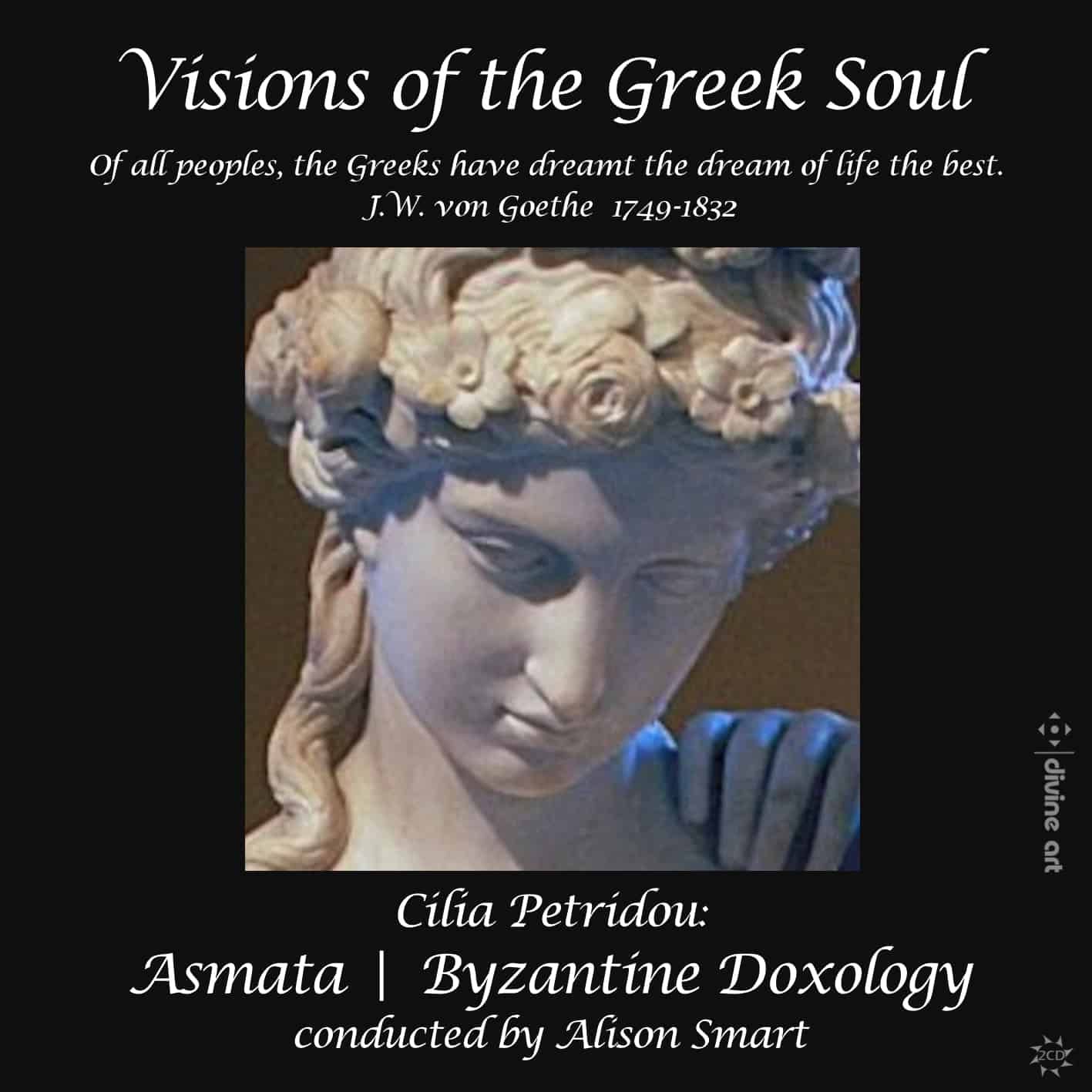
Visions of the Greek Soul
Cilia Petridou was an accomplished pianist until her career was ended by major surgery, since when she has concentrated on composition. Moving with her family to the UK, she was hugely affected by the Turkish invasion of north Cyprus which destroyed their home town of Famagusta; her music is often informed by that political and social tragedy and also by the landscapes of Cyprus, ancient literature and the Greek Orthodox liturgy.
This double album is in two parts: The Asmata is a collection of songs inspired by modern Greek poetry, divided between two sopranos. A small vocal ensemble then presents the Byzantine Doxology, a new setting of Orthodox liturgical texts. Most is sung in Greek and is suffused, even in the case of a setting of Emily Dickinson, with the musical traditions of that country. The composer has also been much inspired by the ancient writings of Anyte of Tegea.
More music by Cilia can be found on ‘Sounds of the Chionistra‘ and ‘The Mystery of Christmas‘