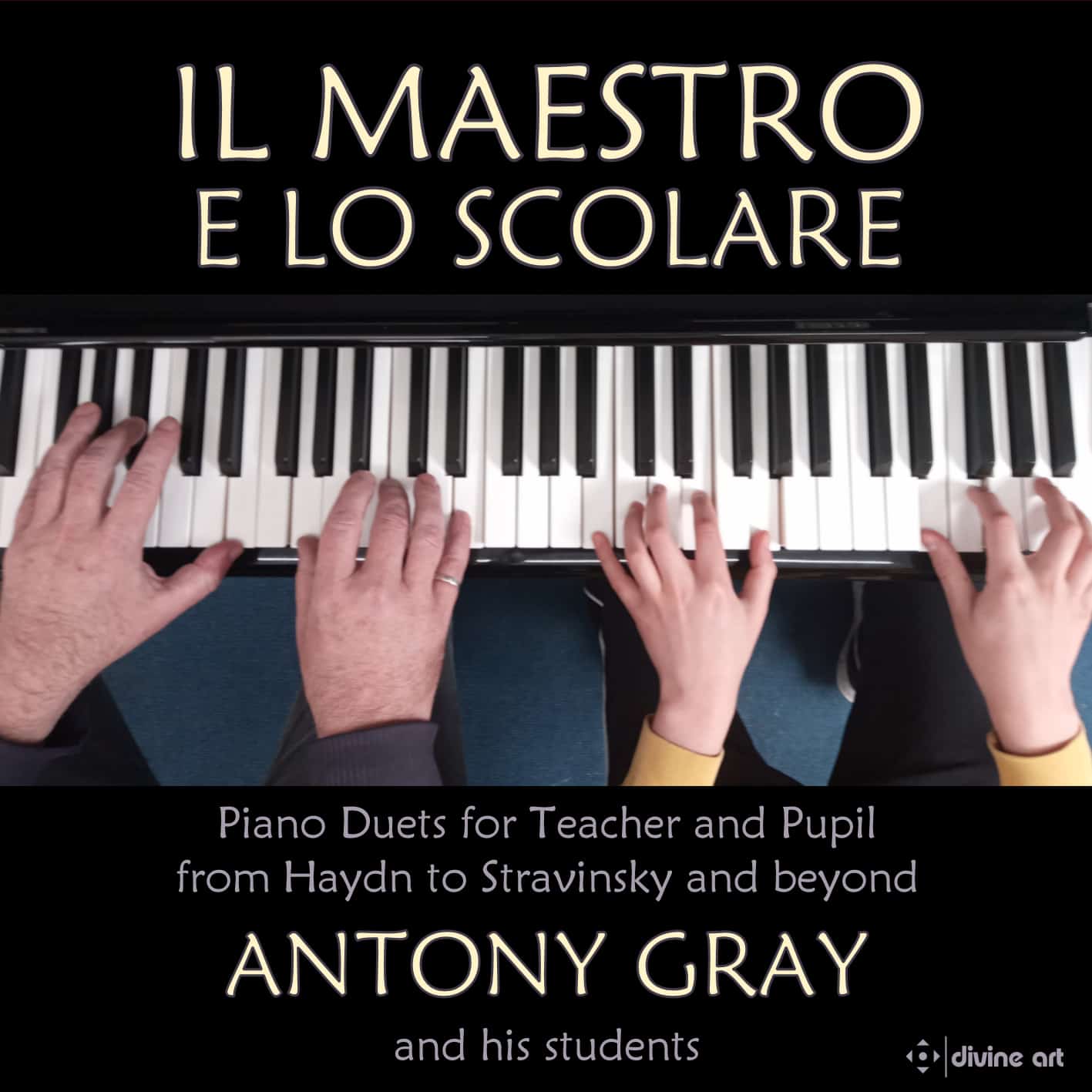
This is a fabulous, large collection of duets that belongs in every piano teacher’s library. Antony Gray has chosen nearly 60 of his students to join him or play in supervised pairs over a wide range of music eras, styles, and difficulty levels. All of these works were written for beginners playing the easier top part and their teacher, or at least a more skilled pianist, playing the lower part. The key to this release (and a good part of its success) is the freshness each student brings to his part. Add in the sensitive and sometimes demanding collaboration by teacher Gray, who researched and collected the music here, and you get an unmatched program.
The big Russian collection of Paraphrases for piano duet was published in 1893 and Liszt contributed a single-page, solo-piano Prelude to Borodin’s Polka for its second edition. This follows Cui’s Finale to 24 Variations and is not engraved, just Liszt’s manuscript page with its dedication inserted. The published title was in French: 24 Variations et 15 Petites Pieces pour Piano sur un Theme Favori et Oblige). I do not believe the “theme favori” was ever called ‘Chopsticks’ in Russia, but it is instantly recognizable. For all who learned it the way I did, this version is slightly different: white keys only, alternating even eighth notes F, G, E, A, D, B, C, C.
This collection is quite amazing for the teacher part, even though nearly 30 minutes of clever, inventive and varied piano writing stretches the well-known, simple theme as far as could possibly be enjoyed. The student’s part never varies except sometimes up an octave, and if the lower part is in triple time, its duple time does not change, making for some interesting ensemble demands. I cannot imagine any beginning pianist being interested in playing the whole work, so including many students seems to work. Borodin’s Polka has the primo part play the “theme favori” 23 times (notes as above) never changing. Underneath, the secondo part has an Introduction and Polka theme in C, modulates to G, back to C, then to F for a Trio, back to the Polka in C and G, then a Coda. Lots of interest and demands for the teacher while the student gets the easy part.
The remainder of this collection is composed of a few single or pairs of pieces and several larger sets. 8 pieces by Moszkowski called Le Maitre et l’eleve (1920) are filled with wonderful surprises. The large set by Leo Ornstein of 10 pieces is Seeing Russia with Teacher (1925) and the thematic and programmatic pieces are always interesting. Repertoire standards by Stravinsky (3 and 5 Easy Pieces) and a few entertaining pieces by Percy Grainger are also quite good. Gray even allows for one of his students (Joe McGrail, b.1992) to contribute a set of three Jazz Duets.
This collection should be in every piano teacher’s library; there are 84 tracks to discover here.