Catalogue Connection: 21236

  • Saint-Saens piano music vol. 2 DDA 21236 Musical Opinion review

    The notably-gifted Australian-born pianist Antony Gray continues his valuable traversal of the complete solo piano music of Camille Saint-Saëns with this second volume, a double-CD set containing very many works which are all but completely unknown today, yet which – as with almost all of this composer’s music – remain virtually unknown, even to pianists.

    His major contributions to the piano, as Divine Art point out, ‘are the equally neglected body of transcriptions (of his own works and those of others) where he was eclipsed by the more outgoing and promotion-minded Liszt.’

    However, Saint-Saëns’ music was hardly unknown, even internationally, during his long life, yet it remains true that in the teeming and sadly fast-shrinking world of classical music today, Saint-Saëns’ output is confined to a mere handful of the over 200 works he completed and published.

    Saint-Saëns’ long life may have led him to become both a friend of Berlioz and an enemy of Les Six, but his genius (by no means too strong a word) and wholly exceptional gifts certainly deserve being made available today, and the medium of commercial recording is the way to do it.

    As with Antony Gray’s first release in this immensely valuable series [reviewed in our last issue],this second set of CDs maintains the high standard of insight, technical command and recording quality – the music is unfailingly interesting and even Saint-Saëns’ twelve (actually 13, the latter number avoided no doubt for superstitious reasons) J S Bach transcriptions are well worth-while. As with volume 1, here are a number of first recordings, making this notable achievement a landmark in solo piano repertoire recording history. A remarkable and valuable achievement, comprehensively recommended. [five stars]

  • Saint-Saëns Piano Works vol 2

    JOINT REVIEW WITH VOL 1 (DDA 21235)

    It is of Caesar that Shakespeare’s Cassius speaks when he says “he doth bestride the narrow world like a Colossus,” but it was Franz Liszt who bestrode the pianistic world of the 19th century like that proverbial giant. Despite all the other superb virtuoso pianists of the time – Herz, Pixis, Kalkbrenner, Czerny, Alkan – everything was compared to and measured by Liszt, an incomparable showman as well as a pianist of the first water and a composer of not-inconsiderable talent. So dominant was the Liszt cult that excellent composer/pianists could fall by the wayside simply because they were less skilled than Liszt at self-promotion and had more inward-looking personalities.

    A prime example is Camille Saint-Saëns, an excellent pianist (and organist) as well as a skilled composer and conductor. In terms of piano works, Saint-Saëns is known for his five concertos and the hilarious “Pianists” movement of Carnival of the Animals, but for almost nothing else. It turns out that this is a real shame: an excellent and genuinely important two-volume, four-CD recording of Saint-Saëns’ piano works on the Divine Art label provides a heretofore unavailable chance to hear just how good Saint-Saëns’ solo-piano music is and to muse about its longstanding neglect.

    The pieces are of interest on multiple levels, sometimes involving forms also much favored by Liszt: paraphrases of operas, travelogues (although far less extensive than Années de pèlerinage), and Bach transcriptions. In addition, Saint-Saëns created a considerable number of lighter “salon” pieces, plus some interesting piano versions of music from ballets, oratorios and cantatas. Antony Gray tackles Saint-Saëns’ very considerable solo-piano output – these CDs contain nearly five hours of music – with relish, seeming to delight even in the trifles while giving the more-considerable works the level of seriousness and dedication they deserve.

    The first two-disc volume places Saint-Saëns firmly in the pantheon of Romantic-era compositional virtuosity, including extended treatments of music from Gluck’s Alceste, Meyerbeer’s Thaïs, and Bizet’s Les Pêcheurs de Perles, plus shorter works based on his own ballet, Javotte, and other stage works. This volume also includes Saint-Saëns’ pianistic travel pieces, the most substantial being Rhapsodie d’Auvergne, Souvenir d’Italy, and Africa; other highlights are the two-movement Suite Algerienne and the charming Barcarolle: Une Nuit à Lisbonne. There is a great deal of understated elegance in Saint-Saëns’ piano writing: he certainly ventures into display pieces from time to time, but retains a sense of good taste and moderation in almost every piece.

    These characteristics stand him in particularly good stead in the transcriptions of Bach offered in Volume 2 of this exemplary project. There are 13 of those (although their title, oddly, gives the number as 12), taken from cantatas, partitas and violin sonatas, and offered uniformly in good taste and with considerable respect for the earlier composer – although certainly not in any way that would today be considered “historically informed.” Saint-Saëns actually delves even more deeply into the past than his handling of Bach would suggest: Volume 2 includes two pianistic transcriptions of works by the early-16th-century Spanish composer Luis de Milán (c. 1500-c. 1561). This volume also ties Saint-Saëns closely to Liszt in two very interesting, highly virtuosic works. One is Improvisation sur la Beethoven-Cantata de Liszt, whose 1870 version (revised by Liszt for the centenary of Beethoven’s birth) led Saint-Saëns to create this piece – which, it should be noted, Gray takes at a somewhat expansive pace, not really slow but perhaps a trifle too deliberate.

    Also here is Paraphrase sur Gallia de Gounod, based on a now-little-known 1871 motet for soprano, chorus, organ and orchestra. Here Saint-Saëns writes a very Lisztian piece (again played at somewhat deliberate speed by Gray), showing that he could, when he wished, absorb, interpret, modify and offer in new, pianistic guise a considerable number of works of all types – in addition to creating entirely new ones of his own. The four CDs in these two volumes excel in showcasing a side of Saint-Saëns with which most listeners will be unfamiliar – an element placing Saint-Saëns firmly within the upper echelon of composer/performer virtuosos of his time.
  • Saint-Saëns Piano Works vol. 2 (DDA 21236) Musicweb review

    I was impressed with Volume one of Antony Gray’s exploration of the lesser known original works and transcriptions of Camille Saint-Saëns and have been looking forward to the treasures on this set. Nadejda Vlaeva gave us an excellent recording of the Bach transcriptions (Hyperion CDA67873 ) and the two more substantial items on disc one appeared on volume 5 of Geoffrey Burleson’s set (Grand Piano GP626) along with the 2 bagatelles but there remain a good selection of works that have not previously been recorded in these versions.

    The biblical oratorio La Déluge was rated one of Saint-Saëns’ best works at one time but it is generally only the prélude recorded here that is heard nowadays. This transcription, basically lifted from the vocal score, is not credited though it is possible that it is by the composer. It opens with a rather archaic introduction and fugue before the theme of the second part begins, scored for solo violin and strings in the original. The Sérénade was originally scored for piano, harmonium, violin and viola and was successful enough that it appeared in several different versions, including one for two mandolins and piano while Sir Thomas Beecham conducted Saint-Saëns’ orchestral version in 1913. With its undulating accompaniment, more complex at its return, it becomes an Italianate serenade; gentle arabesques adorn the central section and like the Déluge extract it is a faithful transcription of the original rather than a reworked paraphrase. The transcription of Schumann’s Chant du soir falls into this category as well, adapted from a previous arrangement for piano duet but his transcription of the Easter Hymn from Act 2 of Berlioz’s Damnation of Faust is a little more adventurous, filling out the orchestral parts and incorporating the chorus in much the same way Liszt did in his later Wagner paraphrases.

    Perhaps my favourite discovery among this collection is the Improvisation written for inclusion in an Album du Gaulois in 1885; I will be checking out the available music from this album that also includes works by Liszt, Clara Schumann and Tschaikowsky as well as lesser known names such as Marie Jaëll and Raoul Pugno. Saint-Saëns’ jaunty and lilting contribution experiments with harmony, manoeuvring from enigmatic layered chords to conventional cadences almost throughout, hardly what I would have expected from the French composer. It is not known if the two Bagatelles of 1858 were originally intended to join the op.3 Bagatelles or if Saint-Saëns even intended them as bagatelles at all; the name was added by his secretary and biographer Jean Bonnerot; the first opens with a simple melody with chordal textures before the chords break into arpeggios for a brief but more harmonically complex section and the opening returns. The second is scherzo-like with echoes of a bucolic hunting scene. The Berceuse, written for the birth of one of Saint-Saëns’ friend’s daughter, was originally for piano duet; French virtuoso Isidor Philipp produced the solo piano version we hear of this gentle little lullaby.

    Two larger scale cantata transcriptions complete disc one; the Improvisation sur la Beethoven-Cantata by Liszt and Paraphrase sur Gallia after Gounod’s now little known work. The improvisation is a largely meditative work though full of the grand gestures that Liszt himself was so fond of, tremolandi and octaves and it is remarkably faithful to his style. Liszt wrote the Beethoven-Cantata for the dedication of the Beethoven monument in Bonn in 1845 but it was a later revised edition for Beethoven’s centenary in 1870 that Saint-Saëns heard and based this work on. The opening develops the andante cantabile from Beethoven’s Archduke trio and the main theme from the opening movement of the Eroica symphony also makes an appearance. Gallia is a four movement work written for the London International Exhibition of 1871 and was inspired by the tribulations of the Franco-Prussian war; it must have impressed Saint-Saëns who produced this quite Lisztian paraphrase soon after. The central section recalls the tumult of battle while the outer sections are more lyrical, the final part a fervent version of the final chorus Jerusalem! Jerusalem! In both of these works, and indeed in much of this music generally, Anthony Gray is quite expansive in his playing so that the Improvisation sur la Beethoven-Cantata takes 16 minutes as opposed to Burleson’s 12 and Gallia is similar; Gray 12:34 Burleson 8:54. This is not really an issue here and as I said in my review of volume one (Divine Art DDA21235) Gray’s playing is neither dull nor cautious. Some may prefer the slightly more flowing playing of Burleson but I think pianophiles may generally want both performances for completeness in any case.

    Saint-Saëns made 13 transcriptions from the cantatas and violin works of Johann Sebastian Bach. The Bach revival had begun with the advocacy of Mendelssohn and others and already works were appearing in transcription; the arrangements of the organ works by Liszt came from the 1840s and between the two sets that Saint-Saëns wrote, in1861 and 1873, Liszt pupil Carl Tausig arranged several of the chorale preludes. The cantatas had been gradually published at the time and Saint-Saëns made his selection from those as well as movements from the violin sonatas and partitas including the transcription of the Bourrée from the first Partita that is still occasionally heard. Gray plays them all well but I have to say that Vlaeva has the edge for me especially in the slower items; the opening of the Andante from the second violin sonata is the most obvious case in point where Gray sounds somewhat stiff in the balance of melody and accompaniment compared to the wonderful richness of Vlaeva’s phrasing though Gray soon warms into the movement. I find Vlaeva’s rhythmic impetus just a little more focussed as well but this is splitting hairs and I am happy to have both versions.

    The final items to mention are two real rarities in the form of transcriptions of works by 16th Century Spanish composer Luis de Milan, or D. Luis Milan de Valence as the first edition would have it. Saint-Saëns edited works of early French music and evidently his wide ranging tastes led him to these works originally written for lute. He makes fine piano works out of them, recreating them respectfully in terms of the modern instrument without going to the grand extremes that Liszt did in his Miserere d’après Palestrina while still making the most of the sustaining features and range of the piano.

    Once again Gray has opened up a treasure trove of fascinating rarities and little known arrangements that add quite considerably to the relatively modest amount of original piano works from this prolific composer and with his performances of conviction and presence this is well worth the outlay to explore.

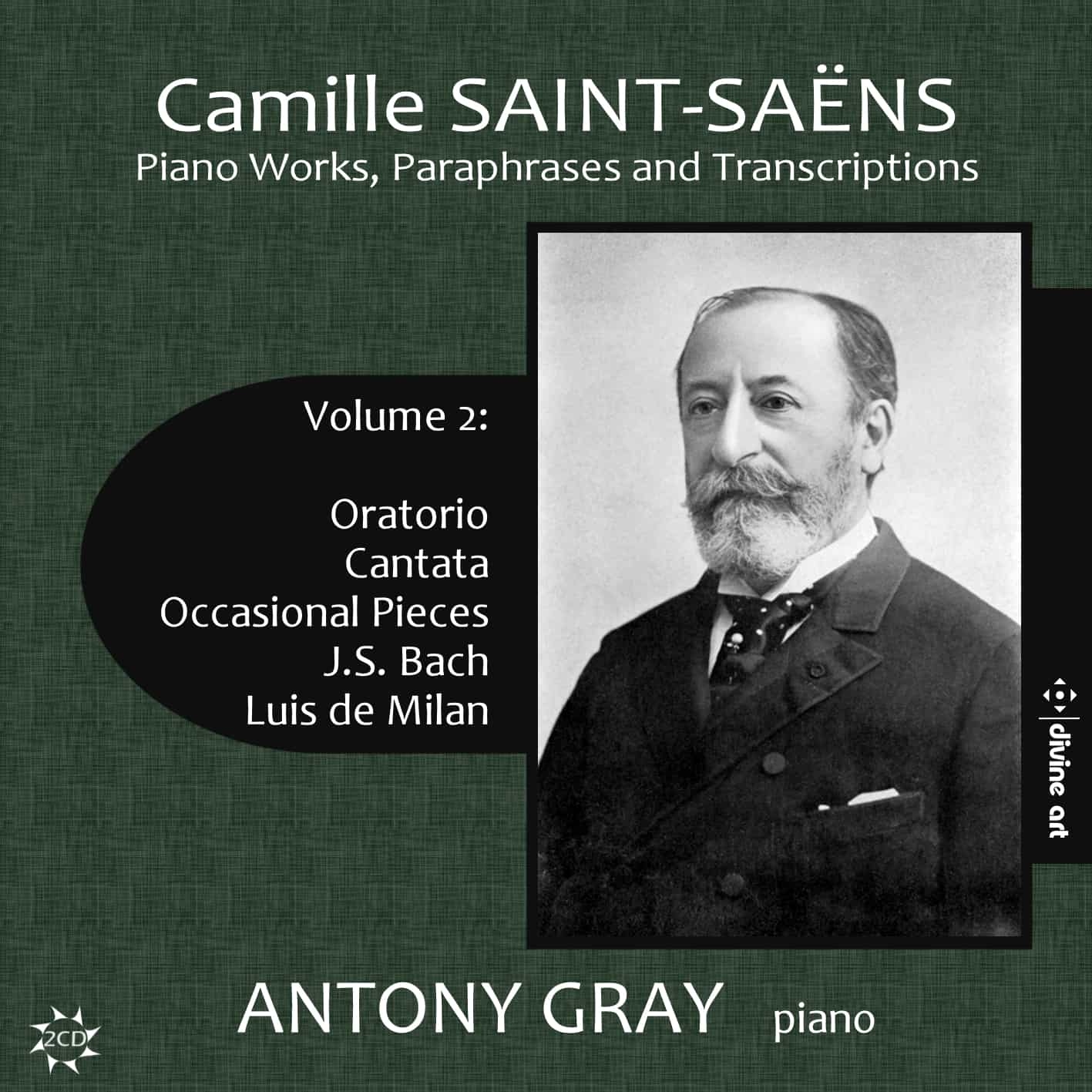
  • Camille Saint-Saëns: Piano Works, Paraphrases and Transcriptions, volume 2

    Camille Saint-Saëns: Piano Works, Paraphrases and Transcriptions, volume 2

    Saint-Saëns excelled as a composer, conductor, pianist and organist – his composition output is enormous, reaching over 160 titles of which many are substantial – operas, ballets, symphonies – yet today much of his work remains neglected and he is known by a few works only: the Organ Symphony, Samson et Dalila, Danse Macabre and Carnival of the Animals. His original piano pieces are generally light ‘salon’ works but are nonetheless delightful and well formed. His major contribution to the piano works is the equally neglected body of transcriptions (of his own works and those of others) where he was sadly eclipsed by the more outgoing and promotion-minded Franz Liszt. This album and its companion include a number of first recordings, introducing a large body of keyboard gems to a new audience. Volume 2 is divided into two sections: transcriptions from Cantata and Oratorio and original ‘occasional pieces’, transcriptions of two works by Luis de Milan and the Douze Transcriptions (of which there 13!) of works by J. S. Bach.

    Antony Gray is a London-based Australian pianist and teacher with numerous acclaimed recordings to his name on ABC and other labels including a 3CD set of Bach transcriptions and a 5-disc set containing the entire piano output of Poulenc. He has premiered many new pieces written for him and has often appeared on radio in the UK and Australia.

    Find volume 1 here