Catalogue Connection: 21237

  • Ek-stasis: Dionysus, Nymphs & Satyrs DDX 21237 – Music Web Revew

    The set aims to capture the essence, nature and exploits of the Greek god Dionysus and his crew. The album is sectioned into themes associated with the divinity: seduction, pathos, illusion, metamorphosis, transcendence, instinct, catharsis, mythos, paradox and transition. The label’s Web site says: “This creates an immersive experience that guides the listener through the various stages of the myth and offers a musical perspective on the story.”

    Zoe Samsarelou is a Greek pianist who holds the post of Professor at the State Conservatory of Thessaloniki. She is the Artistic Director of the International Pelion Festival held yearly in Greece. She first majored in archaeology, and then pursued a career as a pianist. Mythology, history and the Arts have held a life-long fascination for her.

    Dionysus was the god of agriculture and more importantly, wine. He also had a great interest in fertility, drama and festivities. His father was Zeus himself, and his mother was the mortal Theban princess Semele. In Roman mythology, he was known as Bacchus, hence the concept of Bacchanalian parties, which tended to descend into orgies. Admirers of Titian’s painting Bacchus and Ariadne (it now hangs in the National Gallery in London) will recall that he was accompanied by satyrs, maenads and the old man Silenus, who was nearly always under the influence of the vino. On a more serious note, Dionysus has been worshipped from the seventh century BCE even unto our own days. Most famous in recent years were the devotees of the Hellfire Clubs which thrived in the eighteenth century. He is associated with the Eleusinian Mysteries, Orphism and – in comparative religion – Jesus Christ.

    As noted, Zoe Samsarelou has themed her recital. The music also falls into three main historical groups. The Baroque includes Rameau, Dandrieu, Couperin and Daquin. Then there are the romantics and moderns, among them Debussy, Dukas, Schmitt, Massenet and Bortkiewicz, plus the British composer Harry Farjeon. Next, several Greek composers, including the well-known Nikos Skalkottas. Lastly, Paul Juón, of Russian birth and Swiss and German descent.

    Highlights for me include all the baroque works. Who can resist the vivacity of Jean Philippe Rameau’s take on the Les cyclopes or François Couperin’s thoughts on the Tendresses bachiques and the Fureurs bachiques? French Impressionism is represented with a transcription of Claude Debussy’s Prélude à l’ après-midi d’ un faune and two of his underplayed Six epigraphies antiques (Pour invoquer Pan, dieu du vent d’été, and Pour la danseuse aux crotales). Equally delicious is Déodat de Séverac’s Les Naïades et le Faune Indiscret, my favourite number in this recital.

    Paul Dukas’s La plainte, au loin, du faune (from the 1920 collective work Le Tombeau de Claude Debussy) is hard-edged and a million miles away from his ubiquitous L’Apprenti sorcier. Lugubrious is a good description of Florent Schmitt’s Et Pan, au fond des bles lunaires, s’accouda from Mirages (also included in Le Tombeau de Claude Debussy).

    A surprise for me was Sergei Bortkiewicz’s Valse grotesque (Satyre) from Trois morceaux, where hints of jazz and Gershwin abound. One of my favourites here is Ukrainian composer and pianist Mischa Levitzki’s dreamily romantic The Enchanted Nymph.

    Then there is Harry Farjeon, the Englishman abroad. We hear his attractive, if Georgian, Pictures from Greece, which examine the Dryads, the Muses and the Graces amongst others.

    Paul Juón, nicknamed the “Russian Brahms”, does not rely too heavily on the Brahmsian association in the nine pieces from his suite Satyre und Nymphen. Diverse movements present “scenes in life and times” of the characters. I especially warmed to the Valse lente: Dryaden reigen im Mondschein (The Dryads Dance in the Moonlight), and to the concluding Scherzo: Nymphe fiehl! Schnell! Satyr hascht dich (it can be creatively and playfully translated as “You’ve been caught, lassie!”).

    The Greek composers’ works are a mixed bunch. Dimitri Terzakis’s Satyr und Naïaden features disjointed figurations, as he depicts the Satyr’s attempts to seduce the Naïades, with singular failure on their behalf. It is as dry as dust. His Ein Satyrspiel has more vivacity. From Tethys to the Mediterranean is part of Giorgos Koumendakis’s suite Mediterranean Desert. It is a dark and cheerless piece, with no relief, no Aegean warmth. Lina Tonia’s neo-impressionistic Prelude of a lost dream “is based on constant alternations between fast movements and small melodic patterns, like a floating between two different worlds, the world of dreams and that of reality”.

    Two pieces by Nikos Skalkottas are included. He was influenced by the Second Viennese School’s serialism, traditional Greek music and the broader classical tradition. Echo, largely tonal, portrays the well-known myth of Echo and Narcissus. It is quite lovely, romantic and impressionistic, especially the aquatic effects. It ends quietly as befits the tale. Procession to Acheron is very different in mood. It depicts the flow of the river from the land of the living to Hades, and it is dark-hued and bitter.

    Nestor Taylor’s Erinyes from Huit clos is a short but immensely powerful toccata. It depicts the Furies, “the goddesses of vengeance and retribution, who also oversaw the implementation of the punishment imposed on the people by the judges of Hades”.

    Dionysus and the pirates, the voyage from Ikaria to Naxos by Dimitris Marangopoulos supposedly tells the story of when “the god Dionysus, disguised as a rich, young man, was seized by pirates to be held for ransom, and the miracles that happened”. Aspasia Nasopoulou’s Krokeatis Lithos-Lakonia from Raw Rocks (not Row Rocks as in the liner notes) is loud, slow and pesante. It is not something I would have chosen to conclude this long recital with. The background to the piece would seem to be more about geology than mythology.

    This fascinating recital explores a wide range of music set against the background of Classical mythology. Zoe Samsarelou  plays enthusiastically, and reveals considerable depth of interpretation and technical expertise. The recording is clear and bright.

    Divine Art’s Web site sums up this release’s unique programme: “It’s a celebration of the Greek spirit that has influenced humanity for over 2,500 years, highlighting the creativity and ingenuity of these wonderful composers.” It is a recital to savour slowly.
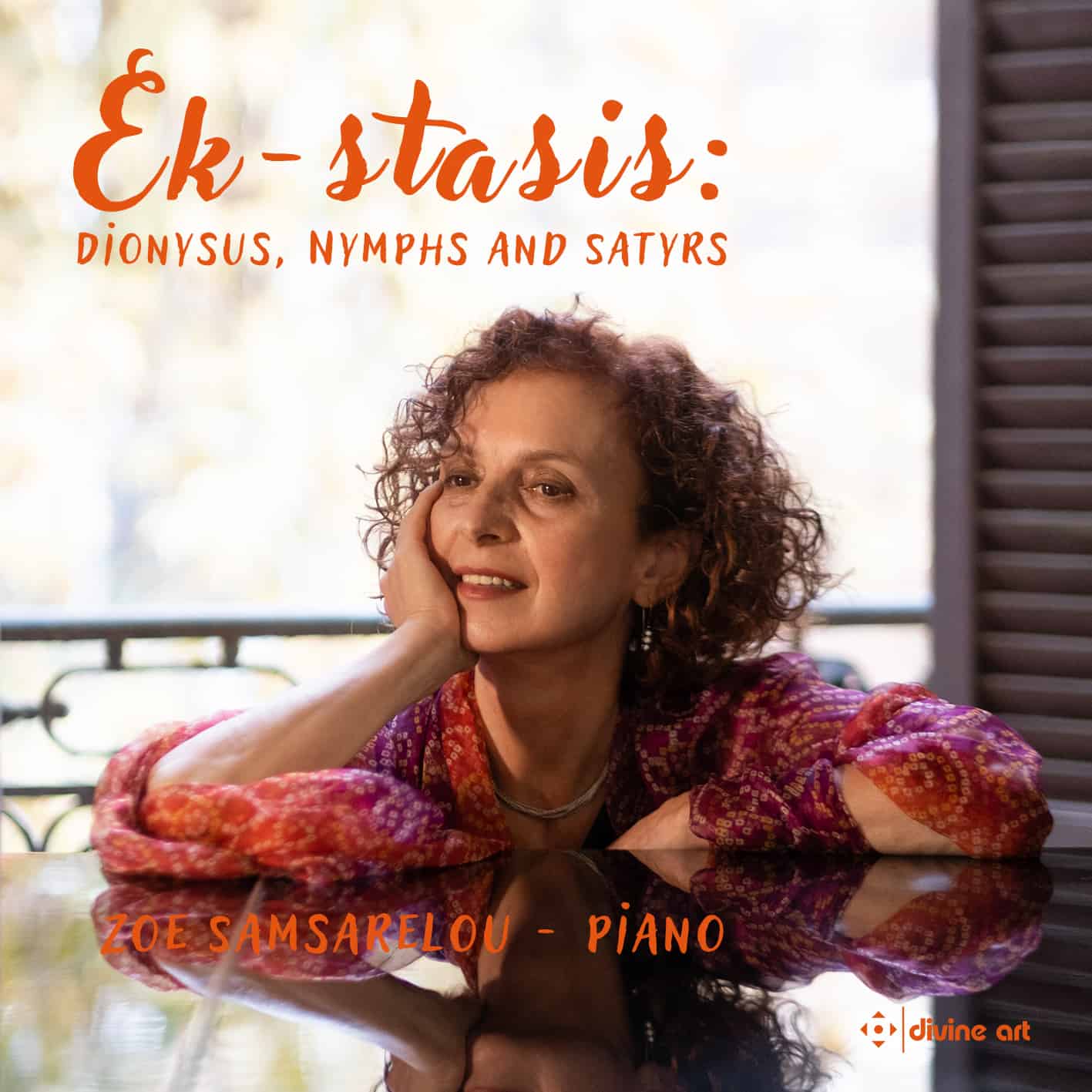
  • Ek-stasis: Dionysys, Nymphs & Satyrs DDX 21237 Textura review

    On her double-CD collection Ek-stasis, Greek pianist Zoe Samsarelou deploys a smart strategy to organize a huge amount of material (143 minutes, to be exact) into a cohesive design. In ordering the pieces according to themes, the recording assumes a satisfying structural form and establishes connections between works that might otherwise seem unrelated. As intimated by its title, the project grounds itself in the myth of Dionysus (Bacchus), the Ancient Greek figure famously associated with wildness, abandon, and ecstasy and diametrically opposed to Apollo, who’s tied to reason, harmony, and balance (it was Nietzsche, of course, who in The Birth of Tragedy examined the “Apollonian” and “Dionysian” as contrasting principles). Dionysus’s followers included satyrs, maenads, and nymphs, hence the album title. It hardly surprises that artists are more typically associated with the wilder of the two principles for their ecstatic flights of creative inspiration.

    Samsarelou’s treatment less fixates on this ecstatic dimension, however, and instead presents an interconnected narrative that progresses through numerous sections. Performing material by Greek and French composers (including three world premiere recordings), the pianist explores themes such as seduction, metamorphosis, transcendence, instinct, and catharsis. Couperin, Rameau, Dandrieu, Daquin, Dukas, and Debussy rub shoulders with a large cast of Greek composers of the twentieth and twenty-first centuries in this thoughtfully curated programme. In detailed liner notes, Samsarelou, who has been a professor in the Piano Department at the State Conservatory in Thessaloniki since 1994, provides historical context and clarifies how certain pieces explore different facets of the myth. The focus of Dimitri Terzakis’s 2003 piece Ein Satyrspiel, for example, is a game played between nymphs and a satyr, the former teasing and the latter aggressive. Nestor Taylor’s 2017 setting “Erinyes,” on the other hand, considers in musical terms three goddesses of vengeance and retribution known as the “Bacchae of Hades” who called the Underworld home.

    While the journey is long, it’s populated with many scenic sights and performances that are unfailingly engaging. Consistent with the section title ‘Seduction,’ the opening pieces, François Dandrieu’s pretty “La sirène” and Déodat de Séverac’s bewitching Les Naïades et le Faune Indiscret (an album standout), offer enticing points of entry. Even at this early stage, Samsarelou’s assured command of the material is readily apparent. The first of two Terzakis pieces, 2005’s Satyr und Naïaden, exudes a noticeably Greek character but is more memorable for its mischievous playfulness (it’s fascinating too for dipping its toes into its blues and jazz idioms).

    Moving on to ‘Pathos,’ Paul Dukas’s haunting La plainte, au loin, du faune pays homage to Debussy, who had died two years earlier (Dukas’s work was part of Le Tombeau de Claude Debussy, which comprised ten pieces commissioned by Henry Prunières in 1920 to commemorate Debussy). In moments reminiscent of J. S. Bach, François Couperin’s rousing “Les Satyres” immediately arrests the ear at the start of ‘Illusion’ and sets the stage for a suitably dreamlike rendering of Debussy’s Prélude à l’après-midi d’ un faune, the inspiration, of course, for Dukas’s tribute. Returning us to the present day, Lina Tonia’s Prelude of a lost dream perpetuates the mood when it smoothly alternates between graceful melodic patterns and rapid gestures. ‘Metamorphosis’ is highlighted by the lyrical, salon-styled lilt of Mischa Levitzki’s The enchanted nymph and the poetic diminishment of Echo’s voice that occurs within Nikos Skalkottas’s Echo, AK 77 (1946). Returning for the third and fourth time, Couperin initiates ‘Transcendence’ with two stately pieces from Les Bacchanales, “Tendresses bachiques” and “Fureurs bachiques,” and paves the way for Taylor’s driving “Erinyes” and Nikos Skalkottas’s foreboding Procession to Acheron, AK 79c (1948).

    Introducing the programme’s second half and its ‘Instinct’ section are Jean Philippe Rameau’s energized “Les cyclopes,” Jules Massenet’s macabre “Le bapteme par le vin,” and Sergei Bortkiewicz’s devilish “Valse grotesque (Satyre).” Debussy reappears, this time in the ‘Catharsis’ set, with two alluring pieces from Six epigraphies antiques, “Pour invoquer Pan, dieu du vent d’été” and “Pour la danseuse aux crotales.” Whereas the first half includes standalone pieces, the second includes two multi-movement works, Harry Farjeon’s Pictures from Greece, Op. 13 (in the ‘Mythos’ section) and Paul Juón’s Satyre und Nymphen – 9 Minuaturen für klavier, Op. 18 (‘Paradox’). Farjeon’s “The Dryads” engages immediately with its youthful elan, “The Fates” for its solemn mystery, “The Muses” wry prettiness, and “The Graces” wistful melancholy. Juón’s lunges into action with the vivacious “Etude (Najaden im Quell)” before settling into the languour of “Idylle (Pat mit der Syrinx),” “Réverie (Träumende Oreade),” and “Valse lenter (Dryaden reigen im Mondschein).” Sombre and elegiac episodes surface (lighter ones too) before Aspasia Nasopoulou’s chromatically adventurous “Krokeatis Lithos-Lakonia” brings the project to a provocative end.

    As much as Dionysus serves as the conceptual springboard for Ek-stasis, Samsarelou was wise to extend the project to include nymphs and satyrs when so many of the composers’ pieces address this broader terrain. Doing so has resulted in a recording of immense scope and abundant musical richness. She deserves credit also for fashioning a set-list whose range reflects scholarship and imagination in equal measure.

  • Ek-stasis: Dionysus, Nymphs and Satyrs – International Piano review DDX 21237

    Zoe Samsarelou does not lack ambition.

    Over nearly two and a half hours, ‘Ek-stasis’ takes a long-range view of Dionysus from his mythical or cult status, via his ritualistic and historical connotations, to his influence on Western civilisation across some two and a half millennia.

    For this purpose, the two-dozen works represented here have been grouped into 10 categories – each (more or less) chronological in itself – that between them illustrate those successive stages of the Dionysian process. Essentially it involves continuous passage from the physical to the abstract, and if the actual music might not always seem to embody this directly, there is rarely any doubt as to the appropriateness of its wider context, nor of the light shed through juxtaposing pieces that are neglected these days or have simply fallen out of the repertoire.

    The journey begins at ‘Seduction’ – initiated by a pert number from Francois Dandrieu and continuing with the proto­Impressionist sensuality of Deodat de Severac, then the pan-tonal obliqueness of Dimitri Terzakis. ‘Pathos’ (seen as a concept rather than an emotion) takes in another incisive Dandrieu vignette, heading to the inward anguish of what is almost Dukas’s last utterance, then the physicality of a piece from the multifaceted suite Mediterranean Desert of Giorgos Koumendakis. ‘Illusion is framed by a ‘satiric’ item from Couperin and a heady aphorism by Lina Tonia; between comes Debussy’s trailblazing Prelude à l’àpres-midi d’un faune in the revelatory transcription by Leonard Borwick.

    Couperin at his most bracing starts ‘Metamorphosis’, also taking in the most evocative from Mischa Levitzki’s handful of encores and a no less affecting miniature by Nikos Skalkottas. A ‘Bacchic’ prelude and toccata from Couperin begins ‘Transcendence’, followed by the enveloping richness of Florent Schmitt and a coursing miniature by Nestor Taylor, before the hieratic tones of further late Skalkottas brings up a nominal intermission.

    Rameau at his most inventive launches ‘Instinct’, followed by an unexpectedly visceral dance from Massenet’s forgotten opera Bacchus and a lively character­study by Sergei Bortkiewicz – ending with more capriciousness courtesy of Terzakis. Moving on to ‘Catharsis’, the tensile elegance of Louis-Claude Daquin precedes two of Debussy’s alluring Epigraphes antiques, as heard in the latter’s solo transcription, and followed with a vividly descriptive genre piece by Dimitris Marangopoulos. The next two categories are each represented with just one collection apiece. ‘Mythos’ comes in the guise of Pictures from Greece by Harry Farjeon, chiefly remembered as a pedagogue but whose artful miniatures are worth reviving, while ‘Paradox’ is illumined by the cycle Satyre und Nymphen from Paul Juon – once referred to as the ‘Russian Brahms’ but whose engaging and often imaginative studies ally more closely with comparable pieces by Schumann or Tchaikovsky. Finally to ‘Transition’ – embodied in the elemental rhetoric of an item from Row Rocks by Aspasia Nasopoulou, which brings about the unequivocal close.

    Throughout her epic recital, Samsarelou is the capable and informed exponent of music that often gains from being heard in this narrative context. This is especially true of those pieces taken from collections by Baroque masters (eminently suited to the piano in any case), while those by contemporary Greek composers should help in the disseminating of their music to a wider listenership. As recorded, her Fazioli has clarity and definition but is lacking in dynamic light and shade, and some may find the occasional sound of the sustaining pedal being depressed distracting. Of course, it is entirely feasible to look beyond the unifying concept of this collection, further detailed by the pianist in her booklet note, and enjoy each of the pieces on its own terms – yet however one chooses to approach it, an enlightening experience is there for the taking.

  • Ek-stasis: Dionysus, Nymphs and Satyrs

    Ek-stasis: Dionysus, Nymphs and Satyrs

    Experience the captivating journey of Ek-stasis, presented by Divine Art Recordings.

    Delve into the world of myths reconstructed in music by celebrated composers from different cultures and times. This unique album features three world premiere recordings, bringing fresh and exciting music to the programme. Greek pianist and professor Zoe Samsarelou has expertly curated a selection of works that weave together an interconnected narrative, taking you on a journey through the myth of Dionysus. From the works of Couperin, Rameau, Dandrieu, and Daquin to the eminent Greek composers of the 20th and 21st centuries and the Late Romantics in between, each piece is thoughtfully selected and presented.

    The album is divided into themes of seduction, pathos, illusion, metamorphosis, transcendence, instinct, catharsis, mythos, paradox, and transition. This creates an immersive experience that guides the listener through the various stages of the myth and offers a musical perspective on the story. Accompanied by Zoe Samsarelou’s insightful prose on the collection and notes on the Greek composers featured in the program, Ek-stasis is more than just a listening
    experience. It’s a celebration of the Greek spirit that has influenced humanity for over 2,500 years, highlighting the creativity and ingenuity of these wonderful composers.