Catalogue Connection: 21238

  • Bach: Six Solo Suites for Cello – Chronicle Review

    The Six Suites for Solo Cello  by Bach, composed around 1720, are generally regarded as the first and greatest masterpieces ever written for the instrument and here, they’re played magnificently. What’s left to say?

    We Googled around for a bit and found a website dedicated solely to cellos and Bach’s six suites, which commented on the unbelievable amount of resin on Ms Tarasova’s instrument’s fingerboard, which said that she had taken the diametrically opposite approach to the suites’ more usual “overly academic and formal” performances.

    The review rather gloriously adds: “If when you were younger you enjoyed the film Spinal Tap and now you are older and into classical music, you might like this performance”. We think it was suggesting that she’s turned everything up to 11 and while energetic and well played, it lacks subtlety.

    The reviewer means people like us. We like the album a lot, and it ranges in tone from the timeless gravitas that only the cello can provide to lighter sections, and from the dramatic to the more playful. Tarasova plays what must be highly technical sections with aplomb, and it’s all very listenable, and makes for nice music to work to.

  • Bach Cello Suites (Tarasova, DDA 21238) – MusicWeb review

    This welcome release presents a brilliant young Russian musician who gives us her unique interpretation of Bach’s challenging cello suites. They are among the treasures of the cello repertoire, the ‘most profound of all classical music works’, yet few of Russia’s many outstanding cello players have given us their take on this wonderful collection. Of course, Rostropovich’s recordings are celebrated; however; I treasure a fine set of Melodiya LPs of the six suites by one of his favourite pupils, Alla Vasilyeva (1933-2018), sadly never released on CD. A founding member of the Moscow Chamber Orchestra, Vasilyeva was one of the finest Soviet cellists and was exceptional in embracing both the baroque and contemporary repertoire.

    Marina Tarasova first studied at the Gnessin School where so many outstanding Russian musicians started out, then at the Moscow Conservatoire with Professor Nataliya Shakhovskaya, entered the competition circuit winning major awards at Prague, Florence and Paris and was a laureate at the Tchaikovsky Competition in Moscow. She has collaborated with such musicians as Mikhail Pletnev, Gennady Rozhdestvensky, Kurt Masur, Edward Grach and Yuri Bashmet. Her first recordings appeared on the Melodiya label and later on Olympia, Northern Flowers; this is her first release on Divine Arts.

    I have heard Ms Tarasova’s recordings of Soviet music, including Myaskovsky, Khachaturian and Kabalevsky, on labels such as Olympia, Melodiya and Northern Flowers, which highly impressed me, but I have never heard her playing western repertoire. This new release surprised me, for she is an outstanding musician presenting her own views on these great works – and I hope that this will lead to more recordings of western baroque repertoire for cello or other western cello works. She has a magnificent technique and is able to make it seem as if the challenging aspects of Bach’s six suites do not exist, allowing the listener so much more enjoyment of her magnificent interpretations.

    In this set of cello suites, Tarasova brings out all the charm of the dances and the life-enhancing flow of Bach’s music, especially in the opening prelude with its complex arpeggiated chords. She plays so magnificently that one forgets about the technical difficulty of this music and is allowed just to sit back and listen to the splendour of her playing. In the second suite in D minor, the mood is more poignant, contrasting with the previous suite; Tarasova undertakes the scale-based cadenza through to the final powerful chords expertly, and in the minuet of the livelier Third Suite she handles the chord-shiftings and string-crossings marvellously.

    In the Fourth suite in E major, the most technically difficult passages are brilliantly handled and the sarabande is serene. The sarabande in the Fifth suite seems to float as if unattached to any tonality, (which allowed Schoenberg to claim that Bach was the ‘first twelve-tone composer’). The prelude is in A-B form, and essentially is an overture in the French style, which Paul Tortelier described as an ‘extension of silence’.

    In the final, sixth suite, the more open form embraces cadenza-like movements and virtuoso passages, and in the D major tonality is what Rostropovich called pure ‘joy and triumph’, all vividly presented here. Again, Tarasova gives no hint of technical difficulty, making it sound beautifully natural.

    The two discs are in a duo-box with a booklet containing an essay in English on the music, a biography of Tarasova with colour photographs and details of the recording venue. This is an outstanding release and one hopes that this label will record more western classical pieces by this remarkable Russian musician.
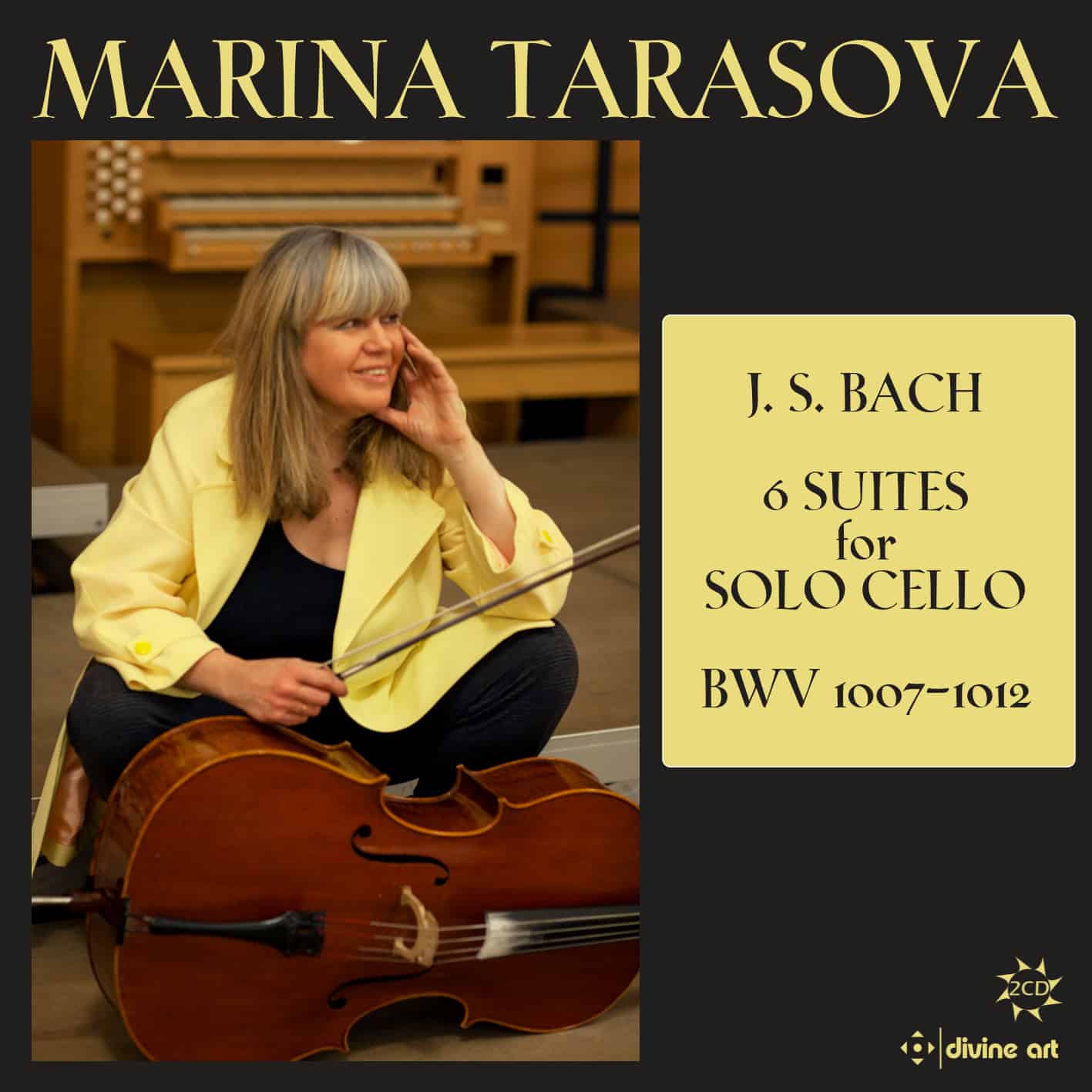
  • Bach: Suites for Solo Cello – DDA 21238 – Gramophone review

    This is not a recording for the faint-hearted. Anyone expecting soothing, bubble-bath arpeggiations from the Prelude of the First Suite is in for a shock. Marina Tarasova’s performance is gritty, windswept and growlingly confident. Then the Allemande, with full-bodied opulence, which turns to a crazed tunnel vision in the closing Gigue. Interestingly, at some point during the Suite the shock factor does wear off: light and shade emerge between the gruff and intense. These are performances that demand your attention.

    Take, for instance, the Allemande of the Second Suite. It’s a slap in the face. One problem with such consistent electricity – thrashing string crossings and high-voltage vibrato – is that harmonies are coloured with more or less equal intensity. Bravura in spades, certainly, but I prefer more spelling out of the harmonic language in my Bach. A similar issue clouds the Gavottes in the Sixth Suite. Tarasova puts so much energy into making the chords sound impressive that the overall impression is not of resonance but rather of labour. The mechanics of chordal work get in the way of the melodic line and flow; the music does not sing.

    This sound world can certainly be addictive. The Sarabande of the Third Suite is rich in mahogany. Intensely sonorous, it can make other performances seem feeble and thin in comparison. But this approach goes too far for my taste in the same suite’s Allemande. Dynamic contrasts are drawn in caricature and phrasing difficult to follow.

  • Bach Suites for Solo Cello (DDA21238): New Classics review

    Born in Eisenach, Germany, in 1685, Johann Sebastian Bach was a sublime baroque-era composer, revered for his work’s musical complexities and stylistic innovations. He came from a family of musicians, stretching back several generations. His father, Johann Ambrosius, worked as the town musician in Eisenach, and taught young Johann to play the violin. The Six Suites for Solo Cello, composed around 1720, are generally regarded as the first and greatest masterpieces ever written for the instrument, though they were not widely known before the early 20th century. Pablo Casals first began to popularize the suites, after discovering an edition in a bargain shop in Barcelona in 1889 when he was 13. Since then, the Suites have been performed and recorded countless times, with a variety of interpretative approaches. Until recently, these could often be rather academic and formal, as it used to be thought that baroque music was mostly about form. The cellist on these recordings, Marina Tarasova, takes a radically different approach, one which is inspirational and which infuses the works with vitality and spirit. Acclaimed Russian cellist Tarasova is a world-renowned cellist with many recordings to her name for Musical Concepts and Northern Flowers among other labels, and this is her first recording for Divine Art. She has won international competitions in Prague, Florence and Paris and has a wide repertoire covering works of composers from the 17th century to the 20th century. Bach’s Cello Suites are among the most profound and ingenious of all classical music works. Highlights include Suite No. 1 in G major, with its prelude mainly consisting of arpeggiated chords and well known from its use in television and films, as well as the technically demanding Suite No. 4 in E and exhilarating Suite No. 6 in D major. ‘Her playing is generous in tone, full-blooded in expression, passionate and confident, evidently fired by love for and commitment to the music.’ – Gramophone.

  • J S Bach : Suites for Solo Cello – Infodad review (DDA 21238)

    The continued fascination of Bach for listeners and instrumentalists of all kinds is scarcely a surprise, and the constant attempts to get to the heart of his music show no sign of letting up anytime. Bach’s solo-instrument pieces, in particular, are endlessly challenging and pleasurable for performers and audiences alike, and the remarkably high quality of playing that they elicit from musicians fully justifies the frequency with which new recordings are released.

    The latest recorded version of the cello suites, a two-CD release on the Divine Art label, is a case in point. Marina Tarasova is an absolutely first-rate cellist, sensitive to the dance forms underlying these remarkable compositions but equally aware of the extent to which Bach built upon and enlarged those forms rather than simply following them slavishly. It is clear from the very beginning – the opening Prelude of the first suite – that this will be a very personal interpretation: Tarasova plays this well-known movement quickly and with almost a “fiddling” quality, seeking to elicit a level of emotional connection that she looks for throughout all six of the suites. These are not historically informed performances, but ones that delve into the underlying emotive nature of the suites and use the capabilities of a modern instrument to bring them out. This means Tarasova sometimes downplays rhythmic precision – as in the minuets of the first suite – in favor of greater expressiveness. In some of the most forward-looking music of the suites, such as the Sarabande of the fifth suite, this approach works particularly well. In more-straightforward movements, such as the Gigue movements that conclude all the suites, it is less winning, although Tarasova deserves praise for the consistency with which she applies her concepts.

    The sixth and longest suite, always a major challenge for a performer using a modern instrument because it was written for a five-string cello, is the high point of this release: everything in this suite is expanded (the Allemande is the longest movement in any of the suites), and Tarasova allows both the notes and their foundational heartfelt communication to flow with considerable beauty and an impressive level of technical precision. The contrast between the lively Courante and very emotional Sarabande in this suite is particularly well-handled. There is no “best” recording of these Bach solo-cello works, and there are so many good ones that it is hard to imagine music lovers settling for a single rendition. Tarasova’s approach, with its unapologetic willingness to downplay traditional form and rhythmic precision in favor of interpretative license, is emotionally satisfying in a way that more-straitlaced performances are not, although it is less sensitive than some other readings to the time period in which Bach actually wrote the suites. It is convincing on its own terms – which is really the most that anyone can hope for in performances of these endlessly fascinating solo-cello creations.

  • J.S. Bach: Six Suites for Solo Cello

    J.S. Bach: Six Suites for Solo Cello

    The Six Suites for Solo Cello by J S Bach composed around 1720, are generally regarded as the first and greatest masterpieces ever written for the instrument.

    Their scope is vast and ingenious. Although most of the time, only one note is played, occasional chords and masterful melodies imply harmony and counterpoint.

    The Suites have been performed and recorded countless times over the last 100 years, with a variety of interpretative approaches. These approaches, until recently, could often be rather academic and formal, as it used to be thought that baroque music was mostly about form. The present cellist takes a radically opposing approach, one which is inspirational and which infuses the works with vitality and spirit.

    Marina Tarasova is a world-renowned cellist with many recordings to her name for Musical Concepts and Northern Flowers among other labels, and this is her first recording for Divine Art. She has won international competitions in Prague, Florence and Paris and has a wide repertoire covering works of composers from the 17th century to the 20th century.