Catalogue Connection: 21239

  • Jonathan Östlund: Imago (DDA 21239) – Fanfare review

    Back in Fanfare 39:4, I enjoyed a similar Divine Art twofer of Swedish composer Jonathan Östlund’s music. The current release certainly continues the trend: this is music of filigree beauty; his mind a magpie, taking sources from the music of Bach, Mussorgsky, Tchaikovsky, Beethoven, Brahms, Reger, Debussy and Swedish and Celtic folk music. The whole traces a journey through the seasons.

    We certainly feel the fragranced flute of Pan in L’eau de l’oubli (Anna Noakes, flute, with  Gabriella Dall’Olio), and there’s no missing the Bach D-Minor Toccata that opens the Fantasia on that theme (Sasha Grynyuk, piano) or the loveliness of Östlund’s take on Bach’s Siciliano. In the astonishingly confusing personnel listing I am afraid I am unable to locate the excellent flutist for Les oiseaux et françois, but whoever it is is a fine player.

    Although I enjoy the sound world of the arrangement of Reger’s Maria Wiegenlied, sadly I cannot warm to Lina Ferencz’s mezzo, which is lacking warmth of tone; she is more convincing in the vocalises (La neige de Noël, La nuit étoilée, and Rêve et lune).

    One of the most clever pieces here is Östlund’s Paraphrase on Komm susser Tod, Komm sel’ge Ruh’, a lovely cross-pollination between Bach and Östlund in lush textures. His piece on Beethoven’s “Moonlight” first movement, Mondspiegel, well played by Sasha Grynyuk, is perhaps of lesser inspiration, and I do wonder why there is quite so much reverb to the recording of Turquoise Spring for violin and viola. That’s a pity, as the performance (Paola Nervi and Elena Saccomandi) is of gossamer lightness, the piece full of flights of fancy.

    It’s interesting to find a choral piece suddenly installed here, Night of June (a Swedish text translated by the composer). Sadly, it’s a rather gray and uninteresting setting;  congratulations are due to the choir for negotiating Östlund’s difficult harmonies, though. The pleasant, Debussyan Lumières du Jardin, sensitively played by Walter Gatti, offers a place of realignment, and the two bassoon and piano piece Will-o ‘-the-wisp offers light amusement, curiously sounding as if it is about to burst into a carol at any moment. This is apt, as the final piece on the first disc is indeed a fantasia on a Swedish carol by Vilhelm Serve-Svensson, Midnight Hour, an absolutely delightful, light-touch retelling (with some superbly fluent piano playing also). The first disc closes with Zephyr, a solo piano piece played by Evgheny Brakhman that is more forthright than its title might imply.

    Östlund’s setting of Gustaf Froding in Titania is well done, but the sound feels over-reverbed again. More playful and in a better recording is Swedish Folk-Dance for two clarinets (only one is listed, Christine E. Hoerning, so I have to assume it is multi-tracked). The shorter pieces here are atmospheric and well done; it’s nice to have a bed of strings for soprano Maria Zagorinskaya’s vocalise, La sirena (which includes some lively horn playing from Oleg Egorov). If Castel Caracal, another vocalise, is rather filmic, there’s no missing “Scarborough Fair” in True Love of Mine (it’s a fantasia for piano on that theme).

    The only extended piece on the twofer is Banquet, a suite for two clarinets (again presumably multi-tracked)—amusing and light, if somewhat over-reverbed again. Here Östlund’s ability to act as a magpie comes in handy again: Starting with a “Fantasia on a Swedish Folk-Song,” we have two clarinet takes on a Brahms Hungarian Dance, Debussy’s Faun, Mussorgsky’s “Promenade” and “The Old Castle” from Pictures, Tchaikovsky’s “June” from The Seasons, plus a “Fantasia on “The Last Rose of Summer.” Everything, both composition and performance, could be summed up by the word “deft.” Most intriguing of the seven movements is the last, “Fantasia on Tchaikovsky’s June,” where one really does get the impression that Tchaikovsky is being taken for a walk. More robust is Traumgewalt, beautifully played by Caroline Doerge, who manages not to break her tone at all and has all the fluency required. If the song The Jester somewhat outstays its welcome, the solo flute La flûte rèveuse is Östlund’s Syrinx, and Myriam Hidber-Dickinson is in top form; some recorded birdsong enhances Imago Theme 2. Certainly this is a pleasant way to spend a couple of hours. Östlund’s music is highly beautiful, and he is lucky to have such a skilled group of performers
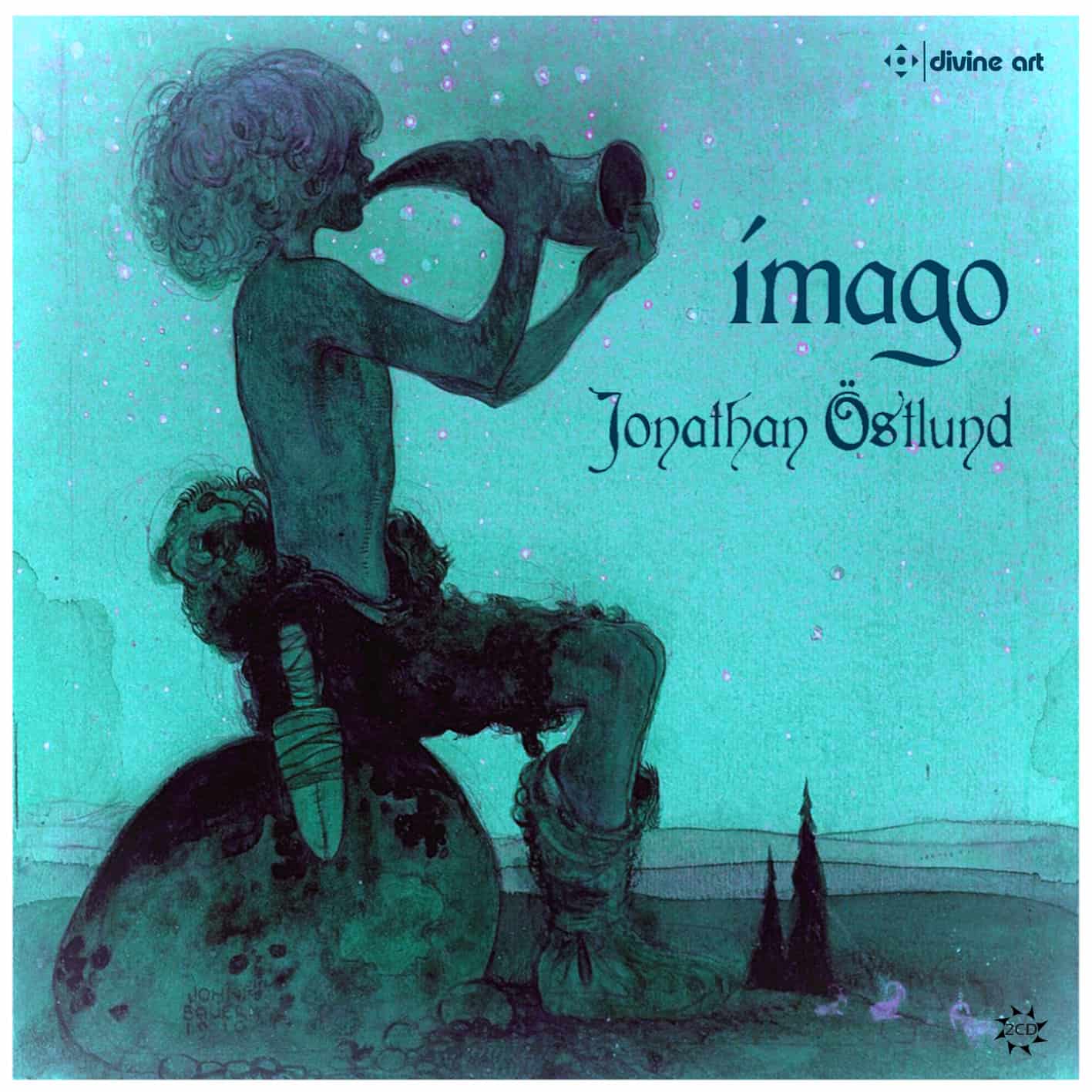
  • Imago (DDA 21239) – Chronicle review

    Östlund is a Swedish composer who has recently been living in Romania and before that London, returning to his home country in 2021.

    We always like his albums. They’re a bit out there and varied, but it’s more or less the sound elves would make if they had an orchestra playing out in the woods under the moon. This one is no different but there’s a lot of it — two CDs, two and a half hours. We’re fans of the whimsical as much as anyone else but two hours all in one go is a bit much.

    We can’t decide what it is: CD1 opens with birdsong, spoken word, flute, harp and dreaminess (the sleeve notes indicate the whole is the story of a butterfly, so expect a fluttery but gentle sound) so a kind of stringy ambience, but there’s also a lot of singing, so a large choral element too, which ranges from the sing-song spoken to full-on dramatic singing. He also combines a feeling of nature with some degree of mystery, hence our feeling of elves in the wood.

    There’s too much to go into it all but CD1 opens very gently, the piano and violin later joining the harp. You’re just getting the measure when in comes Bach’s Toccata in D Minor, reimagined by Östlund, so you go from relaxing in the mysterious glade with elves to this incredibly well-known piece of music. He repeats the trick more than once, side two seeing Scarborough Fair brought into play. That’s also a useful element because, despite being Swedish, there is a strong sense of English folk to it all, as well, ranging from a Green Man / morris dance vibe to the more familiar, though Scarborough Fair itself goes back several hundred years.

    We guess you’ll either get him or you won’t. We’d hope you do because all his albums bring pleasure and, if you leave his jumping around the genres aside, are easy to listen to — he’s trying to create a mood rather than dropping in a memorable melody, so it’s often textured and impressionistic rather than getting to a point. It’s probably a lot of fun to play, as well.

  • Östlund: Imago (DDA 21239) – Infodad review

    Modern choral music, no matter how well composed and performed, is something of a specialty item – and a new two-CD release on the Divine Art label, featuring the music of Jonathan Östlund (born 1975), is even more so. That is because there is such a large amount of material here – a true wealth of music for those already familiar with and interested in this composer, but an overwhelming offering for most potential listeners. The discs contain nearly two-and-a-quarter hours of material, and it is of all types: choral, vocal, chamber, and orchestral.

    Sorting through all of this music, much less listening to it in the order presented (the sequence is essentially arbitrary), is a lot to ask of an audience; and the attempt to bracket the material by sandwiching it between the brief Imago Theme at the start of the first disc and Imago Theme 2 at the end of the second is not particularly useful. To the extent that there is any connection among these disparate works, it lies in the way that Östlund uses and pays tribute to the past. For one thing, Östlund frequently makes use of Impressionistic techniques, employing instruments and voices to emotive effects that are intended to elucidate scenes including La Neige de Noël, Turquoise Spring, Night of June, and Zephyr. For another thing, Östlund deliberately quotes from, paraphrases or creates fantasias or variations on specific music of the past, from Bach’s Komm süßer Tod, Komm selge Ruh to Reger’s Mariä Wiegenlied. This element of Östlund’s approach is most clearly on display in the seven-movement Bouquet (Suite for Two Clarinets), which is a set of fantasias – on a Swedish folk song, Brahms’ Hungarian Dance No. 5, and Debussy’s Afternoon of a Faun, plus The Last Rose of Summer, two parts of Mussorgsky’s Pictures at an Exhibition, and Tchaikovsky’s June. The mixing of classical and folk music works well, thanks to the specific items chosen by Östlund and his way of delving into their expressive potential. And in fact, a great many of the pieces heard here are inviting and pleasant to listen to, staying firmly in a tonal universe and paying respectful tribute to music of the past from a wide variety of sources, including several from Östlund’s native Sweden. Listeners unfamiliar with Östlund may be pleasantly surprised at the accessibility of his works and the consistent quality with which he produces them. And all the performances, by a very large number of soloists and ensembles, are engaging and effective. Nevertheless, this is a great deal of material by a single contemporary composer, and one whose sensibilities tend not to vary much from piece to piece. Therefore, for most audiences, this recording will be far more enjoyable in small doses than as a start-to-finish experience.

  • Jonathan Östlund : Imago – New Classics review

    Swedish composer Jonathan Östlund has recently been living in Romania and before that London before returning to his home country in 2021. He manifested an avid interest for music from an early age and pursued his passion with a BA and MA in Composition at the Luleå Tekniska Universitet, in Sweden. He has studied under the artistic guidance of Prof. Rolf Martinsson, Prof. Jan Sandström and Prof. Sverker Jullander, among others, and has so far completed over 100 works, including several orchestral pieces, a Violin Concerto and a Piano Concerto, and has been awarded many prizes in international competitions.

    Acclaimed for his imaginative and accessible music, he has been championed by some of Europe’s best musicians. Following his previous well-received albums, Voyages and Lunaris, Imago follows the distinctive format of previous programs in that its 35 tracks features orchestral, vocal, choral, instrumental and chamber music.

    Jonathan Östlund’s primary inspiration is nature which is brought out fully in beautiful Impressionist works such as L’eau de l’oubli and La nuit étoilée.  He is also fascinated by the art of composing fantasies and paraphrases on classics and several are included here. A large team of top class soloists (several of whom also gave the world premieres of these works) were gathered in various locations, often having to work through lockdowns, to record this new album of music that is attractive, full of wit and humour, and always atmospheric.

    Highlights include two entrancing Imago Themes with bird song, an arrangement of Reger’s ‘Mariä Wiegenlied’ (with Hungarian-born mezzo-soprano Lina Ferencz), the magical La Neige de Noël, a sprightly Will-o’-the-wisp, and the evocative Fantasia on Mussorgsky’s ‘The Old Castle’.

  • Jonathan Östlund: Imago

    Jonathan Östlund: Imago

    “Östlund’s 2019 double CD Voyages and 2020’s Mistral elevate him to the status of the 21st century’s Debussy.”– Jan Hocek (His Voice)

    Jonathan Östlund (b.1975) is a Swedish composer who has recently been living in Romania and before that London before returning to his home country in 2021. He has manifested an avid interest for music from an early age and has pursued his passion with a BA and MA in Composition at the Luleå Tekniska Universitet, in Sweden. He has studied under the artistic guidance of Prof. Rolf Martinsson, Prof. Jan Sandström and Prof. Sverker Jullander, among others, and has so far completed over 100 works, including several orchestral pieces, a Violin Concerto and a Piano Concerto, and has been awarded many prizes in international competitions.

    This new album follows the distinctive format of previous programs in that it features orchestral, vocal, choral, instrumental and chamber music. Östlund’s primary inspiration is nature which is brought out fully in beautiful Impressionist works such as L’eau de l’oubli and La nuit étoilee. He is also fascinated by the art of composing fantasies and paraphrases on classics and several are included here. A large team of soloists (several of whom also gave the world premieres of these works) were gathered in various locations, often having to work through lockdowns, to record this album. Östlund’s music is very accessible and tonal and often full of wit and humor, and is always atmospheric.