Catalogue Connection: 21240

  • Souvenirs d’oiseaux DDA 21240 – ARG review

    This unusual piano collection celebrates various kinds of bird song and effects of light  through the course of the day and into the evening. The performances by Roderick Chadwick, a gifted pianist, professor, and writer, are lucid, wildly colorful, and a bit understated when need be. The inventive structure is organized around Messiaen’s Catalogue d’oiseaux with selections from books 2, 3, and 5, depicting a tawny owl, a bittern, a spectacled warbler, and others, as well as frogs croaking in a marshland and mists on the water represented by silence. A particular pleasure is ‘Le Traquet Stapazin’ from Book 2, which opens the album, alternating landscape painting with bird sounds, culminating in a nocturnal coda. Chadwick is a meticulous scholar specializing in this massive work; one couldn’t ask for a more compelling, authoritative performance.

    The rest of the album offers a rich combination of composers representing radically different styles. Sadie Harrison’s gentle, inviting Lunae, an homage to the 19th Century piano nocturne, combines depictions of nature with the idea of love in varying guises (not unlike Messiaen). Julian Anderson’s Sensation, “a tour of the senses”, opens with ‘ She Hears’, a series of soft chords in honor of Imogen Holst, and ends with a celebration of dawn light. If parts of Betsy Jolas’s Chanson d’Approche sound like Messiaen, that is because Jolas was his student; indeed the piece has fragments of her mentor’s work, though it has its own individuality. Debussy’s Prelude 1:4, one of his most exquisite nocturnes, is played with subtle voicing; the realistic recording captures every nuance, including the distant, deep bass at the end.

    This is all 20th Century music except for its conclusion, Grieg’s Nocturne from his Lyric Pieces, containing forward-looking hints of Delius and Debussy—Grieg at his most evocative, and beautifully played, a perfect coda.

  • Souvenirs d’oiseaux DDA 21240 – Fanfare review 2

    Pianist Roderick Chadwick appears on another disc I reviewed in this issue: Gregory Fritze’sSpanish Meditations & Dances, again on Divine Art. There, he was in a duo; here, he flies solo in one of the most perfectly programmed twofers I have ever heard.

    Each disc begins with Messiaen, and Messiaen punctuates the remaining composers. The first piece is “Le traquet stapazin,” heard here in a performance of the utmost understanding. Those who cherish (rightly) Aimard, Yvnne Loriod, or Anatol Ugorski will find Chadwick sits well in their company. He is as sensitive as Aimard, and yet can be as gestural as Loriod. There is such beauty here, such perfect conjuring of magical textures. Messiaen saw birds spiritually, and how that shines through Chadwisk’s performance.

    We have met Australian-born (1965), UK-resident composer Sadie Harrison before a number of times, via her NMC disc (which included An Unexpected Light, Fanfare 31:2), and the Toccata Classics disc including Gallery (Fanfare 39:3). Her Lunae also works with evocation of both the world around us and of the world of the Romantic piano nocturne, plus music especially close to her heart, the nocturnal evocations of the Impressionists, plus Bartók. The first movement, “Around and a Round …” is what she calls a “midnight merry-go-round.” I do feel a sense of the Fauré Nocturnes behind this, in addition to the composers she herself mentions. It is brilliantly written for the piano (Harrison is a fine pianist herself). Chadwick paints the music in a multitude of shades of semi-light. Based around Dowland’s Lachrymae Pavane, the arpeggiations of “Lachrymae” indeed invoke the world of the lute. It is written as an “In Memoriam” to “Pamela Parr, epigraphist and adventurer” and the score quotes Lithuanian poet Valdas Daskevcius: “Love is the silence in which I remember you and repeat you.” Chadwick delivers this with the utmost delicacy; rarely have I heard tremolandos so sensitively and evenly delivered. The third nocturne, “Of Stars and Nightingales,” takes its inspiration from Debussy’s Prélude, “La terrasse des audiences du clair du lune” and, linking to the gist of the disc, Messiaen’s “Régard de l’étoile.” There is almost the sense of a deconstructed Impressionist world here, punctuated by a nightingale’s song. The fourth nocturne, “Sufficit lumen in tenebris” (One light suffices in the dark) begins with a chorale; the piece is based on a Medieval chant from the Worcester school, dating from around 1300 AD. As the composer points out, the word “nocturne” comes from Medieval Latin and refers to the liturgical office associated with night prayers. The stillness of some of this music is breathtaking, and all credit is due to Chadwick for taking all the time in the world to create this atmosphere.

    Two more Messiaen pieces from the Catalogue, both from Book 3, follow: first is a vast, chthonic “La chouette hulotte.” The call of the tawny owl was one of the first Messiaen collected for the Catalogue, notated at two in the morning (linking nicely with the nocturnes just heard). Again, Chadwick’s dynamic range is huge, and his pianissimos are always perfectly weighted. Notated at midnight, “L’allouette lulu” contrasts registers beautifully, the slowly crawling bass against the call of the woodlark up above. It is pure Messiaen, and Chadwick delineates the plateaus perfectly. His variety of touch is the key, along with some clearly well-considered pedaling.

    I confess to having been less than enthusiastic about some of Julian Anderson’s work in the past, so it is good to report that his set of six pieces, Sensation, that closes the first disc is a fine work. It works with our experience (sensation) of time and also contains an “In Memoriam,” this time to Imogen Holst. The piece is called “She hears.” The concentration of the music and its unhurried nature both pay tribute to her (she was known for the intensity of her listening process). The next piece is for Pierre-Laurent Aimard and is called “Toucher.” It is effectively an etude in variety of touch. especially jeu perlé. The dialogue between two lines is partly witty, partly very clever. There’s no missing the virtuosity of “Sight Lines”; its disjunct hyperactivity is exciting and in complete contrast to the nocturne that is “Nuits,” which, like Messiaen’s piece, invokes the natural world. Pierre Audi is the recipient of “Alba”: “Daen.” The bell chords here do seem very close to Messiaen in their colorful resonance before a short coda seeks to summarize the set in a mere two-and-a-half minutes, and somehow succeeds.

    A half-hour Messiaen piece opens the second disc: “La rousserolle effarvate” from the fourth book of the Catalogue. This piece contains remarkable moments: the rising of a red sun in sound and the song of the nightingale, all contained within a representation of a 27-hour cycle. One of the most remarkable pieces in Catalogue, this is given a positively virtuoso performance by Chadwick; his command and understanding of Messiaen’s use of gesture is complete. This is a commanding performance.

    It’s interesting to hear the music of Betsy Jolas (b. 1926), her Chanson d’approche. A student of Messiaen’s, and so nicely binding herself into the set, Jolas spatially notated her piece, which gives the pianist a certain fluidity that is certainly audible in this beautiful performance. It is a rarefied interlude between Messiaen pieces. “L’alouette calandrelle” follows, a bird from Provence; such a short piece, with so many colors. Chadwick’s staccato chords are almost playful in “La bouscarle” (Cetti’s warbler).

    So, how to finish? Debussy and Grieg is the answer: a lovely performance of the fourth Prélude from Book I of Debussy’s Préludes, textures nicely terraced, and Grieg’s famous “Notturno” from the Lyric Pieces, bringing us back to Harrison’s four offerings but in a very different language (yet one that still explores birdsong in its treble trills).

    This is a superb release, thought-provoking and utterly involving. Roderick Chadwick is a name to remember. I learned a lot from the extensive booklet notes, too.
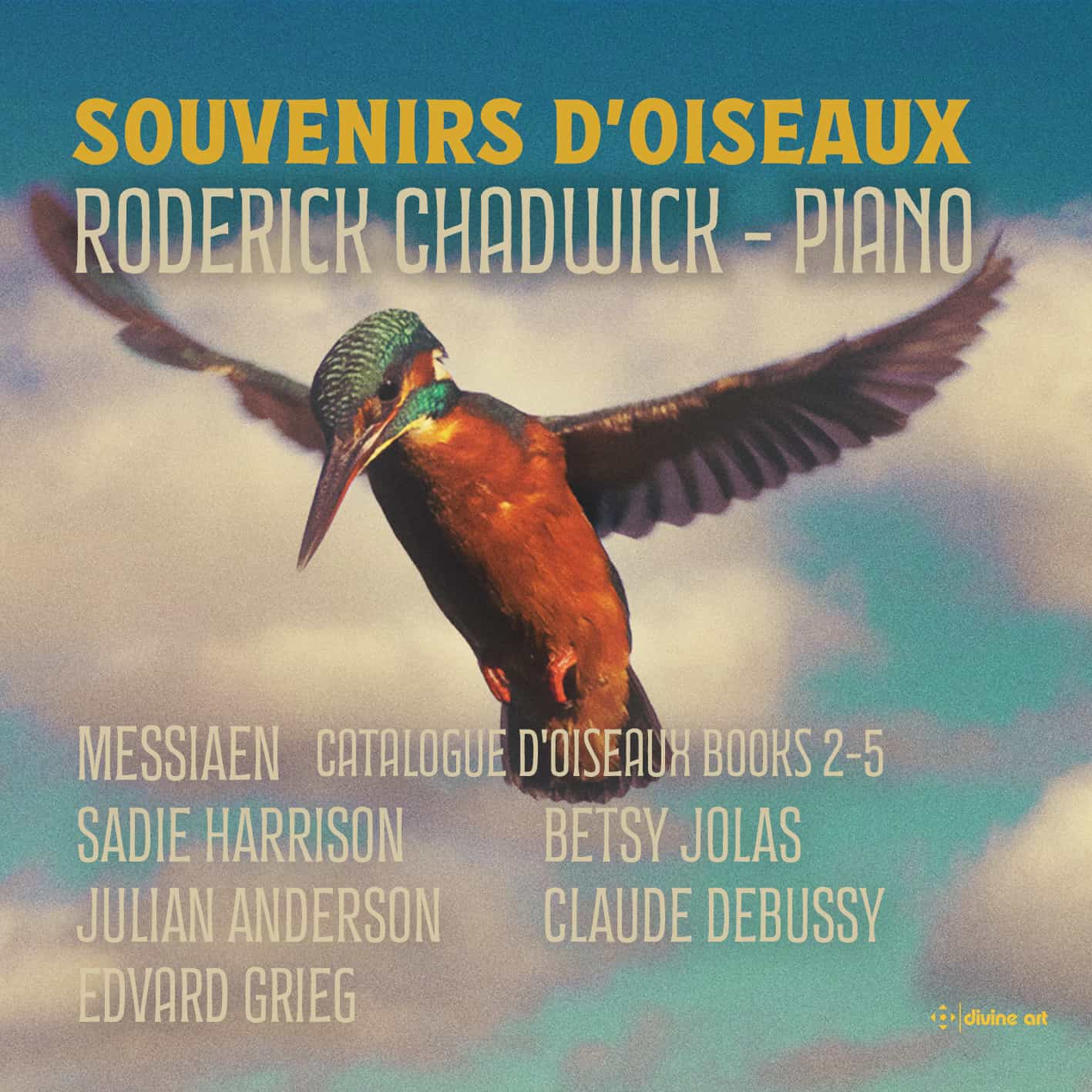
  • Souvenirs d’oiseaux (DDA 21240) – Fanfare review 1

    In Fanfare 44:3 Peter Rabinowitz favorably reviewed Roderick Chadwick’s recording of Book 1 of Olivier Messiaen’s Catalogue d’oiseaux. The only complaint that Rabinowitz expressed was that Chadwick “has only given us a small portion of the complete work.” This new release addresses that issue by giving us four more books from this extraordinary cycle of piano pieces. It seems reasonable to assume that the final two books are still to come. Chadwick has separated each of Messiaen’s four books with music by other composers that is related specifically to birds or more generally to Nature. The result is highly imaginative and captivating.

    Chadwick was co-author with Peter Hill of Olivier Messiaen’s Catalogue d’oiseaux: From Conception to Performance, published in 2017. His intimate familiarity with the music shows throughout his playing. It is not surprising that most of the existing recordings of Catalogue d’oiseaux are very good. Only a pianist with a fierce dedication to this difficult and highly unusual music would bother to learn and perform it. Thus there are fine recordings by Yvonne Loriod (the composer’s wife and dedicatee of the cycle), Pierre-Laurent Aimard, and Peter Hill, among others. Chadwick joins that upper level.

    Although Messiaen’s fascination with birdsong is well known, this cycle is much more than a transcription of bird calls. It is not necessary, or even advisable, to listen with the purpose of identifying specific birds. Rather, one should hear it as an exploration of all that Nature has to offer—daylight, sundown, sunrise, wind, cool breezes, and the vastness of the universe. Messiaen’s sound world is different from any other composer’s, although he was strongly influenced by Debussy. For me, the way to listen to Catalogue d’oiseaux is to just let the music sweep over you, to absorb it as a discovery in sound.

    This cycle is extraordinarily difficult to bring off in performance. It requires a prodigious technique, a wide palette of colors, and the full spectrum of dynamic shadings in order to capture Messiaen’s boundless imagination. There are moments of extraordinary delicacy along with moments of enormous power. The qualities that make Chadwick’s performance compelling include its beauty in quiet passages, Chadwick’s accuracy and clarity in the most rapid passagework and repeated notes, and the majesty of the mystical sections.

    In his superb and extensive program notes, Chadwick writes: “The remaining pieces on this recording are configured with the aim of complementing the masterpiece at the heart of Catalogue d’oiseaux, and to enhance the sense of day night continuum that is established throughout the Catalogue’s interior Livres.” Sadie Harrison is an Australian composer (b. 1965) whose lovely Lunae: Four Nocturnes is more traditional in its sound world. These Nocturnes are clearly in the tradition of Chopin, although there are hints of Debussy and Messiaen in the third, “Of Stars and Nightingales.” Individually or as a group, Harrison’s pieces would make an attractive addition to the recital repertoire of any pianist.

    Julian Anderson is a British composer (b. 1967) whose Sensation was premiered by Pierre-Laurent Aimard at the Aldeburgh Festival in 2016, and then as part of the Santa Fe Chamber Music Festival the following year. The six-movement cycle encompasses almost as wide a range of colors as Messiaen’s Catalogue, though I find much less unity in Anderson’s work. The longest movement is titled “Alba.” According to the composer it is “a celebration of the sounds and sensations of dawn and the return of sunlight in increasingly bright, radiant bell chords and resonances. These grow in intensity and resonance until they cover every register of the piano.” I fear that to me it seemed a series of disconnected sounds. Other listeners will probably find more shape and coherence in the music than I do.

    Betsy Jolas is a French-American composer, born in Paris in 1926 to an American couple who returned to the U.S. in 1940. Jolas went back to Paris in 1946 and studied at the Conservatoire with Darius Milhaud and Messiaen. In the 1970s she became an assistant to Messiaen, and the influence of him on her music is clear in Chanson d’approche, although the music is more pointillistic than her teacher’s. The textures of this piece are spare, and Chadwick conveys the music’s delicacy beautifully.

    The inclusion of Debussy and Grieg on the program is more than a concession to listeners who might like something familiar. The influence of Debussy on Messiaen is often written about, and including a brief Debussy Prélude clarifies that relationship. The “Notturno” from Grieg’s Lyric Pieces might seem less related, but in fact the replication of delicate bells and a trilling bird call show a closer connection that one might have imagined.  

    The recorded sound is utterly natural, with a perspective that is neither too close nor too distant. Everything is clear, but there is also plenty of ambience. This is an extremely successful recording that will reward the curious listener along with devotees of Messiaen.

  • Souvenirs d’oiseaux DDA 21240 Review from Atlanta Audio Club

    English pianist Roderick Chadwick (b. Manchester 1978) loves nothing more than a musical challenge, and he has consistently found it over the years in the music of Olivier Messiaen (1908-1992). The French composer, in turn, had an abiding interest, virtually amounting to a mania, in birdsong. It all fit in with his innovative use of color and musical time, which gained him the loyalty of a number of students and admirers.

    I almost passed on the opportunity to review the present album, consisting of Books 2 – 5 of Messiaen’s Catalogue d’oiseaux. The music is that different from any I’m used to reviewing. In fact, I’m not sure that Catalogue d’oiseaux is not so much music for its own sake as it is the application of musical technique, in the way of harmonic progressions and Messiaen’s unique concept of musical time, to the study of the pitch level and rhythmic precision in the songs of birds, which he seems to have regarded as nature’s primordial singers. This album may, in fact, appeal most keenly to music lovers who also happen to be enthusiastic bird-watchers.

    For the sake of space, and ignoring pieces by Messiaen’s students and loyal followers Sadie Harrison, Julian Anderson, and Betsy Jolas, Claude Debussy’s prelude “Les sons et les parfums tournent dans l’air du soir” and Edvard Grieg’s well-loved Notturno, included for our listening pleasure, as well as the other Messiaen pieces in this album, I’d like to focus on Book 5, No. 4 of Catalogue d’oiseaux. It seems to embody the essence of all Messiaen was striving for. It also reflects the fact that he is said to have experienced the phenomenon of chromesthesia, by means of which musical chords are perceived as colors (no kidding). This piece, subtitled La Bouscarle, (also known as Cetti’s Warbler) is, at a playing time of 11:35, the most fully developed piece in all the Catalogue. It encompasses the variety of sounds one is likely to hear in a marsh on a river in the late afternoon as evening begins to descend, including the seamless flow of the stream whose music transforms into gentle evening sounds. Numerous color impressions which Messiaen would later classify as: yellow, violet purple, lead grey; blueish green, magenta, light pink, red-orange, violet blue, light coffee tending to white, green, gold, and reddish brown, mark the gradual transformation of the day into night, and are contrasted with the characteristic complaint, “brusque and violent,” of the Bouscarle itself.

  • Souvenirs d’oiseaux DDA 21240 Gramophone review

    Roderick Chadwick’s 2020 recital ‘La mer bleue’, featuring the first book of Catalogue d’oiseaux alongside Szymanowski and Gorton, set a notable marker for the pianist’s credentials in Messiaen. These are amply consolidated in a follow-up that interposes the next four books of the composer’s piano masterpiece with music from previous and later generations,

    Opening with ‘Le traquet stapazin’ is an astute move, this being the most accessible piece of the cycle with its lush evocation of a Mediterranean landscape. Chadwick renders it with due sensitivity, then is hardly less attuned to the nocturnal plangency of ‘La chouette hulotte’ and twilit remoteness of ‘L’aloutette-lulu’. Between these books, Sadie Harrison’s Lunae explores aspects of the natural world via four nocturnes whose impressionistic take on music past and present reaches its climax in the fervent ‘Of Stars and Nightingales’. Ending this first volume, the six pieces that comprise Julian Anderson’s Sensation explore facets of musical time as these accrue intensity from the sparseness of ‘She Hears’ to the luminous textures of ‘Alba’.

    The second volume begins with ‘Le rousserolle effarvatte’, the centrepiece of Messiaen’s cycle with the interplay between bird(s), place and time at its most resourceful and imaginative. In contrast comes the whimsical elegance of ‘Alouette calandrelle’ hen the impetuous animation of ‘Le bouscarle’, whose virtuosity Chadwick projects with unfailing assurance. He is no less inside the alluring poise of Chanson d’approche, a concert study in which Betsy Jolas channels birdsong along a more formal trajectory, exuding a more spontaneous expressive profile. Nor do the Prélude by Debussy and the Nocturne by Grieg sound at all anticlimactic in rounding off thus sequence, especially when played with such fastidious charm.

    This release is enhanced by Chadwick’s detailed notes, together with Messiaen’s prefaces to each of the pieces. The only reservation concerns a recording that, while it lacks nothing in clarity, feels a little too enclosed fully to convey dynamic nuance and tonal resonance, but this is a minor blemish on an impressive achievement such as warrants urgent investigation.

  • Souvenirs d’oiseaux (DDA 21240) review from The Guardian

    Messiaen’s birds provide the linking thread through Souvenirs d’Oiseaux, pianist Roderick Chadwick’s two-disc Divine Art anthology. It’s the second instalment in a series in which Chadwick is interleaving the seven volumes of the Catalogue d’Oiseaux with other piano works.

    This set includes pieces from books 2 to 5 of Messiaen’s great cycle, including the centrepiece of the series, La Rousserolle Effarvatte (The Reed Warbler) which takes the whole of the fourth book; in between them there’s music by Grieg and Debussy, Betsy Jolas, Sadie Harrison and Julian Anderson. The juxtapositions aren’t always convincing, though Chadwick’s playing is keenly focused; competition from complete versions of the Catalogue on disc is fierce, too.

  • Souvenirs d’oiseaux

    Souvenirs d’oiseaux

    English pianist Roderick Chadwick has recorded the second volume in a series which presents Books 2 through 5 of Messiaen’s “Catalogue d’oiseaux” coupled with works which are linked either in style or subject matter. This follows the well-received issue in October 2020 of the first volume, entitled ‘La Mer Bleue’ which included Book 1 of the Catalogue.

    This double album is a continuation of Chadwick’s journey through Messiaen’s “Catalogue d’oiseaux”, programming it alongside an array of solo piano works that share its themes, atmospheres and inspirations. The latest issue features Books 2 through 5, including the cycle’s great centrepiece ‘La rousserolle effarvatte’ (The Reed Warbler), which evokes the sights and sounds of the Sologne region across a full day’s span.

    Roderick Chadwick, as both soloist and collaborator, has performed some of the most challenging works for piano; his recent Stockhausen disc was highly praised. He is a particular expert on Messiaen and in 2018 co-authored and published a book on the Catalogue d’oiseaux. He lives in South London and is Reader in Music at the Royal Academy of Music.