Catalogue Connection: 21241

  • The Whistling book (DDA 21241) – Chronicle Review

    The sleeve notes list all the composers featured and cite “Skally Skarekrow’s Whistling Book” from Geoffrey Poole as “pure entertainment, with catchy tunes and spiced-up traditional harmonies”, which probably sums up the album as whole.

    Most of the pieces seem to have some connection with whistler-in-chief, John Turner, whose recorder features on all the tracks, and most of the music is melodic and tuneful. The tone ranges from gentle to the almost dance-able and on to the blues – “Barbecue Blues (When the Fire Goes Out)” from Alan Bullard. If you’ve never heard the blues played on recorder, it works surprisingly well. (The same composer’s Prawn Paella that follows is a tango). There’s also everything from trad English folk to Braveheart-style Celtic whimsy/music for slow motion movie scenes in a Scottish battle.

    So while you might look at this – 31 tracks of mainly recorder and piano – with a feeling of slight anxiety, if not fear and panic (or maybe that was just us) it’s actually very good and anyone who wants an hour-and-a-half (66 minutes on CD1, 54 minutes on CD2 to be precise) of relaxing and witty music should give it a try. It’s not po-faced or serious, just some entertainment laid on for your delectation by skilled players.

    It’s almost local too, as Turner is based in Manchester and the previously mentioned Mr Poole was/is head of composition at Manchester University.

    Of the other composers, Michael Ball was born in Manchester, Alan Rawsthorne was born in Haslingden, Lancashire, and studied composition, piano and cello at the Royal Manchester College of Music and Douglas Steele was born in Carlisle but studied at Manchester University and the Royal Manchester College of Music and was later as assistant organist at Manchester Cathedral and taught at Chetham’s School and Stockport Grammar School.

    The opener is Walter Leigh’s Air, a gentle piece that always induces a feeling of calm but is alas only one minute and 20 seconds long. Aside from the enjoyable Bullard food-based pieces, also worthy of mention is David Ellis’s Shadows in Blue, Op. 61.

    Incidentally, we found an American review of this which described it as “the even keel of the British temperament,” though this was not good: “The execution is full of duty, so it lacks what the trained ear hopes to encounter with every performance of classical concert repertory, often called inspiration or bringing it to life. Thus although the contents are practical, straightforward, pleasant, and consistently good, they might not amount to pleasure for the most discerning potential listeners.” Happily for us, we are English so the album is apparently admirably suited to our temperament.

  • The Whistling Book DDA 21241 ARG review

    Most of this recording was made in 1988 on recorders by Friedrich von Huene of Brookline, Massachusetts, Hiroyuki Takeyama of Osaka, and Hermann Moeck of Celle. A few new tracks were added, from 2017 and 2021, for this reissue. It surveys English composers of the 20th Century along with a few more recent pieces. The Suite Alan Rawsthorne wrote for an amateur in 1939 was long believed to be lost, then found in 1992 and performed again the following summer. Most of the selections are suites of short movements with descriptive titles, like ‘ Barbecue Blues’. They are not typical of the concert music of their time since they’re for the domestic setting.

    In 1779 CPE Bach self-published a set of six keyboard sonatas “for connoisseur and amateur”. These pieces are pitched at the amateur. The Jewish Austrian-American violinist and composer Hugo Kauder liked the term “music for playing” or spielmusik to describe such pieces. The point is that unlike much of our concert music these examples are written for playing as much as for hearing. They are what the recording and broadcast of sound and video have replaced almost entirely—which is doing it yourself, given a piano and someone who can play it too.

    Although the recorder playing is quite good in an absolute sense, it lacks the finer touches and qualities that usually distinguish the amateur from the professional. I don’t like the mild trace of shallow vibrato I detect sometimes, and many notes just end, though that’s due partly to the nature of the instrument and cannot be altered, just hidden. On occasion the writing gets more adventurous: the ‘ Barbecue Blues’ includes flutter-tonguing. What’s missing so often is spirit or fun in the playing, and drama or contrast in the writing. What we encounter here is the even keel of the British temperament. It’s what makes it characteristic and distinct. The execution is full of duty, so it lacks what the trained ear hopes to encounter with every performance of classical concert repertory, often called inspiration or bringing it to life. Thus although the contents are practical, straightforward, pleasant, and consistently good, they might not amount to pleasure for the most discerning potential listeners. Mozart, Haydn, and Schubert wrote for amateurs in their time. Here are some counterparts to their examples from the 20th Century—the guinea pigs and hamsters of the musical realm, which I don’t believe is any disservice to say.

  • The Whistling Book DDA 21241 – Fanfare review

    Many of the tracks on this disc originated, I believe, from a compact disc from Forsyth Brothers, a musical instrument and sheet music shop on Manchester’s Deansgate with a long and venerable history. Forsyths holds many fond memories for me, as I was brought up in Manchester and this was my go-to shop. Many years later, I returned to write on their piano stock for a UK journal. This rerelease, then, is a testament to their devotion to and passion for music. It is also testament to John Turner, whose work for the recorder has helped to put contemporary English music for the instrument on the map.

    We met the combination of John Turner and composer Nicholas Marshall on a disc entitled Anthony Burgess: The Man and his Music on Métier (Fanfare 37:4, reviewed by myself back in 2014). Now we have a whole two discs of contemporary recorder music, a veritable treasure trove for recorder players. Take Geoffrey Poole’s attractive Skally Skarekrow’s Book, comprising a nicely varied four movements, from the pastoral “Clouds (with silver linings)” to the light waltz “Spring Breezes” (where Peter Lawson gets his moment of glory in the rhythmically skipping Trio). After one 1:19 of languishing in the sun (“Sunshine” is the title of the third movement), the final “Hailstones” delivers a helter-skelter shower of notes. It’s great fun, but amongst all the frivolity is a piece that requires keen communication between the players. Rhythms and motivic interchanges need to be pinpoint; and, indeed, they are everywhere on this release.

    The musical language of Mancunian composer Michael Ball’s Prospero’s Music is more advanced. Ball studied with Howells at the Royal College of Music and later, in Siena, with Franco Donatoni. Unafraid to call for extended techniques in Prospero’s Music (originally for recorder and guitar), Ball’s 1984 piece is inspired by The Tempest; the sound of a sea-buoy in the mist on a coastal walk provided the necessary nudge of inspiration. Some of the rhythms are taken from speech rhythms in “Full Fathom Five” (Ariel). There is a scherzo for Ariel, and music depicting the lovers Ferdinand and Miranda. A piano cadenza (with “recorder taunts”) is stunningly delivered by Lawson. While Poole’s piece was the perfect opener, it is good to hear something one can get one’s teeth into. Again, ensemble is impeccable, and there is a wonderful sense of play from Turner, who is also clearly a consummate master of the recorder. The piece is just a smidge under 10 minutes, but my only complaint is that there is not more of it. The ending, though, is beautiful and haunting.

    The programming is carefully considered. Light relief is required after Ball’s piece, and Alan Bullard (b. 1947) does the honors with his Recipes, five delightful movements that encompass “Prawn Paella,” “Fish and Chips,” “Special Chop-Suey,” “Coffee and Croissants,” and “Barbecue Blues (when the fire goes out).” As frothy as the presumed cappuccino of the initial “Coffee and Croissants,” this is skillfully written, as is the Gallic-tinged Waltz. The barbecue is clearly a laid-back affair (there is some amusing flutter-tonguing from Turner here). Continuing the national affiliations, “Prawn Paella” arrives as a habanera with a Carmen quote, while there is inevitable pentatonicism in “Special Chop Suey” (an air of mystery does make me wonder what went into the mix, though). The UK’s second national dish, fish and chips (we are told the first is curry) is a circus galop, cheeky and outrageous. It needs a nimble player, and Turner is obviously one such.

    Lancashire-born Alan Rawsthorne is probably the most familiar name so far, another Northerner (born in Haslingden, Lancashire in 1905). His Suite was premiered in 1939 and later arranged for viola d’amore and piano. Thought to be lost, Rawsthorne’s Suite resurfaced in 1992, in the viola d’amore version. But the alterations from the recorder version were apparent, and we are blessed to hear a sophisticated piece, particularly its second movement “Fantasia.” Even the concluding “Jig” is no mere vapid romp. This is a fabulous piece.

    Born in 1942, Nicholas Marshall taught at Dartington; he also penned two operas. His Caprice is all too brief, but it does breathe the air of carefree contentedness. Against that, Douglas Steele (1910–1999, a successful conductor as well as composer) offers a haunting Song for recorder and piano. It is no surprise to learn this was originally a song for voice and piano. The piece seems to offer solace, ending in distinctly warm mode.

    Surrey-born John Addison (1923–1998) is probably best known as a composer of film and television music. Here, we have his Spring Dances, premiered by Turner in 1995. Written for solo recorder, the second of the three movements, an Andante con moto, is rather bland, but the outer movements have more life. Interestingly, Addison’s Wellington Suite has just recently turned up in Fanfare’s reviews (British Piano Concertos on Lyrita, reviewed by Robert Markow in 46:3, Jan/Feb 2023). From the review description, Wellington Suite sounds like a lot of fun; I find it hard to find such joy in Spring Dances, no matter what that title promises, alas.

    The music of Robin Walker tends to fuse the traditions of English music with those of India (especially the rhythmic processes of the latter territory). First performed in York Minster by John Turner and the composer, A Book of Song and Dance comprises 11 movements. There’s no missing the composer’ dipping into the repository of English folk music. The fifth movement, “Rite,” is particularly fine, with the spiky piano lines often in contrast to the more lyrical recorder. Just as impressive is Turner’s tuning: When asked to replicate a (very) high piano pitch, Turner is spot-on. Five of the movements include piano; four are for solo recorder; the remaining two are for solo piano (the 20-second, Bartók-brutal “Dance 1” and a short canon that sits next to it). Just as impressive is “Shenandoah,” the familiar tune garlanded by beautiful, dissonant harmonies on piano. Walker’s writing for piano is incredibly imaginative, and very subtle. He has humor, too (witness the final lullaby, “Tired Boy”; you will recognize the tune, beyond doubt).

    The final piece on disc one is also by Robin Walker: Her Rapture (2021), written to celebrate composer and teacher Dorothy Pilling. Walker met Pilling only once, and was impressed by an “idiosyncratic charm that seemed to belong to an earlier age.” Later, he found that Pilling was born near his own hometown of Todmorden (in the West Riding of Yorkshire). As he puts it, “the piece … seeks to set down both the delight and the propriety of this remarkable lady.” Scored for solo recorder, it consists of soaring lines and high, exultant gestures. A whole disc of Robin Walker’s works can also be found on Métier, again featuring John Turner in a couple of pieces. This disc was extensively reviewed by David DeBoor Canfield in Fanfare 43:2, who wrote that “the music of Robin Walker is engaging and effectively written, and will provide enjoyment to anyone who will give a listen.” I can only concur.

    The second, shorter, disc reveals a similarly eclectic mix of composers, including a piece by Turner himself. Walter Leigh’s Air for recorder and piano acts as an intrada. After studies at Cambridge, Leigh (1905–1942) studied with Hindemith in Berlin. The short Air is his last work (he was killed four days later, serving in World War II as a radio operator in Cairo; his tank received a direct hit). There is, I think, a touch of Hindemith to some of the harmonies here.

    Readers may know I am something of a fan of the music of the long-lived Arnold Cooke (1906–2005). Another Hindemith student in Berlin, Cooke left a large corpus of works, including two operas. The Capriccio for recorder and piano (1985) exhibits the spiky playfulness I associate with his music, and his ability to create lyrical spaces utilizing similar harmonies, often with little or no drop in tempo.

    Another UK composer with a fascination for Indian music, Anthony Gilbert (b. 1934), has a particular love of the sopranino recorder. His Farings is a set of eight virtuoso pieces (try the unstoppable second, “Eighty for William Alwyn”). Written over a span of some 13 years, the set nevertheless coheres beautifully, and yet each movement is entirely individual. Try contrasting that “Eighty for William Alwyn” with the very next “Arbor Avium Canentium”; the latter is both a tree of singing birds and variations on the initials of composer Arnold Cooke, whom Gilbert refers to as “the gentlest of composers.” I like the concept of the fifth movement, “Slow down after fifty,” partly because maybe that’s what I should have done (but didn’t) and partly for its surely Messiaen-influenced lines and rhythms. A “great lady of Manchester,” Ida Carroll, is the inspiration for “Ida Carroll Her Lullabye”; the title surely is inspired by Dowland and his contemporaries, and the material by the tuning of Carroll’s double bass (apparently called Ebenezer). Gilbert’s playfulness (although never frothy frivolity) is found again in “MidWales Lightwhistle Automatic,” inspired by the shipping forecast (something of an unexplained institution in the United Kingdom; perhaps there is something reassuring about the announcer’s delivery). Finally, “Chant-au-Clair,” for composer David Cox, reflects Cox’s love of plainchant, but in the most skipping way possible. This is a fabulous set of pieces.

    The one piece written by Turner himself here is the Four Diversions. There is a full disc of Turner’s music reviewed on the Fanfare Archive, Christmas Card Carols, again on the Divine Art label (regarding which Henry Fogel gave very positive his thoughts in Fanfare 41:4). The Diversions were written in 1968–69 and comprise “Intrada,” “Waltz,” “Aubade,” and “Hornpipe.” Needless to say, all the movements are superbly written for the recorder. The “Hornpipe” is particularly virtuosic in nature, while the third movement “Aubade” is lovely and wistful.

    David Ellis’s Shadows in Blue uses sopranino, bass, and tenor recorders. Ellis was at Manchester at the same time as Peter Maxwell Davies, Alexander Goehr, Harrison Birtwistle, Elgar Howarth, and, for what it is worth, my first piano teacher, Robert Marsh. The writing here is fabulous: This is music to get one’s teeth into and offers a plateau of complexity but also highly emotive, profound harmonies. This piece alone is enough to ask for more. There is an opera by Ellis, Crito, which won a Gulbenkian Award and the Morley College Opera Prize; a piano concerto written for none other than the great John Ogdon (who was also at Manchester at that time); and a violin concerto for Martin Milner (co-leader of the Hallé with Pan Hon Lee in my day). Again, Divine Art has previously done sterling service and furnished us with a complete disc of music by Ellis, performed by Mancunian forces and reviewed by Barnaby Rayfield in Fanfare 38:4.

    We stay near Manchester (Ashton-under-Lyme) for composer John Golland (1942–1993). A student of Thomas Pitfield, Golland taught at Salford College of Technology (in the Media Studies department). The Divertissement was first performed in its revised version in a concert for the 85th birthday of Pitfield. Three movements have been arranged for horn and piano, a transcription requested by Ifor James. These remain unpublished, so now would be a good time to highlight this; the horn repertoire needs all the help it can get. The four movements of the recorder version are lovely, with the third movement “Air” diving down to surprising depths. The concluding “Gigue” is quite the whirligig. A second piece by Golland is New World Dances (1980); there is also a version for recorder and string orchestra. This is lighter: The initial “Ragtime” is deftly performed by Turner and Lawson, the “Blues” is nice and laid-back, while the concluding “Bossa Nova” shows off Lawson’s repeated notes (a kind of Erlkönig on a hot tin roof), his left-hand dexterity, and of course Turner’s supreme command of his instrument. Fun (there are even some finger clicks, for goodness’ sake) here masks as art, perhaps.

    The piece by Richard Whalley (b. 1974, senior lecturer at the University of Manchester) takes us to a very different space. Here, Turner is joined by the composer on prepared piano. Cage is the obvious reference point. The title of his piece here, Kokopelli, refers to a fertility deity of some Native American cultures of the southwestern USA; he is shown in some depictions playing the flute. Of his various affiliations, one is that Kokopelli represents the spirit of music. Written to celebrate Turner’s 70th birthday, the piece was premiered in 2013. Highly atmospheric and with skillful use of both the prepared piano and recorder multiphonics, Kokopelli is a significant addition to the recorder repertoire.

    The final, fun piece is Saturday Soundtrack by Kevin Malone (a pupil of Feldman and Bolcom). This is a soundtrack to an imaginary cartoon (there’s a touch of the Marseillaise in there, amongst other snippets). There are also sound effects from the performers (and apparently visual ones in live performance, too), although we are necessarily denied them here. It certainly raises a smile, anyway, and Turner and Lawson throw themselves into the mix with abandon.

    This is a massively varied twofer, then, and a testament to Turner’s devotion to and command of his instrument. The recording quality is splendid throughout, mostly taken down in Macclesfield at ASC Studios in October 1988, with the balance recorded at Heaton Moor Studio, Stockport in January 2021, and the Cosmo Rodewald Concert Hall, Manchester University, in June 2017.
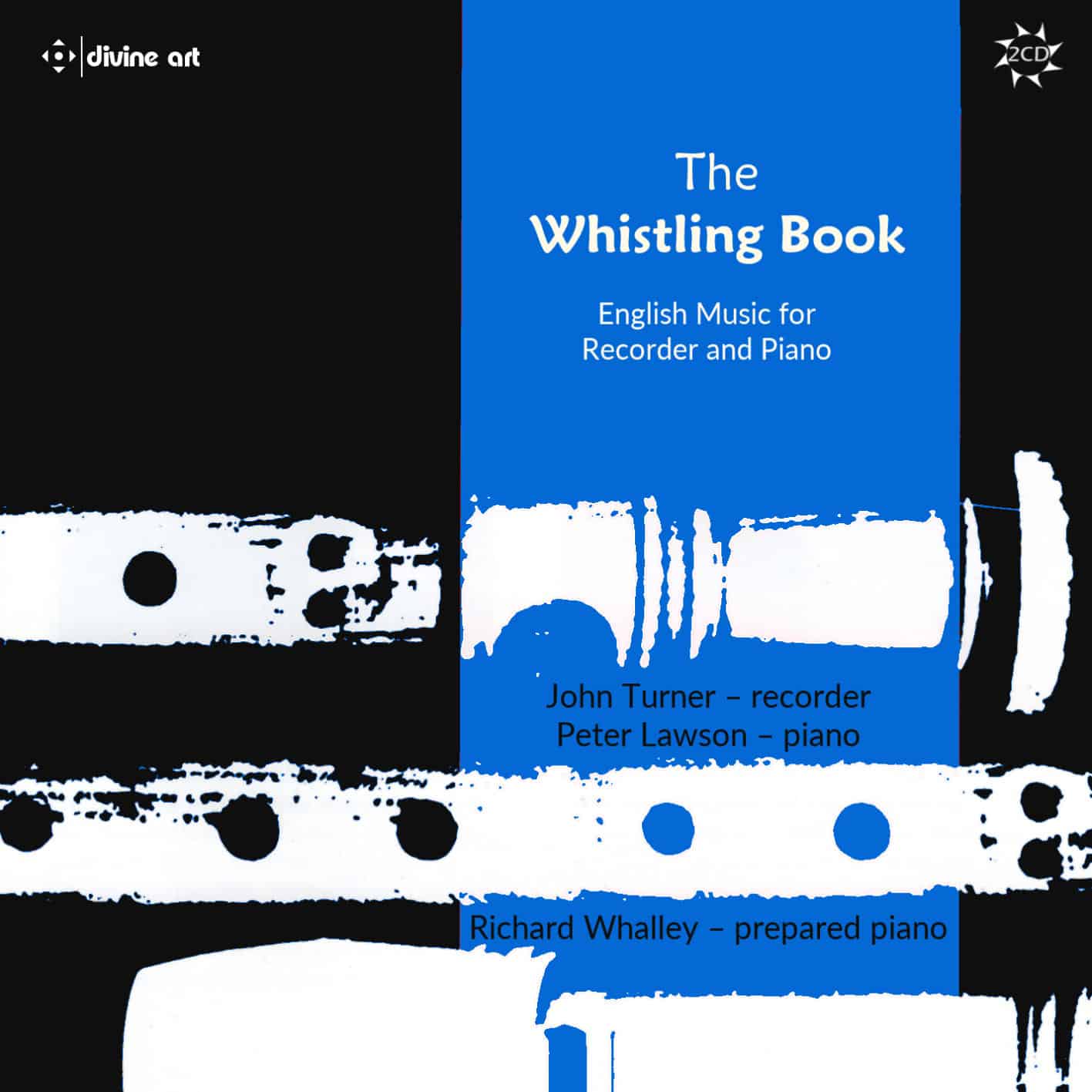
  • The Whistling Book – DDA 21241 Fanfare review

    One of the more interesting features of the New Virtuosity movement is that instruments long out of fashion or relegated to history were revived, with new music being written for the soundscape that these provide. One of the earliest of these was the harpsichord, which found new expression in the music of, for example, György Ligeti. But everything from this keyboard to Renaissance consorts were reinvented to contribute their unique sounds to contemporary music. Of course, this was not entirely new; one only needs to be reminded of Paul Hindemith composing for the viola d’amore in 1922, but this was an anomaly until relatively recently. Fusionist composers today feel free to use whatever instruments are available, old or new, borrowed or blue, acoustic or electric, to expand their own sound worlds.

    The Whistling Book focuses on just one of these revived early instruments, the recorder (orrather recorder family), taken from a series of pieces by Geoffrey Poole written to “amuse the composer’s young son,” as the booklet notes state. This apparently inspired a number of English composers to reconsider the facility of this early instrument, writing new music to accommodate its unique sound qualities. In 1988, the first version of this disc was recorded by John Turner and Peter Lawson. Its revival in 2022 by Divine Art needed some extra pieces to fill out the set, and so they added Richard Whalley’s prepared piano for his Kokopelli from 2017, as well as John Addison’s Spring Dances and Robin Walker’s Her Rapture last year. The result is, as they say, about two hours of neatly entertaining works that show that the recorder has a future as a chamber instrument in modern times; i.e., not just an anachronistic pretty, if soft, sound.

    In keeping with more modem aesthetics, the various pieces have eclectic names. For example, Alan Bullard’s Recipes from 1989 seems inspired by a gastronomic journey, beginning with a musical breakfast of coffee and croissants, a light and sort of circus-like tune with folk ancestry. There is something plaintive about the second movement, when a barbecue fire goes out, and here one gets a sort of jazzy moment, and of course nothing could be more English than the finale, entitled “Fish and Chips,” with light flutter-tonguing and a trippy little tune, sounding like it ought to be a sound-track to a silent film. Alan Rawsthorne’s more conventional suite originally dates from 1939 but was rediscovered only in 1992. The opening Sarabande is quite Impressionist, with hints of Ravel, while the Fantasia is a sort of Minimalist throwback to Renaissance times, and the Jig that concludes it is really frothy. Robin Walker’s A Book of Song and Dance from 1994 has a series of movements or songs. The first, for solo recorder, sounds Celtic or perhaps a bit from a Hobbit movie. The remainder do have a plaintive and even nostalgic sound, with a folk element in the background. Walter Leigh’s Air is quite old-fashioned, even perhaps a bit Elizabethan-sounding (the first Elizabeth) in its meandering modal theme. Anthony Gilbert’s Farings, on the other hand, are highly original, using both instruments for sound quality rather than for identifiable tunes. The opening “Mr. Pitfield’s Pibroch” has sounds like a steam whistle, while the “Eighty for William Alwyn” is a sort of Minimalist John Cage. This is followed by the recorder doing what sound like bird imitations (“Arbor Avium Canentium”), and so it goes right up to the final “Chant-au-Clair,” which suddenly turns to a folk round dance above a drone, very Celtic and actually quite the opposite of the remainder of the movements. Turner himself has a four-movement suite, containing a lively waltz and a final manic hornpipe. Contrasts abound between the John Golland Suite with its slightly Neoclassical dances and his New World Dances, which take the recorder into the realm of modem ragtime, blues, and finally a trippy bossa nova. The Whalley work, Kokopelli, named for a famed Hopi figure, uses a prepared piano, where the sound is a bit otherworldly, with a haunting recorder counterpoint. The performance by Turner and Lawson is uniformly excellent, allowing for the blend of the two instruments to complement each other, and even Whalley’s homage to John Cage is quite accessible. If you wish to know how an early instrument can fit into the sound world of contemporary music, this is the disc; entertaining, eclectic, and fully expressive of the possibilities of the recorder and piano. Highly recommended.

  • The Whistling Book DDA 21241 Musicweb review

    This double album, featuring sixteen composers, may be of more interest to performers than to listeners. It appears to be a “tidying up” exercise: the blurb says that most of the works are included in the catalogue of recorder and piano sheet music at the Manchester music shop/publisher Forsyth Brothers Ltd. Some pieces seem to be appropriate for teaching purposes, or for younger players who begin to build a repertoire. Most will be unfamiliar territory to many listeners, and perhaps even to recorderists. Stylistically, they range from the naïve to the pretentiously avant-garde; most of them fit into the tonal, approachable, fun and enjoyable category. So, I think that its greatest use will be as a thesaurus for instrumentalists who seek to extend and enhance their repertoire.

    Many of the works here are dated between 1968 and 1998; only two valuable pieces by Alan Rawsthorne and Walter Leigh extending the range back to the 1930s and 1940s. The album was first released in 1998 as John & Peter’s Whistling Book. This edition includes three more items: Robin Walker’s Her Rapture for solo recorder, John Addison’s Spring Dances for solo descant recorder, and the eccentric Kokopelli by Richard Whalley.

    This smorgasbord of recorder and piano music gets off to a brilliant start with Geoffrey Poole’s varied Skally Skarekrow’s Whistling Book. Poole devised the four short movements for his son James, but he then souped up the final movement, Hailstones, to match John Turner’s virtuosity. The other movements are Clouds (with silver linings)Spring Breezes and Sunshine.

    The Tempest has always been one of my favourite Shakespeare plays. Michael  Ball’s Prospero’s Music depicts Caliban’s contention that the island is “full of noises and sweet airs, that delight and hurt not”. This enchanting music explores various aspects of the play, including the love of Ferdinand and Miranda and, more seriously, Ariel’s taunting of Caliban. The liner notes explain that the inspiration was hearing the ringing of a mist-shrouded sea-buoy whilst Ball was on holiday on the Scilly Isles.

    Rob Barnett in his 1999 review of the first release described Alan Bullard’s Recipes perfectly: “These are high quality musical postcards: Continental serenade, hurdy-gurdy sentimentality, purring and bubbling jazziness, a Carmen fantasy, Chinoiserie with a dash of the puys of the Auvergne and a final knotted hanky knees-up.” The movement titles that provoked this marvellous prose are Coffee and CroissantsBarbecue Blues (when the fire goes out), Prawn PaellaSpecial Chop-Suey, and Fish and Chips. This articulate suite would make an entertaining offering at any recital.

    Arnold Dolmetsch first performed Alan Rawsthorne’s little Suite on 17 July 1939 at a meeting of the London Contemporary Music Society. Rawsthorne presumably withdrew it after the concert, but arranged it later for viola d’amore and piano. The four movements include a short, deeply felt Sarabande, a lively Fantasia on an old English country dance, a sad Air and a sprightly Jig. The score, presumed lost, turned up in 1992. It did not deserve to be forgotten.

    Nicholas Marshall’s undated short Caprice is a spry little number that fairly bounces along. Douglas Steele’s also undated Song for recorder, with its long-breathed melody, is touching and quite charming.

    A big discovery is John Addison’s Spring Dances, written for John Turner after his visit to the composer’s residence in Old Bennington, Vermont. The three dances for solo recorder explore a variety of moods: a cosy Allegretto, an expressive Andante con moto, and a vivacious Allegro moderato whose progress covers a wide variety of time signatures. (John Addison was born in 1920, not 1929 the booklet says.)

    Robin Walker’s A Book of Song and Dance in eleven short sections is an album of folk-like tunes. On occasion, there is barely time to get to know the melody. For example, Dance 1 lasts only 20 seconds. Nods to well-known tunes include My Luve is like a Red RoseShenandoah and Clark Saunders. Four of them are for recorder alone, the others have piano accompaniment. These are discrete pieces, but somehow they seem to make a valid and consistent whole. I would suggest that they always be played through in the order presented in the score. Her Rapture was written very recently in memory of Robin Walker’s teacher, the composer Dorothy Pilling, who died in 1998. It is not a piece I warm to; the tessitura of the descant recorder is just a little too high and piercing in its imitation of our feathered friends.

    I understand that Walter Leigh’s Air was his very last composition, before he was killed in action near Tobruk, Libya. This miniature is quite lovely in its apparent simplicity. Yet, there are deeper moments and more intricate harmonies to add to its success. It is good that it has been recorded here for posterity. Equally satisfying is Arnold Cooke’s Capriccio, which celebrates William Alwyn’s eightieth birthday.

    I am not convinced by Anthony Gilbert’s Farings. The opening number, Mr Pitfield’s Pibroch, is wild and screechy. Equally headache-making is Eighty for Willam Alwyn with its clattering high notes on the piano. Five more movements follow, including the Arbor Avium Canentium with its birdsong, the jig-like Batterfeet, dedicated to the composer Howard Ferguson and a take on plainsong in Chant-au-Clair. Other musicians referred to include John Turner (Slow Down after Fifty), Ida Carroll (Miss Carroll, her Lullabye) which would wake the dead, and composer Ian Parrott MidWales (Lightwhistle Automatic) with its repetitive (never ending!) melody. Perhaps it is the small recorder used that makes this listener reach for the paracetamol. I cannot resist the temptation to quote Rob Barnett’s again: “This is a much harder work with stop-start, strangulation occasional, Shostakovich-like intensity, flitters and shards of music, sparks and shrapnel.”

    It is appropriate that one of John Turner’s compositions is included in this album. Four Diversions, as the liner note say, have become one of the best known works in the recorder repertoire. The four movements are written in what would then have been an approachable contemporary style. The Intrada is bold in effect. This is followed by a vibrant, but too short, Waltz. The third Diversion, Aubade, has a touch of the Celt in it. It is followed by a dashing Hornpipe, once again looking north of the Border. The Four Diversions is deservedly popular.

    Shadows in Blue by David Ellis uses a variety of recorders for its effect – sopranino, bass and tenor instruments along with the piano. Does this work nod more to Schoenberg than to jazz? Some lovely sounds here would certainly enhance a smoke-filled bar in downtown New York.

    John Gollard’s Divertissement is a satisfying backward glance to the baroque era with its modern take on an Entrée, a Gavotte, an Air and a Gigue. Equally rewarding is his pastiche New World Dances, a decent account of RagtimeBlues and the Bossa Nova. Richard Whalley’s Kokopelli is gruelling. It may represent a Native-American fertility rite, but it just does nothing for me, prepared piano and all.

    The last track is dreadful. Kevin Malone’s Saturday Soundtrack is meant to evoke “background music” to an imaginary cartoon. Its concatenation of vocalised coughs, splutters, mutters, monkey chants and growls are a pathetic attempt at being relevant. Fortunately it only lasts for just over two minutes.

    John Turner compiled very useful liner notes. They include information about the composers and brief, but helpful, notes about all the works. These details could well be mined by performers for their programme notes (with permission, of course). Unfortunately, some of the dates of composition and premieres have been omitted from the text and from the track listings. Resumés of the instrumentalists have been included.

    The performance and the recording are beyond reproach. John Turner and Peter Lawson make a hugely talented team.

    I enjoyed most of the works here, but I think that this repertoire should be investigated slowly. Two hours of unremitting recorder and piano sound could be an endurance test for some folk. And it would be a pity to miss some of the gems presented here. The music ranges from grade pieces for tyros to major recital works. Almost all of them would enhance a recorderist’s concert.

  • The Whistling Book DDA 21241 – Infodad review

    This offering of English music for recorder and piano, like the Prokofiev CD, includes older material and newer, but the motivation of the whole thing is different: it builds on a 1998 release of recorder works and adds to that earlier material both through remastering for improved sound and by the addition of previously unrecorded material. What is heard here will likely be unknown to virtually anyone who does not play the recorder, and even to many people who do. This is therefore an exploratory release that should be of considerable interest to recorder players but will inevitably be somewhat less sanguine for non-performers, given that it offers two full hours of pieces that are all short enough to be encores: some are individual works, some are suites consisting of brief works, but in all cases the material is short and to the point.

    Furthermore, the music, although mainly tonal and often danceable and light, is all from the 20th and 21st centuries, resulting in a certain inevitability of sound that is often quite pleasant but tends after a while (that “while” being less than two hours) to wear thin. The composers included on the first disc here are Geoffrey Poole (born 1949), Michael Ball (born 1946), Alan Bullard (born 1947), Alan Rawsthorne (1905-1971), Nicholas Marshall (born 1942), Douglas Steele (1910-1999), John  Addison (1929-1998), and Robin Walker (born 1953). Those on the second disc are Walter Leigh (1905-1942), Arnold Cooke (1906-2005), Anthony Gilbert (born 1934), John Turner (born 1943), David Ellis (born 1933), John Golland (1942-1993), Richard Whalley (born 1974), and Kevin Malone (born 1958).

    With the exception of Whalley’s Kokopelli, written for prepared piano and performed on that instrument by the composer, all the works use a standard piano to go with the recorder – several different recorders, actually, all played with skill and obvious devotion by John Turner. The admirable way that Turner and pianist Peter Lawson handle these works provides them with as much individuality and differentiation as possible. But even when some composers assemble suites using old-fashioned movement designations (Rawsthorne, Turner, Golland), while others favor more-modern titles for individual sections (Poole, Bullard, Gilbert), and still others contribute single pieces rather than groups of them (Ball, Marshall, Steele, Leigh, Cooke), the fact remains that for most listeners this will be “much of a muchness” of pleasantries of various sorts.

    There is a lot to enjoy here in small doses, but the dosage totality is such that the recording seems primarily designed to draw recorder players to recent or fairly recent music of which they are likely unaware, so they can incorporate it into their own practices and recitals.

  • The Whistling Book

    The Whistling Book

    This album derives from a 1998 release from Forsyth Brothers (Manchester) featuring works published in their Recorder Catalogue. It was then called ‘John and Peter’s Whistling Book’. For this new version, remastered in 2022, several extra tracks have been added. The album features the recorder at its most scintillatingly bright – most of the music here, though very recent, is melodic, tuneful, often in dance form, and witty – for example Alan Bullard’s suite inspired by favorite foods from around the world. Two small forays into modernism are provided by superb pieces by Richard Whalley and Kevin Malone.

    John Turner is one of the world’s most respected and skilful recorderists, with a long history of recordings, publications and premieres, including regular appearances with the Academy of Ancient Music, the Early Music Consort with David Munrow, English Chamber Orchestra and Academy of St. Martin-in-the-Fields.
    Peter Lawson has also enjoyed a long and illustrious career; he taught at Chetham’s School of Music for almost 40 years and has a large and impressive discography to his name.