Catalogue Connection: 21243

  • Dibble: 24 Preludes and Fugues Fanfare Review

    From Divine Art comes the world premiere recording of the 24 Preludes and Fugues for piano by Matt Dibble (1980–2021). The London musician, self-described as “a song-writer/composer, multi-instrumentalist, arranger, and producer,” pursued a wide variety of genres, both classical and popular, often in tandem. Dibble was a member of the “punk-jazz band DOLLYman.” As a clarinetist, Dibble collaborated with the Italian guitarist Fabio Zambelli on three albums exploring jazz and free improvisation. Dibble’s life was cut short in May of 2021, when “he died unexpectedly, a rare victim of the AstraZeneca covid vaccine.” A few weeks prior to his death, Dibble completed his 24 Preludes and Fugues for piano, a project begun in 2015. According to Jon Hargreaves, the author of the liner notes for the Divine Art release: “Only a handful of close friends knew of the ‘Preludes and Fugues’….

    There continued six years of very private composition, the set being finished within mere weeks of his passing. With its quasi-secrecy, the longevity of the project, and the incredible timing of its completion, the story behind this music feels like a romantic tragedy.” Indeed, this narrative evokes the creation of works such as the Mozart Requiem and Bruckner Ninth Symphony. But a visit to Matt Dibble’s website (mattdibblemusic.wordpress.com) reveals the composer made no secret of his work on the Preludes and Fugues. On November 13, 2017, he wrote: “Lastly, I’m currently on a composition journey of writing 24 Preludes and Fugues – in all keys – embracing Jazz and Classical idioms. I love to playaround with different modes of composition, including improvisation, and different techniques, for example atonal and pandiatonicism. I’ve written 7, so 17 to go! (Wish me luck..).” And, as part of his website bio: “My new solo album ‘Bedroom Pop’ will be released sometime in 2021. I am also in the middle of writing 24 Preludes and Fugues, inspired by Bach. I’m currently at number 19 (August 2020).” I’ll add that there seems to be no indication that when Dibble composed his 24 Preludes and Fugues he (unlike Mozart and Bruckner) was confronting his impending demise. To Hargreaves’s credit, he cautions: “Matt, equally a stoic in life, is better honoured if we focus on his music than if we give ourselves to circumstantial emotion.”

    Hargreaves describes the harmonic progression of Dibble’s Preludes and Fugues: “Starting on middle D rather than C, they move around in circles of fifths, alternating major/minor (D major-A minor-E major-B minor, and so on). After coming full circle, the key centres swap to the alternate mode (D minor-A major-E minor-B major).” The sense of continuity is enhanced by (with some exceptions) each fugue concluding on the identical pitch of the ensuing prelude. The music reflects Dibble’s eclectic musical world. To be sure, the spirit of the Baroque, and Bach in particular, is present (the B♭-Minor Prelude is entitled “To J. S. Bach”). But so is jazz (and with it, the almost inevitable allusions to Debussy and Ravel, as well as a touch of Prokofiev), blues, pop, rock, Latin dance, and big-band standards. Dibble seems to allow his imagination to journey as it wishes, resulting in music that offers a compelling and rewarding variety, intimacy,expressiveness, and melodic beauty. The textures are generally spare and elegant, with a premium placed on clarity of articulation. While the general mood is one of introspection, Dibble also provides arresting moments of bravura expression, including the dancing final fugue, marked “Defiant, almost aggressively, positive and energetic.” These are lovely works that maintain interest and momentum during the course of their two-hour journey.

    One of the pianists Matt Dibble hoped would perform his 24 Preludes and Fugues was Freddy Kempf (b. London, 1977). While the two never met, Dibble greatly admired Kempf’s artistry. And it is Kempf who premieres Dibble’s work on the Divine Arts release. After completing the recording, Kempf said: “I feel close to [Matt] because it really felt like the values that [he] paid attention to match some of my own.”

    Kempf performs the Preludes and Fugues with technical panache, rich tone, lovely phrasing, and a marvelous grasp of the work’s ever-shifting moods and musical worlds. All told, this is a lovely recording.
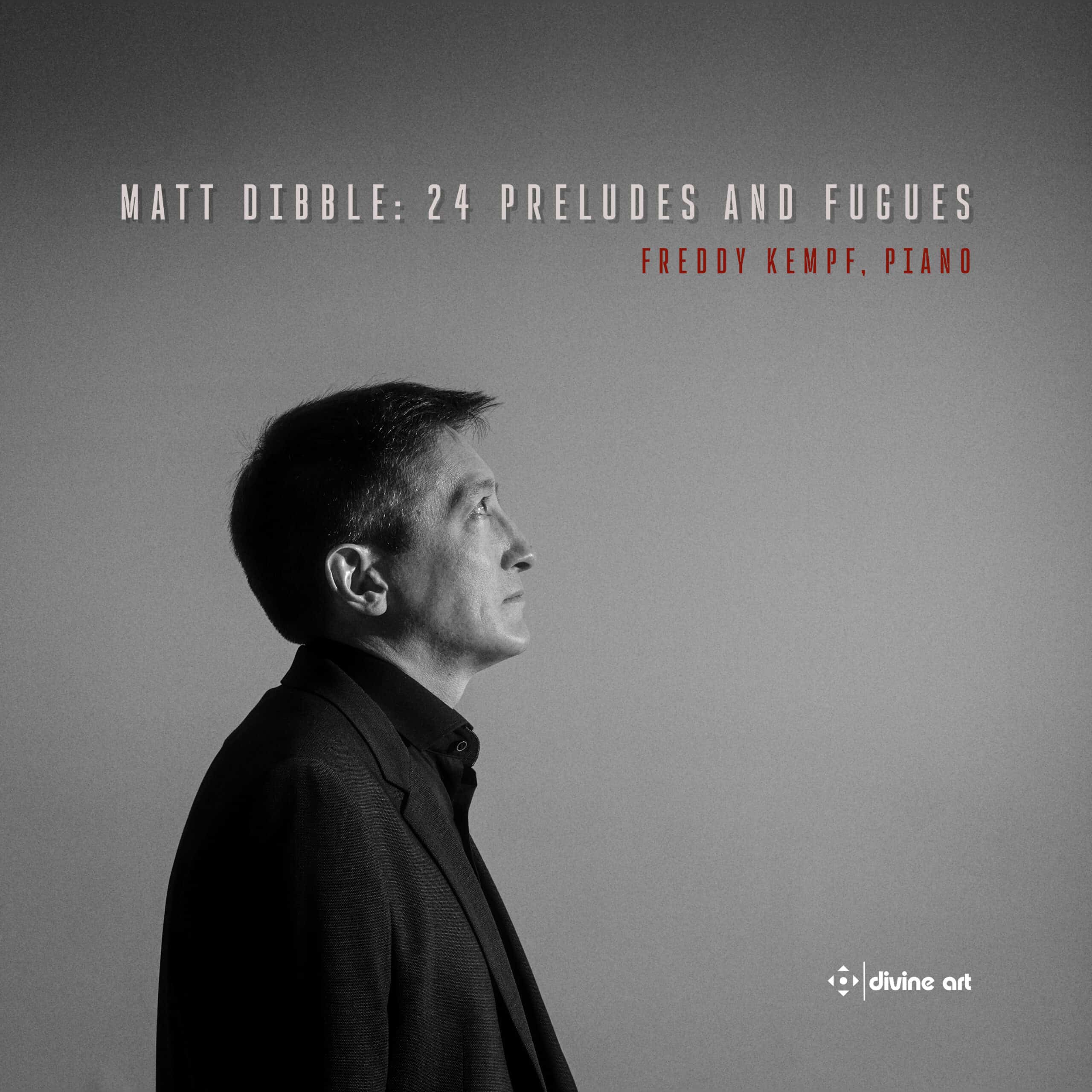
  • Dibble: 24 Preludes and Fugues All Music Review

    The 24 prelude-and-fugue pairs of Bach’s Well-Tempered Clavier, BWV 846-893, were intended to demonstrate the virtues of equal temperament in tuning a keyboard instrument. Yet they had, as great works so often do, a secondary function, namely that they mixed various strands of Bach’s art together. The same is true of the 24 Preludes and Fugues of composer Matt Dibble, completed shortly before his death in 2021. They are an homage to Bach, certainly, but they also sum up Dibble’s own art, which extended beyond classical music into jazz, rock, and R&B. These traditions are audible in these works, not as flavorings but rather as indissoluble parts of the composer’s background. The notations attached to the names of each piece, for example, Prelude No. 4 on Bm3, are jazz key designations, but the pieces aren’t overtly jazzy; instead, jazz furnishes one direction a piece can go at any given time. The fugues do not reflect strict rules of counterpoint but rather evoke the Baroque fugue. It is an intriguing concept, and it is rendered well by pianist Freddy Kempf, who never met Dibble but knew about the work as it developed and got a leg up on how to approach what would likely be a troublesomely novel work for any pianist. He is alert to the small details that are at the heart of the stylistic mixes here. The best-selling status of this album, which landed on classical charts in the summer of 2024, should be taken not simply as a tribute to Dibble but as a sign of interest in a genuinely fresh work.

  • Matt Dibble: 24 Preludes and Fugues Textura Review

    Before London-based composer Matt Dibble passed away in May 2021 (the cause complications from the AstraZeneca Covid-19 vaccination) at the age of forty, he reportedly told his mother his dream was to have pianist Freddy Kempf record the preludes and fugues he’d been creating in secret over six years and that were completed three months before his death. Determined to make that wish a reality, Dibble’s friends raised funds to cover recording expenses and recruit Kempf for the project. While the composer and pianist never met, the latter’s indelible and enthusiastic performances on this posthumously released collection indicate that a connection of the deepest kind was forged between them.

    The immense weight of tradition associated with preludes and fugues is less relevant in Dibble’s case than expected. Of course any composer embarking on such a project is fully aware of J. S. Bach’s iconic Das Wohltemperierte Klavier (The Well-Tempered Clavier, 1722) as well as sets by other composers, including Dmitri Shostakovich’s. To his credit, Dibble didn’t let such precedents inhibit him creatively; on the contrary, the undertaking seemed to liberate him and encouraged him to indulge himself to the fullest creative degree. That feeling of freedom was, one guesses, reinforced when the pieces were composed in private and thus suggest Dibble venturing deep within to give voice to his most personal self; it’s also noteworthy that in the work’s forty-eight pieces, only three include subtitles.

    Dibble’s love of multiple genres emerges in 24 Preludes & Fugues, where conventional barriers between blues, jazz, pop, and classical dissolve. Structural continuity is, however, established when the last note of each fugue becomes the first note of the prelude that follows, and the work is also neatly tied together when the last note of the final fugue is the same as the first note of the opening prelude. Another structural aspect is worth clarifying too, specifically the fundamental difference between prelude and fugue. The parts in each pairing are separated by a difference in character, the prelude being the free-form structure that anticipates the more formally defined fugue. On the one hand, there’s a quasi-improvisatory form, on the other one whose successive patterns adhere to long-standing rules of counterpoint. While Dibble’s handling of the prelude and fugue forms is freer than the Bach model, being aware of such details makes listening to the pairings all the more engrossing. Still, even with such structural details in place, the field within which the material was created reflects no stylistic constraints restricted Dibble’s creative vision.

    While subtitles were kept to a minimum, markings appear throughout that would have helped guide Kempf in crafting his interpretations. One reads “as if humming – an echo of a memory” and another “slow (but not that slow).” And, as mentioned by Jon Hargreaves in liner notes, the marking included with the final fugue, “Defiantly, almost aggressively, positive and energetic,” is telling in the way it seemingly embodies the composer who created it. Hargreaves also notes that different parts nod to both classical and jazz artists, from Bach and Debussy to Evans and Jarrett. Educated at the University of York and the Guildhall School of Music and Drama, Dibble was, after all, a composer and pianist but also a clarinetist and saxophonist who played in a number of bands and released six solo albums. He found a fitting partner in the London-born Kempf, whose prior recordings of recitals and concertos by Tchaikovsky, Schumann, Prokofiev, and Gershwin have brought him critical acclaim. He’s appeared with some of the globe’s most prestigious ensembles, appeared on many of its greatest stages, including the Berlin Konzerthaus, the Concertgebouw, the Sydney Opera House, and Tokyo’s Suntory Hall, and is currently keyboard professor at Munich City Music School.

    With only five of the forty-eight tracks nudging into the three-minute zone, most are miniatures that enter and exit with dispatch. Yet even with brevity in play, there’s no shortage of elaboration when each piece is a fully developed entity. Moods change with regularity, with one rhapsodic (“Fugue on Ab3”) and others pensive (“Fugue on Ebm3”), theatrical (“Prelude on E3”), brooding (“Fugue on B3”), introspective (“Prelude on F#3”), ornate (“Fugue on A3”), and florid (“Prelude on Gm3”). Whereas “Fugue on Am3” and “Fugue on Gm3” evoke Bach in their contrapuntal design, “Prelude on A3” hints at Ravel with a faint echo of Le Tombeau de Couperin and “Prelude on F#m3” Scriabin in its macabre tone. “Prelude on Bb3 (‘Alone – 5AM’),” on the other hand, recalls the sophistication and ruminative lyricism of Bill Evans. Undoubtedly two of the prettiest are “Prelude on Bm3” for its solemnity and lyrical quality and “Prelude on B3” for its gently flowing ripples. While blues touches emerge in “Prelude on Fm3,” “Fugue on F#m3,” and “Prelude on F3,” the entangling and knotty “Prelude on C#m3” flirts with jazz when it ventures into boldly chromatic territory. The declamatory and grandiose “Prelude on C3,” by comparison, is punctuated with crushing chords.

    The project naturally carries with it the weight of Dibble’s passing, yet there’s nothing maudlin about Kempf’s probing and clear-headed renderings. If ever a recording deserved to be regarded as a celebration of a composer’s work, 24 Preludes & Fugues is it. At 111 minutes, there’s much to absorb, but the huge scope and high calibre of the material more than rewards the investment of time and attention required to appreciate it. Were Dibble still with us, he’d be no doubt thrilled with Kempf’s presentation.

  • 24 Preludes and Fugues British Music Society

    Matt Dibble was born and lived in Southeast London. He studied music at the University of York, and at the Guildhall School of Music and Drama. He was a songwriter, multi-instrumentalist, vocalist, arranger and producer, releasing six albums. 

    As a composer he wrote everything from pop songs to jazz and classical numbers. He finished the 24 Preludes and Fugues a short while before his death in 2021 (a result of a fatal reaction to the AstraZeneca vaccine). He had been writing them in secret since 2015 but, before dying, told friends where they could find them. 

    The pieces are wide ranging in style reflecting the composer’s training and interests. There are respectful references to Bach and Shostakovich, how could there not be? – but also to jazz pianists such Keith Jarrett and Bill Evans. They are meticulously worked out, and the final pitch of each fugue matches the first note of the following prelude.  They are unorthodox in that none of them say in D or F#, but rather on C#m3 or on Fm3, which relate to chords not keys.  That said, they do follow a pattern of alternating fifths starting on D, and go through all the major and minor keys. 

    Picking favourites out of 24 is hard but I liked Prelude No. 7, maybe because its simple arpeggiated chords reminded me of the Shostakovich in D major which I played for my ABRSM Grade 8 exam 50 years ago. The fugue however is not like the Shostakovich, being decidedly chromatic and turbulent, but very impressive. Prelude No. 17 (Alone -5AM) is a beautiful jazzy nightclub number. The fugue is altogether jollier, like something Madeline Dring would have written had she been so minded. The fugue subject from No. 3 reminded me of that from the finale of Vaughan Williams Piano Concerto, such is the journey we are taken on. The final fugue on G3 is very much an homage to Keith Jarrett and its puckish 7/8-time signature works brilliantly.

    Mr Dibble’s family and friends crowdfunded over £17,000 to enable Mr Kempff to realise this recording. He does them proud approaching each of the pieces with the care and sensitivity he brings to established classics. The Divine Art engineers have captured the piano sound in a wonderfully warm acoustic. Fugues can be very dry affairs, but Mr Dibble clearly loved the form, and his approach has left us with something refreshingly alive.  I hope other pianists will take up at least some of them.

  • 24 Preludes and Fugues ArtMuse Review

    British composer and multi-faceted musician Matt Dibble died tragically in 2021 at the age of 40 from complications following the AstraZeneca covid vaccination. His untimely death left a void in the classical, jazz and pop worlds: he was a musician of great breadth, versatility, talent and innovation, and his 24 Preludes & Fugues, released posthumously, are a testament to this, blending neo-Baroque, jazz, easy listening pop, klezmer and folk music, and modernist influences into a deeply personal collection created over six years.

    Only a handful of close friends knew of the ‘Preludes and Fugues’, which Matt began in 2015 and composed very privately, completing the set within mere weeks of his passing. Such was his devotion to this project that, when he first went to hospital, he told those with him where the compositions could be found, should anything happen to him. With the secrecy and longevity of the project, and the incredible timing of its completion, the story behind this music is akin to a romantic tragedy.

    When Matt’s close friends retrieved the compositions, they discovered classical piano music of the highest order, of great courage and passion, and set up a crowdfunder to ensure the music could be recorded by a world-class pianist. Although pianist Freddy Kempf never met Matt Dibble, he undertook the recording of the Preludes and Fugues with great enthusiasm and a real appreciation of the brilliance of the music and its composer.

    “It feels like it’s been written at the piano, but at the same time there’s a lot of other influence and it’s great that this set of Preludes and Fugues has almost every style imaginable….” (Freddy Kempf)

    While Dibble’s 24 Preludes and Fugues hark back to J S Bach, their conception and musical language are freer than the Bach model. There are respectful references to the Preludes and Fugues of Bach, Shostakovich and Debussy, but this music also makes nods to jazz pianists Keith Jarrett and Bill Evans, amongst others, as well as other musical genres.

    The result is an incredibly varied collection of music, rich in contrast, colour, textures and mood, in which genres mix, meld and sometimes collide. Prelude No. 3, for example, begins with a distinctly Schoenbergian atonalism, reminiscent of the Sechs Kleine Klavierstücke, but then switches to an almost boogie-woogie sequence, before a passage of Debussyan sweetness. Prelude No. 4 could be mistaken for Bach in its open measures and simple yet arresting melody, while a dramatic falling figure in the middle section opens up new territory.

    Such is the variety and diversity of this collection, it’s hard to pick out favourites (I personally enjoyed the more mellow, jazz-inspired tracks), and there is definitely something to suit all tastes in this generous recording as well as offering a serious contemporary take on the structure and concept of the Prelude and Fugue. Kempf is adept at capturing the essence and distinctive features of each individual piece, reflecting an appreciation of shared musical values. The result is a warm tribute to the late composer.

  • Matt Dibble: 24 Preludes and Fugues Interlude Review

    British composer and multi-faceted musician Matt Dibble died tragically in 2021 at the age of 40 from complications following the AstraZeneca Covid vaccination. His untimely death left a void in the classical, jazz, and pop worlds: he was a musician of great breadth, versatility, talent and innovation, and his 24 Preludes & Fugues, released posthumously, are a testament to this, blending neo-Baroque, jazz, easy listening pop music, klezmer and folk music, and modernist influences into a deeply personal collection created over six years.

    Only a handful of close friends knew of the ‘Preludes and Fugues’, which Matt began in 2015 and composed very privately, and completed within mere weeks of his passing. Such was his devotion to this project that, when he first went to hospital, he told those with him where the compositions could be found, should anything happen to him. With the secrecy and longevity of the project, and the incredible timing of its completion, the story behind this music is akin to a romantic tragedy.

    When Matt’s close friends retrieved the compositions, they discovered classical piano music of the highest order, of great courage and passion, and set up a crowdfunder to ensure the music could be recorded by a world-class pianist. Although pianist Freddy Kempf never met Matt Dibble, he undertook the recording of the Preludes and Fugues with great enthusiasm.

    While Dibble’s 24 Preludes and Fugues hark back to J S Bach, their conception and musical language are freer than the Bach model. There are respectful references to the Preludes and Fugues of Bach, Shostakovich and Debussy, but this music also makes nods to jazz pianists Keith Jarrett and Bill Evans, amongst others, as well as other musical genres.

    The result is an incredibly varied collection of music, rich in contrast, colour, textures and mood, in which genres mix, meld and sometimes collide. Prelude No. 3, for example, begins with a distinctly Schoenbergian atonalism, reminiscent of the Sechs Kleine Klavierstücke, but then switches to an almost boogie-woogie sequence, before a passage of Debussyan sweetness. Prelude No. 4 could be mistaken for Bach in its open measures and simple yet arresting melody, while a dramatic falling figure in the middle section opens up new territory.

    Such is the variety and diversity of this collection, it’s hard to pick out favourites (I personally enjoyed the more mellow, jazz-inspired tracks), and there is definitely something to suit all tastes in this generous recording as well as offering a serious contemporary take on the structure and concept of the Prelude and Fugue. Kempf is adept at capturing the essence and distinctive features of each individual piece, reflecting an appreciation of shared musical values. The result is a warm tribute to the late composer.

  • Matt Dibble: 24 Preludes and Fugues

    Matt Dibble: 24 Preludes and Fugues

    London-based composer Matt Dibble tragically passed away in 2021 shortly after completing his 24 Preludes and Fugues for solo piano. His death, attributed to complications from the AstraZeneca Covid-19 vaccination, left a void in the classical, jazz, and pop music scenes where he was beloved and respected. Dibble’s compositions showcased his remarkable versatility, blending neo-Baroque, jazz, pop, and modernist influences into a deeply personal collection crafted over six years.

    Despite never meeting the composer, internationally renowned pianist Freddy Kempf undertook the recording of Dibble’s work with great enthusiasm. Produced by Paul Baily, Kempf’s interpretation captured the essence of Dibble’s compositions, reflecting a shared appreciation for musical values. One of the pieces from the collection will soon be included in Trinity College London piano exams, ensuring Dibble’s legacy reaches pianists worldwide. Divine Art Records released the recordings as a tribute to the late composer.

    Freddy Kempf, celebrated for his dynamic performances and expansive repertoire, has collaborated with esteemed conductors and orchestras around the globe. His recordings, including Tchaikovsky and Schumann recitals, as well as Prokofiev and Gershwin concertos, have garnered critical acclaim, establishing him as a masterful and versatile pianist.

    Matt Dibble, born and raised in Southeast London, left a diverse musical legacy spanning classical, jazz, and pop genres. Alongside composing, he was a songwriter, multi-instrumentalist and producer. Dibble’s jazz trio and participation in various bands showcased his eclectic talents, from punk-jazz to Beach Boys tribute performances. In pop music, he released six solo albums and co-founded the successful band Super dB.

    Educated at the University of York and the Guildhall School of Music and Drama, Dibble honed his skills under the mentorship of Alan Hacker and Tony Coe. His untimely death at the age of 40 marked a profound loss for the music community, robbing it of a visionary artist with boundless creativity and passion.

    Matt Dibble’s posthumously released 24 Preludes and Fugues stand as a testament to his artistic legacy, showcasing his innovative blend of musical styles. Collaborating pianist Freddy Kempf’s interpretation ensures Dibble’s music resonates with audiences worldwide, while Dibble’s diverse musical contributions across genres continue to inspire and be enjoyed by listeners.