Catalogue Connection: 21244

  • Boyden Celebration Fanfare

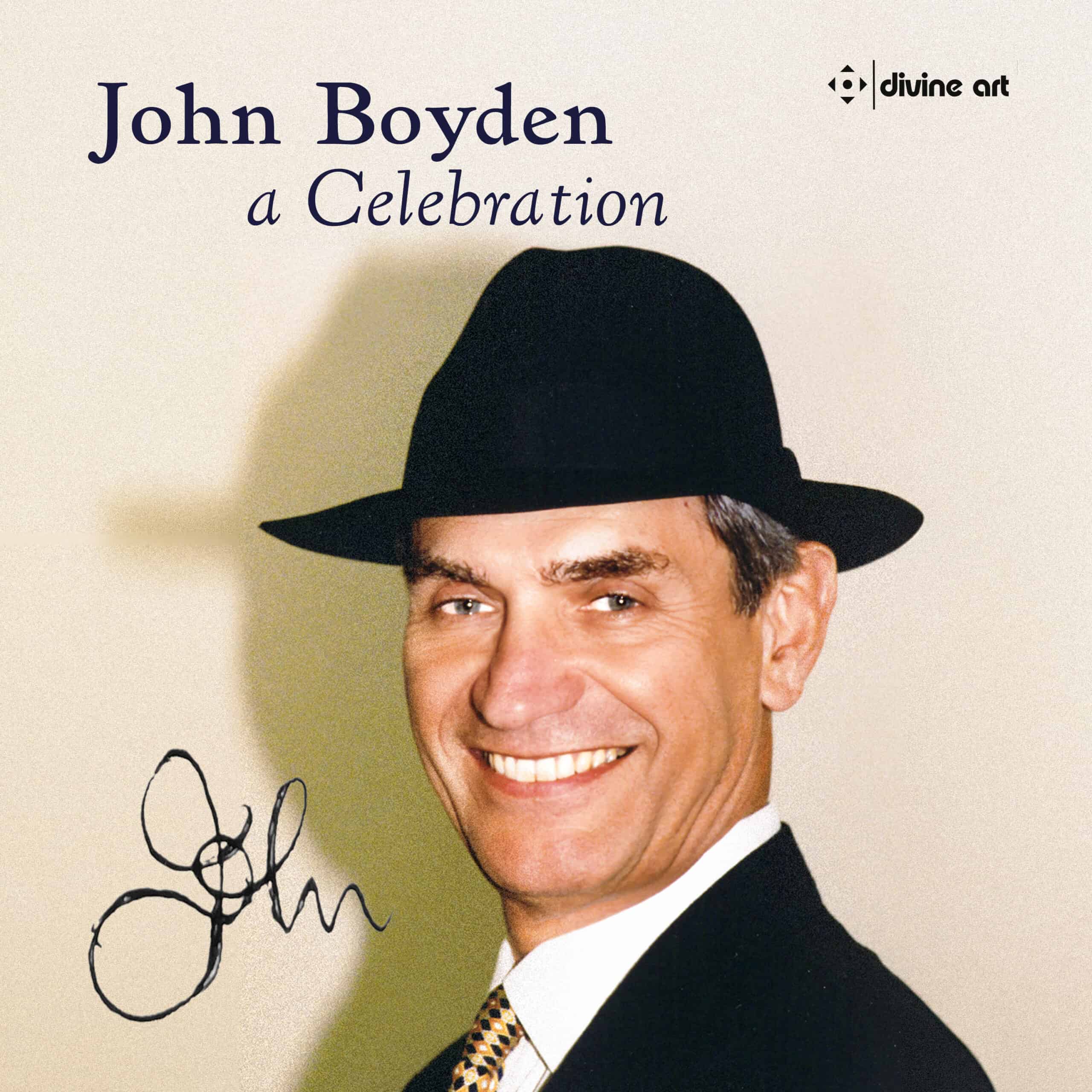
    Releases showcasing record producers and entrepreneurs are few and far between, but here is one: a celebration of the record executive and producer John Boyden (1936–2021). If his name is unfamiliar, the record label Classics for Pleasure (CfP) will not be. Boyden cofounded it with philanthropist Paul Hamlyn as a sub-label of Music for Pleasure, and it enjoyed extraordinary success in the LP era (I am proud to say I owned the LP of the Schubert Die schöne Müllerin here as a boy). Boyden was also the first Managing Director of the London Symphony Orchestra and revived the New Queen’s Hall Orchestra (NQHO), four of whose string players perform here.

    Like the Müllerin, the John Lill Beethoven performance was also a previous release, in that instance on the Enigma label. Not so the “Trout” Quintet, a fresh arrival here, but it is a cause for great joy that it appears here now. Jonathan Higgins is the excellent pianist; he was principal pianist of Birmingham’s Royal Ballet for over a quarter of a century. Vera Pereiro, the double-bassist, was a principal at that ballet company too. They are joined by Robert Gibbs, violin; Daisy Spiers, viola; and Bozidar Vukotic, cello. This is, simply, a performance of sunshine. The spirit of chamber music shines out, both in dialogs and in a communal delight in Schubert’s writing. Higgins’s fingerwork is superb, accurate and perfectly placed. The performance is never rushed, and celebrates unexpected harmonic shifts. The second movement is on a similar level: Schubert’s waves are only slightly ruffled, but most of all it is notable for channeling the spirit of pure song. The Lied underpins this; while whirling dervishes surely come out to play in the Scherzo, taken (as Schubert indicates) at presto, not allegro, detail is never compromised. The players’ accuracy is supported by the fine recording; the bass is firm and focused, but not overpowering and with no unnecessary bloom. The famous theme and variations is as fresh as the day Schubert composed it, with the Andantino theme given tenderly, as if the players cradled a baby, not a melody. Higgins’ own statement of the theme sounds almost improvised, while Gibbs’s high violin decorations surely are given with tongue in cheek. Schubert’s variations contain huge emotional range, and so does this performance. It is the sudden veering into interior worlds that is so impressive. Even Pereiro’s double bass sounds light, a vital part of the equation. The finale scampers beautifully. While everybody’s favorite “Trout” seems to be the Gilels/Amadeus recording, this performance has an outdoorsy freshness that is infectious and arguably gets closerto the very heart of the work. The exact date of the present “Trout” is 2002. It should be made clear that the link to Boyden in this instance is that this is “his” NQHO; the actual producer of this “Trout” is Tony Faulkner.

    The pianist John Lill was a regular guest with the Hallé Orchestra in the 1970s and 1980s, usually with James Loughran at the helm. Hearing him in his trademark Beethoven and Brahms repeatedly, the impression was of a pianist who had infinite technique but who could be a little rough with the music. The technical excellence is no surprise, given that Lill won the 1970 Tchaikovsky Competition in Moscow. But there is more sensitivity in this “Waldstein” than I remember in his Beethoven concerto performances. This Beethoven Sonata was issued on Enigma K53520 and recorded in 2002–03. There are moments that veer towards the clangorous in the first movement, it is true, but it is easy to forgive those in light of Lill’s major achievement, mastery of pulse and rhythm. There are real moments of insight: Is that rapid descent into the return of the first theme meant to sound almost like a glissando, a precursor of the notorious finale? Lill manages not to make the first movement coda sound like a mad dash to the finish line before embarking on the slip of mystery that precedes the finale. The first theme steals in as it should, but what marks this reading out is the sustained beauty: Lill’s touch is crystalline and beautiful, but his left hand keeps the momentum so the music does not sound self- indulgent. It is true that Lill’s left hand can appear on the rough side at times, but this is a “Waldstein” that should, indeed must, be heard, not least for the excellence and evenness of his right hand. Those glissandos are articulated like rapid scales, and yet lose no effectiveness thanks to Lill’s variety of touch.

    Expectations for reviewers are prickly things. After my teenage experiences of Lill, though, it was perhaps not unreasonable to expect something rougher than what is captured here. My memories of the Schubert Müllerin, however, were not only confirmed, but enhanced. Issued originally on a single LP disc in 1973 (CfP 40043), it was in a coupling with Schumann Dichterliebe (CfP 4436) that this performance joined my ever-growing collection. Coming back to a beloved recording is one thing record collectors live for. Ian and Jennifer Partridge’s Müllerin is one of the finest performances of that piece, characterized by its freshness. Ian Partridge’s voice is infinitely flexible, and Jennifer Partridge’s low-pedal approach and baseline legato enable Schubert’s piano part to radiate transparency. Perhaps “Am Feierabend” is an excellent demonstration of this, or “Mein!”, where she manages perfect elucidation in tandem with a feeling of breathless elation, preparing the way of the singer’s declarations of success in love. Together, the whole breathes youthful exuberance and impetuosity, and yet Ian Partridge brings to this a tenderness that is heart-stopping (just try “Morgengruss”). Ian Partridge’s tenor is remarkably sweet-toned in its higher reaches; his tuning never wavers. He has the agility, too (listen to the leaps in “Mein!”). When themusic thins, as in “Die liebe Farbe,” the effect is crippling because the performers present it so starkly, with Ian Partridge trimming his vibrato to almost nothing—a blanched, almost harrowing sound. The weight of the world is here, as in the final “Des Baches Wiegenlied,” with the piano’s hypnotic rockings underpinning the protagonist’s woe. This is a truly remarkable performance, as is the recording and transfer. There are more famous Müllerins, for sure, but few if any surpass this one in penetrating to the heart of Schubert’s cycle while maintaining a feeling of youthful love, its promises of eternity and its cruel disappointments. Everything here is believable, including the protagonist’s desolation.

    Divine Art’s release is so full of revelations and Rückblick. But for those coming to these recordings for the first time, surely no one could possibly be disappointed. The overall quality remains a testament to John Boyden’s legacy. A final quip: I had no idea that Boyden was the UK publication Private Eye’s original “Lunchtime O’Boulez” (a liquid pseudonym, so the column continues to this day). The Schubert “Trout,” a new recording in HD, will be issued as a stand-alone digital High-Def single in August 2024.

    This disc remains dedicated to “H. M. The Queen,” who was patron of the New Queen’s Hall Orchestra. Divine Art offers one of the most interesting, carefully thought through re-releases of recent times.
  • John Boyden Tribute Musical Opinion Review

    The world of classical music – certainly in Britain – owed more to John Bowden (1936-2021) that it generally gave him, too often dubbing him a ‘maverick’ in that he fearlessly challenged the oft-repeated beliefs that produced so much that was second-rate or downright wrong in terms of performance understanding. A review of this disc, which is self-evidently issued to mark his passing, is not the place to outline his myriad career, but this issue marks a dual commemoration – from the players he engaged for the New Queen’s Hall Orchestra to the hundreds of recordings he produced for EMI and for his own Enigma company. Although the choice of repertoire – just Beethoven and Schubert – does no more than scratch the surface of his recorded achievements, the artists chosen – John Lil and lan and Jennifer Partridge – are twin marks of the quality of Boyden’s musicianship and abilities as a classical record producer. There will be those who may have also wished for more music from his legacy on these discs, from other composers, but there will be no criticism regarding the choice of artists or the nature of the performances, for they are indicative of the consistently admirable standards which John Boyden set and achieved. At his passing, John had completed his memoirs, and one hopes they will be published soon. It is indicative of this remarkable man’s stature that Her Majesty the Queen (a long-time supporter of John Boyden) has accepted the dedication of this commemorative release, which will surely do much to ensure the continuing validity of the legacy that John Boyden’s long life has bequeathed to later generations.

  • John Boyden: A Celebration Classical Music Sentinel Review

    On the face of it, this might seem somewhat of a curate’s egg of a release, containing as it does a combination of new and old releases, of famous pieces that have countless other versions available, often performed by better known artists that are performing here.

    However, this holds interest for several reasons. Firstly, the reissues of the Waldstein sonata and the Die Schöne Müllerin song cycle are well respected performances, if not high in the public eye currently. Secondly, it draws attention to an interesting, some might say typically British idiosyncratic musical career that would probably be unusual nowadays. John Boyden is associated with the initial pioneering days of classical CDs, starting the once popular budget and semi-budget LP/CD labels Enigma Classics and Classics for Pleasure. For one that is of a certain age and a certain nationality mention of those labels recalls times when such releases were greeted with justifiable excitement and admiration. John Boyden did a lot more, running a large HMV Record shop in central London, managing the London Symphony Orchestra for a time, and starting the New Queen’s Hall Orchestra (2nd iteration, re-founded in 1992). Outside of musical performances, it’s a fascinating story with some controversial elements entwined.

    The Trout Quintet is a new recording, the Beethoven and Die Schöne Müllerin performances are classics of the earlier CD era, and bear comparison with the many other great performances of these classics available nowadays.

    It is certainly a pleasing collection, starting with the Trout Quintet. This is an intimate performance, perhaps not the highest powered, but enjoyable, nonetheless. The piano is given a prominent balance, not to the exclusion of the strings, but a forward balance in what sounds like a small room, and we are in the front row. The sound world is one that aims at clarity, and without being in the ‘Original Instruments’ world to aim at the gentler sound of instruments with an emphasis on expression rather than simply accuracy, and the merging of instruments into a harmonious whole rather than individual instruments dominating over the others.

    The ‘Waldstein’ played by John Lill is an unashamedly great performance. I have long admired this pianist and would willingly listen to anything he played. My personal favorite ‘Waldstein’ is that by Maurizio Pollini on DG, but since Pollini is my favorite in almost anything he plays, I can still admire others. John Lill starts briskly and produces a thrilling end of this and the final movement. His Adagio is thoughtful and moves through the third movement Rondo to the start of the final Prestissimo which emerges truly and magnificently triumphal out of the darkness. At times, the level of acrobatic pianism is extraordinary. Lill is often described as a Beethoven specialist, he resisted that description, but his Beethoven is always humane and civilized, very much in accord with the music’s Enlightenment aspirations. Recommended.

    The Schubert cycle has so many great performances available, from both contemporary and historical perspectives. So, why choose this one? Firstly, it is beautifully sung. Ian Partridge’s tenor is immediately heard as riding nimbly across the initially merry/naïve songs, and then wonderfully darkens for the gradual descent into despair. Essentially, I would describe the performance as sounding clean and unmannered. I remember buying this when it first was released on Classics for Pleasure label (decades ago now), I was not sure I would enjoy Schubert or indeed any Romantic song cycles, but this performance drew me to them. The giants in such cycles include Dietrich Fischer-Dieskau, especially accompanied by Gerald Moore who with their more deliberate expression conveys multiple different aspects. However, I still overall prefer to hear the Partridges, though either could be one for the desert island, along with several more recent performances, such as those sung by Ian Bostridge, and Christoph Prégardien amongst the tenors. The choices are many, with baritones, mezzos, accompanied by guitar etc…

    So, in the end, the reasons for buying this would seem to be either in recognition of Boyden’s life, or possibly nostalgia for the reissue, but finally for the chance to sample some highly rated, but under the radar classics of the earlier Romantic era. If the program suits your interest, you will be getting some cultivated performances with good recording.

  • John Boyden: A Celebration

    John Boyden: A Celebration

    By kind permission, dedicated to H.M. The Queen, Patron of the New Queen’s Hall Orchestra.

    This album to be released in March celebrates the life and career of John Boyden, a pivotal figure in British music circles, not least for his founding of Classics for Pleasure, and later Enigma Records. Two key recordings from the original catalogues are presented for appraisal anew, together with a brand new recording of the ‘Trout’ Quintet, commissioned specially for this release and recorded at the Henry Wood Hall, London,  on 10 and 11 July, 2023. Beethoven’s Waldstein Sonata is played by John Lill courtesy of Universal /Decca (successors to the Enigma catalogue), and Schubert’s Die Schöne Müllerin by Ian and Jennifer Partridge is licensed from Warner Music as current owners of the former EMI/Classics for Pleasure list.

    Schubert: Piano Quintet in A Major, D. 667 (“The Trout”) from this album is available as a digital ‘EP’ in high definition download here.