Catalogue Connection: 21245

  • Highways and Byways MusicWeb Review

    This fine two-disc release comes with an informative booklet. The notes, written or assembled by recorderist John Turner, were very helpful in  the present review.

    The programme gets off to a great start with Lennox Berkeley’s Sonatina. Typical of his style, it is a successful fusion of baroque and neo-classical sensibilities, with a touch of Gallic charm. The three movements entertain with lovely melodies and alluring harmonies.

    Sheffield-born Wilfred Heaton is best recalled for his contribution to the brass band repertoire, but he wrote in many other genres. The Little Suite for recorder and piano, five “contrasting cameos”, was premiered in 2001 at the Royal Northern College of Music. The notes say: “Heaton’s models are the dance-based instrumental suites of Bach and Bartok.” A vibrant Courante, a lugubrious Cantabile and a humorous Bourée are bookended by a brilliant Toccata and a will-o’-the-wisp Gigue.

    The booklet tells us that Peter Pope composed the Sonatina No.2 in Croydon in April-May 1980, but there is no information on early performances. The piece is gentle and thoughtful throughout its three complementary movements. Gary Higginson’s review on this site notes that Pope was a pupil of John Ireland, and that Ireland’s influence can be heard in the sad slow movement.

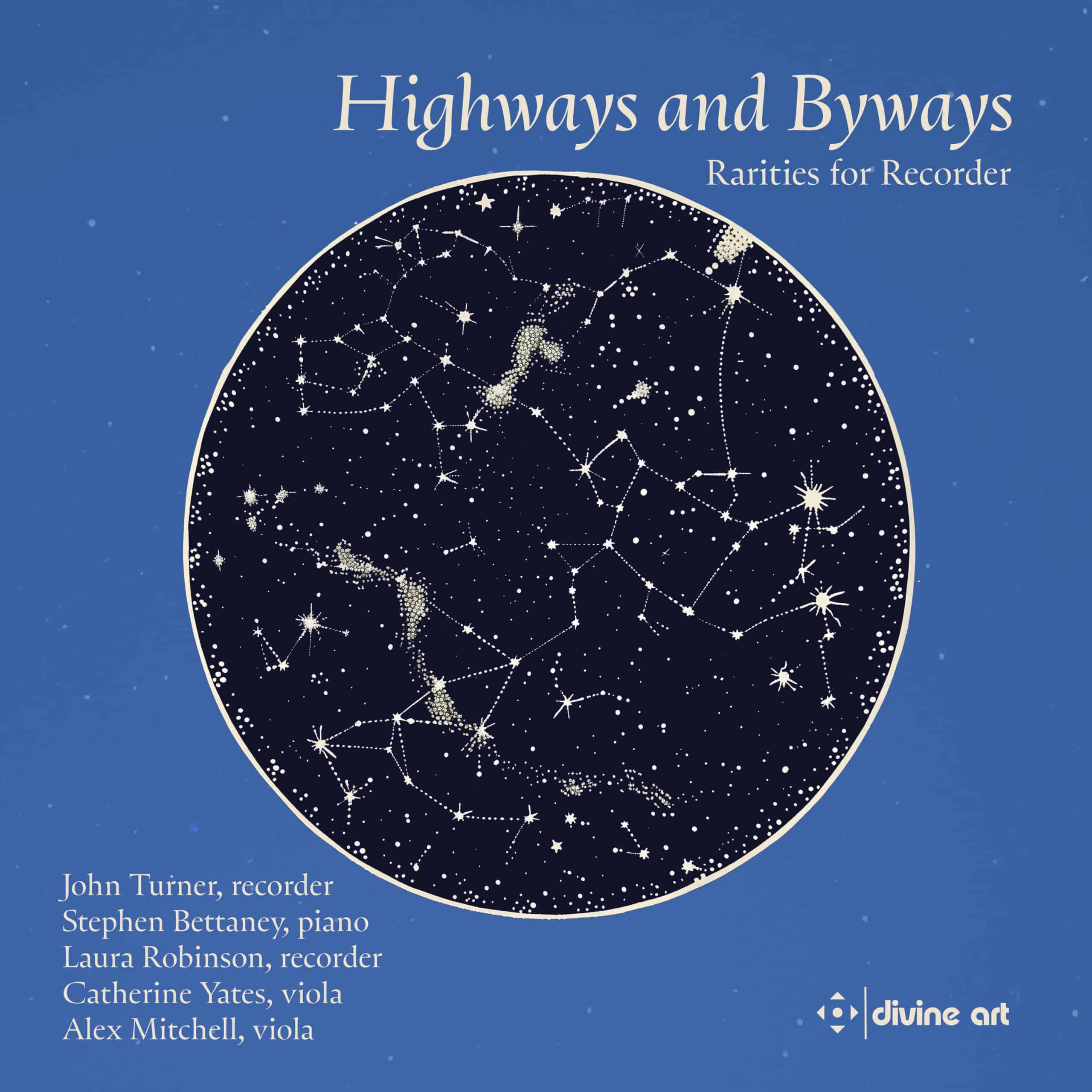
    David Butler’s The Summer Triangle by was inspired by three stars seen in the night sky: Vega, Altair and Deneb. And is The Eagle (mentioned in the notes) a fourth? The CD cover is meant to illustrate this phenomenon, but I am not sure I can quite see it. This attractive and absorbing composition was inspired by Butler’s nighttime exploration of the beaches around Lowestoft and by witnessing a rising moon. But the piece does not need the astronomical programme to be enjoyed.

    Igor Stravinsky’s Lullaby for two recorders is an arrangement of Ann’s Lullaby from The Rake’s Progress (1951). The notes say: “It involved an ingenious reduction of both song and chorus throughout to just two parts.” All I will say it that would not send anyone off to sleep – it is just too piercing.

    John Locke dedicated the brief Sonatina to the present soloist, John Turner. It comes as a gentle relief after the astringency of the Stravinsky. Even so, this is no pastoral ramble, but an exploration of some complex chromatic phrases. The central Adagio is particularly redolent. The final movement, played on the descant recorder, has a brighter, bouncy conclusion.

    The disc concludes with Thomas Pitfield’s Dancery, a suite inspired by Tielman Susato’s collection of dance tunes made popular by early music expert David Munrow. Pitfield has formulated five contrasting melodies, short but always musically significant. My favourite is the smoky Pavan in Three Notes (Hommage à Poulenc). Equally attractive is the Finzian second Pavan. Altogether a delightful work fit to be in the recorderists’ repertoire.

    The second disc contains a pot-pourri of miniatures. John Turner’s A Sad Pavane was part of a collection designed for a video in support of the Ukrainian people. It is sad but ultimately positive. The second of Two Pieces is a rumbustious little Hopscotch (in Scotland, we call this game peevers).

    John McCabe’s Domestic Life, the notes say, is “an arrangement of tunes from an ‘entertainment’, This Town’s a Corporation Full of Crooked Streets, for voice and ensemble”. The texts of the original, not shown in the booklet, were derived from poems by the Mersey Sound poets, Adrian Henri, Roger McGough and Brian Patten, and included children’s rhymes. McCabe’s contribution is a fascinating little selection of tunes, played without a break. He referred to it as a “pièce d’occasion”. It would make a splendid encore at any recorder and piano recital.

    McCabe’s Sam’s Tune, penned for a Granada TV production, is not typical of his style but quite catchy.

    According to the notes, Christopher Ball “was a musical polymath, being a clarinettist, conductor, composer, arranger, publisher, recorder virtuoso, teacher and photographer”. Two Pieces for recorder and piano were intended to be part of a sonatina which never materialised. A Cheerful Little Piece, with a few neat twists and turns, does what it says on the tin. The Homage to Dvořák is slower, thoughtful and has hints of Grandmother’s Songs and Hovis.

    For a railway enthusiast, memories of Stockport Edgeley with it signal boxes, large station, and impressive viaduct may bring back happy memories. Peter Hope has evoked The Edgeley Tram in his short contribution. It presents musical onomatopoeia of a journey from Mersey Square in the centre of town up the hill to the suburb of Edgeley. Sadly, the network of trams closed in 1951. Fortunately, Mersey Square has remained very much the same, despite town council planning.

    David Jepson also recalls the locality with his bewitching Edgeley Fold. The notes inform us: “It is a meditation on an excerpt from a poem by the Edgeley poet Anthony Warren Bardsley”. It balances wistful reflection with, as the poem says, “memories […] of a darker hue” created by wartime memories. A lovely little creation.

    I am not sure why Alexander Gretchaninov’s Concertino has been included in this collection of largely British music. It is a “short and happy” number for two recorders and piano which is fun, but in my view not essential.

    American composer William Bergsma’s Pastorale and Scherzo brings a touch of variety to the prevailing instrumentation on this programme. He has devised them for recorder and two violas. The Pastorale is a little too profound, whilst the Scherzo lets zip. A good encore.

    Conversation Piece for two recorders by Dorothy Pilling is a pleasant little exercise, full of summery delight. My only criticism is that it is too short!

    David Ellis’s Mount Street Blues is “in memory of his friend from childhood John McCabe”. Mount Street is the location of the Liverpool Institute where they both studied. There is only a hint of the blues in this exquisite tribute. Also by Ellis is Fipple-Baguette: Three Encores for Solo Recorder. The titles are Round DanceSarabande with Doubles and End-Piece. He dedicated these exceedingly difficult miniatures to John Turner. I do not know why “Baguette”, but “Fipple” is the mouthpiece of a recorder.

    The recital ends with Thomas Pitfield’s A Little Caribbean, originally scored for clarinet and piano. This charming miniature has a memorable melody and clever rhythmic patterning.

    The liner notes are clear and legible. The playing is outstanding. Most of the burden falls on John Turner and on pianist Stephen Bettaney. There are fine contributions by recorderist Laura Robinson and violists Catherine Yates and Alex Mitchell. Brief biographies of the performers are included for all performers. Cover art by Divine Arts’ James Cardell-Oliver shows a starry sky at night.

    All the music here is of interest. The listener will decide what are their favourites and what they can live without. What is clear is that this production, overseen by the eminent recorderist John Turner, reveals a wonderful treasure chest of music in the repertoire’s Highways and Byways. Long may these explorations continue.
  • Highways and Byways American Record Guide Review

    Not long ago Divine Art and Turner gave us a large set called “The Whistling Book” (July/Aug 2023: 142), a collection of pleasant pieces for amateurs. Here is considerably more, some with a second recorder or viola too. The composers range from more to less familiar: Igor Stravinsky, Alexander Gretchaninoff, Lennox Berkeley, and John McCabe to Peter Hope, Peter Pope, Dorothy Pilling, and Thomas Pitfield. 

    The longest selection is The Summer Triangle, a set of 3 pieces by British violinist- composer David Butler (b 1953). A 19-page booklet tells interesting details worth getting to know, including publishers. One work is available with orchestra on Prima Facie 101 (not reviewed) and one has been released separately on Prima Facie 138 (not reviewed). As I write this 3 of the composers are living, one at the age of 93. English composer, arranger, and radio producer David Ellis died in April of 2023 at the age of 90. 

    Although he began as a lawyer at Fitzwilliam College of Cambridge University, John Turner (b 1943) now spends his time performing, commissioning, editing, publishing, and writing about music. We also have 2 pieces from him in this collection. His playing is reliably solid, sometimes with vibrato, sometimes without, on descant, alto, and tenor recorders. The piano comes across closely and clearly in good balance. 

    The range and variety of British recorder music is substantial. Much of it is accessible to the amateur performer and though conventional, not boring, as a few minutes spent here will prove.

  • Highways and Byways Charlottesville Classical Review

    I have a slogan for my WTJU radio program. It’s “exploring the highways and byways of the classical repertoire to help you discover your next favorite classical work.” So of course I’m going to audition an album entitled “Highways and Byways!”

    In this case, the repertoire is “Rarities for Recorder.” And John Turner isn’t kidding. This album of contemporary recorder music is full of surprises. Recorder music by Stravinsky? It’s here.

    Recorder music by percussionist William Bergsma? Got it. As well as works by big names such as Lennox Berkeley, Alexander Gretchaninov, and John McCabe. And it includes works by Christopher Ball, Peter Hope, and Dorothy Pilling, among others.

    What really appeals to me is that all these works were written for the instrument.  No arrangements or transcriptions here. And it’s an impressive lineup of the music.

    John Turner is a true virtuoso. His career stretches back to the 1960s with David Munro and the Early Consort of London. He was also a member of Christopher Hogwood’s Early Consort of Music. Turner has premiered over 600 works for his instrument. 

    So consider this a mere sampling of what’s available. And a demonstration of how beautiful and expressive the recorder can sound. 

    The album delivers both in quality and quantity. And yes, Turner’s helped me discover some new favorite classical works.   

  • Highways and Byways Fanfare Review

    This is an entertaining collection of mainly 20th-century British music for recorder. There is nothing particularly modernist here. This is all conservative, tuneful music designed for the pleasure of recorder players and their audiences. The essentially lyrical quality of much of the music is leavened by some more lively pieces, some clearly inspired by Baroque dances.

    The principal soloist and guiding force behind this disc is John Turner, an English recorder player who has also practiced as an attorney. He has also done a lot to promote his instrument and commissioned many of the pieces in this collection in order to increase the available repertoire. There is a bit of dry British humor encountered here. John McCabe’s Domestic Life, for example, is an arrangement of three tunes taken from his 1969 “entertainment,” titled This Town’s a Corporation Full of Crooked Streets. The last of the three sounds humorously like “Yankee Doodle.” At the other end of the emotional spectrum is David Ellis’s Mount Street Blues, a touching tribute composed in 2015 in memory of McCabe, who died that year. Turner adopts an appropriately darker coloring here.

    This would be a more gratifying collection were Turner more skilled at establishing a firm legato. Mount Street Blues is one example, but there are many where the articulation of each note is too clear and strong. Moreover, there is a sameness of sound that sets in fairly early. A contributing cause is that so much the music exists in a narrow dynamic range, not too loud, not too soft. I don’t know a lot about what is possible on the recorder, but in my listening experience a greater range of color and dynamics is possible than what we have here.

    Along with these specific issues, there is the harder-to-define issue of personality. Everything on these two discs is pleasant, but nothing captivated my attention. I hate to make such a damning judgment, but the fact is that this release would make for moderately interesting background music at a cocktail party. It is pleasant and tonal, not too intrusive, occasionally lighthearted, but rarely riveting. Pianist Stephen Bettany’s accompaniments are fine, as is the recorded sound.

  • Highways and Byways: Rarities for Recorder

    John Turner, now in his early 80s, keeps recording rare and little-known works by rarely heard or little-known composers. His rate of learning is phenomenal, and his tone quality and virtuosity still shine through. He is a giant in the recorder world, as this twofer clearly demonstrates.

    Some of the fourteen composers here can be strongly associated with John Turner, like David Ellis, John McCabe and Thomas Pitfield, who may have been or were his personal friends. Ellis worked for a while at the BBC. His Three Encores for solo recorder are challenging and exciting. The attractive Mount Street Blues, dedicated to his friend McCabe, refers to the street in Liverpool where McCabe spent his early youth.

    Pitfield is represented by two miniatures. Dancery – a title borrowed from the renaissance composer Tielman Susato – is a set of tuneful dances. Pitfield’s ability to write an earworm shows too in A Little Caribbean, which spends much time in 7/8.

    There are McCabe’s two brief pieces here, in an unusually sunny mood. He wrote Sam’s Tune for a Granada TV series in 1973. Domestic Life is an arrangement of ‘three tunes from an entertainment originally for voices in ensemble from 1969’.

    The album kicks off with Lennox Berkeley’s three-movement Sonatina, a joyous performance of a joyous work. The longest work on the first disc David Butler’s Summer Triangle. Butler explains that these are Altair, Deneb and Vega, three stars in a constellation seen especially in the summer months. As he wandered Suffolk beaches, he was struck by the magic of the scene and by the rising moon, but this is not necessarily Romantic nature music. There is atmosphere and vitality, and some dissonance, all under the umbrella of arresting ideas and melodies. That is quite a highlight. The box cover shows the night sky which inspired the work.

    John Turner himself is no mean composer, with many choral works in his catalogue, for instance. He wrote The Sad Pavane in 2022 for a video made in support of the Ukrainian people. There follows the brief and jazzy Hopscotch from 2012. In a way, this sums up the album: beautifully crafted, idiomatically conceived music, largely undemanding and tuneful. Needless to say, it is played immaculately and expressively, accompanied by the supportive and sensitive stalwart Stephen Bettaney.

    It may be difficult to find originality in some of the numbers here. Christopher Ball’s A Cheerful Little Piece and Homage to Dvořák have nothing especially interesting to say. I feel the same about Dorothy Pilling’s all-too-brief Conversation Piece.

    Two viola players add interest. They join Turner in Pastorale and Scherzo by William Bergsma. The unusual combination gives a lovely warm sound, with the tenor recorder in the Pastorale and the treble recorder in the light-footed Scherzo. There is good fun in two pieces associated with the village of Edgeley in Cheshire close to John Turner’ s home in Stockport. Peter Hope’s The Edgeley Tram has suitable sound effects. David Jepson’s Edgeley Fold, his last work, was a present for Hope’s 80th birthday. Jepson was born in Edgeley, and Hope lived there as a child.

    Peter Pope contributes a very English Sonatina of 1980. He was a pupil of John Ireland. Something of his teacher’s character appears especially in the slow movement.

    It was a surprise to find Stravinsky and Gretchaninov in this programme. The former’s Lullaby for two recorders is an arrangement of ‘Ann’s Lullaby’ from The Rake’s Progress. The latter’s Concertino includes a second recorder, and has a folk-dance element with the instruments often in thirds.

    We also have music by the all-too-little heard Wilfred Heaton and John Locke. Heaton’s Little Suite is especially pleasing. Its five movements have a Hindemithian quality in their harmonies. The cantabile is a good example of his originality.

    Another Sonatina is by John Locke. He composed it in 1978 for tenor recorder. John Turner plays the first two movements on that instrument, but the finale works better, it is thought, on the descant. The language is quite chromatic and original, but it is not always possible to find its melodic direction.

    All told, the entirely admirable project offers us an opportunity to discover music and composers who have largely gone under the radar. John Turner, aided brilliantly by Stephen Bettaney, has again done us all a great service.

  • Highways and Byways: Rarities for Recorder

    Highways and Byways: Rarities for Recorder

    2024 American Record Guide Critic’s Choice

    Highways and Byways: A Double Album of Rarities for Recorder

    A seminal contribution to the canon of recorder music, this recording assumes a pivotal role, enriching the repertoire and captivating audiences with its distinct allure and technical prowess. Serving as a valuable resource for connoisseurs of recorder music and an inviting introduction for novices, Highways and Byways features a diverse array of compositions. Through its discerning curation and expert execution, this recording not only commemorates the recorder’s storied legacy but also fosters an appreciation for its enduring elegance and adaptability.

    John Turner presents recorder pieces by renowned composers such as Lennox Berkeley, John McCabe, and Thomas Pitfield. Discover rare gems by Igor Stravinsky and Alexander Gretchaninov, alongside a remarkable composition for recorder and two violas by the distinguished American composer William Bergsma.

    As a special treat, the album includes two previously unknown pieces by the late Christopher Ball, along with two compositions by John Turner himself, including a homage to Ukraine. It’s a veritable feast of rare and captivating music!

    Renowned as one of today’s leading recorder players, John Turner’s illustrious career spans performances with esteemed ensembles like David Munrow’s Early Music Consort of London and recordings with prestigious orchestras worldwide. With over 600 premieres to his credit, including works by Leonard Bernstein and Peter Sculthorpe, Turner’s artistry has left an indelible mark on the contemporary recorder repertoire.

    Featuring performances by John Turner (recorder), Stephen Bettaney (piano), Laura Robinson (recorder), Catherine Yates (viola), and Alex Mitchell (viola), “Highways and Byways” is a testament to the dedication of these exceptional musicians.