Catalogue Connection: 21246

  • Pitfield His Friends and Contemporaries MusicWeb Review

    Does reading about Renaissance men and women make you feel inadequate, wishing you had made more of your life than you have done? If so, then it would be better to skip the description that follows of the composer featured on these two discs. As the booklet declares, Thomas Baron Pitfield (1903-1999), born in Bolton, was ‘a prolific largely self-taught composer, much-loved teacher, admired artist and engraver, sometime poet, writer, skilled furniture maker and enthusiastic ornithologist’. Well, I did warn you! My feeling was compounded by the fact that over these two discs I was introduced to no fewer than twelve composers who were completely unknown to me, including the titular composer, Pitfield himself. The esteem he enjoyed and still commands, especially as teacher and supporter of his fellow composers and students, is demonstrated by the fact that the set is centred around him and his influence. That, despite there being but three of his compositions among the sixteen works.

    The first of the two discs opens with his Divertimento, for oboe and string trio composed in 1966-7 for the then most notable oboist, Leon Goossens. It is a wonderfully tuneful work which has the magnificently expressive oboe soaring above the accompanying trio. The first movement is delightfully sunny, with the sort of beguiling tune that had Hamelin’s children follow the piper on that fateful day in the 13thcentury. The second, a Pastorale, is quintessentially English in sound, its gentle nature delivered so beautifully by these consummate musicians. The Intermezzo is even more gentle with a reflective edge, with transformations occurring along the way. The work’s Finale is a lively piece in which the composer quotes from an earlier work also dedicated to Goossens. It hopefully made up for Goossens feeling somewhat jealous of another oboist, Evelyn Rothwell, Sir John Barbirolli’s wife, to whom Pitfield had dedicated an oboe sonata. Since Pitfield had already dedicated the Rondo Lirico to him, one wonders what that jealously could reasonably have been based upon.

    Next, we have Remember: Scena for soprano, recorder and string quartet, Op 184It is a particularly powerful and effective work, in which Christina Rossetti’s poem Remember has the dying poet call upon her surviving lover to remember her as she was in life. Reflecting rather on all the good times they enjoyed together, instead of dwelling on the fact that she is no longer there and on any thoughts of her decaying state. John Joubert certainly captures that in his setting.

    Along with Joubert, E.J. Moeran was the only other composer whose name I knew across these two discs. This, one of his last completed works, was written for Leon Goossens following his request for an oboe work, and Moeran wrote his Fantasy Quartet while staying in Norfolk in 1946. With a surprising twenty-one tempo changes in its relatively short fourteen-minute length, its folksy character charms the listener. The concept of the fantasy quartet came from the mind of industrialist Walter William Cobbett, who reflected that while literature had its lyric and epic poem, its short story and longer novel and music the symphony, overture and symphonic poem, chamber music was bereft of any other form and could do with a compact one movement work rather than the usual three or four movements. Moeran was only one of a number of composers who responded to the idea, amongst whom were Frank Bridge, Holst, Moeran’s own teacher John Ireland, and Vaughan Williams – and in fact Moeran’s was one of the last who did. The work’s opening sunny disposition is folk-inspired and contrasted with its more serious, even strident episodes, though its overall impression is one of effective and affecting music that remains in the memory long after its conclusion.

    Now, Voyager may firstly bring to mind the 1942 film of the same name starring Bette Davis based upon the novel of the same name; however, this work was inspired by the American poet Walt Whitman poem that reads:

    Now finale to the shore!Now, land and life, finale, and farewell!Now Voyager depart! (much, much for thee is yet in store;)Often enough hast though adventur’d o’er the seas,Cautiously cruising, studying the charts,Duly again to port, and hawser’s tie, returning:—But now obey thy cherish’d, secret wish,Embrace thy friends—leave all in order;To port, and hawser’s tie, no more returning,Depart upon thy endless cruise, old Sailor!

    Several composers have chosen to set to music Walt Whitman’s words and Ernst Hermann Meyer, a refugee from Hitler’s Germany, composed this work for voice and string quartet in Switzerland on his way back to post-war Germany. The poem urges the voyager to go further to seek what life holds in store, but also to prepare psychologically for the end of life’s journey having set his things in order and to feel able to leave without regrets. It is a poignant message for us all and is wonderfully set by Meyer, whose music we should know more of.  

    The first disc ends with a truly delightful piece by Pitfield entitled Three Nautical Sketches, arranged from the original for recorder and piano by Pitfield’s pupil John McCabe, for recorder and string quartet (whilst another version exists for recorder and string orchestra, see Naxos 8.572503). The recorder seems particularly appropriate to represent English folk dance, with its sound often resembling the penny whistle. Its three parts recall four sea shanties and folk songs, ending with a rumbustious take on The Keel Row.

    Disc Two opens with Robin Walker’s Parrottry for recorder and string quartet, which is super-clever in terms of the music and the title. As Walker explains, it was a 90th birthday tribute to composer Ian Parrott (1916-2012). The play on words gives us the composer’s name but in no way seeks to imply that he could be accused of ‘parrotry’ which is defined as “servile imitation and repetition” – far from it, but then Robin Walker ensures he can’t be accused of it either. I found it most interesting to read his explanation in the booklet in which he says “Literal repetition rapidly wears thin (vide Minimalism) …” I couldn’t agree more, and often when I am listening to something by a composer of one of those pieces I inevitably am led to thinking, ‘It’s gone too far; when will this end!?’  To avoid this happening, Walker ensures he steers a musical path between literal and varied repetition having the instruments ‘play out a mixture of the two until – to avoid things getting out of hand, and the likely onset of parrotry – it is time, as it were, to place a cloth over the parrot’s cage’.  Brilliantly put in both words and music!

    Next comes Jeremy Pike’s Spring, for recorder, harp and string quartet. The composer, whose daughter is the violinist Jennifer Pike, has cleverly taken the letters in John Turner’s name to “create a theme that reflects the various sounds of the season. The music alludes to the conflicting emotions stirred in the months of March and April.” It is a wonderfully melodic piece. Incidentally, recorder player John Turner features as soloist in every one of the nineteen tracks on this second disc, which showcases his extraordinary facility with the instrument. 

    The following three pieces are short songs by Pitfield’s friends Nicholas Marshall, Anthony Gilbert and John Turner himself. In the first, Lesley-Jane Roger’s voice and the recorder revolve around each other in the most affecting manner. The second, Anthony Gilbert’s last work, expresses both the importance of breath to sustain life and also to power the wondrous sounds that the tenor recorder can produce, as indeed it does here. The final song by John Turner himself is a truly delightful expression of spring in music, in which dancing rhythms evoke relief after the seemingly endless winter.

    The Spring Suite by Richard Pantcheff is in five short movements and despite being a contemporary composition (from 2022), it aims to bring to mind early English and European dance suites with their “lightness, space, and movement” as well as demonstrating the range and abilities of soloist and strings. It is highly successful in fulfilling all its stated aims, not least in demonstrating how versatile the recorder is.

    There follow three songs set to poems by William Blake, with Stuart Scott quite magically capturing Blake’s wondrous facility with words.  Geoffrey Poole’s Seasons of Mist, for recorder and string quintet, the music for which finally revealed itself to the composer after the worst of the restrictions imposed by Covid-19 following what seemed like a virtual writer’s block. The result appears even more celebratory than perhaps first intended, as he puts it in the notes: “The poignancy of transience blended with the promise of renewal, seems to become more intense with each passing year”. It is divided into three sections: November Dawn, which is superbly atmospheric, the double bass particularly adept at creating the sound picture of swirling mist; Bonfire Night, opening with a jolly, dancing interlude filled with the excitement of anticipation is followed by a slower closing section I took to be depicting the dying embers of the fire, and Autumn Leaves, a reflective piece that bids a fond farewell to autumn and the hope that comes with the feeling that ‘spring cannot be far behind’.

    Another piece by Thomas Pitfield follows, the first of two lullabies, a beguiling Carol-Lullaby and then Gordon Crosse’s Lullaby (TBP his goodnight), another bewitchingly gentle song. This second disc closes with Christopher Cotton’s Overture for St. Paul’s which is a suitably delightful and positive note to end on. In fact, all the compositions on the two-disc set are overwhelmingly positive in outlook and bleakness rarely, if ever, gets a look in.  

    As I said at the outset, the set has introduced me to no fewer than twelve new composers, all British, all hugely talented, whose music is outstanding, uber-tuneful and memorable.  Seeking out others of their compositions will be a very worthwhile enterprise. The sound is beautifully clear, which enables the mellifluous sound of the recorder to shine through as an instrument worthy of further exploration, reminding us that we don’t hear it nearly often enough.  All the players are exemplary in their musicianship and Lesley-Jane Rogers’ soaring soprano voice is crystal clear and a perfect vehicle for the lovely songs included. Altogether, it is a fascinating and rewarding set and a suitable tribute to polymath Thomas Pitfield as well as his many friends and contemporaries with an appropriately inspired selection of works that illustrate their brilliant compositional skills. 
  • Pitfield: His Friends and Contemporaries Land of Lost Content Review

    The advertising brief for this new CD from Divine Art states that this album “pays homage to the multifaceted talent of Thomas Baron Pitfield (1903-1999). Pitfield was not just a composer; he embodied the essence of a Renaissance man, excelling in various fields including teaching, visual arts, poetry, writing, furniture making, and ornithology.” Of huge importance was his impact on his musical colleagues. Here is a wide selection of works by Pitfield and his peers, friends, and students.

    The four movement Divertimento, for oboe and string trio was dedicated to Leon Goossens who celebrated his 70th birthday during 1967. Pitfield headed the score with a few poetic lines, beginning, “He pipes his pastoral way…” These five words sum up the impression of this delightful tribute. After a brief, airy Toccatina, the Pastorale unsurprisingly presents a folksong-like melody. This is followed by a well-crafted, introspective Intermezzo, before concluding with a rondo featuring a “chattering” tune with several reflective byways. It is a long work, lasting for eighteen minutes. It delights the listener with its evocation of the North Country landscape.

    John Joubert’s Remember: Scena for soprano, recorder and string quartet, op. 184 (2018) was one of his final compositions. It was dedicated to the recorderist, John Turner. The text is taken from Christina Rossetti’s heart-breaking sonnet, Remember,which explores themes of love, death, and memory. This intense setting emphasizes the poet’s desire that the beloved should remember her without sadness.

    The highlight (for me) of this first CD is E.J. Moeran’s Fantasy Quartet, for oboe and string trio. The liner notes explain that Pitfield knew Moeran well. The Fantasy was devised for Leon Goossens, who gave the premiere performance on 8 December 1946. It should be recalled that at this time, Moeran was struggling with alcoholism as well as marriage problems with Peers Coetmore. Yet, these issues barely trouble the progress of this mature and deeply felt piece. It was summed up by the reviewer of the premiere (The Times, 10 December 1946, p.6) who noted that it was “almost inevitably pastoral in its general character” and “somehow conveyed the feeling of sunshine over rural England.”

    Ernst Hermann Meyer’s Now, Voyager: Ode for voice and string quartet was completed in 1946. It is a haunting exploration of Walt Whitmans’ poem Now finalè to the shore. This text encourages the reader to embark on new adventures, suggesting that there is much still to be discovered and experienced. The words can be seen as being a metaphor for the transition between life and death. Although contemporaries, Meyer and Pitfield never actually met. Both men were Socialists, although Meyer was a card-carrying communist who would find fulfilment after the Second World War in East Germany.

    The final work on CD 1 is the charming Three Nautical Sketches (1982) for recorder and string quartet. Originally devised for recorder and piano, the present arrangement was made in 2003 by Pitfield’s onetime pupil, the late John McCabe. The three movements explore a “quodlibet” (often a light-hearted combination of tunes) on the sea shanties The Three Mariners and Donkey Riding. The slow movement is a moving reflection on Tom Bowling, whilst the finale majors on a rumbustious take on The Keel Row. There is also a version for recorder and string orchestra. (Naxos 8.572503). Any of these incarnations would make a great piece for the concert hall or recital room.

    The second CD opens with Robin Walker’s Parrottry for recorder and string quartet, completed in 2006. The title is a play on words between the dictionary definition of Parrotry (one ‘t’) as being “servile imitation and repetition” and the composer Ian Parrott (1916-2012) whose ninetieth birthday was celebrated in this commission. Certainly, the progress of the music calls for repetition, but never “servile.” Walker asks “How much repetition is too much? Literal repetition rapidly wears thin (vide Minimalism), but varied repetition is the essence of extended symphonic composition. The instruments play out a mixture of the two until – to avoid things getting out of hand, and the likely onset of parrotry – it is time, as it were, to place a cloth over the parrot’s cage.” It is fun, and I am sure Ian Parrott must have appreciated it, with no imputation concerning his musical achievement!

    The liner notes explain that Jeremy Pike’s Spring for recorder and quartet was written to celebrate the eightieth birthday of John Turner during 2023. Pike explains that “the letters contained in John’s name are used to create a theme that reflects the various sounds of the season. The music alludes to the conflicting emotions stirred in the months of March and April.” The only musical note in JT’s name is ‘E,’ but perhaps there was a scheme…? Altogether a dark offering, rather than an explosion of vernal fecundity.

    My comments on the songs for soprano solo and recorder are given together. Firstly, the Three Short Songs by friends of Pitfield, for soprano and recorder. First up, is a lively Yeats setting, by Nicolas Marshall, To a Child Dancing in the Wind. This is followed by Anthony Gilbert’s lugubrious realisation of his own text, A breath for Life. Finally, John Turner has contributed a song to words by William Blake, Spring. Stuart Scott’s Three Blake Songs for recorder and soprano include: Ah, Sunflower, The Lilly,and Infant Joy. For me, the tessitura of the two soloists tends to be too piercing and overbearing in most of these songs.

    Richard Pantcheff’s Spring Suite, for recorder and string quartet was written in 2022 for John Turner. It is an attractive collection of baroque dances reimagined in a contemporary, but not unapproachable, musical language. The four contrasting movements include, a Bourrée, a Siciliano, an Air, a Minuet, and a concluding Gigue.

    Seasons of Mist for recorder and string quintet (2021) by Geoffrey Poole’s was conceived during the Covid pandemic. It was designed to reflect “poets from Basho to Keats [who] have dwelt on the peculiar beauties of Autumn.” There are three contrasting movements. November Dawn is restrained and impressionistic, and the Bonfire Night is a vibrant scherzo, complete with musical onomatopoeia, of bursting rockets and Catherine wheel. The work concludes with a meditation on Autumn Leaves,echoing the transience of life, rather than portraying a blustery day.

    Two more songs follow. The Carol Lullaby for soprano recorder and harp is gentle and sentimentally religious. Both text and music are by Pitfield. The second number Lullaby (TBP [Thomas Baron Pitfield] his goodnight) is by Gordon Crosse and uses the same forces. The liner notes explain that this piece began life as part of the incidental music for Michael Elliott’s Manchester Royal Exchange production of the Greek tragedy Philoctetes, by Sophocles. It was revised as a contribution to Thomas Pitfield’s eightieth birthday album, published by Forsyth’s of Manchester. It is an astringent, rather than soothing, berceuse.

    Christopher Cotton’s Overture for St. Paul’s, (possibly 2018), for recorder, oboe and string quartet was composed for the launch of the Stockport Heatons concert series ‘Music on the Moor.’ The liner notes are shy on explaining which St Paul’s is referenced in the title: it is in fact St Paul’s Church, in Heaton Mersey, Stockport. This is a wistful little work that seems timeless in its evocation of baroque mannerisms and more up-to-date echoes. It is perfectly scored with the two wind instruments in equilibrium.

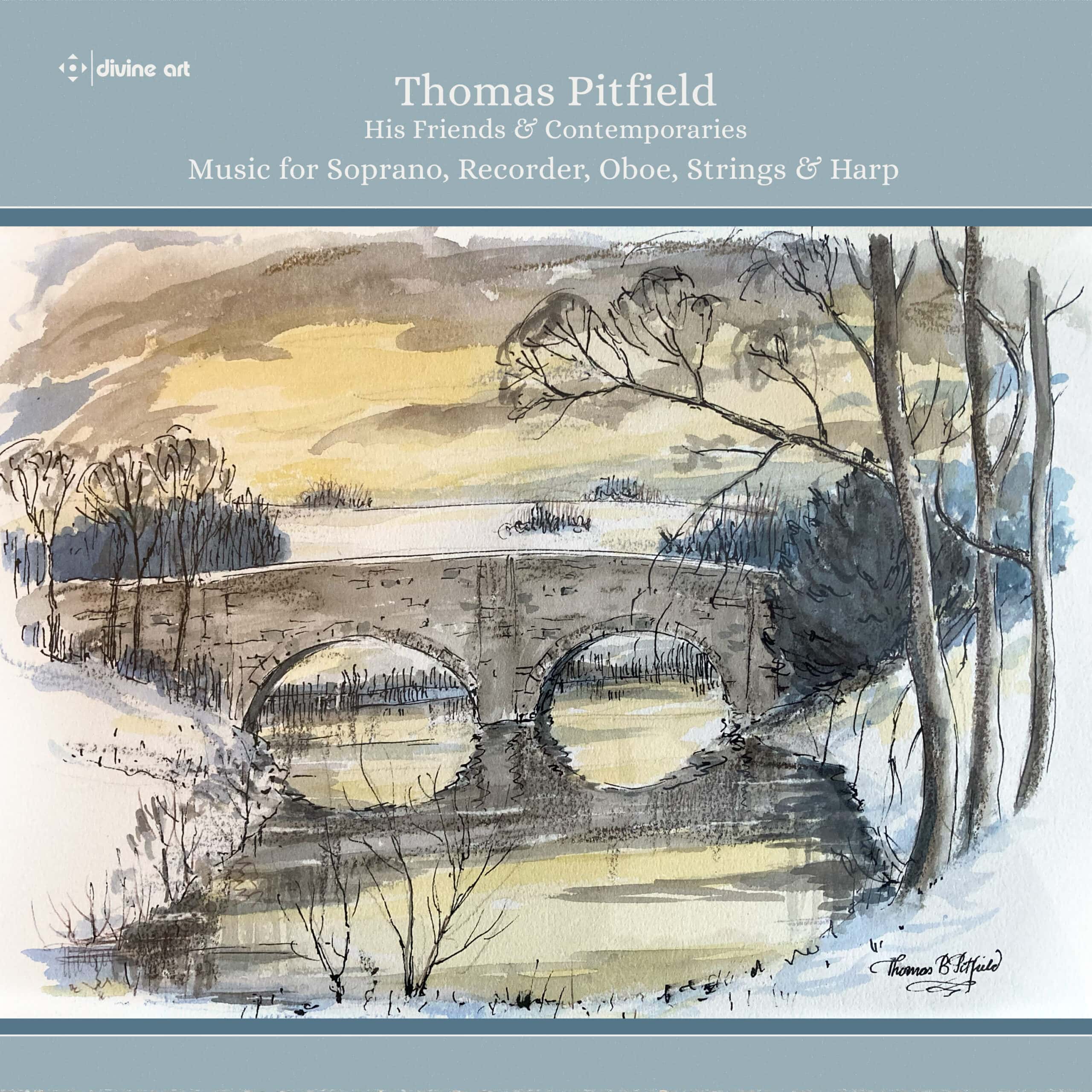
    This CD features magnificent performances from all the artists, a splendid recording, and an informative booklet. The cover features the evocative water colour “Weaver Bridge at Church Minshull, Cheshire, from the garden of Weaver Cottage.” It is a remarkable sample of Pitfield’s accomplishment as a visual artist.

    This two-disc set is a rewarding exploration of music by Thomas Pitfield, his contemporaries, and friends.

  • Pitfield: His Friends and Contemporaries MusicWeb Review

    The blurb says that the album “pays homage to the multifaceted talent of Thomas Baron Pitfield (1903-1999). Pitfield was not just a composer; he embodied the essence of a Renaissance man, excelling in various fields including teaching, visual arts, poetry, writing, furniture making, and ornithology.” The influence on his musical colleagues was very important. Here is a wide selection of works by Pitfield and his peers, friends and students.

    Pitfield dedicated the four-movement eighteen-minute Divertimento for oboe and string trio to Leon Goossens on his 70th birthday. He headed the score with a few poetic lines, beginning with “He pipes his pastoral way”. The words sum up the impression of this charming tribute. After a brief, airy Toccatina, the Pastorale presents a folksong-like melody. There follows a well-crafted, introspective Intermezzo, and a rondo with a chattering tune with several reflective byways. The work delights with the evocation of the North Country landscape.

    John Joubert dedicated Remember: Scena for soprano, recorder and string quartet (one of his last compositions) to recorderist John Turner. The text comes from Christina Rossetti’s heart-breaking sonnet Remember, which explores themes of love, death and memory. The intense setting emphasizes the poet’s desire that the beloved remember her without sadness.

    My highlight of the first disc is Ernest John Moeran’s Fantasy Quartet for oboe and string trio. The liner notes explain that Pitfield knew Moeran well. The Fantasy was devised for Leon Goossens, who premiered it on 8 December 1946. At that time, Moeran was struggling with alcoholism, and his marriage to cellist Peers Coetmore was in trouble. But none of that affects the progress of this mature, deeply felt piece. The reviewer of the premiere (The Times, 10 December 1946, p.6) summed it up saying that it was “almost inevitably pastoral in its general character” and “somehow conveyed the feeling of sunshine over rural England”.

    Ernst Hermann Meyer’sNow, Voyager: Ode for voice and string quartet is a haunting exploration of Walt Whitman’s poem Now finalè to the shore. It encourages the reader to embark on new adventures: there is much still to discover and experience. The words can be seen as a metaphor for the transition between life and death. 

    The disc ends with Pitfield’s charming Three Nautical Sketches for recorder and string quartet, an arrangement by his onetime pupil, John McCabe, of the original work for recorder and piano. The first movement, Quodlibet, explores the sea shanties The Three Mariners and Donkey Riding. The slow movement is a moving reflection on Tom Bowling. The finale is a rumbustious take on The Keel Row. There also is a version for recorder and string orchestra (review). Any incarnation would make a great piece for the concert hall or recital room.

    The second disc begins with Robin Walker’s Parrottry for recorder and string quartet. The title is a play on words: parrotry (servile imitation and repetition) and the surname of composer Ian Parrott (1916-2012). This commission celebrated his ninetieth birthday. The progress of the music does call for repetition but never servile. Walker asks: “How much repetition is too much? Literal repetition rapidly wears thin (vide Minimalism), but varied repetition is the essence of extended symphonic composition. The instruments play out a mixture of the two until – to avoid things getting out of hand, and the likely onset of parrotry – it is time, as it were, to place a cloth over the parrot’s cage.” It is fun. Ian Parrott must have appreciated it, with no imputation on his musical achievement!

    The liner notes tell us that Jeremy Pike’s Spring for recorder and quartet celebrates John Turner’s eightieth birthday in 2023. Pike says: “the letters contained in John’s name are used to create a theme that reflects the various sounds of the season. The music alludes to the conflicting emotions stirred in the months of March and April.” The only musical note in JT’s name is E, but perhaps there was a scheme… This is altogether a dark offering, not an explosion of vernal fecundity.

    The programme includes six songs for soprano solo and recorder. Pitfield’s friends wrote three. We get Nicolas Marshall’s lively Yeats setting To a Child Dancing in the Wind; Anthony Gilbert’s lugubrious realisation of his own text A breath for Life; and John Turner’s Springto words by William Blake. Stuart Scott’s Three Blake Songs are Ah, SunflowerThe Lilly and Infant Joy. I feel that the tessitura of both soloists tends to be too piercing and overbearing in most of these songs.

    Richard Pantcheff wrote Spring Suite for recorder and string quartet for John Turner. It is an attractive collection of baroque dances reimagined in a contemporary but approachable musical language. The five contrasting movements are a Bourrée, a Siciliano, an Air, a Minuet, and a Gigue.

    Geoffrey Poole penned Seasons of Mist for recorder and string quintet during the Covid pandemic. It was designed to reflect “poets from Basho to Keats [who] have dwelt on the peculiar beauties of Autumn”. There are three contrasting movements. November Dawn is restrained and impressionistic. The Bonfire Night is a vibrant scherzo, complete with musical onomatopoeia of bursting rockets and Catherine wheel. The work concludes with a meditation on Autumn Leaves; it echoes the transience of life, rather than portraying a blustery day.

    Two songs for soprano, recorder and harp follow. The Carol Lullaby, with Pitfield’s text and music, is gentle and sentimentally religious. Gordon Crosse wrote Lullaby (TBP his goodnight) – an astringent rather than soothing berceuse – for Thomas Baron Pitfield. According to the liner notes, the piece began life as part of the incidental music for Michael Elliott’s Manchester Royal Exchange production of Sophocles’ tragedy Philoctetes. It was revised as a contribution to Pitfield’s eightieth-birthday album published by Forsyth’s of Manchester.

    Christopher Cotton composedOverture for St. Paul’s for recorder, oboe and string quartet for the launch of the Stockport Heatons concert series ‘Music on the Moor.’ The liner notes do not say that this is St Paul’s Church in Heaton Mersey, Stockport. This wistful little work seems timeless in its evocation of baroque mannerisms and more up-to-date echoes. It is perfectly scored, with the two wind instruments in equilibrium.

    The discs offer magnificent performances, a splendid recording and an informative booklet. As all of Divine Art’s Pitfield releases thus far, the cover shows Pitfield’s remarkable and evocative watercolour Weaver Bridge at Church Minshull, Cheshire, from the garden of Weaver Cottage. This is a rewarding exploration of music by Thomas Pitfield and his circle.

  • Thomas Pitfield: His Friends & Contemporaries

    Thomas Pitfield: His Friends & Contemporaries

    “Thomas Pitfield: His Friends & Contemporaries” pays homage to the multifaceted talent of Thomas Baron Pitfield (1903-1999). Pitfield was not just a composer; he embodied the essence of a Renaissance man, excelling in various fields including teaching, visual arts, poetry, writing, furniture making, and ornithology. Despite his immense talents, Pitfield remained modest and unassuming, dedicating himself to nurturing the gifts of his students at the Royal Manchester College of Music, where he taught composition from 1947 onwards.

    This album sheds light on Pitfield’s contributions to the classical music landscape, showcasing his compositions alongside those of his contemporaries including John Joubert, E. J. Moeran, Ernst Hermann Meyer, John McCabe, and many more. While Pitfield’s name may not be as widely recognized as some of his peers from the “Manchester School,” such as Richard Hall, his music exudes charm, wit, and inventiveness that captivate listeners. In an era marked by the emergence of modernist compositions, Pitfield chose to traverse the middle ground, creating music that resonates with its timeless appeal.

    Throughout his tenure as a composition teacher, Pitfield played a pivotal role in shaping the careers of notable composers like John McCabe, David Ellis, and John Golland, the latter of whom also shared a close personal friendship with Pitfield. Despite being somewhat overshadowed by the achievements of his contemporaries, Pitfield’s legacy lives on through a revival of interest in his music.

    The album offers a glimpse into Pitfield’s musical world, featuring a selection of chamber and instrumental works that highlight his artistic vision and craftsmanship. Pitfield’s compositions are filled with elegance, lyricism, and emotional depth. His music not only showcases his technical skill but also reflects his genuine love for the art form and his dedication to inspiring future generations of musicians.

    Moreover, the album serves as a tribute to Pitfield’s enduring influence on his peers and students. His selfless encouragement and mentorship left an indelible mark on those he taught, fostering a sense of camaraderie among composers and musicians. Pitfield’s generosity of spirit and unwavering commitment to excellence resonate throughout the album, underscoring his legacy as both an artist and an educator.

    This double album celebrates the life and work of a remarkable individual whose contributions to the world of classical music extend far beyond his compositions. Through this album, listeners will rediscover the brilliance of Thomas Baron Pitfield and the rich music woven by his friends and contemporaries.