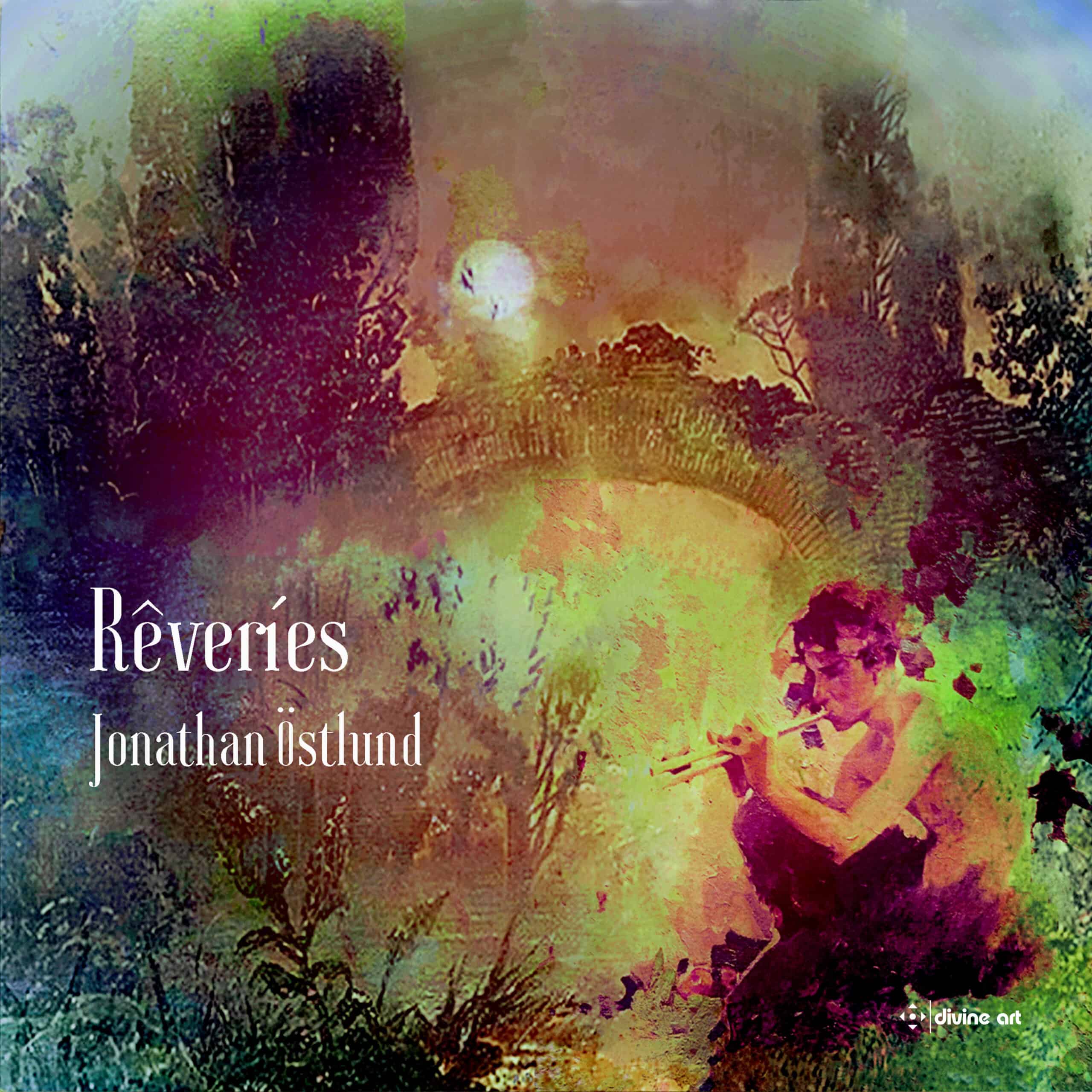
Following on from Jonathan Östlund’s Lunaris (Fanfare 39:4) comes Rêveries, a two-disc set of music that rarely fails to enchant. Sadly, the documentation, as regards the music, is minimal: We are left to make up our own minds. Each piece here seems to have a different recording location and recording crew.
It begins with a poem in Rêverie—The Whispering Wind before the violin (Constantin Bogdanas) spins its silken line. This is the equivalent of opening a gate on the world of fairy tale; Bertrand Giraud is the imaginative pianist. Bogdanas is a fine viola player; his lines swoop like a leaf borne in the wind (and indeed there are some whistling wind effects). A gentler drawing-room aesthetic seems to pervade Empyrean Fantasia for piano trio (Elizaveta Brakhman, violin; Sofia Lebed, viola; Nataly Grines, piano), and yet textures remain delicate. These pieces are all short (no more than four minutes each), as is Fantaisie sur un cantique français for piano (here fluently played by Evgeny Brakhman). More enigmatic still is the Nocturne (Elizaveta Brakhman, violin, with Evgeny Brakhman, piano). Here, it is the piano that creates the sense of magic, of time and reality suspended, while the violin presents single lines not quite as memorable.
The sound of flutist Myriam Hidber-Dickinson is remarkable: full-bodied and glorious. It suits Östlund’s Winds; Wander and Vigil (Folklore Suite No. II). The first three movements praise Nature herself (wind, a rose, a valley of thorns), while the final movement focuses on bells (“Clang, my sonorous bell”).The mysterious second movement (“I know a Beauteous Rose”) is an exercise in beauty, with some bitonality adding an advance notice of horns. Those thorns appear in the darker “Valley of Thorns,” while the music retains a somewhat folkloric slant. It’s a pity that here the recording seems over-reverberant (this is a live recording of the premiere in Spain). I do like the slow tolling of the bell, though, contrasted with a more tripping motif in the finale.
French Impressionism pervades not only the title of La Lune d’Automne, a piano piece well performed by Edward Cohen, but the music as well. Right and left hands have separate agendas at one point, and registral gaps are well used. Cohen has remarkably even trills, too. This is a lovely piece. In contrast comes an ensemble work, Invocation of Dreams, which mangles traditional harmonic and cadential tropes as if in a nightmare, or at least something close to it. Scored for piano (Alberto Portugheis), string quartet (Quatuor Enesco), double bass (Michael Cretu), flute (Wissam Boustany), oboe (Andrew Knight), English horn (Ruth Berresford), clarinet (Florian Popa), bassoon (Tom Hardy), and horn (Mark Wood), and conducted by Hu Kun, this is a short snippet of hallucinatory fun, all well kept together by Kun.
The melding of Beethoven’s “Moonlight” and Debussy in Östlund’s Fantaisie Chatoyant sur deux “Clair de lune” is an impressive piece of compositional alchemy. Elizaveta Brakhman is perhaps not at her steadiest here, but Evgeny Brachman on piano is incredibly imaginative. The couple excel together, though, in the sprightly (but with a black edge) Zaubernacht (Night of Magic). The contrasting section is likewatching a spider spin its web, though, as Östlund slowly reveals the melody. The first disc ends with Östlund’s Concerto for Violin and Symphony Orchestra No. 2, “Gethsemane.” We are left wondering about the biblical reference as Ihar Leanidavich Viarzhbouski (the soloist) and the Belarus State Symphony under Vyacheslav Larin create an expanded version of that dark fairy landscape in the initial “Spellbound.” At least, that’s who I think it is: Two violin soloists are listed for one concerto (the other is Maria Poishchik). Anyway, the soloist has a lovely strong low register, fully on display in the second movement (“Folklore”) before a very energetic “Twilight” closes the concerto. The acoustic is a touch reverberant for the rapid woodwind gestures, but it does support the soloist’s low register well. Not every chord from the Belarus orchestra is together, but the spirit is there. It would be interesting to learn how folklore meshes with biblical lore here, but this remains an interesting piece.
The second disc launches with Waiting for Pierrot for flute (Myriam Hidber-Dickinson), cello (Mariona Tuset), and piano (Eva Simó), a gently wafting, harmonically ambiguous piece. The following piece for violin and piano (Elizaveta Brakhman, violin; Nataly Grines, piano), Winds of Spring, is nicely contrasting, fluently flowing, with the two players in perfect congruence. Beethoven’s “Moonlight” reappears for Mondspiegel (which is actually designated as a “Fantasia on Beethoven’s Moonlight Sonata”). “Moon mirror” is the title in translation, and indeed this sems to be a reflection of the Beethoven (although perhaps a watery reflection). The pianistis Thomas Kelly, who in my humble opinion was misplaced as fifth of six in the 2021 Leeds Piano Competition (I was there in Leeds Town Hall for that final, and Kelly showed more imagination than any of the other finalists). He is one of the finest of the new generation of pianists and a worthy recipient of the UK Critics Circle Young Talent (piano) prize for 2022. His live performance comes from a concert series held at St. Mary’s, Perivale (West London), and Östlund simply could not ask for a finer performance.
Pierrot, an elusive, nocturnal figure who unsurprisingly appeals to Östlund, reappears in the ensemble piece Pierrot, Too Tired to Sleep for solo viola (Milena Pajaro-van de Stadt), piano (Amanda Anastasescu), violins (Emil Huckle-Kleve, Francesco Ionascu); viola (Mihai Cocea), cello (Peter Rayner), and double bass (Michael Cretu). Recorded in London’s Royal Academy of Music, Pajaro-van de Stadt is a fine soloist. The piece is very dreamy, but the somewhat swimmy recording takes it too far in that direction. The piece ends inconclusively, leading to the more fantastical Le Berceau Lunaire (Quatuor Enesco with Bertrand Giraud, piano), a performance of great spirit and energy.
The Sonata for Cello and Piano, “Night Struck,” is performed by Julia Vasylyuk and Vyacheslav Tkach. There seems to be a more pronounced folkloric slant to the opening cello soliloquy. The grittier writing with piano offers a rare glimpse of this side of Östlund’s output. Unfortunately, this is not the finest performance of the set: Vasylyuk could do with more body to her sound and her tuning can slip somewhat. The piece for soprano (Martina Bortolotti) and piano (Luca Schinai) is compromised by the recording; the voice is too distant. I see the pianist is also the recording engineer. Maybe it is not such a great idea to mix roles in this way.
The next piece, though, is special. It is Hommage a Bellman’s “Fredmans Gesang No. 21, “Tafelmusik.” The original has been recorded on Telefunken/Swedish Society by Folke Sällström and Kurt Roland Bengtsson, and more famously perhaps by Aksel Schiøtz and Ulrik Neumann (on Musica Veciae: there is a review of the Danacord incarnation of that recording in Fanfare 20:5); the title translates as “So tipsy we are taking leave.” Östlund’s take is highly skillful. This is for multi-tracked flute, or at least that is how it is performed here, expertly, by Hidber-Dickinson, who continues not only as multi-flutist but also as vocalist for the haunting Inland Eve.
Next comes a folklore suite of peaceful music, the second Winds’ Wander & Vigil Suite for flute (Hidber-Dickinson) and piano (Eva Simó). The recording is from the same source as the first suite. On disc 1, there was a substantive work in the form of a concerto; here, it is Gethsemane for orchestra and chorus (with the Belarus State Symphony and Ensemble Introverse), and it’s back to those biblical references, too. Ensemble Introverse is a choir. This is a beautiful, masterful piece. It is as if all of Östlund’s thought clarifies here, its slow-moving trajectory speaking of the Nordic symphonic tradition. There is a ritualistic element to this as well. All credit is due to the choir and orchestra for their steadfast concentration throughout this piece. It is only 9:36, though. Surely there is room for expansion?
This twofer expands our view of Jonathan Östlund and his music. The performances and recordings are from varied sources and are therefore themselves varied, but the set as a whole comes with a firm recommendation.