Catalogue Connection: 21249

  • International Piano Chopin Nocturnes Review

    This new recording of Chopin’s complete Nocturnes by Tom Hicks turns out to be an unusually rewarding project.

    In terms of its special claims, Hicks has opted to use some of the variants noted in Jan Ekier’s edition (published by PWM in 2013), producing some delightful alternatives as a result. His aim was to get closer to the style of playing (and occasional improvisatory flourishes) that Chopin himself would have recognised.

    That alone makes this set worth investigating, but what clinches matters is the quality of Hicks’s playing. These are lovely performances, marked by unsentimental poetry and a strong sense of structural integrity, but never short on expressive phrasing. As an example, the start of the great C minor Nocturne (Op 48 No 1) not only has nobility in terms of pace and the articulation of the right-hand melody (even Rubinstein is a little wayward here), but Hicks also pays attention to the voicing of the left-hand chords (something Pollini – for instance – seems unconcerned about). Hicks isn’t aiming for the mystical beauty of Maria João Pires in this passage but his clear-sighted eloquence is just as effective, and similar in some ways to Stephen Hough in his complete set.

    Combine Hicks’s refined and intelligent pianism with his detailed exploration of the sources, and the result is engrossing (Divine Art DDX21249).

  • ArtsMuse Chopin Nocturnes Review

    It’s rare to come across a recording, or indeed a live concert, where one thinks “yes, that is how it should be played!”, but this was my reaction on listening to Tom Hicks’ new recording of Chopin’s Nocturnes. I cannot fault this performance; it is wonderful in so many ways.

    Chopin’s Nocturnes are perhaps his best-loved piano works, for audiences and performers alike. And indeed these gems are amongst the most beloved music in the pianist’s repertoire. Tom Hicks’ recording came out of the enforced isolation of the Covid-19 lockdowns, at time when he was exploring “the more introspective and generally calming world of nocturnes”, and creating concert programmes based around this “music of the night”.

    The appeal of Chopin’s Nocturnes is their wide range of emotions, colours, textures and sounds; they are also deeply romantic, in the purest sense of the word – elegant, expressive and heartfelt. Hicks captures these aspects so sensitively in his performance, avoiding sentimentality by offering, in my opinion, a very ‘pure’ interpretation of this lovely music.

    This ‘purity’ is the result of meticulous study, yet what we hear is not dry academic playing but music which is supple and lyrical, by turns tender and dramatic, heroic and poignant. Hicks spent a lot of time “getting to know Chopin’s creative processes and the historical sources”. A key aspect of this was the presence of multiple autograph manuscripts: Chopin tended to publish multiple first editions in several countries, and in the course of copying out manuscripts for publication, he “would be improvising upon the piece, developing new ideas and progressing his own relationship with the work. For this reason, there are often multiple versions of the same piece, or at least variants of passages within a piece, which are all Chopin’s own.” (Tom Hicks).

    And so while fidelity to the score is an important aspect of preparing and performing music, “It is clear from Chopin’s creative practices as a composer and performer that he did not view the musical work, much less the score representing it, as embodying an exclusive and singular truth.” (Tom Hicks).

    Thus, for Chopin and indeed Tom Hicks, fidelity to the score should not mean slavish devotion to what is printed on the page, but instead represent a ‘starting point’ for interpretation.

    And so in this exquisite new recording we hear the result of Hicks’ research, in particular in the ornamentation, some of it familiar, some unexpected. These are Chopin’s own versions and variants as well as some of Hicks’ improvisations, embellishments one is unlikely to hear in modern recordings of these pieces. This brings a wonderful spontaneity and to the music, and allows one to appreciate details afresh. Coupled with Hicks’ acute sense of pacing, tasteful rubato, unexpected articulation and accents, and a luminous cantabile, the result is a very special recording indeed.

    But there’s more: the recording was made at night and the sound engineers have really captured a special sense of intimacy. Longer ‘live’ takes suggest the intimate setting of the drawing room or salon, and one can easily imagine these pieces played in candlelit, with friends. Here, Hicks takes Chopin out of the concert hall and back into the more domestic setting for which this music was written.

    Highly Recommended.

  • Chopin Nocturnes InfoDad Review

    As renowned as they are, Chopin’s Nocturnes are fraught with complexities for performers – not just technically and expressively, but in terms of figuring out just which notes to play in the first place. There are well-known disparities among the 21 works, caused by multiple equally valid editions and Chopin’s own tendency to revise works even after publication, and to improvise upon and within them in his own performances. Thus, there is no such thing as a definitive set of these Nocturnes. Each recording is by its very nature a pianist’s expression of opinion on what music each short work ought to contain – and how each should fit into the group (which is not a true cycle but simply a collection). None of the textual and textural questions interferes with listeners’ enjoyment of the music, however, and Tom Hicks’ fascinating decision-making underlying his two-disc recording of the complete Nocturnes on the Divine Art label shows just how expressive the pieces can be, individually and collectively, whether or not the audience notes (so to speak) the intriguing, mostly subtle choices that Hicks made that are out of the ordinary. Most of those decisions really are minor within the sweep of individual works and the totality of the group. What matters here, and what comes through with exceptional clarity, is how thoroughly engaged with the music Hicks is – whether through careful study to evaluate variants or through emotional connection is almost beside the point. Again and again, Hicks impresses with his attention to the pieces’ free-flowing rhythms, their bel canto thematic sound, their elements of drama contrasted with those of emotion that ventures well beyond the salon. What Hicks does particularly well is to communicate the songfulness of the music, his unerring attentiveness to the right-hand melodies making a designation such as “songs without words” almost as apt for these works as is the word “nocturnes.” Hicks’ pedal use is also worth noting: Chopin used the sustaining pedal liberally, creating a kind of musical climate or sonic background against which the “foreground” melodic material shines through with greater clarity. But overuse of the pedal does the music no favors, tending to muddy the sound and enlarge the overall audio impression of the Nocturnes in a way that undermines their effectiveness. There is no gigantism here. Hicks thoroughly understands this, using the pedal effectively and in true partnership with the left and right hands, almost as an organist uses pedal material in a third contrapuntal line. The comparison with the organ is overstated, true, but the notion of counterpoint is not: Chopin’s Nocturnes employ the technique to a considerable extent, using it to add to the pieces’ dramatic qualities while giving them the feeling of works hovering between the Classical and Romantic era (although their sheer expressiveness puts them firmly in the latter time period). Hicks is, from a strictly technical standpoint, a very fine pianist, one not afraid to step back from a focus on his own performance and let the music flow through his fingers (and pedals) so that what listeners hear is not all about the player but all about the composer – even though, in this case, exactly what the composer intended from each of the Nocturnes is unknowable, and perhaps was less than clear even to Chopin himself. Because the Nocturnes were not created as a cycle, it is just as valid and just as engaging to listen to Hicks’ recording in small bits, the way the pieces were originally published (in sets of two or three), or as a totality lasting close to two hours and immersing a listener into an auditory environment that becomes deeper and more welcoming every time it is experienced. 

  • Chopin Nocturnes Pizzicato Review

    Thirty-one-year-old pianist Tom Hicks, originally from Guernsey, presents one of the most interesting complete recordings of Chopin’s Nocturnes with this album. His interpretations are notable because they are personal yet not overly idiosyncratic or manneristic.

    Divine Arts provides the following information about the recording: « In recording these nocturnes, Hicks takes Ekier’s print edition, including some of those lesser-heard variants, as a starting point but also refers to the Chopin Online edition, which provides access to high-quality scans of manuscripts and early editions, paying homage to Chopin’s multifaceted creative process, in which improvisations were central. Hicks includes some of Chopin’s own embellishments and occasional localized improvisations, which are rarely heard in performance and especially recordings. »

    This demonstrates that Hicks has studied the nocturnes in depth and seeks the most impressive interpretations possible. Incidentally, these interpretations were made at night.

    The playing is extremely clear, immensely imaginative, incredibly fresh, and spontaneous. There is alert rubato, unexpected accents, unusual articulations, and fine nuances of color and dynamic shading.

    The only other recording I can recall that displays a similar richness of differentiation, which makes these works so distinctive, is the Pires recording. Hicks allows us to share in the mystery of these Chopin compositions, thereby stimulating our imagination.

    *Supersonic Award

  • Chopin Nocturnes Fanfare Review

    Tom Hicks based his performances of Chopin’s Nocturnes on the National Edition of the Works of Fryderyk Chopin, published by Polskie Wydawnictwo Muzyczne (PWM), edited by Jan Ekier. This edition was based mainly on the composer’s manuscripts and first editions. Its source commentary notes 4 early French editions, 4 German and 2 English, many with numerous additions and revisions – some authentic and some not. Chopin’s hand-written annotations were numerous in several of his pupils’ copies, also consulted by Ekier. 

    During his lifetime Chopin published 18 Nocturnes to which he assigned opus numbers. These were composed 1830-46, and published 1832-46. Those are all included here, along with three early Nocturnes (1826, 1830 and 1837) that were only published posthumously. There are three Nocturnes in both Op. 9 and Op. 15. All other opuses contain two Nocturnes each (Opp. 27, 32, 37, 48, 55, 62). Remembering that Chopin died at the age of 39 in 1849, and his first composition was published in 1825, the Nocturnes truly cover his entire creative life. Hicks arranges these in opus number order, with the three early ones serving as an effective encore. We can clearly hear the development and maturation of Chopin’s style. 

    Among the many genres of short (under 10 minutes) pieces Chopin excelled at are the Nocturnes. Although John Field is given credit for the first Nocturnes, it was Chopin who brought the form to its peak. Liszt wrote that “Chopin composes for himself and plays for himself. Listen to him as he dreams. As he weeps. As he sings, with tenderness, gentleness, and melancholy; how perfectly he expresses every feeling, however delicate, however lofty.” The nuance and sensitivity we can imagine in Chopin’s own performances are brought out effectively by Hicks. He shapes the melodies beautifully, and is very attentive to ornamentation and melismatic extensions. He uses wonderful dynamic shading in the inner voices that is normally reserved for the main melody. 

    Chopin expressed annoyance in 1843 when Liszt performed one of his Nocturnes with the addition of numerous intricate embellishments, at which Chopin remarked that he should play the music as written or not play it at all. Chopin was nevertheless noted for his own variants and often improvisatory moments in his own music. Hicks has chosen a number of these from the Ekier edition. The famous EI Nocturne Op. 9, No.2 is published in two versions by Ekier because of the many authentic variants. What I learned over 50 years ago was the “standard” published version. Hicks has chosen many of the variants which perk up the discerning ear without ever altering the basic piece. I doubt that Chopin would have been less than quite pleased with Hicks performance.

    After listening to Hick’s Nocturnes, I purchased the Ekier edition. I cannot imagine any other performances of these masterpieces that captures their essence any better than Hicks. A Yamaha artist, Hicks recorded the Nocturnes at Cordiner Hall, Walla Walla, Washington between May 2023 and March 2024. The recorded piano sound is state of the art with a clarity and ambience rarely heard. The detailed booklet essay by Kim Sauberlich is enjoyable and enlightening. This recording now occupies the top position of my list for the complete Nocturnes. I would most certainly look forward to more Chopin (or anything else) from this outstanding pianist! 

  • Chopin Nocturnes Fanfare Review

    Tom Hicks is not exactly new to these pages, though until now, he has been represented in Fanfare by only two albums—one pairing works by Tchaikovsky and John Ireland, the other a crossover disc of solo piano pieces by Camden Reeves—both far removed from Chopin and neither of them on the present Divine Art record label. Hicks’s official website, however, tells a fuller story of his recording activities.

    In another Divine Art album released in 2022, but apparently not reviewed in Fanfare, Hicks took on Liszt’s formidable Piano Sonata in B Minor, coupled it with the seldom heard Piano Sonata in E Minor by Ireland, and filled out the CD with a handful of small gems by Rebecca Clarke, Samuel Coleridge-Taylor and Charles Stanford.

    But that’s not all. As recently as last year (2024), Hicks recorded yet another album, this one titled Terpsichore’s Box of Dreams, a CD devoted to the music of Augusta Read. It was named BBC Music Magazine Album of the Month and was nominated for three Grammys.

    In case you’re wondering why the heavy emphasis on British composers, yes, Tom Hicks is Guernsey-born and bred, Manchester trained, Yale University groomed by Boris Berman, and Northwestern University finished, earning his Doctorate in Musical Arts degree in December 2021. Awards, prizes, and more than 60 appearances as concerto soloist and chamber music participant followed.

    With his new two-disc Divine Art album of Chopin’s complete nocturnes, Hicks has taken on one of the composer’s most treasurable contributions to the solo piano repertoire and some of his most personal and intimate musical utterances. As the music historians tell us, and is agreed by most, Chopin did not invent the nocturne. Credit for that goes to John Field (1782–1837), 28 years Chopin’s senior. Field may have been the first to give the name “nocturne” to some 18 pieces he composed in a style that generally featured a singing melody line over an arpeggiated or chordal accompaniment in a slowish temp, but such pieces were part of a larger body of early Romantic-period “mood music” types of compositions that would be expanded upon and newly coined titles added as another generation of composers came of age.

    But even before Field, the term nocturne, or some derivative thereof of, is encountered in the titles of musical works, a prime example being Mozart’s Serenade, K. 239, titled “Serenata notturna.” But there and then the word carried a different meaning. It wasn’t intended to describe the mood or character of the music, but rather its functional purpose—i.e., the occasion for which it was written. The word was associated with evening or nighttime al fresco dining and entertainments, especially during the summer months when they’d have been held outdoors to escape the heat of living quarters before there was air-conditioning.

    Mozart’s nocturnal serenade was just such a work, but its musical content and style were hardly of the “twilight last gleaming” variety that Field and then Chopin conjured for their nocturnes. I suppose you could say that Mozart’s serenade, which was probably performed for a gathering of guests on the hacienda’s veranda, is a sort of mood music, but it’s a mood elevator, full of high spirits, humorous elements, and an odd assortment of instruments consisting of solo and orchestral strings plus timpani. Both Field and Chopin, who followed Field’s lead, had something different in mind for their nocturnes—mood downers or at least soothers.

    Chopin’s Nocturnes are 21 in number, which aren’t that many compared to his Mazurkas, but they occupied him for most of his active career, for almost 20 years, from 1827 to 1846. Because they weren’t all written at once, they were split up and published among several different opus numbers which do not, in all cases, correspond to their actual dates of composition. The first consideration then of the pianist who sets out to perform them complete is the order in which to present them. Hicks chooses what is probably the most logical and sensible way of proceeding, which is straightforwardly by opus number. So, he begins his journey with the three Nocturnes published as op. 9, Nos. 1–3. Next, he takes up the three Nocturne published as op. 15, Nos. 1–3. From there, all but the last three nocturnes were published in pairs—two each in opp. 27, 32, 37, 48, 55, and 62. The final three were only published after Chopin’s death, and so they entered his catalog as opp. posth.

    Longtime readers may recall that in past reviews I’ve expressed a certain mild disaffection for Chopin’s music. It’s not that I don’t find it beautiful. It is and I do. But I find that much of it makes me feel sad and depressed in a bad way, while I experience sadness in the music by other composers in a good way. With that in mind, I wasn’t sure I could take almost two hours of Chopin’s oh-so-sad-and depressing nocturnes in one sitting.

    But there’s a profound sense of loss and sadness to the moment in which we find ourselves living as I write this that lent these nocturnes and Hicks’s playing of them a transfixing resonance for me that touched something in my being I wasn’t expecting and am unable to express. The music is filled with poetry and pathos, with love lost and longing, and always with indescribable beauty, but the title “nocturne” is apt, for once again, in a seemingly never-ending cycle, night has fallen on civilization. Will a new day dawn once again, as it always has in the past, or is this the end times? Perhaps the Oracle at Delphi knows the answer. Or maybe Tom Hicks does. If we listen to him play Chopin’s Nocturnes throughout the night, like an all-night vigil, he will usher in for us the next rising of the sun.

    This is my attempt at trying, as best I can, to contextualize for you the extraordinary effect and emotional impact Hicks’s music-making had on me. Was it just the moment that caught me in a most receptive state to music I’m generally not receptive to? I don’t think so. There’s something about Hicks’s touch, the tone he draws from his piano—he’s a Yamaha Artist, so I assume it’s a Yamaha concert grand he’s playing—the sensitivity of his phrasing, and the subtleties of his voice-leading, as he takes us inside of Chopin’s emporium of harmonic wonders.

    The ghost of Schubert made an appearance more than once, but I especially felt its presence in the mid-section of the Nocturne in CT Minor, op. 27/1, which has much in common with the angry mid-section of the Andantino movement from Schubert’s Piano Sonata, D 959. The Los Angeles Philharmonic’s program annotator described that passage in the Schubert as being “so uncoupled from what came before, a deranged breakdown of sorts, played out as we listen, unforgiving and tragic.” That is exactly how would describe the mid-section of Chopin’s op. 27/1. Where does such tortured music come from? And in a nocturne. This is indeed the music of night terrors.

    Nor is this nocturne unique in that respect among the 21. Many have more animated mid-sections, some of which veer into very agitated passages. And some don’t seem to really fit the lullaby-like, sweet-dreams-like character of the music we tend to associate with the nocturne title—for example, the Nocturne in AI Major, op. 32/2, which has an almost folksy, dance-like character. But these broadenings of the genre to allow a wider palette of musical elements into the mix are evidence of Chopin taking what he learned from Field and endowing it with his special spark of genius.

    This is a Chopin disc for all to covet and have.
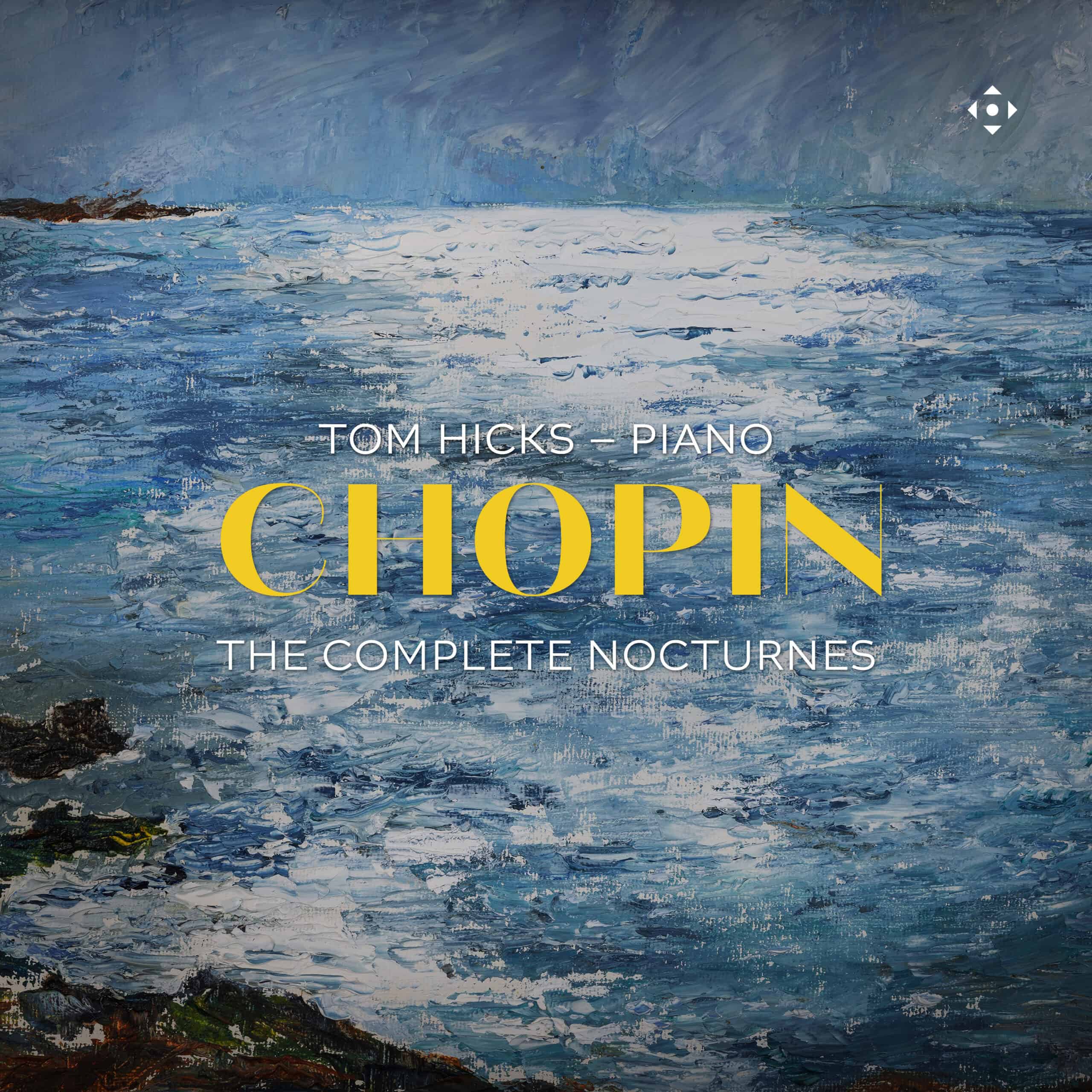
  • Chopin: The Complete Nocturnes

    Chopin: The Complete Nocturnes

    Chopin’s 21 Nocturnes, often described as ‘songs of the night’, are among the most well-known and beautiful of Chopin’s short solo piano works.

    Divine Art is thrilled to present pianist Tom Hicks’ insightful new recording of these works which synthesizes his research into Chopin’s performance and composition practices with modern listeners’ expectations via a ‘stunning technical agility’ (American Record Guide). Dr Kim Sauberlich’s excellent liner notes delve deeper into this often-forgotten performance, teaching, and historical recording practice and, together with the 21 pieces on this album, pose fascinating questions about authenticity and interpretation.

    Chopin’s practice of sending manuscripts to publishers in multiple countries, while continuing to edit, led to multiple, authentic first editions which are not often heard in performance today, and even less in recordings. In this recording, Tom has tastefully incorporated some of these variants, alongside historically informed choices about tempo rubato and pedaling, to create a version of the Nocturnes that feels fresh, individual, and truly authentic. He has even included minor and occasional improvisations, paying homage to the composer’s multifaceted creative process, in which improvisation was central.

    Tom Hicks has said “All of this led me to see Chopin as a highly creative and spontaneous musician for whom the score is one representation of the work and for whom the score is only the starting point of an interpretation, not the end.”

    The album was recorded at night and the engineers have captured an intimacy of sound. The recording process relied upon minimal editing and longer ‘live’ takes to recreate the intimate feel of the salon where these pieces were most often heard.

    Guernsey-born pianist Tom Hicks has an expansive repertoire and has been praised for his “brilliantly evocative”(International Piano) and “gorgeously creative playing” (Fanfare). He has won many awards and competitions and has appeared at the Wigmore Hall in London, Bridgewater Hall in Manchester and many other venues throughout Europe and the United States. This new album follows his March 2022 albums centered around the Liszt and Ireland Piano Sonatas and Camden Reeves’ ‘Blue Sounds’.