Catalogue Connection: 21373

  • The New Listener review of DDA 21373 At the Heart of the Piano

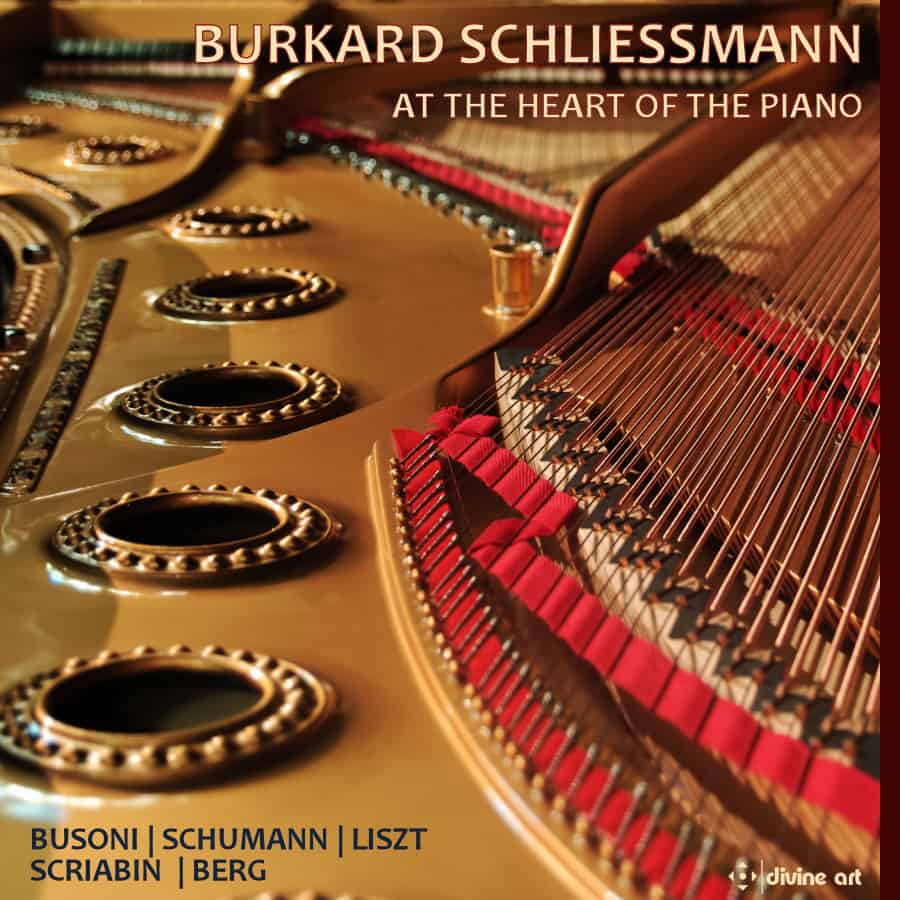
    After his 3-CD box set “Chronological Chopin”, which was released in 2016 and was highly acclaimed by the media, Burkard Schliessmann is now presenting a new collection of three CDs on Divine Art, entitled “At the Heart of the Piano”. It is an attempt to approach the piano as an instrument and to wring one’s deepest emotions from it. The title addresses the philosophical question of whether the piano, a first glance the most non-physical of all instruments, consisting largely of wood and metal, which produces a perfect tone by simply pressing a button without physical effort, can convey and express feelings at all, has a heart. Burkard Schliessmann wants to prove this with a very intimate repertoire that means a great deal to him and that brings together various aspects of the piano literature on three CDs). These are exclusively older recordings from the years 1990 (Scriabin), 1994 (Bach/Busoni and Berg), 1999 (Schumann Fantasy and Liszt) and 2000 (Schumann Etudes), which have either never been made or only in a small edition and regionally restricted have appeared, and they shine with new mastering in fresh splendor, so that they are now given the soundworld they deserve. Schliessmann used his own grand piano for all recordings; as a Steinway Artist this is a Steinway Piano D Concert Grand.

    Burkard Schliessmann describes himself in his detailed accompanying text for the triple CD, which reveals both facts and personal views on the pieces, as a representative of the “great romantic tradition”. “Technical mastery is of course important, but my interpretations remain essentially intuitive. I don’t think about it and I don’t worry about the implementation of my interpretation.” Although this may certainly be true for the moment of the performance, he is thereby concealing the immense work that he had previously – must have had – with the works. Because it is unmistakable that Schliessmann has thought carefully about what he wants to say with the works and how his personal voice should flow into the notes. In the recordings he shows himself to be a pianist with a strong character who knows how to shape the works according to his ideas and thus tailor them to him. Schliessmann interprets the famous Chaconne in D minor by Johann Sebastian Bach in the virtuoso transcription of Ferruccio Busoni as an attempt to synthesize a baroque and an early modern style of playing. He saves the tempo rubato for special moments in order to maximize expression there.

    Schumann is played by Burkard Schliessmann truly appassionato, taking the fantasy in a comparatively more classical way in order to be able to make the symphonic etudes all the more romantic and lively – but this impression may also be partly due to the different reverberation, because here the ambience is more apparent  in the etudes (while on the other hand the acoustics flatter the piano sound very clearly and clearly in the other recordings). In both pieces, the pianist uses clear tempo contrasts and rubato for a strong effect, separates individual passages from each other and thus gives the music a vivid, spontaneous, almost improvisational aspect. He plays with the reverberation of the pedal to develop orchestral sonority, although I would argue that he does not see the “symphonic” nature of the etudes in the imitation of certain orchestral instruments, but purely in relation to the differentiated tonal colors of the piano. Schliessmann also experiments with the relationship between the voices, which is clearly evident in variations four and sixteen: the melody remains clear, but always has to assert itself against the seething secondary voices, which makes for extremely exciting listening.

    Franz Liszt’s daring Sonata in B minor, which was only recognized late by the public, presents Burkard Schliessmann in a quite aggressive manner; he lets the sound soar to unimagined heights and even takes the liberty to present some highlights violently – probably just like the great virtuoso and showman Liszt might have played it at the time to more deeply polarize the effect. But the fact that this is not Schliessmann’s top priority is shown by the deeply musical development of the themes and their modifications in the course of the piece, whereby he lends the main theme in particular an eerie, oppressive presence. In this way, he succeeds in creating an overall impression of a sophisticated psychological nature that appears to be unified and consistent in itself.

    In the works by Alexander Scriabin, Burkard Schliessmann presents a program across all the composer’s creative periods, from the Etudes opp. 2 and 8 and the Préludes op. 11 to the Sonata in F sharp minor op. 23, which shows more individual writing, to the late Dances op. 73 and Préludes op. 74, which appear absolutely independent in the history of music in their spiritual appearance and the complex extended harmony. The flowing, freely presumptuous forms are in the instinctive playing of the pianist, who brings the individual moments to bloom while knowing how to hold the overall form together. The rhythmic polyphony between the hands or their individual voices spurs him on to maintain a high degree of delicacy, even in grandly triumphant passages. Schliessmann pushes the contrasts to extremes and thus shows even the early Scriabin as a modern, progressive composer.

    The program closes with Alban Berg’s Sonata op. 1, a showpiece of early modernism and especially of free tonality, which however always reveals tonal relationships. Schliessmann creates a bridge between the second Viennese school and the ecstatic Scriabin, brings out a certain volume in Berg too and allows himself tempo-related liberties in order to underline the density of the polyphony. In this way, this stylistically uniform and yet versatile presentation of Schliessmann’s pianistic work succeeds, which, through the pianist’s highly personal views, brings us closer to masterpieces from different eras in a very human way and invites us to explore them.

  • DDA 21373 At the Heart of the piano – review from Music Voice Italy

    [This notice has been translated from Italian using Google (…) and then slightly edited to improve intelligibility. Any offer to re-translate would be welcomed!]

    Burkard Schliessmann is one of the currently most appreciated and interesting German pianists at an international level and already boasts a large discography, mainly focused on composers who belong to the European Romantic school. Even his latest recording, a box set comprising three CDs published by Divine Art, does not differ from this principle, as the title itself, “At the Heart of the Piano”,  demonstrates,  The set presents Bach’s Chaconne in D minor in the transcription by Busoni, the Symphonic Studies Op. 12 and the Fantasia in C major Op. 17 by Schumann, the inevitable Sonata in B minor by Liszt;  we have from Scriabin the Sonata in F sharp minor Op. 23, two Studies from Op. 8 and Op. 12, Preludes from Op. 11, Op. 16 and Op. 37 and the Two Dances of Op. 73 and the Five Preludes of Op. 74, ending with the Sonata Op. 1 of Berg.

    Considering this program more carefully, on the basis of Schliessmann’s aesthetic vision, one can easily realize how the works and composers can be seen as an explanatory map of musical Romanticism, based not so much on a philosophy to be proposed through the overall sound, but more by  rigorous formal study in which the key content of Romantic thought can be expresed without entering into contrast with what is exposed by the form itself. In this sense, Bach’s famous Chaconne, revised and enunciated by Ferruccio Busoni, is already symptomatic; the choice that Schliessmann makes is not in exalting the transcendental dimension with which this piece is usually presented, but by involving more the immanent aspect, that is the sensitive perception of the artist who performs it. The Chaconne, therefore, seen not in the Bachian vision mediated by Busoni’s technicality, but through the (late) Romanticism of the composer and pianist from Empoli, detaching himself from the pure spiritual dimension that inevitably invests Bach’s music, shapes the primeval matter according to the modalities and the urgencies of one’s time. From here, the technique itself becomes a form of transcendentality with which to draw the prerogatives of a vision, the Romantic one or at least of what remains of it, which observes, reflects and offers itself to the ear, heart and brain of those who listens.

    But pay attention to an aspect that distinguishes the path of the program chosen by the German pianist, namely that there is a red thread that links each work in the recording to the next, not taking into account the chronological discrepancies of the program itself. Therefore, the Busoni who mediates and “actualizes” Bach is very close to that technical transcendentality evoked by both Schumann and Liszt, that is, by two custodians of the “sacred” Romantic vision. That is why, in the name of this “transcendentality”, Schliessmann continues his exploration of the Romantic genre, first with Schumann’s Symphonic Studies and Fantasia and then with the Liszt Sonata. And how does he deal with these pages? The Symphonic Studies undergo dilations and restrictions in the metronome, but this must not cause scandal, as the German artist bridges the possible time lags by frescoing the theme and the variations of this composition with a due passion, such as to give life to a sort of “story” (the “imaginative” Schumann that makes the art of sounds cross over into narrative and literary structures) that unfolds with a coloristic sagacity given to each of the twelve Studies, a color that Schliessmann exalts above all by emphasising the play of tonality given by the chromatic keys and the technique to be used on the basis of the same indications provided by Schumann, which leads to giving life to a timbral fresco that for some may even be exaggerated in its final result (there is effectism, pathos, emotional impetus; but, by God, are we or are we not in the heart of piano Romanticism?) This all however fully falls within the vision that Schliessmann wanted to impose here, which shows how this pianist does not at all suffer from a lack of personality, on the contrary. Hence, abundant monumentalism (Track X – Variation IX), but also soft, rounded brushstrokes, made crystalline (Track XI – Variation X and Track XII – Variation XI), that is, in the very heart of Op. 13, to better highlight the bipolar antagonism of the Schumannian personality, with Florestano and Eusebio going into the ring to give them a blessing.

    Such monumentality and delicacy are consistently maintained also in the Fantasia Op. 17, which, as we know, is above all (see the first movement) a passionate and heartfelt act of love towards Clara Wieck and which Schliessmann explores with powerful, full, open, solemn sounds, giving an “architectural” identity to his pianism, in order to solidify the image of the “phantastisch”, as per Schumann’s indications. But also in this case the projection is valid, the “throwing-forward” with which the German artist permeates the entire program in question, that is, preparing the listener for the irruption of the Lisztian Sonata (chronologically, the Fantasia dates back to 1836, while the Sonata in B minor is from 1852 and is dedicated to Schumann). Schliessmann, therefore, ideally builds a bridge, a connection between the passion that seeks to be form, given by the Fantasia op. 13, with a form, precisely, that throws his cloak to the winds to rise to the most free, free from the impositions given by the classicism of the genre; he does it to remember once again how in just sixteen years, those that separate the two works, two worlds that while reconciled in their creative intentionality, are at the same time like two galaxies destined to expand and move away in space.

    Here, too, the German pianist does not deny the characteristics of his program, since the reading of the Lisztian Sonata is devoted to yet another “look-ahead”, prefiguring, anticipating, acting as a precursor to what will come after and what Schliessmann justifiably identifies in Scriabin. But let’s go in order. The vision that the German pianist brings to the surface of Liszt’s Sonata is not only devoted to monumentality of form (an element inherited from the past, especially Schumann), but is based on a sound that is increasingly circumscribed in it, that is, enhancing the single sound as a self-referential datum, as a completely autonomous cell that compares itself with the other cells that precede it and with those that follow it. A sound, therefore, decidedly devoted to a modernity that if on the one hand will be deepened by Brahmsian pianism (the one that will fascinate Schönberg), on the other hand it will be faced by Scriabin’s visionary nature.  Scriabin, whose pianism, together with that of Debussy, explores up to essence of the cellular element given by the harmonic conception which is transformed acoustically into a dimension in its own right and which at the same time manages to interpenetrate the other timbral dimensions that surround it and of which it is necessarily part.

    And here we come to the third and last disc of this set and which I personally consider the most intriguing and stimulating. Schliessmann has included Sonata no. 3 Op. 23, the Etudes no. 1 Op. 2 and no. 12 Op. 8, the Preludes nos. 1, 3, 9, 10, 13, 14 Op. 11, nos. 3 & 4 Op. 16, nos. 1 & 2 Op. 27, nos. 2 & 3 Op. 37 and nos. 2 & 4 Op. 51;  the Two dances Op. 73 and, finally, the Five Preludes Op. 74. If, in the words of Francis Bacon, the Schumannian Fantasia is given by the pars construens provided by Clara Wieck, the Sonata by Scriabin is modeled on the pars destruens of Vera Isakovic, the unfortunate consort of the Russian composer, who realized ever since his nuptial trip to Paris in 1897 of having made a tragic mistake in marrying her. Thus, if the Fantasia is musically a unifying part, the Sonata on the contrary is devoted to a disintegrating dimension. This disintegration is already an attempt to flesh out the sound, to make it closed in itself through a process of timbral legitimisation in which the phrasing already tends to fragment, to “sectorize”, as well as being, although in its emotional arrogance, more and more diaphanous, rarefied, almost suspended over the abyss of nothingness.

    In his interpretation, Schliessmann instead tends to recover a formal legitimacy that allows one to still manifest a sort of “hope”, so that the phrasing is more fluid, less “bumpy”. This does not mean that a rethinking of the vision of “looking forward” is taking place in his interpretation, but it represents a reconsidering in perspective what will come in Scriabin’s musical poetics. Thus, the German pianist takes the Sonata no. 3 so that he draws a line of demarcation between what is still Romanticism and its passing phase, which in the Russian composer cannot be accurately defined as Late Romanticism per se. The disintegration, in this sense, materializes in the exposition and in its development and at last, in the  “Presto con fuoco” which is the tenuous explosion of a continuity that is linked to what was stated at the beginning of the Sonata. And it is here that Schliessmann’s “reconsideration” transforms the “Presto con fuoco” into a launch pad through which to launch a missile whose expressive consistency is represented by the other works by the Russian composer included in this set.

    And this has happened since the two included Etudes, in which the sound matter already manifests a change in progress in anticipation of what is destined to take place if it does not come true, that is, that Scriabin would have reached the archipelago of atonality by following a path different from that of Schönberg and the others belonging to the Second Vienna School. This happens from the Étude in C sharp minor which belongs to the Three Pieces of Op. 2 (dating back to 1886-89) and the last of the twelve Études op. 8 which are from 1894-95. These are two Studies that for Schliessmann evidently belong to that process of planning that lays the foundations for starting that specific alternative path to modernity, a modernity, mind you, which does not, however, deny what happened previously.

    And here the Preludes taken into consideration, those belonging to Op. 11, Op. 16, Op. 27, Op. 37 and Pp. 51, appear to be nothing short of idiomatic in the choice of the German artist and represent a miracle of “oscillation”, a pendulum that passes alternately between what is still past (Op. 11 no. 9 – Op. 16 no. 3 – Op . 27 no. 2 – Op. 37 no. 3) and what is already future (Op. 11 no. 3 – Op. 27 no. 1 – Op. 51 nos. 2 & 4). Faced with such a choice that intends to show the Scriabinian two-faced Janus, it can and must appear completely obvious that the great final step is represented for the German pianist by the two last piano compositions of the Russian composer, namely the Deux Danses Op. 73 and the Cinq Préludes Op. 74, both dating to 1914, that is to say a year before his death. These two works are, as we know, intimately connected and represent, as Schliessmann points out with his reading of him, the ultimate offshoots of that romantic tension conceived within his aesthetic tradition.

    Of course, especially the Op. 74 necessarily refers to the contemporary Six Pieces Op. 19 by Schönberg, an emblem of that process of harmonic dissolution that will inevitably lead to the concretization of seriality, but neither Op. 73 or Op. 74  boast the same purposes, as Scriabin, beyond the mystical intentions to which these last two piano works were designed, are extensions of a past that certainly looks ahead, but is not yet the future, as is perhaps the Schönberg Op. 19. This is why the interpretation made by the German pianist follows this “prudential” line, never pushed into formal excesses, and this is especially true for the Cinq Préludes, since their enunciation aims at least to be “nostalgic”, that is to say, of a past, in his tradition, which senses the moment of change, of passing away, of an end that can no longer be postponed (in this sense, the timbre dimension that Schliessmann provides in the second Prelude Op. 74 is exquisitely evocative).

    Nostalgia has been stated. So, to conclude his program dedicated to Romantic transmutation in the piano, a transmutation with an alchemical flavor at times, Schliessmann puts his hand to Berg’s Sonata, which, just to underline the aesthetic purposes of the recording in question, is not addressed in its “radicality ”, but as a sign of something that has by now been lost, a footprint of an ancient stone that wants to be a milestone, that is, to act as a watershed between the (late) Romantic vision and the post-Romantic one. Following this path, I find that Schliessmann, at a piano level, does not differ from what Karl Böhm did at the directorial level by addressing Berg’s ‘Wozzeck’, therefore not considering it as an expressionist creature, a suspended bridge towards ‘Lulu’, but as the ultimate expression of a late Romanticism that was struggling to exhale the last breath.

    From here, those who are familiar with the readings made, among others, by Glenn Gould of this Sonata, get ready for a performance by the German pianist in which the few motivic cells that animate it are never exaggerated, or brought to a point of tension close to rupture, but his reading is conceived as a repudiation of fragmentation, a look forward with a look backwards, also because Op. 1 itself is basically an act of gratitude towards that tradition (the Sonata dates back to the two-year period 1907-08, only to be revised by the author in 1920) which at that time is beginning to fall apart (and in this we follow the coeval path taken in parallel by Scriabin himself in that first decade on a sonatic level). Schliessmann thus uses the palette of a passion which, however, now smacks of consummation, a supreme act, a corollary that ideally closes the circle of his journey towards the funeral of Romanticism, returning an unsuspected evocative sweetness, a very fine shroud with which to wrap the corpse, so as to be able to preserve it from the corrosion of time and memory. So be it.

    The recordings were made at three different times by as many engineers (ranging from 1990 to 2021), but we do not notice timbral and dynamic imbalances in the use of the piano, rigorously always a Steinway Piano D. Therefore, the dynamics always turns out to be strong, but at the same time sensitive and careful in restoring the necessary nuances of microdynamics; the sound stage adequately reconstructs the instrument at a discrete spatial depth, restoring a pleasant height in the sound, as well as filling the space between the speakers. Even the tonal balance and detail do not fail, with the first always precise in making the low and medium-high register always distinct and never blurred, and with the second showing a remarkable materiality in the physical rendering of the piano.

    Artistic interpretation 4/5

    Technical value 4/5
  • At the Heart of the Piano DDA 21373 AV Club of Atlanta review

    “At the Heart of the Piano” is a 3-CD collection of dynamite recordings by Burkard Schliessman that really define him in terms of his distinctive profile as a pianist. The native of Aschafffenburg Germany has often been noted for his passion for using all the resouces of the instrument to get to the heart of the music and bring it out in all its expressive power and beauty. In that respect, he reminds me of the fondly remembered American pianist Earl Wild (1915-2010), especially in his accounts of the Romantics.

    Speaking of which, his Schumann recordings call for special recognition. As I said of Schliessmann in a review some years ago, “he is the last sort of pianist you would expect to just play the notes as written, without comment.” The composer would certainly have approved. In his account of the Symphonic Etudes, which Schumann described as “etudes in the form of variations,” Schliessmann incorporates the five “posthumous etudes” that Brahms published after the composer’s death, carefully distributing them for best effect to fill out the harmony. That is no easy task, but carefully placed, these etudes add much in the way of searching, introspection, and exaltation to a work that is already distinguished for its wealth of color and for Schumann’s notable mastery in blending, contrasting, and superimposing timbres. Schliessmann takes all these issues in stride, making this an eminently satisfying account of one of the most difficult works in the repertoire.

    He also does a fantastic job in Schumann’s Fantasia in C Major, Op. 17, a work marked by rhapsodic lyricism occasioned by trill structures, which are typically in downward motion, in the opening movement. It is succeeded by a march in the middle movement that culminates in sensational back-rhythms and syncopations that still have the power to astonish us today, and a finale whose harmonic structure conjures up the image of a star-filled night of which Schumann was doubtless thinking when he subtitled this movement “Crown of Stars.” The reader will note how the composer reversed the usual order of this slow movement, marked “thoroughly fantastic and sorrowfully laden” (Durchaus fantastisch und leidenschaftlich vorzutragen) and what then became the middle movement with its thumping fortes in the afore-mentioned march.

    There follows Franz Liszt’s wonderful Sonata in B Minor, in which the dramatic tensions, and releases of the same, are in part a direct function of an unusual structure in which all the elements of sonata-allegro form (exposition, development, lead back, and recapitulation) are encompassed by a single movement, played continuously. Any pianist less knowledgeable than Burkard Schliessmann might easily end in disaster in a work that has also been unified by a considerable application of cyclical form, making it imperative to think ahead to where you are going. Carefully considered pauses, allowing the music room to breathe, powerful climaxes, hard-won struggle, and then a devotional atmosphere based on high, bright harp-like chords, and then a radiant conclusion sinking softly into near-inaudibility: all these and more contribute to the effectiveness of the B Minor Sonata in an informed interpretation. Schliessmann’s is one of the best, an inspiring triumph of faith and art.

    The program actually begins with J S Bach’s famous Chaconne from Violin Partita No. 2 in the piano transcription by Ferruccio Busoni which is the first track on CD1. In retrospect, it seems as much of a work of Busoni as it is of Bach. Certainly, the changes of tonal color, dynamics, and increasingly dense harmonic effects are more easily accomplished and more effective than they would have been on the harpsichords available to Bach, as is Busoni’s extensive use of the pedal. On the other hand, Schliessmann has to work harder to achieve its demon pacing and high-energy rhythms on his modern Steinway D. The moments of calm and reflection that accompany heart-stopping key changes at about 7:10 and 10:55 in this performance have all the effect anyone might desire.

    CD3 is dedicated solely to two composers whose work was absorbed in speculations about the future of music, Alexander Scriabin (1872-1915) and Alban Berg (1885-1935). They could not have been more different. Scriabin, the Russian, showed only the most casual reverence for received musical tradition. He was a visionary, in his quest for ever more brilliant tonal expression as well as in his own spiritual orientation, based on the Theosophy of Madame Blavatsky but going beyond that in his embrace of enraptured musical tones. His Sonata No. 1 in F-sharp minor, Op. 23, represents an early breakthrough, particularly in his choice of an extraordinarily rich and difficult key with no fewer than six sharps in its signature. The work has the requisite four movements of a classical sonata, to which it pays homage, but clearly Scriabin is interested in something other than thematic development. The final movement, Presto con fuoco, ends suddenly without a decisive finish, as if Scriabin had finished digging all the brilliantly colored musical ore in this particular mineshaft.

    It would be easy to dismiss so many of this composer’s musical explorations as mere incontinent rhapsodizing (as some observers have continued to do to this day), but that would be to miss the point of what this composer was all about. In a 66-minute selection including Preludes, Etudes and Dances, Schliessmann presents Scriabin as a man on a quest for transcendently beautiful tonal expression in large forms as well as small. Using chains of thirds and transposable fourths, he created musical structures of great beauty. In the process, he also showed other composers what could be done with rich and rare keys they had generally avoided, such as G-flat major (six flats) and E-flat minor, also six flats. (Its enharmonic parallel is a more accessible F-sharp major). All this he did in the interest of music expression that might be darkly glowing, melancholy or ecstatic.

    Someone like Scriabin is obviously a hard act to follow. So, what are we to say of the Austrian composer Alban Berg, whose 11-minute Piano Sonata, Op. 1, concludes the program? At the opening, flickering shy lights take the place of the dramatically compelling or quietly understated introduction we might have expected. As in the Liszt sonata, all the structural elements are subsumed in a single movement, but the thrust is quite different. We have here music that is still basically tonal, leading to musical structures in which melody and harmony are subjected to constant variation and interweaving. In Schliessmann’s sensitive performance, I found a down-to-earth warmth of human emotion that I had not expected to discover in a composer who was to be associated with the 12-tone music of the New Viennese School. For yours truly, that was a nice revelation.

  • Fanfare review (3) DDA 21373 At the Heart of the Piano

    This commanding, almost regal selection of recordings from Burkard Schliessmann was recorded 1990–2000. It is a shining example of integrity and intelligence in music, welded to a technique of gargantuan proportions. There is logic guiding in the programming also: The Liszt Sonata and Schumann Fantasie bear mutual dedications, while the worlds of Scriabin and Berg are hardly a million miles from one another. This is the first digital issue of all tracks on this set.

    The three-disc set therefore posits one route from Bach (in Busoni’s granitic hands) to Scriabin and Berg. The Bach/Busoni Chaconne is a fine performance, big-boned and captured in superb sound that really allows one to enjoy the strength of the bass of Schliessmann’s Steinway piano. In this context, the sober, chordal opening of the Schumann could almost be by Busoni; as the variations unravel, the piece could only be by Schumann. Schliessmann includes the posthumous variations in what becomes a panoramic journey through myriad vistas: Schliessmann’s ability to utilize tone color within stylistic bounds is something any pianist could learn from profitably. Textures are always carefully considered (the tremolos of Variation 16 being a case in point), while the finale is as brilliant as its indication requires, and, most importantly, properly cumulative in context, ending in what amounts to a pianistic pealing of bells. As Schliessmann pointed out to me in an interview once, no less a figure than Brahms included the posthumous variations, so it makes sense to do so.

    It is fascinating how, while being part of a larger whole, each individual disc operates as a cycle within itself. So, one has the Bach/Busoni and the Schumann above, perfectly contained and with a real sense of inevitability of continuity; the second disc has those pieces of mutual admiration, the Schumann Fantasie and the Liszt B-Minor Sonata, both major masterpieces of the Romantic era. The sense of grandeur we heard particularly in the Bach/Busoni recurs in the first movement of the Schumann Fantaise, while the tricky second movement holds no perils for Schliessmann (and he maintains the indication Durchaus energisch: energetic throughout). One of Schliessmann’s core properties is that he can bend his sound and way with tempo to each individual composer perfectly, and we certainly feel that here. He creates two separate sound worlds: Schumann’s is full of fantasy, as if trying to escape the world’s strictures and limitations to ascend Heavenwards (one certainly feels that is how the songful finale operates, with those themes ascending ever upwards, garnished with delicious celestial decorations in the high treble), while Liszt’s sublimity is more sensual, more demonic. One hears the prefiguring of the dark nights of Liszt’s very late works in the sonata’s opening, and this colors the octave explosion: yes, we hear virtuosity, but it is part of an over-riding diablerie. While Schumann ascends radiantly, Liszt struggles with his inner demons to do so, and Schliessmann leaves us in no doubt of the power of that struggle. The fine piano he plays on is part of this; it is clearly a majestic instrument, sublimely prepared. Schliessmann’s slower sections have a distinct simmer underneath them, ready to explode into headier regions. It is this mix of visceral excitement combined with a tour guide who always has the end in sight that is so impressive, so that when the end comes, we feel we have come full circle and the journey can begin again. Both the Schumann Fantasie and the Liszt B-Minor sit up there with the greats: Polini’s DG accounts of both are classics, another pianist with a fierce musical intellect, but Schliessmann offers an alternative that is just as engrossing.

    Scriabin’s Third Sonata sees the composer moving away from his explicitly Chopin-influenced output to a more inner space that was perfect for his Theosophical-based reflections on mysticism. Interestingly, Schliessmann shares Scriabin’s synesthesia (the equating of colors to key areas in this case). Schliessmann’s Scriabin sits in the line of Scriabin playing that emanated from Vladimir Sofronitsky. His Third Sonata begins volcanically, but it is in the harmonic explorations where it becomes most alluring. It’s interesting that Schliessmann bookends this disc with sonatas (another indication of the discs acting as mini-recitals within themselves); here the antipode is a superbly delineated performance of the Berg Sonata, op. 1, like the Liszt, in B Minor (although unlike the Liszt the B Minor it is more a structural reference point than an anchor). Schliessmann’s second movement of the Scriabin Third Sonata is beautifully unsettled, the bass ominous, the rhythms themselves of foreboding intent. The twilit, Russian pastoral shades of the Andante in Schliessmann’s performance are revelatory. Again, we get a sense of cyclical arrival at the beginning of the Third Sonata’s finale before the music devolves and spirals into milieus of heady energy. After the sonata, Schliessmann presents a sequence of 21 pieces by Scriabin that move from the famous, post-Rachmaninoff Étude, op. 2/1 through a selection from the exquisite op. 11 set of Preludes, tracing a journey all the way to the harmonically adventurous “Danse languide” of op. 51/4, itself the gateway for the Deux Danses, op. 73 (the delicate traceries of “Guarlandes” and the flickering “Flammes sombre”) and the harmonic ambiguities of the set of five Préludes, op. 74. And while the opening gesture of the Berg Sonata might seem to equate to the perfumed world of Scriabin, Schliessmann ensures we hear all of Berg’s contrapuntal rigor.

    This is a most thought-provoking set, overflowing with performances of insight, and beautifully recorded.

  • Fanfare review (2) DDA 21373 At the Heart of the Piano

    Having not been familiar with the keyboard art of Burkard Schliessmann, I approached his chosen program of “transcendence, vision, and personified aesthetics of effect” with some skepticism, if not a predisposition for cynicism. The recordings, previously unknown to me, derive from sessions made 1990–2000, here remastered by Paul Baily. To my sustained delight, Schliessmann reveals himself as a Romantic temperament deeply motivated by both intimacy and intuition, sustained by a wholesome and astonishing technical resource. His capacities in contrapuntal music assert themselves fully and without pedantry in Busoni’s transcription of Bach’s Chaconne from the Partita No. 2, the Schumann Symphonic Études and Fantasie, and in the heroic, stratified figures in the Liszt Sonata, even before he wrestles with the intricacies of Scriabin, whose miniatures often prove more mechanically daunting than his larger forms. The placement and order of the assembled works no less contributes to the cumulative effect of the evolution of a Romantic ethos, an increasingly subjective outlook that subsumes reality into an affirmation of selfhood.

    What proves consistent in this traversal of essentially Romantic repertory emanates from the pianist’s sense of space and of individual coloring. Much in the tradition of Cherkassky and Michelangeli, Schliessmann allots each of the evolving musical lines its own breadth, which becomes instantly apparent in the various permutations in the Bach piece and in virtually every line in the Schumann Fantasie. The art of applying silence between notes and distinct musical lines never fails to make or to undo a dramatic performance. In this regard, I find Schliessmann eminently theatrical in style, compelling in the grand line he assumes for each of his endeavors. The Schumann Symphonic Études enjoy their proclaimed “symphonic” ambitions, certainly. But in incorporating the full set of Schumann’s posthumous and various appendices Schliessmann burdens himself with the problem of musical and dramatic continuity, having to sustain a canvas that now spreads out well beyond established time parameters, at almost 40 minutes.

    If my remarks seem to suggest a highly “contrived” sensibility, let me assure possible auditors of the miraculous power of spontaneity that permeates these realizations. The Liszt Sonata regains much its shocking originality, its tempestuous and outrageous shifts of mood and musical means, especially in the manipulation of its Grund-Gestalt, its through-composed opening motifs and the subsequent harmonic audacities that follow. The Schumann Fantasie and the Liszt Sonata, works coincidentally dedicated reciprocally by each composer, occupy the same disc, providing an hour’s unrelenting display of controlled, intelligent passion in the same paradoxical moment. The immanence of the urge to poetry suffuses every musical impulse. We sense as we move to the music of Alexander Scriabin and the “new” school of Alban Berg that the keyboard instrument has gained an increased sense of liberation in its power to express subjective reality, even as traditional harmony breaks down. True, we have skipped over the contributions of Beethoven and Chopin, a substantial break in the history of keyboard transcendentalism. But in compensation, Schliessmann turns in disc 3 to a concentrated survey of the Russian mystic Scriabin, all too easily dismissed as an eccentric, musical solipsist who always spells Reality with a capital I.

    Schliessmann opens his Scriabin sequence with the 1898 Third Sonata, meant to express the composer’s flights of the soul toward liberation. The oceanic imagery Scriabin invokes for the last two movements, no less based on cyclical motifs and transposable fourth chords, intensifies the paradoxical sense of unity in the midst of free-fall. Schliessmann provides a pungent, searching sonority to the music’s nervous rhythms and ardent declamations. His third movement Andante finds a moment for childlike simplicity. Schliessmann’s left hand helps catapult the last movement, Presto con fuoco, to a Tristan-inspired paroxysm of energy, the “uproar of life,” fraught with fervent rebellion. The taut, forward motion may remind auditors of the classic Horowitz approach. As in his Schumann, Schliessmann applies a canny soft pedal, when required. Schliessmann concedes to popular taste for the moment, performing the two most famous études, those in C♯ Minor and D♯ Minor, with the op. 2/1 providing an immediate contrast to the emotional throes of Sonata No. 3. The famed D♯-Minor returns to the primal passions, insistent and voluptuous. Schliessmann then turns to the variegated world of Scriabin’s 90 preludes, of which the op. 11 set (1888–96) follows Chopin in his arrangement in the circle of fifths, and varying the form of these pieces as nocturnes, études, and mazurkas. A fine example occurs in the E Major, No. 9, in which Scriabin avoids the tonic triad until the end, and Schliessmann’s attentions to designations rubato, ritardando, and accelerando create a poised nocturne tinged by mazurka rhythm. The use of parallel motion in sixths in No. 13 reminds us of Bach as well as Chopin. The pattern of sixths informs the Andante cantabile, op. 16/3, to create its restrained angst. The preludes of 1900, op. 27, reveal a new and rich assertiveness. The Prelude in B Major, op. 27/2, from Schliessmann has a luxuriant abandon, a fertile reverie. Schliessmann plays the Prelude in A Minor, op. 51/2, Lugubre, which the composer avoided in his public performances. The music imparts an eerie atmosphere, somewhat in the manner of late Liszt. Scriabin called it “a ghastly piece!” Fluttering motives define the Dance languide in G Major, op. 51/4, which hesitates and then ends as one of Schliessmann’s riddles.

    With the Deux Dances, op. 73, we enter into Scriabin’s last phase, a distillation of harmony and vision. Schliessmann realizes the crystalline figures of Guirlandes with the required “languid grace.” Scriabin characterizes the figures as “sweet to the point of agony.” The Flammes sombre invokes Dante and Liszt into the equation. A perverse eroticism pervades this piece, a descent into the labyrinth, “an orgiastic dance” among the ruins. The weird agogics of the piece proceed with a “natural supernaturalism” entirely suited to the occasion. The complete set of Five Preludes, op. 74 (1914), gives us Schliessmann’s perspective of Scriabin’s last opera. Miniatures they are, but their intensely compressed fusion of consonance and dissonance testifies to a mind’s seeking new paths. Heartfelt anguish joins with points of resistance, spiritual fatigue with infusions of aching energy. The number four, Lent, vague, indécis, proceeds in four-part, uncertain harmony. Each of these five “mysteries” Schliessmann reveals with a deliberate, tempered fury.

    And so we proceed to the musical compressions of Alban Berg’s 1909 sonata. Berg’s sonata in one movement owes its color to Wagner, Liszt, and the late-Romantic concept of “developing variation.” Janus-like, the work bids farewell to the Romantic syntax and likewise looks forward to the 12-tone system about to be initiated by Schoenberg and his school. The opening, with its dotted rhythm and perfect fourth/tritone intervals, followed by falling thirds, announces a serious departure from tradition, even as the structure follows the pattern of exposition, development, and recapitulation. Schliessmann realizes its various swells and retreats, its idiosyncratic counterpoint, with insistence and often delicate clarity, a lyric sense of its diverse, keyboard palette. We have moved, in Schliessmann’s own words from his extensive liner notes, from “the ecstasy of expression to the ecstasy of structures.” The extensive journey has proved most compelling.

  • Fanfare review (1) DDA 21373 At the Heart of the Piano

    At the Heart of the Piano, a three-disc release from Divine Art, presents German pianist Burkard Schliessmann in a recital of works by Bach (arr. Busoni), Schumann, Liszt, Scriabin, and Berg. The Bach/Busoni Chaconne and Berg Sonata receive their first release on this set. All the other recordings were previously issued by Bayer. The included Scriabin works were recorded in July, 1990, the Bach/Busoni Chaconne and Berg Sonata in 1994, the Schumann Fantasie and Liszt B-Minor Sonata in September 1999, and the Schumann Symphonic Études in March 2000. The new Divine Art set features 2021 remasterings by Paul Baily of all the included material. In the CD booklet’s extensive and informative liner notes, the uncredited author (Schliessmann, perhaps?) states: “Although at (a) glance the works offered here do not share any direct common ground, if considered more closely there are certain common factors with regard to their genesis over time and their conception….” Indeed, there are many elements that connect the works, and in an intriguing fashion. The composers appear in order of their birth years (if we use the “Bach” in “Bach/Busoni” as our start). Within that time progression, each of the three discs explores particular aspects of musical expression. Disc 1, comprising the Bach/Busoni Chaconne and the Schumann Symphonic Études, focuses on theme and variation structures. The second disc pairs the Schumann Fantasie in C Major with the Liszt B-Minor Sonata. Each of the composers dedicated his work to the other. Here Schumann and Liszt, in addition to writing music demanding a virtuoso of the highest order, explore the structural boundaries of the traditional piano sonata (and for that matter, sonata form). The final disc charts the trajectory of Scriabin’s increasingly daring harmonic world, a gateway to Berg’s atonality.

    Just as the repertoire shares common elements, so do Burkard Schliessmann’s performances. Schliessmann plays all of this challenging repertoire with an impressively assured technique that is always at the service of the music. Schliessmann is a pianist who avoids such exaggerations as italicizing passages to showcase his virtuosity, extremes in tempo, or an excessive application of rubato. That said, Schliessmann’s interpretations exhibit a convincing ebb and flow, and the ability to draw upon a wide range of colors and dynamics to create the appropriate sound world for the work at hand. Schliessmann is also an artist with a keen sense of pacing. Both the Bach/Busoni and Schumann Symphonic Études are notable both for the accomplished and expressive way Schliessmann executes the variations, and the manner in which he connects one variation to the next. This sense of proportion serves Schliessmann and the music well in the Schumann Fantasie, and the Liszt, Scriabin, and Berg sonatas. The performances of the numerous brief Scriabin pieces also reflect the artist’s keen attention to pacing and architecture. A biography of the pianist, also part of the CD booklet, includes this appraisal from music critic Harold C. Schonberg: “Schliessmann’s playing is representative of the best of the modern school.” Based upon what I heard in this release, that seems a most apt characterization. The recordings are all excellent, a lifelike and marvelous reproduction of a concert grand. Perhaps these aren’t the most individual or viscerally thrilling performances of the works in question. But they are all beautifully played, unfailingly musical, and masterfully structured and paced. I found this recital immensely satisfying, and I am delighted to recommend it for your consideration.

  • At the Heart of the Piano – International Piano review

    All of the pieces on this impressive triple album aim at some sort of transcendence. The Bach/Busoni Chaconne is at once a tribute to Bach and a pinnacle of the Romantic piano virtuoso repertoire. Schliessmann’s account is noble yet kaleidoscopic. As Busoni pulls Bach into his orbit, so the piano seems to expand into a protoorgan. Schliessmann’s intuitive grasp of the work’s structure allows him to mould it naturally while retaining the underlying form. Its outsized ending leaves the listener feeling replete.

    The limpid, descending phrase that opens Schumann’s Symphonic Studies comes as balm to the soul after such high drama. Schliessmann’s commanding performance is beautifully variegated. He is right to follow Brahms’ approach by including Schumann’s posthumously published variations. Grandeur meets tenderness in a performance that suggests Schliessmann’s complete resonance with the spirit of Schumann. The coupling of mutually dedicated works on the second disc works well. Schumann’s Op 17 Fantasie and Liszt’s Sonata in B minor are like two sides of the same Romantic coin. Schumann’s writing is utterly individual and Schliessmann’s performance is gloriously unbuttoned. The Liszt also receives a fine performance, unrushed in the slower sections, playful and diabolic when the tempo picks up. Schliessmann’s technique is rock solid, his command reminding me of Daniil Trifonov in the music’s stormier sections. He masterfully navigates the expansive lyricism that lies at the heart of Liszt’s masterwork.

    The crowning glory of the set, though, is Schliessmann’s Scriabin. His performance of the composer’s Third Sonata (F-sharp minor Op 23) is magnificently powerful, while the six excerpts from the Op 11 set of Preludes are exquisitely moulded. The two Danses Op 73 and five Op 74 Preludes resonate in perfect harmony with Scriabin’s elusive late style. Schliessmann conjures a glittering yet liminal space, supported not only by his fine Steinway but also by the Divine Art recording and piano technician Georges Ammann, who Schliessmann describes as ‘the best in the world, and the most prominent piano technician from Steinway’ (Ammann only collaborates with five pianists, of whom Schliessmann is one).

    The Berg Sonata arises from the fire of Scriabin’s Op 74/5 like a phoenix soaring in a post-Tristan world. Schliessmann’s considered, polished reading, impeccable in its realisation of complex textures, is a model of its kind. This, coupled with a prevailing crepuscular tendresse gives Schliessmann’s reading warmth and academic integrity, bringing his thought-provoking album to a perfect close.

  • Infodad review: At the Heart of the Piano

    Fine performances of fine music stand the test of time on two levels: that of the music itself and that of the interpretations. Burkard Schliessmann proves a first-rate interpreter of a variety of Romantic piano music on a new three-CD release on the Divine Art label – and in so doing, affirms or reaffirms the quality of the works he plays. The performances are not new: all date to 1990, 1999 or 2000 and were released on CD before, except for those of Busoni’s Chaconne and Berg’s Piano Sonata, Op. 1, which are of the same vintage (1994) but have not previously been issued. The entire set of recordings has been remastered, but that is not an especially significant matter in recordings that were originally digital, although certainly everything here sounds fine – and has been remastered in such a way that any sound changes associated with the use of different Steinways are not apparent.

     What does matter is the quality of Schliessmann’s playing and the service of the music at which he puts it. On that basis, this is a very fine release/re-release indeed. It is dominated by Schumann, for whose works Schliessmann clearly has particular affinity. The Symphonic Études, Op. 13 have elegance and sweep in addition to attention to the fine detail inherent in the carefully crafted variations. And the Fantasie in C, Op. 17 scales emotional heights with unerring skill, giving full expression to the “Florestan” and “Eusebius” elements of Schumann’s personality. Similar expressiveness, combined with truly impressive power to evoke the piano’s near-orchestral capabilities, is present in Liszt’s Piano Sonata in B minor, which inhabits an emotional landscape different from Schumann’s but which, to Schliessmann, is cut from similar cloth in terms of the relationship between technique and the evocation of feelings.

    Schliessmann very effectively makes a similar argument regarding Scriabin, whose place on the cusp of Romanticism’s end is one thing that makes his music difficult to interpret successfully. Schliessmann deals with this by simply accepting Scriabin’s substantial debt to the Romantic era, whether or not he fits easily into it. Piano Sonata in F-sharp minor, Op. 23 has a distinctive mixing of Baroque underpinnings with virtuosic technique – a thoroughly Romantic combination. Two Études – Op. 2, No. 1 and Op. 8, No. 12 – are charming, almost pastoral. And Schliessmann gives plenty of evocative individuality to a considerable selection of Préludes, offering Op. 11, Nos. 1, 3, 9, 11, 13 and 14; Op. 16, Nos. 3 and 4; Op. 27, Nos. 1 and 2; Op. 37, Nos. 2 and 3; and Op. 51, Nos. 2 and 4. In truth, this rather scattershot mixture of material – with the Op. 11 works not even offered in the order in which they appear in the total set – is something of a disappointment, not because of the playing or interpretation but because there is a feeling of disorganization bordering on disorientation in the choice to present these specific pieces in this specific and rather arbitrary order. This becomes clear in the other Scriabin works here, the Deux Danses, Op. 73, and the entire Cinq Préludes, Op. 74. In both those instances, especially the latter, it is easy to hear each small piece’s independence and clear communication, while also picking up on the context in which Scriabin places it. This makes Schliessmann’s finely honed interpretations all the more impressive. His finely balanced and carefully considered handling of the remaining two works heard here are first-rate as well. These two pieces – one of which appears first on the first disc and the other of which is heard last on the third – are the least overtly Romantic pieces Schliessmann plays, yet both show their ties to that era quite clearly in these performances.

    Busoni’s Chaconne in D minor, after Bach’s Partita No. 2, BWV 1004, uses Bach as a jumping-off point for a work whose sound differs as much as possible from that of Baroque times – but, in that reinterpretation of an earlier era, reflects the way in which many Romantic composers rethought Bach and altered his works for their own purposes (as in, for example, Brahms’ Symphony No. 4). And Berg’s Piano Sonata, Op. 1, which retains the tonal clothing of the Romantic era, at the same time contains hints that music itself is changing in as-yet-undefined ways to something derived from Romanticism but quite different from it. The skill with which Schliessmann makes this point, without ever being untrue to the music as Berg created it, is just one pleasure among many in this three-hour-plus offering of top-notch interpretations of multifaceted works.

  • At the Heart of the Piano – in New Classics

    Burkard Schliessmann is an accomplished German classical pianist and a renowned scuba diver. Winner of the esteemed Goethe-Prize of Francfort/Main 2019, he is one of the compelling pianists and artists of the modern era. Critical recognition includes two Gold Medals ‘Awards of Excellence’ from the Global Music Awards, three Silver Medals for ‘Outstanding Achievement’, two Critics’ Choice Awards from the American Record Guide, two Recording of the Year Prizes from MusicWeb International and the prestigious Melvin Jones Fellowship Award. He has also developed a considerable personal following over the years as an international concert artist giving performances of music by Bach, Beethoven, Mozart, Schumann, Chopin, Liszt, Brahms, Scriabin, and the Second Viennese School up to the Avantgarde.

    This 3-CD / triple digital album features music by some of the great Romantic works in which he specialises. These include Busoni’s stunning Chaconne (after J S Bach’s Partita No 2) and Alban Berg’s youthful Sonata Piano Sonata, Op. 1, which are receiving their first release. The other tracks were previously issued (on CD only, not digitally) by Bayer and have been newly remastered. Burkard Schliessmann is a unique interpreter, never afraid to find a new expression and always searching for the heart of the music and the composer’s inspiration. On their initial release these recordings received many accolades: American Record Guide said: ‘The best pianist I know at entering the world and expressing the awareness of the German romantics. There is something personal and unique about Schliessmann’s Schumann. It does not sound like anyone else’s. He is better than any other pianist I have heard.’ High Performance Review said of his Scriabin: ‘This is the most imaginative playing one has heard yet – on the level of Richter, Michelangeli, Wild, Gould – the highest order of artistry.’ Highlights include Schumann’s expressive and thrilling Symphonic Études, Franz Liszt’s enigmatic Piano Sonata in B minor, and works by the innovative and controversial  Alexander Scriabin.

  • At the Heart of the Piano

    At the Heart of the Piano

    A special 3-CD / triple digital album of great Romantic works by one of the world’s most accomplished pianists specialising in works of that era. These stunning performances of Busoni’s Chaconne (after J S Bach) and Berg’s Sonata are receiving their first release; the other tracks were previously issued (on CD only, not digitally ) by Bayer and have been newly remastered.

    Schliessmann is a unique interpreter, never afraid to find a new expression and always searching for the heart of the music and the composer’s inspiration.

    On their initial release these recordings attracted great accolades: American Record Guide said : “The best pianist I know at entering the world and expressing the awareness of the German romantics. There is something personal and unique about Schliessmann’s Schumann. It does not sound like anyone else’s. He is better than any other pianist I have heard.”

    High Performance Review said of his Scriabin: “This is the most imaginative playing one has heard yet – on the level of Richter, Michelangeli, Wild, Gould – the highest order of artistry.”