Catalogue Connection: 21374

  • Afrikosmos Piano Professional Review 

    In this recent release from Divine Art, the 75 pieces which make up the six volumes of Michael Blake’s Afrikosmos, Progressive African Piano Pieces, are beautiful and convincingly presented by pianist Antony Gray. As hinted at by the title, the original inspiration for this collection came from Bartok’s Mikrokosmos, and Afrikosmos similarly consists of studies, dances, character pieces, transcriptions and variations, sequenced in order of increasing difficulty and complexity. While Bartok took inspiration from the folk music of Hungary, Romania and Bulgaria, Blake has used this series as an opportunity to explore “in as comprehensive a way possible the enormous range of traditional music from much of sub-Saharan Africa”. Currently living in France, Blake was born in South Africa, and Afrikosmos was composed between 2015 and 2020. Some of the pieces are direct transcriptions of South African traditional songs, but the vast majority are original compositions written in a “neo-African” style, infusing the rhythmic patterns, modes and textures found in the indigenous music, as well as seeking to recreate a sense of the original instrumentation. In several of the pieces, homage is paid directly to composers that have been a defining influence on Blake, including J. S. Bach, Satie, Schumann, Grieg, Messiaen and, of course, Bartok.

    Many unique and innovative features are explored in these pieces, such as the hexatonic mode, extended piano techniques (strumming directly on the strings, note clusters and whistling, for instance) and the use of graphics scores. Bartók’s influence is apparent throughout the set, but the compositional content and the musical language is entirely different. Although the rhythmic and tonal language may seem unfamiliar at first, the music is instantly accessible and is very picturesque and highly engaging throughout. From the infectious rhythms of If I had wings I could flyPatterns in a Heptatonic Field and In Goema Style, to the evocative worlds of Reflection and Seventh Must Fal, there is much to be enjoyed and admired here. Most of the pieces last around a few minutes, with the shortest being In the Hexatonic Mode(49 seconds)extended being Night Music (9’43).

    Antony Gray is a highly prolific pianist with a rich and varied repertoire and a large discography, and his playing here is consistently committed, refined and engaging. The recorded sound is clear yet resonant, and the informative liner notes highlight details in the music very effectively. Further information about this wonderful music and insightful commentary on each individual piece can be found at www.afrikosmos.michaelblake.co.za.

  • Afrikosmos DDA 21374 – ARG review

    Bela Bartók’s six-volume Mikrokosmos was the inspiration for Afrikosmos, a six-volume, 75-piece collection by South Africa-born composer Michael Blake. Just as Bartók worked with many pieces of Bulgarian folk music, so does Blake with traditional Sub-Saharan music. Blake classifies his works as “studies, pieces on rhythm and texture, character pieces, dances, pieces exploring a mode or scale, folk song arrangements and variations, transcriptions, and homages”.

    Quite a few pieces grabbed me. In disc 1 there is a lively, odd-metered ‘Walking Song’ (an homage to Percy Grainger), an enigmatic Chorale’ that pays homage to South African composer Michael Mosoeu Moerane, and Ntsikana’s Bell’ with its sympathetically vibrating piano strings. John Knox Bokwe’s ‘Plea for Africa’ has an old-timey church-hymn sound. ‘Night Music’, by far the longest (9:43) of the collection, includes some real dissonance, and ‘Unevensong’ is unpredictable in many ways.

    In disc 2, I enjoy the complex and lively ‘Dance in Seakhi Rhythm’; the cheerful, 3-chord pop-tune sound of ‘Chaconne in Mbaqanga Style’; the pianist’s whistling in Diary of a Dung Beetle’; and the “ragged edges and silent core” in ‘Broken Line’. And then there’s the happy-go-lucky, celebratory ‘Dar komm die Alibama’, a song about a Confederate raiding ship that arrived at South Africa in 1863.

    Disc 3 offers the meditative ‘Sonnerie pour G D’, a tribute to Gabriele Delius that uses only the chords G and D. ‘Supermoon’ is an homage to Henry Cowell where spooky inside-the-piano strumming is heard.

    And then there are the final selections. All sevenths fall in the beautiful, serene ‘ Seventh Must Fall’, which challenges the rule that says ‘a major seventh must rise to the tonic and the minor seventh fall to the sixth”. In a haunting ‘Haiku’, the melody of the South African national anthem is played slowly, each note octaves apart. And then there is the rugged ‘ Freedom Day Variation’, based on a struggle song from the darkest days of apartheid.

    All works are played with skill and feeling by pianist Antony Gray.

  • Afrikosmos (DDA 21374 – Fanfare review 2

    South African composer Michael Blake has created three hour-long cycles of piano music modeled after Bartók’s Mikrokosmos, totaling 75 miniatures that average around two minutes each, the shortest being 0:53 and the longest 7:37. In his informative program notes, Blake writes, “As a white South African-born composer my identification with my birthplace has always been important to me in forging a compositional identity.” He points to numerous modern composers—Villa-Lobos, Ginastera, Revueltas, Stravinsky, Janáček, and Copland, as well as Bartók—who used indigenous music from their respective countries to develop their musical languages. The brevity and conciseness of Mikrokosmos, however, stands front and center.

    Blake rarely employs literal piano transcriptions of folk songs in this cycle. Instead, he cites the strong influence of African musical techniques, melodic patterns, and rhythms in shaping these pieces. He provides more details in his notes for those who are interested. The texture of the writing can also incorporate birdsongs, hymn tunes, work songs, and homages to classical composers (e. g. Bach, Schumann, Puccini, Kurtág, Grainger).

    Each of the three discs contains an hour-long cycle. While I would not recommend listening to all 75 pieces in succession (nor would I recommend so listening to the 153 pieces that make up Bartók’s cycle), I found each individual disc enjoyable. There is enough variety of mood and rhythmic pulse to sustain a listener’s attention through the hour. While Blake originally wrote the pieces in order of ascending difficulty (matching Bartók’s approach), when he came to arrange them into three one-hour programs, he did so such that each disc goes from easy to difficult. This scheme works to the music’s advantage, whereas with Mikrokosmos listening to the first two books is a chore because of the music’s unrelieved simplicity.

    There are many lovely, picturesque pieces here. “Distant Cowbells” replicates the sounds one hears while walking in the hills above villages in Lesotho, with high semitone clusters in no fixed rhythm. “Reedpipe Dance” is a lively representation of a Tshikona panpipe. “To Comfort a Child” is a particularly beautiful lullaby.

    Australian pianist Antony Gray plays every piece with conviction and skill. He has performed Afrikosmos in recitals in France as well as Cape Town, and he clearly believes in the music. The recorded sound is excellent. I can recommend this release to curious listeners interested in exploring new keyboard repertoire, but in a style still tethered to tradition. I learned a great deal about African music from listening to what it inspired Blake to write.

  • Afrikosmos (DDA 21374) – Fanfare review 1

    This is a major cycle by the composer South African-born Michael Blake (who has been based in London since 1977). The title of his nearly three-hour cycle Afrikosmos is deliberately close to Bartók’s Mikrokosmos; both composers use indigenous musical material from their respective territories (although Blake relied largely on the field work of specialists who work in southern Africa).

    As with Bartók’s piece, there is a wide variety of levels of difficulty here, but running through that is a consistency of invention. Blake is lucky to have Antony Gray as his interpreter: Gray’s recordings of Saint-Saëns for Divine Art are models of their kind (neither has been reviewed for Fanfare, although I took them on for another publication). Gray has a wonderful touch. Try the pecking staccato of “If I had wings I could fly,” a traditional melody given an imaginative toccata-like treatment; and note how in the very next piece, “Walking Song (Homage to Percy Grainger),” Blake takes the staccato over to the left hand alone, with the right giving out the melody before moving into a passage that seems to have a slowed-down, Nancarrow type of mechanistic asynchronicity. (I heard Nancarrow again in “Dance in Seakhi Rhythm” that opens the second disc.) Pithiest of all the homages (appropriately) is that to Kurtág, “Message from the Nduna”; while the sparsest is “Reflection,” a homage to Satie. Gray seems to intuitively know exactly what Blake intends in each and every instance.

    The piece draws on indigenous African scales and Xhosa bow harmony. Rhythm is obviously a major consideration, whether dissected into component parts under a microscope or heard in combinations to create complex walls of sound. There are some deliberate dissections of musical parameters in the movements called “Patterns”—examinations of those very patterns found in this music. As Blake points out, patterning is “as integral to African weaving as it is to music”; there is even a piece called “Weave” (it is deceptively simple, and Blake invokes the idea of an ongoing, repetitive action superbly). The piece “Four-note Patterns” is interesting in its slowness, as if Blake is holding the four-note groups and slowly rotating them in front of us. Gray laudably allows the music to unfold in its own perfect time.

    There are several strands that run through this 75-piece cycle: birdsong (heard in the first piece, “Spotted Dikhop and Black Cuckoo,” for example); Xhosa music (a hexatonic scale or so-called “bow” harmonies); Hymns and Bells; Work Songs and Domestic Songs; Homages; and Popular Music. It is an eclectic mix, especially when one factors in the homages: try the charming “Lyric Piece” (No. 8, “Homage to Grieg”). Fascinatingly, there is an “Homage to Henry Cowell” called “Supermoon,” which has the pianist strum on the piano strings. There are also three movements comprising an “Homage to Robert Schumann” wittily called Scents of Childhood 1, 2, and 3. These are delivered with delicious wit in the first, a magnificent sense of harmonic awareness and beauty in the slowly spread chords of the second, and a sense of downright cheek in the third.

    Of course, any work based on African music would be incomplete without “Call and Response,” brilliantly evoked by Blake. Intriguingly, another aspect is signposts—not in the semiotic sense necessarily, but literal signs: “Stay on the Path” and “Keep left, pass right.” It is as if we are being exposed to an all-angles view of Africa with the component parts dispersed, Picasso-like—and how exciting that makes it. Like wondering through a landscape and allowing the scenery to determine where one goes, the piece is full of surprises and is wonderfully varied. Perhaps that feeling of wondering is itself expressed in microcosm in the piece “Emerging Melody,” an interior, very special moment in the cycle.

    Blake’s way with the traditional song “Song for the Evening” is absolutely beautiful, and Gray caresses the tune most effectively and touchingly. Blake also takes a traditional piece for his “Reedpipe Dance” and brings it into the vernacular of Afrikosmos. It is almost bell-like, with pealing descents that overlap in the most exciting manner. The melding of Western form with African musical dialect is another fascinating aspect; try the “Chaconne in Mbaqanga Style” for the most interesting example. As the music progresses, it almost becomes jazzy, the Chaconne rhythm obsessive, until it all suddenly stops short. It is complemented by a different sort of repetition, that of obsessive repetition, in the very next movement, “In Goema Style,” and in the chattering repetitions of “Diary of a Dung Beetle” (!). While I can imagine the repetitions of “Lebombo Bone” might be irritating to some, personally I find them fascinating. The perpetuum mobile “The music flows jolly as it won’t stop forever” has a pronounced Minimalist bent.

    Structurally the set seems perfectly considered. Plateaus of calm (for instance, “Distant Cowbells,” a Mahler-free zone, although there is more than a touch of Bartókian Night Music) are strategically placed, and certainly allow for a straight-through listen. I tried it, along with listening to the discs separately, and then zooming in on individual numbers. Another beguiling staging post is the intriguingly titled “There cried a hippo,” a piece of lachrymose, slow-moving chords. The high-lying “High Fives” is perfectly placed, too.

    Let us not forget there is purest beauty here: try “Major-Minor,” such a simple idea brilliantly executed both by composer and pianist. There is purest energy, too, latent but so evident in “Keep Left, Pass Right” in terms of movement, and latent in harmonic terms in the dancing “The Seven Steps.” Blake finds beauty in the simplest of gestures, as in “Sevenths Must Fall”; and Gray makes the silences between the suspensions speak, as he does in the very next movement, the penultimate “Haiku.” The work ends in bright sunlight with “Freedom Day Variation.” This is no virtuoso close, though, as befits a cycle as thoughtful and indeed thought-provoking as this one. The end is deeply satisfying: the tune, appropriately harmonized, finding its way to the surface before Blake’s more playful side interjects.

    It is probably heresy to say that I prefer Blake’s Afrikosmos to Bartók’s Mikrokosmos; but there we are, it is true. The fine recording was made in the Menuhin Hall (Cobham, Surrey), with Simon Weir expertly in charge of production, engineering and mastering. The booklet is not only incredibly useful as a listening guide, but also itself is produced to the very highest of standards and has a beauty all of its own. As to the performance overall, Antony Gray’s achievement is not merely technical. He is able to sustain the attention throughout via what feels like deep saturation in Blake’s score. This is one heck of a ride into a host of Africanisms, something truly different, truly engaging—sonic African food for the soul, one might say. I would bet my bottom dollar Afrikosmos will be in my next Want List.
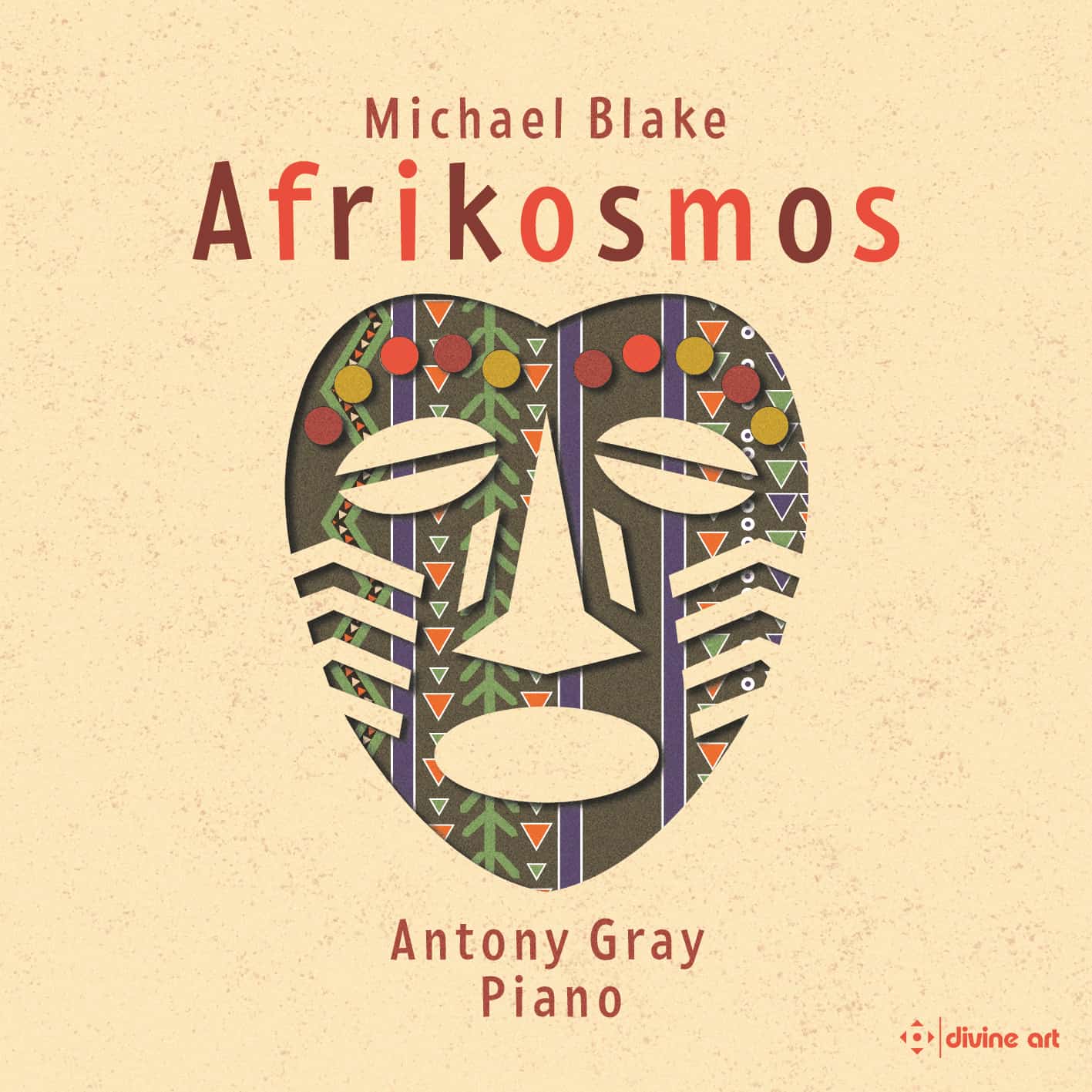
  • Afrikosmos DDA 21374 Arts Desk review

    It’s all in the name: the six volumes of Bartók’s Mikrokosmos were indeed the model for Afrikosmos, a sequence of 75 short pieces by South African composer Michael Blake (b. 1951). As with the Bartók, Blake’s epic work is a six-volume compendium of studies, dances and character pieces in ascending order of technical difficulty, Blake seeking to explore “the range of traditional music in sub-Saharan Africa”.

    Each of the three discs in this set can be listened to as a discrete hour-long programme, Blake further categorising the pieces into groups which include birdsong, work and domestic songs, ‘Experiments, Signposts and Places’ and what he describes as “musical nuts and bolts.”

    Blake’s lucid, detailed sleeve notes are fascinating, but I’d suggest just diving in and listening. Begin listing your favourite numbers and you’ll need several sheets of paper. Homages to Grieg and Percy Grainger on the first disc are delightful, Blake later paying tribute to figures as diverse as Bach, Puccini and Kurtag. “The Diary of a Dung Beetle: is a propulsive nod to Bartók’s own “From the Diary of a Fly”, pianist Antony Gray whistling half way though.

    The four pieces based on popular music which appear early on the second disc are fun, their business and energy in stark contrast to the sparseness of numbers like “Distant Cowbells”. Blake is fascinated by rhythmic and harmonic patterns, “Weave” sounding exactly like someone absent-mindedly fiddling with a thumb piano. The third disc includes tributes to Satie and Henry Cowell and several fascinating studies based on modes and differing intervals, the set closing with variations on a South African protest song.

    It’s all marvellous, and if any pieces really catch your ear, you can inspect, buy and download the sheet music from Blake’s website. Gray is a persuasive advocate, and Divine Art’s engineering has atmosphere and impact.

  • Michael Blake: Afrikosmos

    Michael Blake: Afrikosmos

    Inspired by Bartók’s’Mikrokosmos’ and by the indigenous music from various parts of Africa, South African composer Michael Blake created this magnum opus – like Bartók’s work, in varying degrees of difficulty for young players and experts alike. The recording was made in June 2021 at the Menuhin Hall, Cobham, Surrey by pianist Antony Gray, whose recent Divine Art albums of piano works by Saint-Saëns have met with great success and glowing reviews.

    Michael Blake is a South African-born composer and pianist based in London from 1977 and later returned to the “New South Africa”. He has been responsible for post-apartheid New Music initiatives such as joining the ISCM and setting up a new music festival and composers meeting. His musical language draws from African music, experimental film, and African weaving techniques. His works have been widely played around the world and appear on 15 CDs. He currently splits his time living in rural France and Cape Town where he is an honorary professor of experimental composition at Stellenbosch University.

    Australian pianist Antony Gray was educated in Victoria, Australia, where he graduated from the Victorian College of Arts and won several awards and prizes. He received a scholarship from the Astra foundation to continue his studies in London with Joyce Rathbone and Geoffrey Parsons. Based in London now, he is regarded as one of the most interesting and communicative performers of his generation, known for his solo and chamber music performances around the world, regular recordings for CD and radio, and his championing of contemporary and neglected composers such as George Enescu, Dussek, Martinů, Malcolm Williamson and John Carmichael. He has recorded 14 discs of solo piano music for ABC Classics, and featured on other recording projects for KNS Classical and other labels.